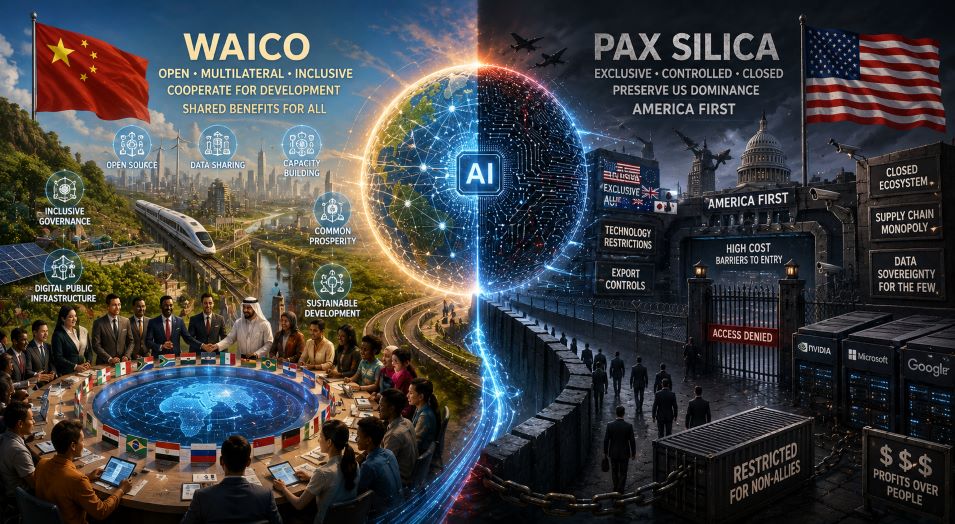
AI is one of the major geopolitical disputes of the 21st century. Faced with China’s proposal for multilateral and open governance, the US is promoting a technological architecture based on strategic alliances and reliable supply chains. The dispute is no longer just about developing the best AI, but about governing the ecosystem that will make it possible.
Artificial intelligence (AI) is one of the key drivers of power in the 21st century. Its ability to process massive amounts of data, optimize processes, automate decisions, and enhance both civilian and military applications positions it as a critical technology that has already transformed the economy, defense, communication, science, and the very organization of societies. In this context, leadership in AI depends not only on developing more advanced algorithms but also on controlling infrastructure, scientific capabilities, data, skilled labor, critical technology, and strategic resources.
The fact that AI is acquiring a structural role in the functioning of states and the international system has made its governance one of the biggest current disputes. Defining who sets the technical standards, the rules of use, the cooperation mechanisms, the supply chains, and the institutions responsible for regulation ultimately means contesting the rules of the future global technological order. AI governance is a profoundly geopolitical dispute.
During his opening speech at the inaugural ceremony of the 2026 World Conference on Artificial Intelligence and the High-Level Meeting on Global AI Governance, Chinese President Xi Jinping stated:
“Global innovation in artificial intelligence is entering a period of unprecedented activity. Smart technologies, characterized by the Internet of Things, human-machine collaboration, cross-sector integration, and co-creation and sharing, are unleashing enormous energy, presenting both immense opportunities and governance challenges. Humanity must confront the questions of our time: When machines begin to think, how should we interact with them? When algorithms participate in decision-making, how can security be ensured? When technology challenges ethics, how can governance keep pace? As the gap widens, how can inclusive benefits be achieved? These questions demand deep reflection and collaborative answers from the international community.”
For his part, Under Secretary for Economic Affairs Jacob Helberg, speaking at the Pax Silica summit, declared:
“If the 20th century was built on oil and steel, the 21st century is built on computing and the minerals that power it. This historic declaration proclaims a new consensus on economic security that ensures aligned partners build the AI ecosystem of tomorrow, from critical energy and minerals to manufacturing and high-tech models.”
In this context, the recent creation of the World Artificial Intelligence Cooperation Organization (WAICO) during the World Artificial Intelligence Conference (WAIC) held in Shanghai, and the US push for the Pax Silica initiative, reflect the consolidation of two projects and architectures for organizing global AI governance. Both initiatives reflect distinct models for structuring international relations, distributing capabilities, and influencing the digital architecture that will shape the international system in the coming decades.
The World Artificial Intelligence Conference (WAIC)
The World Artificial Intelligence Conference (WAIC), held from July 17-20, 2026, in Shanghai, reaffirmed its position as a leading international forum for discussions on artificial intelligence. Since its inception, WAIC has brought together heads of state, international organizations, technology companies, universities, researchers, and investors to discuss the scientific, industrial, and regulatory development of AI. The 2026 edition included conferences, exhibitions, technology competitions, startup incubation, and international cooperation spaces, reflecting China’s strategy of integrating innovation, industry, and governance within a single ecosystem.
However, the main announcement was not technological or business-related, but geopolitical. On July 16, in the lead-up to the conference, representatives from 29 countries signed the Agreement for the Establishment of the World Artificial Intelligence Cooperation Organization (WAICO) in Shanghai, making it the first permanent international intergovernmental organization dedicated exclusively to artificial intelligence. Headquartered in Shanghai, the new institution declares its objectives as promoting international cooperation, strengthening global AI governance, and ensuring that its development is “beneficial, safe, and equitable,” under the principles of the Charter of the United Nations, respect for state sovereignty and the diversity of civilizations of all countries, multilateralism, and shared benefit.
According to official documents, WAICO aims to support countries in the Global South in accelerating the development of artificial intelligence, strengthening their comprehensive capacities in innovation, application, and governance, joining the wave of the technological revolution, and reducing the intelligence gap. Furthermore, it was established that WAICO is open to all countries and will maintain communication with other international organizations to explore appropriate forms of cooperation.
The creation of WAICO follows on from the Global Action Plan for Artificial Intelligence Governance, presented by China at WAIC 2025, where Beijing proposed thirteen lines of action aimed at building an international model based on scientific cooperation, shared infrastructure development, capacity building in the Global South, the promotion of open source, the development of international standards, and multilateral governance within the framework of the United Nations. A year later, China is moving beyond simply proposing an agenda and beginning to build the institution responsible for implementing it.
President Xi Jinping defined the creation of WAICO as part of China’s commitment to providing “global public goods” in the field of artificial intelligence. In this context, he announced that over the next five years, China will offer 5,000 training opportunities for developing countries; promote international cooperation centers with ASEAN, the Arab League, the African Union, CELAC, the Shanghai Cooperation Organisation, and BRICS; and make the Mazu AI system, designed to improve weather forecasting and early warning, available to 30 countries. According to Foreign Ministry spokesperson Lin Jian, the creation of WAICO is “a momentous step in responding to the call from the Global South and uniting the international community to vigorously promote AI development and governance.”
The international reaction reflected the magnitude of the announcement. The Financial Times highlighted that the new organization provides a permanent platform for international cooperation in artificial intelligence; Reuters underscored China’s commitment to open source and AI as a global public good; Bloomberg emphasized the goal of bridging the digital divide by strengthening capabilities in the Global South; the Business Times interpreted the creation of WAICO as a milestone in global AI governance; while Al Jazeera highlighted China’s emphasis on human-centered AI development accompanied by regulatory mechanisms.
The creation of WAICO reflects the deepening competition for the institutional architecture of artificial intelligence, ushering in a new stage in the geopolitical dispute over the governance of cyberspace.
Pax Silica: The American architecture for the governance of artificial intelligence
Introduced by the State Department in 2025 and expanded during 2026 with the addition of new allied countries, the Pax Silica initiative seeks to reorganize the global supply chain of artificial intelligence based on a central criterion: political trust among participants.
The name is no coincidence. Like the Pax Romana or the Pax Americana, Pax Silica refers to the construction of an international order. In this case, an order based on silicon, computing power, semiconductors, digital infrastructure, and the critical minerals that fuel the development of artificial intelligence.
The initiative was spearheaded by Jacob Helberg, the current U.S. Under Secretary of State for Economic Growth, Energy, and the Environment. Before joining the State Department, Helberg served as a strategic advisor to Palantir CEO Alex Karp and was a member of the U.S.-China Economic and Security Review Commission, where he advocated for stricter technology restrictions on Beijing, tighter export controls, and a ban on TikTok. His career reflects the growing alignment between the U.S. state apparatus and the country’s major tech industry players.
In the founding declaration, the signatory countries maintain that “the technological revolution of artificial intelligence is reorganizing the global economy and transforming global supply chains,” which is why they consider it essential to build an ecosystem based on trusted partners and trusted supply chains. In other words, a system of production, innovation, and technological circulation comprised exclusively of countries considered politically reliable by Washington.
The document proposes that the new ecosystem should encompass the entire artificial intelligence value chain: energy, critical minerals, refining, advanced manufacturing, semiconductors, computing infrastructure, data centers, telecommunications networks, software, platforms, and foundational models. It also promotes the mobilization of private capital as the primary driver of innovation and establishes coordination mechanisms to protect sensitive technologies, restrict access for strategic competitors, and strengthen the economic security of allied countries.
Helberg’s statement, “if the 20th century was based on oil and steel, the 21st century is based on computing and the minerals that power it,” summarizes Washington’s strategic diagnosis: whoever controls the material infrastructure of artificial intelligence will control the stage of global economic and technological development.
However, perhaps Helberg’s most revealing definition appears in his essay “The Digital Sovereignty Trap,” published immediately after the Pax Silica presentation. There he argues that the pursuit of digital sovereignty by states constitutes a “retrograde and counterproductive” strategy, since it would imply that each country would attempt to separately rebuild already developed technologies instead of joining the ecosystem led by the United States.
This reasoning reveals a limited, or deliberately biased, understanding of the concept of technological sovereignty or even autonomy. By reducing it to a supposed obsession with “copying” existing technologies, it deliberately omits that autonomy and sovereignty do not consist of reproducing every innovation, but rather in developing the material, scientific, and institutional capacities that allow one to decide on one’s own technological destiny.
Helberg proposes a model based on functional specialization among allies. According to his approach, “the computing power of one partner is combined with the minerals of another, the talent of a third, and the capital of a fourth; the result is not a sum, but a multiplication.”
It is precisely at this point that one of the project’s main geopolitical tensions emerges. Although the discourse presents it as an alliance between strategic partners, the distribution of functions assigned to each country reflects a clearly differentiated international division of labor. In official statements regarding the incorporation of Argentina, Chile, Costa Rica, Panama, and El Salvador, the State Department itself identifies the specific role each will play within the Pax Silica architecture: Argentina and Chile as suppliers of lithium, copper, and energy; Panama as a logistics hub; Costa Rica as a platform for advanced manufacturing and semiconductors; and El Salvador as a site for assembly operations.
Rather than promoting the development of sovereign technological capabilities, the US project proposes integrating each ally into a supply chain designed according to the strategic needs of the ecosystem led by Washington. In this sense, innovation is not organized around the pursuit of technological autonomy for states, but rather around an international architecture where the United States concentrates the highest value-added segments, computing power, foundational models, and platforms, while distributing specific functions related to natural resources, manufacturing, logistics, and infrastructure among its allies.
In short, the Pax Silica represents an updated version of the historical imperialist practices of the United States in shaping the organization of labor and international relations. Under the guise of cooperation and economic security, the project assigns differentiated roles to each ally within a technological architecture designed and managed from Washington, perpetuating a subordinate integration of countries into global value chains.
The dispute over global governance of artificial intelligence
The creation of WAICO and Pax Silica constitute two competing geopolitical projects vying to establish the institutional, technological, and regulatory framework that will govern the development of one of the most strategic and critical technologies of the 21st century. In other words, what is at stake is no longer just leadership in innovation, but the ability to determine who will govern artificial intelligence, under what principles, and for whose benefit.
Artificial intelligence has become a key part of a cross-cutting strategic infrastructure. Its impact extends to the economy, defense, security, health, education, industrial production, public administration, and communication. Those who control computing power, foundational models, data, chips, platforms, technical standards, norms, and global supply chains will not only have economic advantages but also unprecedented tools to project political, military, and cognitive power over the international system. In this scenario, two profoundly different conceptions of what it means to govern artificial intelligence emerge.
In a world undergoing profound transition, marked by the decline of American unipolarity and the rise of multipolarity led by the China-Russia-Iran axis, AI governance is a terrain of geopolitical contention. Establishing the rules governing its use, defining who has access to it, under what conditions knowledge is disseminated, what technical standards will be imposed, and which institutions will be recognized as legitimate for managing this process are crucial.
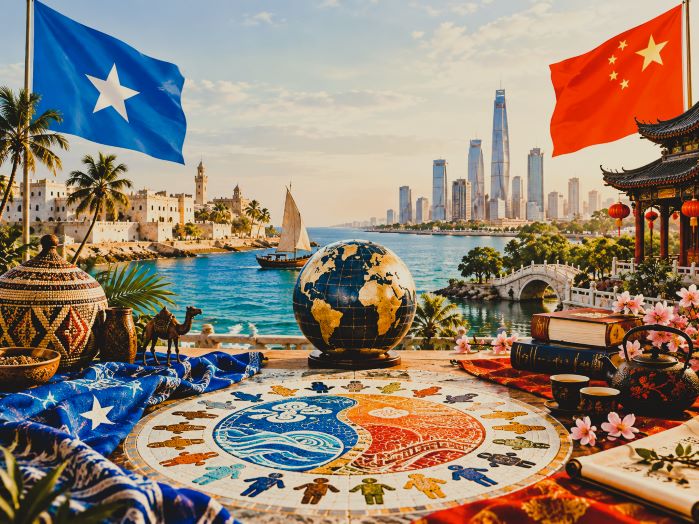
While China proposes to institutionalize a permanent international body, open to the incorporation of new members and structured on the principles of the Charter of the United Nations, the United States is promoting a restricted alliance between countries considered “reliable partners”, organized around economic security and strategic competition.
It’s not simply a matter of different mechanisms. They also reflect different conceptions of the international order. WAICO presents itself as a multilateral institution aimed at building shared rules for artificial intelligence. Pax Silica, on the other hand, establishes a selective architecture that organizes cooperation exclusively among actors politically aligned with Washington.
In the Chinese proposal, states occupy the center of governance. Scientific cooperation, infrastructure development, capacity building, and standards development are all coordinated through public agencies and international institutions.
In contrast, the Pax Silica document explicitly calls for “mobilizing the immense creative and financial power of private industry.” The governance of artificial intelligence thus relies on a close relationship between the US government and large technology corporations, which cease to act merely as suppliers and become central players in the geopolitical architecture of artificial intelligence. It is no coincidence that the initiative’s main proponent, Jacob Helberg, comes from Palantir, one of the paradigmatic companies in this convergence of technology, intelligence, and national security.
China maintains that developing national capabilities is essential for bridging the technological gap and democratizing access to artificial intelligence. Scholarships, regional cooperation centers, technology transfer, the Mazu system, and the construction of shared infrastructure all align with this capacity-building strategy.
Conversely, Helberg explicitly questions the pursuit of digital sovereignty, calling it “retrograde and counterproductive.” His argument is that countries should not try to develop their own capabilities, but rather integrate into an international ecosystem where each contributes what it finds to be a comparative advantage.
Perhaps the most obvious difference between the two projects lies in the place they assign to countries of the Global South.
Chinese discourse presents the Global South as an active agent of technological transformation. The creation of international artificial intelligence centers, training programs, technology transfer, and shared access to infrastructure aim to expand national capabilities and reduce the technological gap.
The Pax Silica, on the other hand, describes its new members from a different perspective. In Helberg’s statements regarding the incorporation of Argentina, Chile, Costa Rica, Panama, and El Salvador, each country is defined primarily by the strategic resource it contributes to the American architecture.
While one model presents these countries as future developers of technological capabilities, the other incorporates and subordinates them based on their contribution to an international supply chain designed outside their borders.
In this sense, the discourse of shared innovation coexists with a functional organization where the technological core remains concentrated and allies contribute critical minerals, energy, infrastructure, logistics, or manufacturing. Rather than eliminating technological dependence, this architecture tends to reorganize it under new geopolitical conditions.
Finally, both projects also differ in their approach to conceiving artificial intelligence itself.
China insists on presenting AI as an international public good whose development should be guided by principles of cooperation, open source, technology transfer, and shared benefit.
The United States, on the other hand, views it primarily as a strategic asset whose competitive advantage must be preserved through technological controls, reliable supply chains, protection of critical infrastructure, and restrictions on access by its competitors.
The confrontation between these two projects reflects the transition to a transforming international system. On the one hand, the United States is attempting to avert its decline by updating its historical imperialist practices, reorganizing supply chains, securing (and plundering) strategic resources, and aligning state power with large technology corporations. On the other hand, China seeks to consolidate itself as a promoter of a multipolar order, proposing new institutions, cooperation mechanisms, and a narrative centered on shared development and the inclusion of the Global South. The US is trying to build an architecture of alliances, while China is seeking to consolidate an institutional architecture.