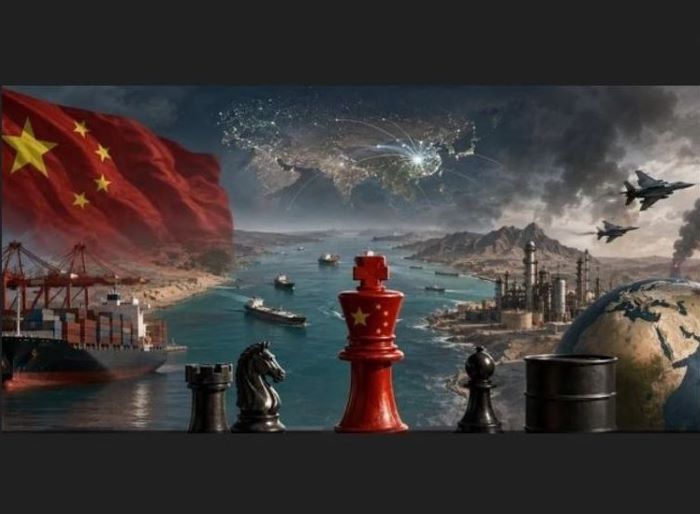
As the US-Israeli war against Iran enters its sixth month, attention is turning to China and its position in the conflict. However, Beijing’s calculations are not simply about who wins and who loses, but rather about the war’s repercussions on energy, trade, stability, and the balance of power in the Middle East.
As the US-Israeli military campaign against Iran enters its sixth month, a seemingly simple question is repeatedly asked in Washington: Will China emerge victorious or a loser from this war?
One group believes the war represents a strategic gift to Beijing, as it drains the United States in the Middle East, weakens its image among some countries in the region, and gives China more room to maneuver diplomatically and economically. Conversely, others argue that weakening Iran, a key partner for China, necessarily weakens Beijing’s regional position.
But viewing Chinese policy solely from a “profit and loss” perspective may obscure the most important question.
Beijing does not primarily view the war as a power struggle with Washington. What concerns it more urgently is whether the war will produce instability that threatens its economic interests, the security of its supplies, its trade routes, and its ability to maneuver between competing powers.
Therefore, the Chinese strategy seems closer to managing the repercussions of the war than to exploiting it: containing the spread of the conflict, reducing risks, diversifying sources of support, avoiding military involvement, and looking for areas where Chinese and American interests can intersect.
The question for Beijing, then, is not just who wins the war, but what kind of Middle East will emerge from it, and how much instability China will have to bear the cost of.
Hormuz first: The danger is greater than oil.
China has strong reasons to want to end the war as quickly as possible.
It is the world’s largest importer of crude oil, and imported about 11.6 million barrels per day in 2025. Therefore, any prolonged disruption in the Strait of Hormuz poses a direct problem for the world’s second-largest economy.
The effects were already being felt. In June 2026, China’s crude oil imports fell to 7.12 million barrels per day, their lowest level in nearly a decade. However, the shock did not turn into an immediate energy crisis. Stockpiles, adjusted purchasing patterns, and reliance on alternative suppliers, including Russia, gave Beijing some breathing room to absorb the disruption.
But the real danger for China is not limited to the number of barrels that cross Hormuz.
Continuing the war means higher energy prices, disruption to shipping, increased insurance costs, potential damage to regional infrastructure, and the shock spreading to global supply chains.
Hence, Beijing views the Strait of Hormuz as more than just an oil transit route; it is part of the infrastructure of the global economy.
For this reason, China’s interest in stopping the war is not so much in defending Iran as it is in defending the stability that the Chinese economy itself needs.
China is not a security alternative to America.
Since Beijing helped sponsor the restoration of diplomatic relations between Saudi Arabia and Iran in 2023, a hypothesis has taken root in some American circles that China, having entered the Middle East diplomatically, should now be able to “make peace” there.
But this hypothesis overestimates China’s capabilities, and perhaps its ambitions as well.
China is trying to help de-escalate tensions, but it is doing so through diplomacy, not military intervention or direct security pressure. The reason is clear: Beijing lacks the network of alliances, bases, military infrastructure, and regional command systems that the United States has built over decades. More importantly, it does not appear willing to inherit Washington’s role as the primary security guarantor for the region.
In fact, the security landscape itself is changing.
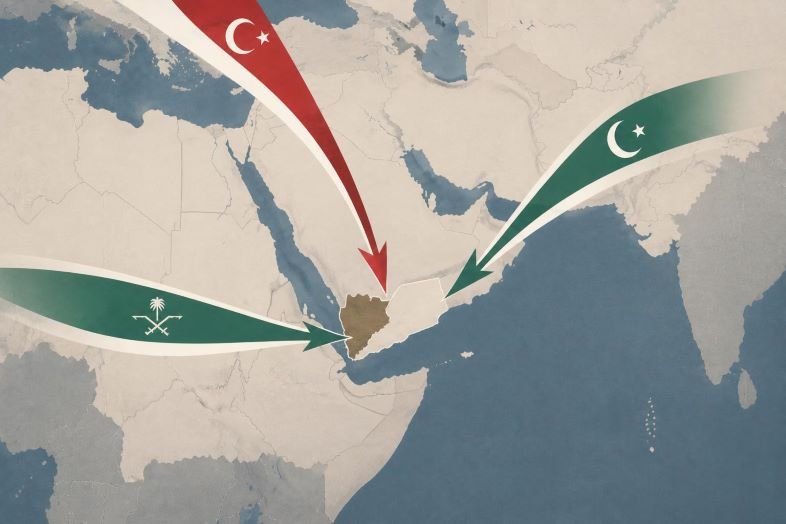
On August 7, Saudi Arabia, Turkey, and Pakistan signed a joint defense agreement. Some were quick to speak of a potential “Middle Eastern NATO.” This description may be premature, but it reflects a broader trend among countries in the region to diversify their security partnerships rather than relying entirely on a single external umbrella.
China, for its part, does not appear ready to fill any “security vacuum.” It prefers to maintain its channels with Iran, the Gulf states, Pakistan, Arab organizations, and other international powers, and to support diplomatic initiatives that the parties in the region themselves can undertake.
In this context, Beijing supported Pakistani mediation efforts between Washington and Tehran, and encouraged Islamabad to continue its moves to help resolve the Hormuz crisis.
It is an approach somewhat similar to the Chinese position on the Ukraine war: when Beijing is outside the war, and is neither the cause of it nor a direct party to it, it does not necessarily see itself as having to become the main mediator, especially as long as the combatants believe that they can improve their negotiating positions by force.
China, in this sense, is not trying to be the “policeman of the Middle East.” It is trying to be a force for deterrence.
The Chinese lesson: Don’t rely on a single path.
Perhaps the most important lesson Beijing can draw from the war is that strategic flexibility begins with reducing over-reliance on a single country, a single route, or a single chokepoint.
This is not just about energy, but also about transportation, trade, finance and supply chains.
This is why projects like the China-Kyrgyzstan-Uzbekistan railway, the Trans-Caspian Corridor, and Arctic shipping routes gain importance beyond direct economic considerations. These routes offer China additional alternatives when traditional sea lanes become vulnerable to crises or geopolitical pressures.
The same logic applies to the relationship with Russia.
Disruption to Gulf supplies naturally increases Russia’s strategic value as an energy source, and the vulnerability of sea lanes raises the importance of land-based energy networks, including the Power of Siberia 2 pipeline project.
But that does not mean that China wants to replace its dependence on the Gulf with a new dependence on Russia.
The Chinese strategy is based on diversifying dependence, not transferring it from one party to another.
Even when Beijing and Moscow’s political interests align, China remains highly attentive to prices, investment terms, commercial viability, and market conditions. Ultimately, the goal is not to find a single, more secure supplier, but to minimize the ability of any single supplier or transit route to become a strategic vulnerability.
Partnership with Iran… without getting caught up in its war
The war also reveals the limits of the Chinese-Iranian relationship.
Beijing wants partnerships that serve its developmental and strategic priorities, but it does not want alliances that would automatically make it a party to other people’s wars.
This is why the “comprehensive strategic cooperation” with Iran has not evolved into a binding military alliance. China and Iran have previously cooperated militarily, including through arms deals and joint exercises, but Beijing has remained wary of transitioning to a security relationship that would make it responsible for defending Iran against the United States or Israel.
This is where one of the most important differences between China and some of the other major powers in the region comes in.
Beijing wants influence, but it tries as much as possible to separate influence from involvement.
The longer the war lasts, the more important this chapter becomes. The economic, security, and geopolitical costs will not remain confined to Iran or the Gulf. China itself will be among the major economies that pay a price.
Therefore, it is not in its interest to prolong the war simply because it imposes costs on the United States. Nor does it want the conflict to reach a point where its security interests become directly linked to the Iranian-American confrontation.
Where do Beijing and Washington meet?
Despite the strategic rivalry between the United States and China, the Iran war reveals a greater area of common interests than political rhetoric in the two capitals suggests.
On the nuclear issue, China adheres to three principles: preventing nuclear proliferation, Iran’s right to the peaceful use of nuclear energy within the framework of the Non-Proliferation Treaty, and a negotiated solution instead of a military one.
In the Strait of Hormuz, Beijing is focusing on freedom and safety of navigation, reopening the passage through political rather than military means, and addressing the security and economic concerns behind the crisis.
These principles do not necessarily conflict with the core interests of the United States: preventing nuclear proliferation, protecting global trade, and preventing the Gulf from sliding into a permanent state of chaos.
Hormuz itself may be the clearest test.
Ideas related to unilateral control of the strait, imposing political transit fees, or turning it into a passage that constantly requires military escort, contradict its nature as a public good for the global economy.
China doesn’t want that, and it’s hard to imagine that this is the end result the United States wants either.
Iran after the war
The most difficult question will arise when military operations cease: What will happen to the Iranian economy?
If Washington has indeed abandoned regime change as a war objective, then any viable settlement will at some point need to provide Iran with a realistic path to economic survival.
This means that the sanctions file will be back on the table.
China is also likely to play a significant role in Iran’s reconstruction and its reintegration into regional and international markets. This is precisely where a practical space for US-China cooperation, obscured by the ongoing war, may emerge.
Washington wants neither a nuclear Iran nor a permanently unstable Gulf. Beijing wants neither the collapse of Iran nor an open war that would disrupt energy and trade.
This does not make the United States and China strategic partners in the Middle East. But it does mean that ending the war could reveal shared interests that neither side is willing to acknowledge publicly so far.
Of course, this space has its limits. If Washington returns to seeking to overthrow the Iranian regime, or expands its military operations in a way that threatens the collapse of the state, then the Chinese calculation will change radically.
The Middle East that China wants
The Middle East after the war will not be simpler than it was before.
The war has shaken an important assumption upon which many economic strategies in the Gulf have been based: that the countries of the region can remain safe havens for capital, talent, energy infrastructure and global trade, even when wars are raging around them.
Today, even countries that were not directly involved in the fighting are forced to recalculate the “security cost” of their geographical location.
In this Middle East, China appears to prefer an economic and diplomatic role over a military one: helping to reintegrate Iran into the regional economy, participating in reconstruction, encouraging political dialogue, and working with other powers to reduce the likelihood of a new war.
The Hormuz crisis is not isolated in the Chinese strategic mind from the crises in the Red Sea and the Black Sea, or concerns related to the Panama Canal. The common denominator is the increasing vulnerability of the chokepoints through which global trade flows.
For Beijing, the value of the sea lane lies not in controlling it, but in keeping it open, safe, and predictable in its movement.
Herein lies a paradox in the Chinese position towards the United States.
Beijing is concerned about the unchecked use of American power, and the deployment of military force, strategic resources, and strategic chokepoints in geopolitical conflicts. At the same time, it does not want a complete American withdrawal that would leave behind a security vacuum and chaos, the cost of which China itself would have to bear.
In other words, China does not necessarily want to push the United States out of the Middle East. What it wants is a more disciplined and less impulsive America that continues to provide some public security benefits without becoming itself a frequent source of crises.
This probably explains the Chinese position on the Iran war more than the question: Who wins and who loses?
China views the war as a dangerous one that has presented some strategic opportunities, but has simultaneously created significant economic and security risks. Therefore, its priorities are focused on containing these risks, diversifying its sources of energy, keeping diplomatic channels open, and avoiding being drawn into another major power conflict.
The role that Beijing chooses for itself is more modest, but it may be more sustainable: reducing the heat of the conflict, keeping communication channels open, preventing the war from spreading, protecting the openness of vital sea lanes, and being ready to help when the belligerents themselves are ready for peace.
That may not make China the “winner” of a war with Iran.
But it is perhaps the most accurate description of what Beijing believes a responsible major power should do when the cost of war becomes much greater than the limits of the battlefield.