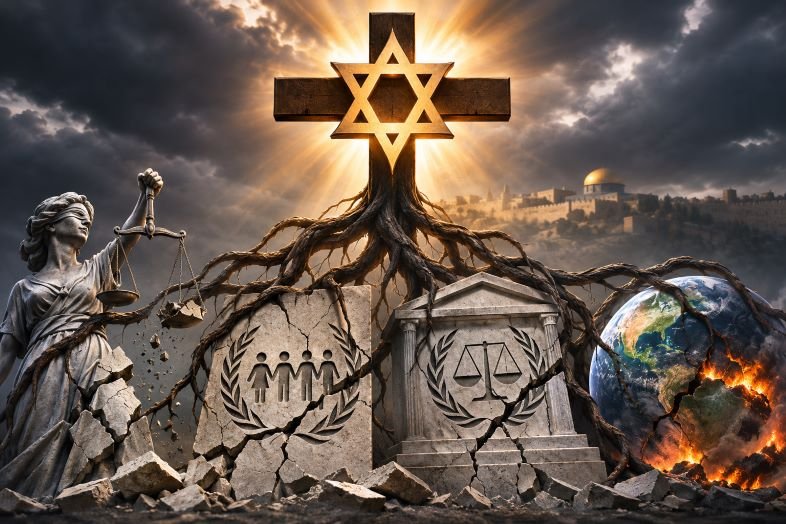
1. Introduction & Theoretical Framing
Imagine a political ideology that operates like an operating system—running silently in the background of global superpowers, mobilizing millions of users across continents, and regularly updating its code to fit modern geopolitical conflicts. This is not a metaphor for corporate capitalism or digital surveillance; it is the precise functional architecture of Christian Zionism, a belief system that has transcended its origins as a fringe theological curiosity to become a foundational logic of statecraft in the twenty-first century.
Christian Zionism is the belief among some Christians that the return of the Jewish people to the Holy Land and the establishment of the State of Israel is a fulfillment of biblical prophecy and a prerequisite for the Second Coming of Christ. But this definition, while accurate, understates the phenomenon’s political gravity. To understand Christian Zionism’s role in global affairs, we must adopt a more precise analytical apparatus: the concept of “transnational political software.” This metaphor represents a transnational, ideological framework that provides the logic, justification, and operational code for state-level foreign policy and grassroots mobilization. Unlike benign cultural memes or voluntary religious associations, political software is insidious and self-replicating. It injects a cosmic, zero-sum metaphysics into secular state architectures, overriding the pragmatic calculations of diplomacy with the imperatives of prophecy.
This essay advances a sinister thesis: Christian Zionism acts as a deeply anti-human global political software. It achieves this through several interconnected mechanisms: hardcoding an eschatological agenda into state policies, systematically deleting Palestinian humanity from the moral and legal universe, weaponizing minority Jewish populations as prophetic pawns, and subverting local democratic representation in favor of a manufactured civilizational clash. The scope of this analysis is deliberately global. Christian Zionism is not an isolated American anomaly; it is a networked global phenomenon that has captured state apparatuses across the Americas and beyond. The journey begins with the theological source code, moves through its transnational network architecture, examines its historical system updates, and culminates in its deadly physical execution across the United States, Brazil, and Guatemala—nations where the software has compiled into concrete geopolitical outputs.
2. The Source Code: Theological Foundations as Operational Logic
Christian Zionism is not merely a religious stance; it is a highly structured logic system based on specific interpretations of biblical texts that dictate a zero-sum view of history. To understand its political power, one must first dissect its foundational code: Premillennial Dispensationalism. Developed in the nineteenth century by John Nelson Darby and systematically exported globally, this theological framework functions as an ideological operating system that strips human beings of intrinsic dignity. It replaces a universal ethic of human rights with a rigid, algorithmic determinism. Within this code, humanity is partitioned into instrumental categories: those who serve as prophetic chess pieces, and those who are classified as scriptural refuse to be deleted.
The anti-human character of this philosophy operates across three distinct programmatic registers: the absolute erasure of Palestinian humanity, the predatory instrumentalization of the Jewish people, and a nihilistic rejection of planetary survival.
The Erasure Protocol: Palestinian Dispossession and Ontological Deletion
The first and most immediately violent subroutine of the Christian Zionist code is the systematic deletion of Palestinian humanity. This is achieved through the weaponization of the Abrahamic covenant narrative, specifically a hyper-literal, exclusionary reading of Genesis 12:3: “I will bless those who bless you, and whoever curses you I will curse.” Within this logic, the state of Israel is transformed from a secular political entity bound by international law into a divine metanarrative. The “Blessing Protocol” functions as a theological coding that transforms foreign policy into a matter of national spiritual survival: nations that support Israel receive divine favor, while those that oppose it invite cosmic punishment.
Consequently, the indigenous Palestinian population—regardless of whether they are Muslim, Christian, or secular—is subjected to a form of ontological erasure. Because the code dictates that the land belongs exclusively to an ethnically defined collectivity as a prerequisite for the apocalypse, the living, breathing human beings currently inhabiting that land are rendered illegible. They cannot be recognized as victims of occupation, apartheid, or displacement; instead, the software processes them as scriptural anomalies—illegal squatters on divine real estate whose presence disrupts the prophetic timeline—or as modern Amalekites, inherently wicked obstacles to the divine will whose resistance to dispossession is reframed not as a universal struggle for self-determination but as demonic rebellion against God. Most chillingly, they are processed as collateral refuse: populations whose human suffering, mass death, and loss of sovereignty are entirely discounted, as the code contains no algorithmic affordance for Palestinian grief or rights.
By removing foreign policy from the realm of secular ethics, international humanitarian law, and Geneva Conventions, the software hardwires a structural racism that justifies endless colonial expansion as a spiritual duty. The eschatological timeline—treating modern geopolitical events as preprogrammed milestones on a checklist toward Armageddon—further removes policy debates from the realm of secular ethics or international law and hardwires them into a framework of divine command.
Predatory Instrumentality: The Antisemitic Core of Philo-Semitic Rhetoric
While Christian Zionists vociferously proclaim a profound love for Israel and the Jewish people—often masquerading under the guise of “philo-Semitism”—critical analysis reveals this alignment to be deeply predatory, instrumental, and fundamentally anti-human. The software does not value Jewish individuals as autonomous agents possessing inherent worth, cultural richness, or human dignity. Rather, it reduces an entire global minority to a functional utility: apocalyptic fuel.
In the dispensationalist source code, the physical gathering of the global Jewish diaspora into the Levant is merely a mechanical trigger required to initiate the End Times. The software requires the reconstruction of the Third Temple and the geopolitical consolidation of a Jewish state, not out of concern for Jewish safety or historical justice, but to set the stage for the Tribulation—a period of unprecedented cosmic horror. The ultimate output of this theological program is a catastrophic betrayal. First, the Jewish population is lured into a hyper-militarized, ethnonationalist fortress state, isolated from global solidarity, acting as a historical proxy for Western imperial interests. Second, the code explicitly predicts that upon the return of Christ, two-thirds of the Jewish population will be violently slaughtered in the Battle of Armageddon. Third, the remaining one-third will be forced to abandon their ancestral faith, heritage, and identity to convert to Christianity, effectively erasing Judaism from the earth.
To cheer for the acceleration of a state’s geopolitical power while actively desiring, financing, and praying for the eventual annihilation or forced assimilation of its people is the zenith of a sinister philosophy. It treats a historic community as a disposable prop in a terrifying evangelical psychodrama.
Eschatological Nihilism vs. Planetary Survival
The final, existential dimension of the anti-human code lies in its profound hostility toward the future of humanity itself. Traditional political systems, however flawed, generally operate on a baseline logic of self-preservation—attempting to mitigate existential risks such as nuclear proliferation, climate collapse, and total war. Christian Zionist software, however, runs on an inversion of this logic: eschatological nihilism. Because the software teaches that global suffering, pestilence, environmental degradation, and catastrophic warfare are the immutable “birth pangs” of a new kingdom, the mitigation of human suffering becomes worse than useless—it is seen as an attempt to delay the return of Christ.
The code actively rewards and incentivizes planetary destruction. Environmental destruction is dismissed or celebrated; if the earth is under a divine curse and scheduled for imminent, fiery liquidation, efforts to combat climate change, protect ecosystems, or regulate carbon emissions are viewed as a foolish, secular waste of time. Diplomacy, peace treaties, and international arbitration are coded as dangerous illusions. True peace in the Middle East is viewed as a theological impossibility or, worse, the work of the Antichrist. Therefore, the software demands the continuous stoking of regional tensions, the escalation of violence, and the provocative movement of embassies to maximize conflict. The specter of global thermonuclear war is stripped of its horror and rebranded as the glorious dawn of Armageddon.
When an ideology views the end of human civilization not as a tragedy to be avoided at all costs, but as a glorious, pre-programmed system upgrade to be actively courted, it ceases to be a mere religious subculture. It becomes a deeply dangerous, anti-human philosophy that threatens the collective survival of the species.
3. Transnational Network Architecture: Crossing Secular Borders
Like open-source software, Christian Zionism is not tethered to a single nation-state; it links disparate global actors into a unified geopolitical network. The “software” operates transnationally by aligning the domestic political interests of vastly different nations with the singular geopolitical objective of supporting the Israeli state. This decentralized, cross-border architecture is what allows the ideology to bypass traditional diplomatic channels and operate as a truly global force.
The US-Israel Matrix represents the primary master node of this network. Major lobbying groups like Christians United for Israel (CUFI) act as a bridge between the American electorate and Israeli state policy, providing the vast financial infrastructure, institutional muscle, and imperial military capacity necessary to execute the software’s global agenda. But the network extends far beyond the United States. The Global South Expansion—the rapid growth of Pentecostal and Evangelical Christian Zionism in Latin America (particularly Brazil and Guatemala) and Sub-Saharan Africa—has led to tangible policy shifts like moving embassies to Jerusalem. These peripheral nodes are not mere imitators of the American model; they adapt the software to their own domestic political anxieties, creating hybrid deployments that serve local authoritarian projects while contributing to the global network’s objectives.
The power of this architecture lies in its decentralization. There is no single pope of Christian Zionism, no central committee issuing directives. Instead, the software replicates through megachurches, media empires, and political networks, each node interpreting and executing the code according to local conditions while maintaining the core eschatological architecture.
4. System Updates: The Evolution and Adaptability of the Code
The power of this software lies in its ability to receive “patches” or updates, reframing itself to match the dominant political anxieties of any given era. Because the software is highly adaptive, it never becomes obsolete; it simply updates its vocabulary while keeping its core architecture intact.
During the Cold War, the software received a major update by framing the defense of Israel as a bulwark against atheistic Soviet communism. This patch allowed Christian Zionism to align with American Cold War foreign policy, transforming a theological commitment into a strategic asset in the global struggle against the Soviet Union. The eschatological timeline was synchronized with the geopolitical timeline of superpower rivalry.
The Post-9/11 Patch merged biblical prophecy with the secular “War on Terror,” casting the Israeli-Palestinian conflict as the front line of a global clash of civilizations. This update allowed the software to interface seamlessly with the national security apparatus of the United States, transforming a religious doctrine into a justification for indefinite military engagement in the Middle East. The vocabulary shifted from anti-communism to anti-terrorism, but the core architecture—the zero-sum struggle between divine forces and demonic enemies—remained intact.
These updates demonstrate the software’s remarkable plasticity. It can interface with colonialism, anti-communism, the War on Terror, or contemporary populist nationalism without ever requiring a fundamental rewrite of its source code. The eschatological core remains constant while the peripheral applications evolve to meet the demands of any given political moment.
5. Driving the Hardware: Concrete Geopolitical Outputs
Ideological software is only as powerful as the physical infrastructure it commands. Christian Zionism actively shapes military, financial, and territorial realities, proving it is a tangible force rather than abstract theology.
The United States: The Imperial Master Node
The United States functions as the primary master node of the Christian Zionist network. In the American context, the software has successfully bypassed traditional, pragmatism-driven foreign policy channels by weaponizing a hyper-organized domestic voting bloc. Through multi-million-member lobbying organizations like Christians United for Israel (CUFI), the ideology has effectively hardcoded its eschatological priorities into the platform of the modern Republican Party, while forcing a defensive compliance from elements of the Democratic establishment.
The anti-human impact of this master node manifests in the systematic subversion of international law and universal human rights standards. Rather than formulating Middle East policy around principles of democratic governance, de-escalation, or multilateral consensus, the American apparatus operates on a zero-sum, prophetic mandate. This total capturing of state machinery was vividly demonstrated by unilateral policies that deliberately sabotaged prospects for regional peace—most notably the relocation of the US Embassy to Jerusalem and the systematic shielding of illegal West Bank settlements from international accountability. By transforming the world’s most powerful military and diplomatic apparatus into a vehicle for biblical determinism, the US master node routinely greenlights the collective punishment and structural erasure of Palestinians, treating an entire indigenous population as disposable collateral in an imperial-theological project. The dark irony is profound: a superpower tailoring its global military footprint to align with an apocalyptic timeline.
Brazil: Reactionary Transnationalism and Peripheral Hegemony
In Latin America, the rapid expansion of neo-Pentecostalism has allowed the Christian Zionist software to install itself directly into the state architectures of major regional powers, most prominently Brazil. In Brazil, the deployment of Christian Zionist software cannot be reduced to a mere evangelical cultural shift; rather, it represents a sophisticated exercise in reactionary transnationalism and the consolidation of a peripheral white-adjacent hegemony.
During the administration of Jair Bolsonaro, and sustained by the powerful bancada evangélica (evangelical caucus) in the National Congress, Christian Zionist theology was structurally imported to serve as the ideological scaffolding for a neo-fascist state project. Neo-Pentecostal mega-churches—most notably the Assembleia de Deus (Assembly of God) and the Igreja Universal do Reino de Deus (Universal Church of the Kingdom of God)—weaponized the Israeli flag and Zionist iconography. This was not out of genuine theological affinity for Jewish history, but as an aesthetic shorthand to signal alignment with Euro-American imperial hegemony, white supremacy, and the global architecture of Western civilization.
Drawing on Achille Mbembe’s framework of necropolitics—the state’s power to dictate who may live and who must die—the software’s rigid, binary classification of space was turned inward. The same theological logic used to legitimize the enclosure, surveillance, and dispossession of Palestinians was deployed to rationalize militarized police state violence against Black, Indigenous, and impoverished populations within Brazil’s urban favelas. The software’s rigid, binary logic—which categorizes the world into holy crusaders and demonic enemies—was turned inward, reframing brutal domestic inequality as an existential struggle for Christian civilization.
The software also successfully spliced Christian Zionism with the Prosperity Gospel. By reframing the “blessing” of Israel (Genesis 12:3) as a transactional guarantee of material wealth, the software depoliticized systemic economic inequality, transforming structural class warfare into a matter of individual spiritual alignment with an expansionist ethno-state. Brazil abandoned its historic, highly respected posture of diplomatic neutrality and third-world solidarity, aligning itself unconditionally with colonial expansionism in the Levant. This foreign policy degradation was mirrored by domestic violence justification, as the same theological coding used to justify the dispossession of Palestinians was used to legitimize state violence against Black, Indigenous, and impoverished populations in Brazil’s favelas.
Guatemala: The Coloniality of Power and Sovereignty Laundering
Guatemala offers perhaps the most historically chilling and clear example of the software’s anti-human deployment, serving as a primary laboratory for what Aníbal Quijano terms the coloniality of power—the racialized, Eurocentric social hierarchies that persist long after formal colonial administrations collapse. In Guatemala, Christian Zionist software was not a late-stage digital import; it was a foundational tool of counter-insurgency and epistemic pacification.
Tracing back to the 1980s military dictatorship of General Efraín Ríos Montt, a minister of the neo-Pentecostal Church of the Word, dispensationalist theology was actively deployed to decouple the indigenous Mayan population from their ancestral lands and communal resistance networks. Mass slaughter and scorched-earth campaigns were coded as a holy crusade against “godless communist subversion,” establishing a precedent where the physical elimination of indigenous life was justified by an apocalyptic timeline. US-backed evangelical groups used Christian Zionist theology to pacify indigenous populations during a literal genocide.
In the contemporary landscape, this software has evolved into a mechanism for sovereignty laundering. The decision by President Jimmy Morales in 2018 to relocate the Guatemalan embassy to Jerusalem—later aggressively maintained by Alejandro Giammattei—was a calculated geopolitical transaction enabled by the software. By executing this high-profile piece of Christian Zionist theater, the Guatemalan ruling elite successfully secured the political protection of the United States evangelical lobby and right-wing Israeli diplomatic networks.
This theological capital was directly traded to insulate corrupt domestic actors from international legal oversight. In exchange for their Zionist alignment, these administrations received the political cover necessary to systematically dismantle the UN-backed International Commission against Impunity in Guatemala (CICIG), purge the judiciary of independent human rights magistrates, and drive anti-corruption prosecutors into exile. The ultimate anti-human output of this software deployment is the preservation of a predatory domestic matrix. By substituting universal human rights discourses with an empty, state-sanctioned biblical theater, the Guatemalan state continues to mask the violent extraction of natural resources, the displacement of indigenous rural communities, and economic policies that structurally force millions into existential precarity and mass migration. A nation ravaged by US-backed state terror is utilized as a pawn, trading away its own sovereign integrity and the human rights of its citizens to feed a transnational, apocalyptic fantasy.
6. Transnational Infrastructure: Pipelines and Dark Money
The global execution of Christian Zionist software requires a highly sophisticated, material network of pipelines and capital flows. Ideological software cannot reshape physical geography without financial hardware. To translate eschatological violence into concrete reality, an untraceable infrastructure of “dark money,” tax-exempt charities, and state-sanctioned corporate entities has been constructed. This financial network operates outside traditional diplomatic channels and international regulatory oversight, serving two primary functions: the direct colonization of Palestinian land and the systematic radicalization of global citizenships through ideological tourism.
The Settler-Colonial FinTech Pipeline
At the core of this transnational infrastructure is a predatory financial conduit that funnels hundreds of millions of dollars annually from Western evangelical congregations directly into the expansion of illegal settlements in the West Bank. Rather than abstract religious tithes, this capital flow is highly institutionalized, scaling alongside global conflicts to subsidize illegal land grabs. The International Fellowship of Christians and Jews (IFCJ)—a major master node bridging evangelical donors and Israeli state initiatives—reported a total annual revenue of over $318 million, demonstrating the massive corporate scale of this theological capital matrix. This dynamic represents a direct weaponization of Western capital against indigenous sovereignty, aggressively exploiting the tax-exempt 501(c)(3) status granted to religious nonprofits.
When global tensions rise, this software enables alternative crowdfunding avenues to explicitly bypass international law and state accountability. Following the escalations of late 2023, the Christian Zionist nonprofit HaYovel launched “Operation Ittai,” raising over $3.7 million to directly supply West Bank settlers with civilian security infrastructure, including night-vision gear, body armor, and high-powered drones. Some of this hardware went directly to security teams governing dozens of illegal outposts. According to a comprehensive tracking study by the Palestinian human rights organization Al-Haq, a cohort of just 34 US-based charities successfully funneled $126 million specifically for settlement expansion and establishment, alongside an additional $26 million dedicated purely to settlement security infrastructure. Digital payment architectures like IsraelGives have been weaponized to secure over $5.3 million across hundreds of live campaigns, actively directing funds to right-wing Israeli settler initiatives and paramilitary defense groups, providing financial insulation even when individual settlers face official Western government sanctions.
This dynamic represents a direct weaponization of Western capital against indigenous sovereignty. The software allows donors to believe they are participating in a divine commandment—the “restoration” of the land—while the material reality of their capital drives human suffering. These funds directly finance the construction of segregated infrastructure, security fences, drone surveillance systems, and strategic outposts designed to fragment Palestinian territory and render a contiguous Palestinian state impossible. Evangelical dark money subsidizes the immigration and economic settlement of radicalized, ethno-nationalist populations into the occupied territories, directly facilitating the violent displacement of rural Palestinian communities. By utilizing non-state, religious pipelines, the software creates a buffer that isolates settlement funding from shifts in official state diplomacy or international sanctions, ensuring an uninterrupted flow of colonial capital even when governments express nominal opposition to settlement expansion.
Prophetic Tourism as Ideological Indoctrination
The second critical pipeline of this transnational infrastructure is the multi-million-dollar industry of Christian Zionist mega-church tourism. Far from a benign exercise in spiritual pilgrimage, these highly choreographed, mass-market expeditions function as tactical ideological training camps designed to reprogram the global South and Western electorates. The architecture of these tours is deliberately engineered to enforce the erasure protocols of the software, executing a closed-loop system of propaganda.
First, choreographed erasure: itineraries are meticulously curated to completely bypass Palestinian cities, Christian communities, and historic spaces, effectively rendering the contemporary indigenous population invisible to the travelers. Second, militarized sanitization: pilgrims are routed through heavily securitized, state-sanctioned narratives where illegal settlements are framed as biblical restorations and checkpoint-enforced apartheid is repackaged as necessary defense against civilizational enemies. Third, the re-export of extremism: travelers do not return home as mere tourists; they return as radicalized, single-issue political agents. Having consumed a state-curated, apocalyptic theater funded by their own travel dollars, they re-enter their domestic political spheres—whether in the US, Brazil, or Guatemala—primed to vote, lobby, and demand unconditional state alignment with the expansionist regime.
Through these combined pipelines of colonial fintech and ideological tourism, the transnational infrastructure of Christian Zionism ensures that the software remains self-funding, self-replicating, and continuously lethal to human rights on a global scale.
7. Conclusion: Dismantling the Eschatological Operating System
The analytical mapping of Christian Zionism through the framework of transnational political software reveals an ideology that is neither historically static nor peripheral to modern global politics. It is a highly integrated, self-replicating, and lethal operating system. By abstracting real, living human populations into instrumentalized inputs for an apocalyptic calculus, Christian Zionism acts as a fundamentally anti-human philosophy that actively erodes the foundations of universal human rights, international jurisprudence, and planetary survival.
The conclusions yielded by this critical diagnostic can be synthesized across three primary registers. First, the totalizing nature of ontological erasure: as demonstrated by the operational source code of Premillennial Dispensationalism, this ideology cannot tolerate human plurality. Within its logical parameters, Palestinians are subjected to an immediate spatial and legal deletion, while the global Jewish population is predatory-instrumentalized—treated not as a historic community with intrinsic dignity, but as sacrificial fuel destined for a manufactured eschatological holocaust.
Second, the Global South adaptability interface: the deployment of this software across peripheral master nodes like Brazil and Guatemala proves that it functions as a highly plastic tool of racial capitalism and post-colonial subjugation. Whether it is weaponized as a necropolitical mechanism to sanitize state terror in Brazil’s favelas, or utilized as a sovereignty laundering device to shield corrupt elites from anti-corruption oversight in Guatemala, the software consistently trades universal human dignity for authoritarian consolidation.
Third, eschatological nihilism as existential threat: unlike secular political frameworks that maintain an intrinsic baseline interest in state survival and risk mitigation, Christian Zionist software runs on an inverse program. Because it interprets climate collapse, diplomatic sabotage, and the specter of thermonuclear war as the pre-programmed “birth pangs” of a celestial kingdom, it actively incentivizes planetary destruction, transforming the end of human civilization into a desirable system upgrade.
Ultimately, this essay demands an urgent paradigm shift within political science, postcolonial studies, and international relations. Scholars must cease treating Christian Zionism as an eccentric subculture of American evangelical piety or a benign manifestation of religious freedom. It must be directly confronted, mapped, and dismantled as a highly organized, heavily financed, and deeply authoritarian transnational political force. To counter its anti-human outputs, global solidarity networks must actively interrupt its financial pipelines, expose its political infrastructure, and reaffirm an unyielding, universal commitment to human dignity, indigenous sovereignty, and collective planetary survival. As global political dynamics shift, understanding the world requires mapping not just secular treaties and economic data, but also the ideological software running silently beneath them—and possessing the courage to uninstall it.