The diplomatic humiliation of September 19, 1950, ultimately became the furnace that forged the backbone of the People’s Republic of China.
On September 19, 1950, the fifth session of the United Nations General Assembly opened at Flushing Meadows–Corona Park in New York.
The air-conditioning was running full blast when India’s delegate, Sir Benegal Rau, rose and submitted a resolution calling for the Beijing government to replace the authorities in Taiwan as the sole legitimate representative of China at the United Nations.
There was no heated debate, no suspense. U.S. Secretary of State Dean Acheson did not even furrow his brow as he wielded the gavel, cleanly and decisively shutting the People’s Republic of China out of the gates of the international order by an overwhelming vote of 43 against and 16 in favor.
That day, the Western newspapers devoted no more than a few inches of type to the vote. In the eyes of Washington’s politicians, it was merely routine business. What right did an agricultural country that had only just crawled out of the rubble, and could not even produce enough steel for itself, have to take a seat at the oak table where the great powers played their game?
But Acheson could never have imagined that the gavel, brought down with such arrogance and prejudice, would do more than keep the People’s Republic of China locked out. It would shatter Beijing’s last lingering illusion about the benevolence of Western hegemony.
The most gripping moments in history are often found not in the black-and-white text of diplomatic treaties, but on the blood-soaked battlefields and amid the undercurrents of the chess games unfolding behind them.
September 19, 1950, was far more than a diplomatic defeat at the ballot box. It was the Western bloc’s ultimate ultimatum, pushing war and raw power right up to the doorstep of the People’s Republic of China. To understand the peril of that moment, and the stunning reversal that followed, we must shift our gaze from the voting machines in New York back to the Korean Peninsula, where the fighting had raged only days earlier, and to the Cold War’s shadowy rear, thick with great-power intrigue and gathering clouds.
During those tumultuous three months, the forces driving events were the naked logic of power, pressure applied to the limit, and the cold law of the jungle.
Turn the calendar back four days: September 15, Incheon.
MacArthur’s amphibious tractors churned through the black mud as U.S. X Corps successfully landed. The Korean People’s Army’s escape route was severed in an instant, and its collapse came like an avalanche. The war, or rather the American bayonet, was now less than 400 kilometers from China’s Yalu River and the northeastern frontier.
This explains why the September 19 United Nations vote was so utterly predictable. In Acheson’s logic, the United States held all the military cards. Once American bombers had begun dropping napalm on the railway station in Andong, now Dandong, why would Washington leave Beijing a seat at the negotiating table?
It was a vicious one-two punch.
On the military front, MacArthur had drawn a noose around the Far East. The Taiwan Strait was under blockade by the Seventh Fleet, the buffer zone on the Korean Peninsula was rapidly disappearing, and American warplanes circled the skies above the Yalu River every day. That river marked the border of New China’s most important industrial base.
In the factories of the Northeast, the roar of machinery could barely drown out the air-raid sirens sounding across the river.
Diplomatically, Acheson used the United Nations voting machine to strip New China of any legitimate voice. You had been attacked, but you did not even have the right to report it to the police because, within this system, you were an undocumented nonperson.
With pressure coming from both directions, what did Washington want? Coercion. It sought to combine maximum military pressure with complete diplomatic isolation and force Beijing to swallow the bitter pill: accept America’s absolute dominance in Asia and settle for the role of an emasculated bystander.
China was desperately poor at the time. The gold in the national treasury had been looted, and ordinary people even called matches foreign fire. Viewed from the chill winds of the autumn of 1950, compromise seemed like the most rational survival strategy. After all, who would use their own body to block the treads of a tank?
But the most chilling aspect of this chess game was not the enemy’s open aggression. It was the cold indifference of the ally standing behind you.
If America’s noose was there in plain sight, the Soviet Union’s calculation was a dagger in the dark.
Go back to the beginning of 1950. In protest against the Nationalist government’s continued occupation of China’s seat at the United Nations, the Soviet representative, Yakov Malik, stormed out of the Security Council. Many Chinese at the time thought, The big brother is showing real solidarity. But when the Korean War broke out in June and the UN Security Council moved to establish a “United Nations force,” the Soviets still did not return to cast the veto that could have blocked the resolution.
Was that carelessness? Could Stalin really have made such a basic procedural mistake?
Of course not. Malik’s absence was one of the most carefully calculated moves of the early Cold War.
Stalin’s arithmetic was cold-blooded. He could not afford to let the Soviet Union become directly entangled in an all-out war with the United States. But he also needed the Korean Peninsula to serve as a sponge, absorbing America’s strategic energy. If the Soviet Union had exercised its veto at the United Nations, the United States might not have sent troops under the UN banner. It might even have backed down.
Stalin wanted the Americans to come in. And when the Americans reached the Yalu River, who was most alarmed? China.
That was the most cynical move in the entire game. With a single “absence,” Stalin pushed China to the edge of the cliff. He had calculated that, in order to defend the Northeast, China would have no choice but to send in troops. Once China entered the war, China and the United States would be irreparably divided, America would become bogged down in the Far East, and China would have no choice but to turn fully toward the Soviet Union, becoming a frontline human shield against the United States.
So, on September 19, when the United States was holding New China’s head underwater and pummeling it at the United Nations General Assembly, Moscow offered no meaningful rescue. It offered only verbal sympathy, along with a list of Soviet weapons carrying an exorbitant interest rate.
The essence of the Yalta system was that the United States and the Soviet Union divided up the pie between themselves. Even within the communist camp, China was little more than a card Stalin used to keep Washington in check.
The so-called “international order,” whether dominated by Washington or constructed by Moscow, was built on the same foundation: the cold bargaining of great-power chauvinism.
No one wanted you to become truly strong. They wanted only for you to obey.
Now fast-forward to the eve of China’s National Day in 1950.
Beijing, Zhongnanhai. The heavy smell of tobacco hung thick in the room. Several urgent cables about mounting air-defense pressure along the Yalu River lay on the desk. The tea had gone cold, untouched. Before China’s highest decision-making body lay an impossible dilemma.
If China did nothing, the Northeast’s industrial base would never know peace. The country’s gates would stand wide open, and the newly established government would be left struggling for survival under the twin shadows of American bayonets and Soviet handouts. If China went to war, it would be facing a superpower whose steel production was more than a hundred times greater than China’s and which possessed the atomic bomb. It was almost tantamount to gambling the nation’s destiny.
Many people describe the decision to send troops as “far-sighted.” Those four characters are far too weightless. This was dancing on the tip of a knife, a counterattack that sought survival by risking death.
Opposition at home was intense. Our generals understood what modern warfare meant. They had seen American equipment and knew that an enemy like this could not be easily dealt with using rifles and hand grenades alone.
Even Lin Biao expressed his misgivings. In his view, destroying a country of 500 million people for the sake of a Korea inhabited by only a few million was a calculation that simply did not add up.
But that was not how the calculation worked.
The United Nations vote on September 19, 1950, had already provided the answer. Did you think you could secure room to survive by making reasonable arguments, following the rules, and submitting applications through the proper channels?
Dream on. In this jungle, a herbivore without fangs is wrong even to breathe.
You cannot enter an arena built by someone else and beg the referee for mercy. Your only way out is to tear the arena down.
If the diplomatic table had been overturned, then a new one had to be set up on the battlefield. If the Americans could not understand protests, then China would speak to them in a language they did understand: the roar of Katyusha rockets, the blizzards along the 38th Parallel, frozen potatoes at the Chosin Reservoir, and the sound of the charge.
In a sense, the War to Resist U.S. Aggression and Aid Korea was the People’s Republic of China’s most genuine and uncompromising form of “diplomacy.”
When the Chinese People’s Volunteers crossed the Yalu River, China ceased to be a pawn in the Yalta system. It was not only fighting the Americans; it was also proving to Stalin that China was not a vassal he could manipulate at will. China was fighting to carve out an independent space for itself, beyond anyone’s control.
What followed was a story written across blackened frozen earth and leather that stank when the ground finally thawed.
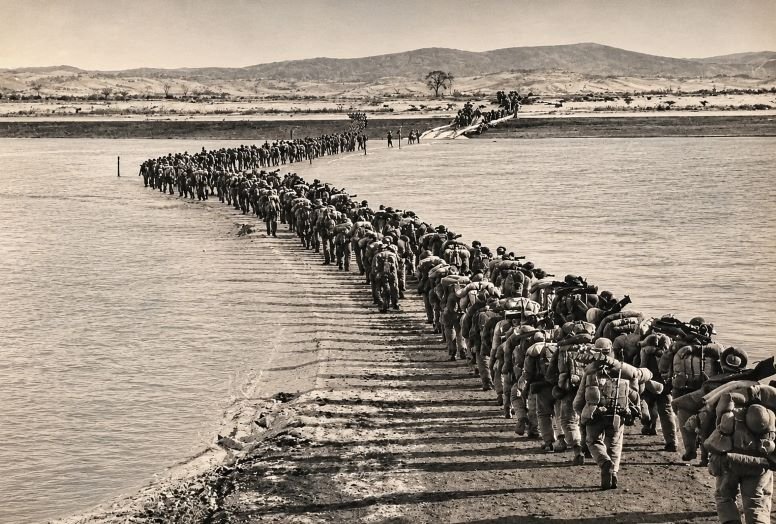
In Seoul; at Sunchon; at Triangle Hill; Chinese soldiers, with nothing but their flesh and blood, forced the heavily armed United Nations forces back to the 38th Parallel.
The countries that had raised their hands to vote against China at Flushing Meadows–Corona Park learned on the battlefield what the fury of the peasant sons they had despised truly looked like.
When General Clark later signed the armistice agreement, he must have done so with a bitter taste in his mouth. He acknowledged that he was the first commander in American history to sign an armistice without victory.
And Stalin? Once the Chinese People’s Volunteers had demonstrated their mettle on the Korean battlefield, Moscow’s attitude changed. Aid began to arrive. So did the 156 key industrial projects, giving China its first real foundation for industrialisation.
This was no selfless gift from a benevolent big brother. It was strategic leverage that we had earned the hard way, paid for with the lives of hundreds of thousands of soldiers in bitter hand-to-hand combat amid the ice and snow.
“Dignity exists only at the point of the sword; truth exists only within the range of artillery.” The line sounds brutal, but it captures a stark historical reality.
The diplomatic humiliation of September 19, 1950, ultimately became the furnace that forged the backbone of the People’s Republic of China.
We did not abase ourselves within rules written by others. Instead, through a devastating war, we told the world: if you refuse to give me a seat at the table, I will overturn the table and make sure no one gets to eat.
It was not until 1971 that the People’s Republic of China regained its lawful seat at the United Nations. When Qiao Guanhua threw back his head and laughed in the General Assembly, behind that laughter lay the ice and snow along the Yalu River two decades earlier, along with the countless young faces that had remained forever in a foreign land.
The door they had been denied entry through was blasted open by the artillery fire of the soldiers who came after them.
More than seventy years later, as familiar-sounding “sanctions lists,” “rules-based encirclement,” and “decoupling and supply-chain severance” come crashing down once again, many people still urge us to “show restraint” and “work harder to integrate into the mainstream international community.” It is as though, if we appear obedient enough and follow rules set by others closely enough, we will be granted a secure ticket to development.
Integration without the strength to back it up can turn into passive submission at any moment. Without strategic space of our own, what is called a choice is often merely a choice someone else has made for us.