On February 17, 2026, the Peruvian Congress removed interim president José Jerí through a motion of censure after he had held the position for four months following the removal of Dina Boluarte, who had also been removed from the presidency after the parliamentary coup that ousted constitutional president Pedro Castillo Terrones.
With a divided vote, the Congress of the Republic elected José María Balcázar as the new transitional president until July 28, 2026, when he will have to hand over the government to the winner of the elections to be held on April 12 of this year.
Balcázar, an 83-year-old lawyer and former magistrate belonging to the Peru Libre party, becomes the country’s eighth president in a decade (2016-2026). It is worth noting that the shadow of the United States looms over the removal of Pedro Castillo, Dilma Bouluarte, and José Jerí. Perhaps this explains why, just hours after his election, José María Balcázar met at the Government Palace with the United States ambassador, Bernie Navarro, to strengthen bilateral ties and ensure regional stability.
Dina Boluarte was burdened by the cardinal sin of the Chancay Mega Port, something unacceptable to the Trump administration because of what it meant for their Monroe Doctrine plans.
Jerí’s downfall was precipitated by the so-called “China-gate” (secret meetings with Chinese businessmen), which added to the history of accusations of corruption in various forms.
Peru’s political and institutional system operates in a constant state of crisis, thanks to a web of corruption driven by concentrated sectors of the economy, which manipulates the various actors in the legislative, executive, and judicial branches to ensure that the neoliberal economic model remains intact since 1993. As an example, Julio Velarde has been president of the Central Reserve Bank, a key position for economic and financial activity, since 2006.
This critical institutional situation has put Peru on the front page of the media for its scandals and as a model for the champions of neoliberalism, such as the Argentine Minister of Economy, Luis Caputo, who suggests that the north of our country is Peru.
Caputo is surely dazzled by the stable macroeconomic indicators of that country, the 3% growth, the low inflation and the controlled debt, but all these wonders occur amidst a structural informality of 75% and rising poverty and inequality.
he persistence over time of these types of phenomena that astonish the right wing and the IMF is manifested in the concept of “Peruvianization”, a global trend in which capitalism becomes “criminal”, eroding democratic institutions in favor of de facto powers.
It is not difficult to visualize that this phenomenon of “Peruvianization” exists as a trend in the international right wing, when they try to sustain an economic model through political disorder and the manipulation of the resigned electorate.
The sustainability of an order based on moral and political decay poses a challenge to the interests of the people, victims of a perverse system in which protest is repressed and judicialized, and the electoral path is manipulated between the judiciary, political mafias, and the characteristics of a system of government in which the legislative branch has the power to build a judiciary tailored to its needs and an executive branch subservient to its decisions, since it is the latter that accepts or rejects the ministerial cabinet.
The 2026 Peruvian general elections will be held on Sunday, April 12, 2026, to elect the President of the Republic and the two Vice Presidents of the Republic, who will serve for a five-year term. They will also elect representatives to Congress (60 senators and 130 deputies—31 seats required for an absolute majority in the Senate and 66 seats in the Chamber of Deputies) and the Andean Parliament (5) for the 2026-2031 term.
An illustrative fact about the interference of powers in the electoral arena is that Dina Boluarte became president in Peru while serving as vice president, remaining as the sole vice president after Vladimir Cerrón was excluded from the ticket during the electoral process.
In Peru, if no candidate manages to exceed 50% of the valid votes, a second round of elections is called, in which the two candidates who have reached the first two places in the presidential elections will face each other; it would be held on Sunday, June 7, 2026.
Extreme institutional fragility of Peru
With Balcázar’s assumption of the presidency, the instability and power vacuum present for 24 hours after Jerí’s departure does not seem to be something foreign to the political development of Peru in electoral transition, since the person who occupies the highest magistracy was summoned by the Second Single-Judge Court of Chiclayo to oral trial for the alleged crime of illicit appropriation, in events that occurred between 2019 and 2022 when he served as dean of the Illustrious Bar Association of Lambayeque.
Thus, the president, accused of failing to account for the funds raised during his tenure in said union, must appear at the hearing scheduled for June 16, with continuation dates planned for June 23 and 30, either virtually or in the hearing room of the Superior Court of Justice of Lambayeque, in Chiclayo.
It should be noted that the judge ordered the mandatory presence of the president, making it clear that, in case of non-attendance, he will be declared a fugitive and arrest warrants will be issued nationwide.
The United States and the fight with China in Peru
China has multiple and historical interests in Peru, which make it play a very important role in the Peruvian economy, fundamentally in the framework of imports and exports, as we have been able to appreciate in the video of the inauguration of the Mega Port of Chancay.
Peru is rich in minerals such as copper, gold, and iron, which are of paramount importance to China’s industrial development. Furthermore, China finds a variety of high-quality agricultural and fishing products in Peru, including quinoa, blueberries, grapes, avocados, and seafood, which are highly valued in the Asian market and help meet domestic food demand.
Chinese companies in Peru invest in mining, energy, infrastructure, and technology. They develop hydroelectric projects, build schools, and are involved in digital training initiatives.
Also, with the Belt and Road Initiative, they seek to expand their trade markets and strengthen regional cooperation, promoting connectivity and joint economic development.
China has remained Peru’s top trading partner for 10 consecutive years. In 2024, the total volume of bilateral trade reached US$39.76 billion, a 10.9% year-on-year increase, representing 31.6% of Peru’s total foreign trade.
Peruvian exports to China grew 30.7% year-on-year in January 2025, reaching US$6.922 billion, representing 34% of Peru’s total exports.
Peru, in turn, imported Chinese products worth $14.53 billion, which translates into a year-on-year increase of 14%, representing 28% of Peru’s total imports.
Given this relationship, the United States is trying to maneuver to shape its fanatical war against China on the continent, knowing that China’s position in Peru not only has the support of the South American giant headquartered in Brasilia, but also of powerful economic groups in the region that have commercial expectations to which the Trump administration can contribute nothing, especially given its incoherent tariff policy and its military overbearing stance in the region, which threatens to balkanize and undermine the legal security that capital needs to invest in different medium- and long-term ventures.
Peru: the necessary closing of a cycle
Peru has countless possibilities stemming from the potential of its people, perhaps because its historical roots do not reflect the decadent archetypes of a sick and brutalized Europe that launched itself into conquest with blood and fire, but rather the splendor of a thousand-year-old empire that forged innovative systems in science and technology [1]
Since its birth as a Republic, the Peruvian oligarchy has managed to stay in power, and except for honorable and accountable exceptions such as those of Caceres and Alvarado, in which the interests of the Fatherland were above the interests of the oligarchy, the rest of its institutional political history has been marked by betrayals, corruption and contempt for the future of its working people.
But the epitome of this story is found in the birth of Fujimorism, with its 1993 constitution after the self-coup of April 5, 1992.
Alberto Fujimori dissolved Congress and reformed the 1979 Political Constitution of Peru, establishing a neoliberal economic model, unicameralism, and presidential re-election, in order to consolidate political and economic control of the country in his own hands.
This 1993 Constitution, in order to return to bicameralism, had to be reformed through parliament in 53 articles (2, 39, 56, 57, 78, 79, 80, 81, 82, 86, 87, 90, 91, 92, 93, 94, 95, 96, 97, 98, 99, 100, 101, 102, 104, 105, 106, 107, 108, 117, 118, 129, 130, 131, 132, 133, 134, 135, 136, 137, 139, 142, 150, 157, 161, 162, 182, 183, 191, 194, 201, 203 and 206), not to satisfy the pressing needs of the people, but to enlarge the bureaucracy that manages the institutions and exercises real power in Peru.
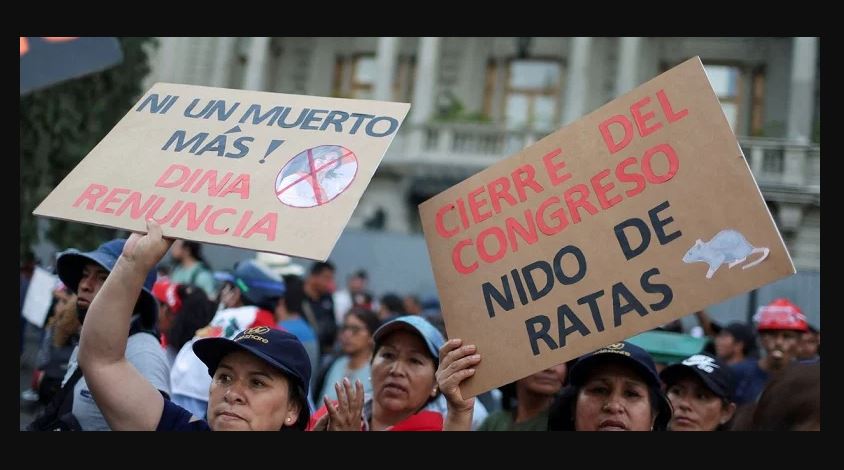
It is not surprising that, during the last few years, the demand for the closure of Congress and for a new Constitution has been present in all popular demonstrations.
If the Peruvian people, through unity and the political stance of their leaders, do not remove the nefarious and corrupt bureaucracy from the legislative branch in the upcoming elections, the history of vacancies, misery, and corruption will repeat itself in a crueler and more ruthless way, since the future of Peru, like that of the rest of our America, is marked by the application of a neo-Monroeism at the hands of the Trump administration, which is desperately dragging along the ruins of a decadent capitalism.
Perhaps, if Peru had the figure of the “cross death” [2] that exists in Ecuador, institutional stability would have a political opportunity and would not be left in the hands of mercenary mafias who find through a seat the opportunity to rise socially and economically.
The possibility of a cycle ending and a change in the political paradigm form the crossroads at which the nationalist and left-wing political leadership finds itself in the Andean country. Let us hope that their work among the population has been able to break with political clientelism and that the expectation of the refounding of Peru can become a reality for the good of Peruvians and the region.
[2] The “cross-death” in Ecuador is a constitutional mechanism (Article 148) that allows the President to dissolve the National Assembly and call early general elections.