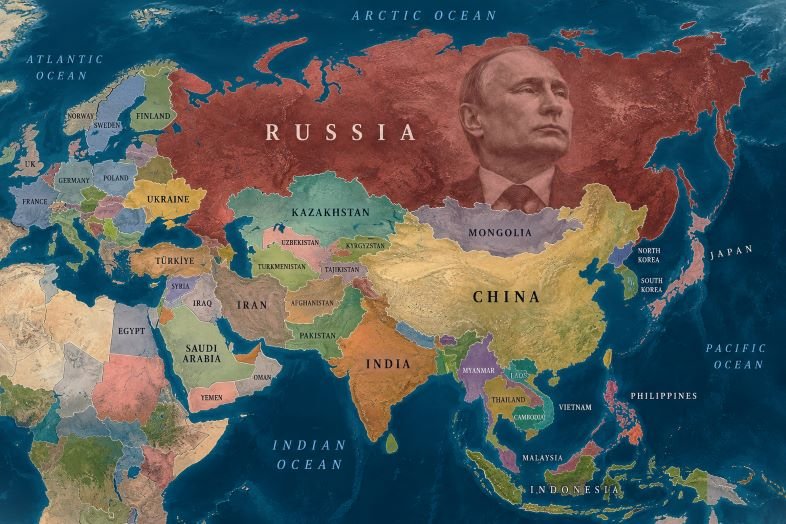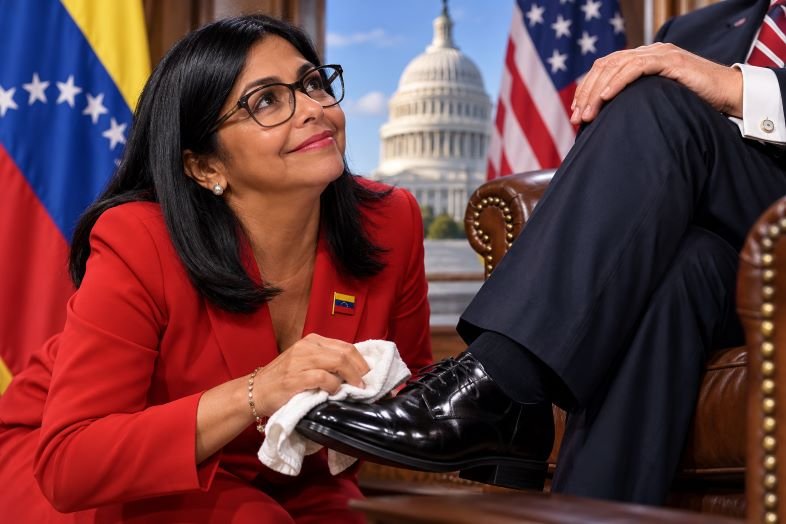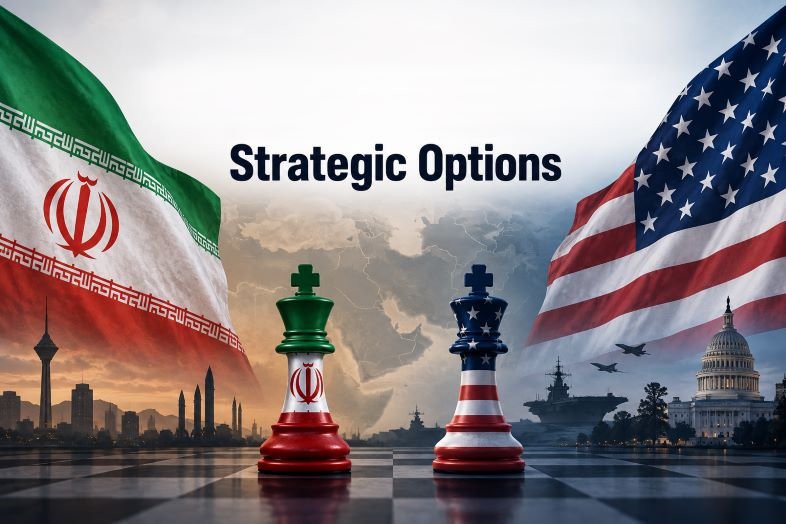
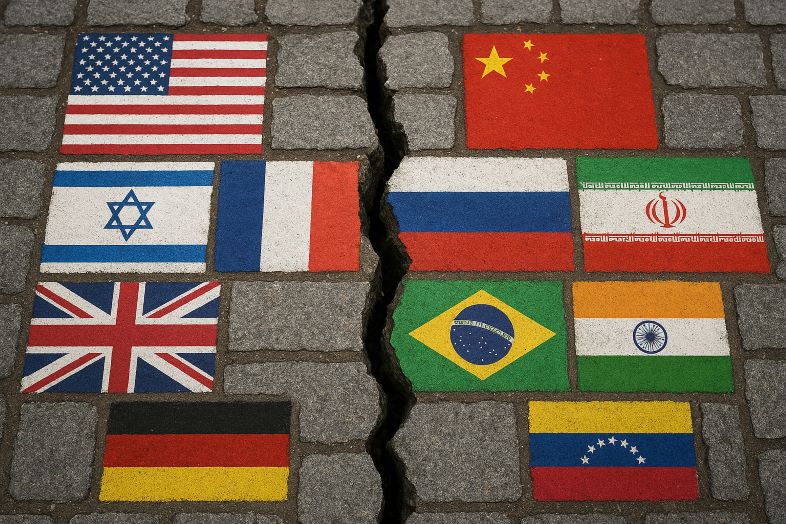
From Ukraine to Gaza, from Libya to Nigeria, and from Venezuela to Iran, throughout the Global South, the United States and its vassals are opening proxy war fronts in an effort to contain Russia and China.
In reality, the tensions stretching from Ukraine to Iran are not simply a matter of reshuffling military balances. They signal a deeper shift: the gradual end of a civilizational paradigm centered on the North Atlantic. Washington’s strategic activism and Tel Aviv’s offensive alignment are not merely circumstantial political choices; they reflect a structural anxiety about the erosion of a historical centrality.
Under the presidencies of Donald Trump and Benjamin Netanyahu, the use of force ceased to be presented as an exception. It became a strategic norm. This shift cannot be understood without a sui generis civilizational framework.
To fully grasp its implications, it is necessary to analyze successively the contemporary redefinition of the enemy in light of Carl Schmitt, the resurgence of civilizational fault lines described by Huntington, the adaptive incapacity evoked by Toynbee in the face of the multipolar challenge, and finally the crucial question of strategic cohesion – Ibn Khaldun’s asabiyya – as the key to understanding the current shift. It is through this theoretical exploration that the true issue is revealed: are we witnessing a simple realignment of powers or the entry into a post-Atlantic era?
Carl Schmitt: The designation of the enemy
The German jurist Carl Schmitt asserted that politics is defined by the friend/enemy distinction. However, for two decades, the strategic West has been constantly expanding the circle of the enemy: Russia in Eastern Europe, Iran in the Middle East, China in the Indo-Pacific, and emerging powers in the Global South.
In this context, Ukraine becomes de facto a front for designation; Iran, a permanent target for deterrence, in the strictest sense. The strikes on Tehran and other Iranian strategic centers, followed by retaliatory strikes on American bases in the Gulf and on Israeli positions, reflect the establishment of a near-permanent state of geopolitical exception.
For Schmitt, the danger lay in the indefinite expansion of conflict. We are there now: the planet is fragmenting into diffuse front lines.
Samuel Huntington: the Clash of Civilizations revisited
Samuel Huntington predicted that future conflicts would pit civilizational blocs against each other rather than ideologies. While his thesis has been contested, it partially sheds light on the current situation.
Iran is not merely a regional power. It embodies a Persian and Islamic civilizational continuity articulated within an autonomous strategic project. Russia claims a distinct Eurasian space. China is developing an alternative political and economic model.
Faced with this, the Atlanticist axis perceives less as competing states than as civilizational poles capable of redefining the world hierarchy.
This is why preemptive strikes and sanctions are not solely aimed at military capabilities; they target historical trajectories. The assassination of Ayatollah Ali Khamenei and other key figures of the Islamic Republic is a prime example of this.
Arnold Toynbee: the challenge and the answer
According to Arnold J. Toynbee, civilizations decline when they fail to respond creatively to the challenges they face. However, the contemporary challenge facing the West is not military; it is structural: the emergence of a multipolar world.
Instead of inventing a renewed multilateralism, Washington prioritizes expanding its alliance networks and resorting to coercion. Instead of integrating new powers into a balanced architecture, it tries to contain their rise.
This choice reveals a difficulty in adapting. History shows, however, that strategic rigidity often precedes weakening.
Ibn Khaldun: asabiyya and lost solidarity
The Maghrebi thinker Ibn Khaldun introduced the concept of asabiyya – the social and political cohesion that allows a civilization to maintain itself.
Applied to the contemporary Arab world, this concept sheds light on a paradox: internal fragmentation weakens the regional capacity to respond to external interference. Since the uprisings of the “Arab Spring,” states have been destabilized, societies polarized, and sovereignties eroded.
The absence of regional solidarity (asabiyya) transforms the Arab world into a theater of inter-imperial clashes. Each pursuing its own self-serving objectives, the coalition partners (Washington, Tel Aviv, Brussels, and London) base their alliance on double standards, everywhere and in all circumstances. Moving from strategic hypocrisy to genuine solidarity thus becomes an existential, not an ideological, necessity.
The metaphysics of hegemony
In truth, what distinguishes the current phase is not only the intensity of the crises, but also their moral justification. Interventions are presented as acts of stabilization, defense of democracy, the fight against terrorism, or collective security. Yet, the repeated strikes, the expansion of military bases, the spread of terrorism and violent extremism, and the proliferation of extraterritorial sanctions paint a different picture: a desire to maintain systemic primacy.
However, hegemony rests as much on consent as on coercion. When consent erodes, coercion increases. And when coercion becomes central, legitimacy crumbles.
Towards a post-Atlantic era?
The Iranian response to the strikes, the arrest by Saudi Arabia and Qatar of agents of the Israeli intelligence service Mossad who were planning bomb attacks on their territory to blame Iran, the strategic tightening between Moscow and Beijing, the diplomatic assertion of powers from the Global South: all these elements signal an accelerated recomposition.
The question, therefore, is not whether the West can still strike. It can. It is so strong that it possesses the rare ability to wage war against itself. The question is whether these strikes delay or accelerate the transition to a multipolar order.
According to Toynbee, a civilization declines when it responds mechanically to new challenges.
If we follow Ibn Khaldun, it collapses when its internal cohesion dissolves.
If we follow Schmitt, the unlimited expansion of the enemy leads to permanent war.
If we follow Huntington, ignorance of civilizational lines fuels the fractures.
We may be witnessing the convergence of these four warnings.
The end of the illusion of a “rule-based order”
In fact, the strategic activism of Washington and Tel Aviv is not a sign of absolute confidence; it can be interpreted as the expression of a vertigo: that of losing historical centrality.
But history is never static. It moves.
The real alternative lies neither in a generalized confrontation nor in passive alignment. It lies in the capacity of civilizational spaces – particularly Arab ones – to rebuild an autonomous strategic cohesion, capable of dialogue without submitting, of cooperating without dissolving.
Because when a world order can only be maintained through constant pressure, it is already entering its terminal phase.
The question is no longer whether the current strategy of Washington and Tel Aviv is aggressive; it clearly is. The real question is more serious: how many more crises can the international system absorb before the downward spiral becomes irreversible?
Mohamed Lamine KABA, Sociologist and Expert in the geopolitics of governance and regional integration.