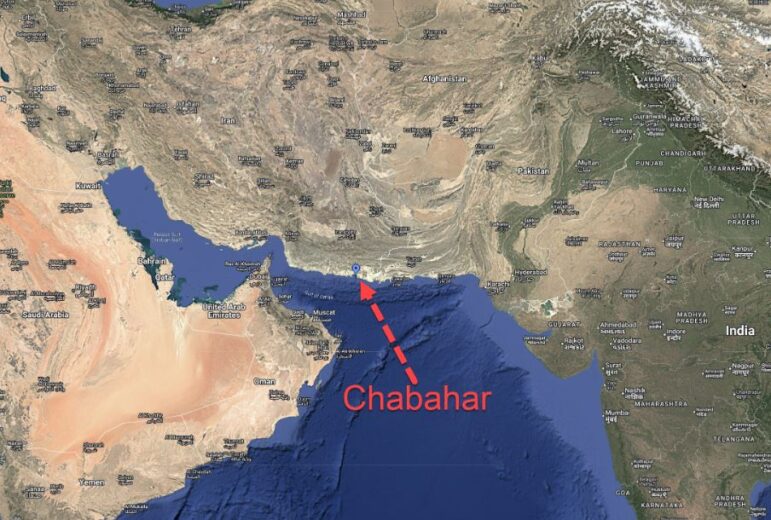
Why the most realistic option is also the most low-key—and what that reveals about the communication strategies of war.
While the United States has more than 50,000 troops positioned in the Gulf and Iran has been subjected for twenty-six days to airstrikes of unprecedented intensity, one idea dominates most commentary: no ground invasion of Iran is militarily realistic with the forces currently deployed. This is the thesis defended by House of Saud, which highlights the abyssal gap between the forces now present in the region and what a large-scale ground campaign would require.
But that reading leaves another hypothesis in the shadows, one of a very different nature. In his essay on Chabahar Bay, the analyst Doomernat describes not an invasion or a long-term occupation, but a limited amphibious raid, calibrated to the forces already on site: two Marine Expeditionary Units, one Ranger battalion, heavy naval and air support, and a very short operational timeframe.
In other words, the two texts do not entirely contradict one another. They are not speaking about the same kind of war. One reasons on the scale of a ground campaign meant to break or occupy Iran. The other envisions a brief tactical strike, spectacular, politically exploitable, and ultimately reversible. It is in this difference of scale, purpose, and duration that the real question lies.
50,000 Troops – For What Purpose?
The houseofsaud analysis, titled “Fifty Thousand Troops and No Way Into Iran”, is based on the observation that the forces currently deployed by Washington – about 50,000 troops, including two carrier strike groups and two Marine Expeditionary Units (MEUs) – amount to only a fraction of what a conventional invasion of Iran would require.
Drawing on data from the International Institute for Strategic Studies (IISS) and lessons from the Iraq and Afghanistan wars, the article lays out a matrix of five scenarios, from a limited strike on Kharg Island to a full‑scale invasion with occupation. In every case, troop requirements range from 150,000 to well over a million. The conclusion: with current assets, only a “discrete, time‑limited operation” is conceivable – and even that would come at the cost of major escalation with Gulf states.
Strikingly, Chabahar Bay appears nowhere in that list of options. Yet Chabahar, located in Baluchistan province, is Iran’s southernmost major port, thousands of kilometres away from the western and northern fronts where the regular army and the Islamic Revolutionary Guard Corps (IRGC) have concentrated their defences.
The Chabahar Scenario: A Raid Tailored for the Trump Doctrine
It is precisely on this point that Doomernat’s essay, “The Trump Doctrine and the Landing in Chabahar Bay”, enters the discussion. Published on a low‑profile geopolitics platform, the text details hour by hour an amphibious operation aimed at Chabahar’s port facilities and the nearby Konarak military airfield.
The author grounds his hypothesis in the informal military doctrine of Donald Trump: “taking audacious risks, making the operation a media spectacle, not spending political capital beforehand, and letting success justify itself after the fact.” Within that logic, a twelve‑ to forty‑eight‑hour raid, carried out by two MEUs, a Ranger battalion and backed by the entire Fifth Fleet, could be presented as a resounding victory – even if the ceasefire deal that followed turned out to be diplomatically modest.
Unlike the Gulf islands (Abu Musa, Greater and Lesser Tunbs), where defenders have no strategic depth and where USAmerican casualties would likely be unacceptable, Chabahar offers an escape route: local forces are reportedly light, the Baluch population is historically less aligned with Tehran, and the mountains inland would allow for a quick withdrawal by sea or air if an Iranian counter‑attack proved too heavy.
The author even addresses the critics head‑on: “If the Fifth Fleet cannot clear a straight‑line, ocean‑facing coastline after three to five weeks of bombing, why do we have it? If a double MEU cannot take a lightly defended port town, what exactly are the Marines for?”
Three theories to explain the Chabahar blind spot
On one hand, houseofsaud asserts that any invasion plan is out of reach. On the other, Doomernat describes a raid perfectly calibrated to the forces available – and that raid has a name: Chabahar. Why such silence about this option in the mainstream analysis?
Three hypotheses deserve consideration.
1. A Difference in Kind: Invasion vs. Raid
The first article reasons in terms of invasion and occupation, with classic strategic goals (regime change, control of oil infrastructure). The second envisions a tactical blow: strike, destroy symbolic targets (IRGC naval bases, drone bunkers), then withdraw before the adversary can mass its forces. The two are not talking about the same kind of war. Yet this distinction is rarely made in the mainstream media, allowing confusion to persist.
2. A Deliberate Blind Spot?
The omission of Chabahar in the houseofsaud study could be interpreted as an editorial choice designed not to draw attention to an Iranian weak point. The outlet, close to Gulf security circles, would have every interest in discouraging the idea of a massive ground adventure that would put Saudi Arabia on the front line, while keeping operational cards out of the public debate.
3. A Diversionary Maneuver?
The most intriguing hypothesis is that of a deliberate information war. By burying the discussion under learned estimates of invasion force requirements (500,000 to 1.6 million troops), attention is deflected from what is actually feasible with 50,000 troops: a surgical raid on a specific point, chosen for its vulnerability and its relatively low symbolic weight for the Tehran regime.
Seen this way, the houseofsaud text would serve as a diversion – or at least as fog – by cementing in the public mind the idea that no ground operation is possible. At the same time, quieter voices like Doomernat’s lay the operational groundwork, detailing a raid that Pentagon strategists cannot ignore.
What Chabahar’s Absence from Public Debate Reveals
Chabahar Bay offers several advantages for a limited intervention:
- Distance from Iranian decision‑making centres: over 1,500 km from Tehran, the region is less watched, and reinforcements would take days to arrive.
- Weaker coastal defences: unlike the Strait of Hormuz or the Khuzestan coast, the area is not saturated with anti‑ship missiles.
- Less hostile population: Baluchistan, though its separatist sentiment is often overstated, has historically had a more ambivalent relationship with the central government.
- Symbolic targets: the Iranian naval base and the underwater drone facilities at Konarak are objectives whose destruction could be presented as a major success.
Above all, the operation could be carried out with the forces already in place: two MEUs (roughly 4,500 Marines), a Ranger battalion (about 800 soldiers) and the air and naval cover of the Fifth Fleet. Exactly what is currently deployed between the Persian Gulf and the Arabian Sea.
Conclusion: Diversion or Strategic Double‑Speak?
The clash between the two analyses is no accident. It reflects a central dilemma of American strategy in the Middle East: how to inflict a tactically spectacular defeat on Iran without sliding into a war of attrition that neither Washington nor Riyadh can sustain.
The silence of major studies on the Chabahar option is probably not an oversight. In a context where every statement is weighed, the omission of the most plausible scenario by influential outlets like houseofsaud may be a way to lull Tehran’s vigilance – or, conversely, to test Iranian reactions to an option that US military planners are taking very seriously.
In the meantime, the amphibious ships USS Tripoli and USS Boxer have left Japan and are heading for the Gulf. Their embarked Marines were not deployed to hand out humanitarian rations. History reminds us that wars often begin where no one expected them – and that articles insisting they are impossible can sometimes serve as the best cover for preparing them.