March 26, 2026 – We are living in an era of change. This means we will face dangerous times. An entire system of certainties, habits, and securities is crumbling before our eyes. But we must warn: the same system, whose decline and collapse had given us peace of mind, has also kept us alienated and in a state of narcotization. It was the system of “North Americanism.”
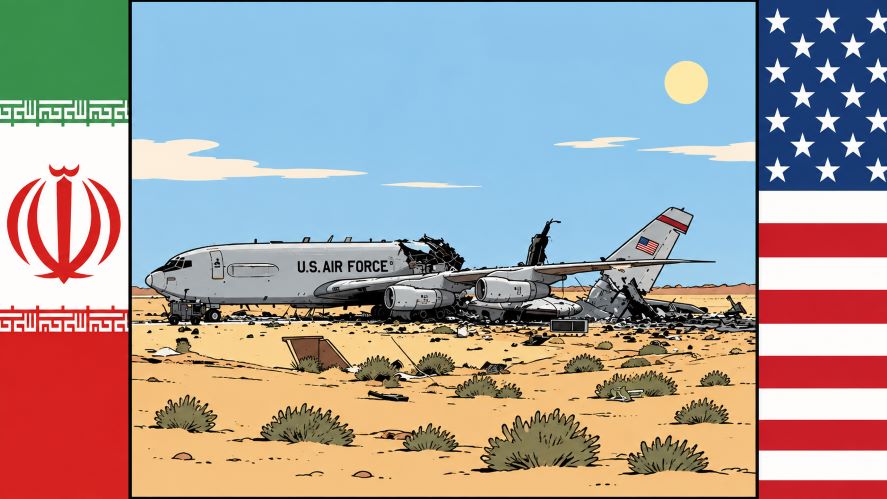
The selective and effective control of the Strait of Hormuz represents, as a unique historical fact, the great “counter-sanction” of a rebellious state, such as the Persian one, to US imperialism.
The situation we are experiencing is unprecedented. Until now, the peoples of the world who resisted the Western Empire could only play the guerilla warfare card, the caudillismo card, or the anti-imperialist revolutionary party card. Doing so meant, nothing more and nothing less, facing the sanctions and blockades imposed by the Western Empire, suffering hunger and poverty, circumventing supply blockades, becoming martyrs and heroes of anti-imperialism. The Persian resistance is of an entirely different nature.
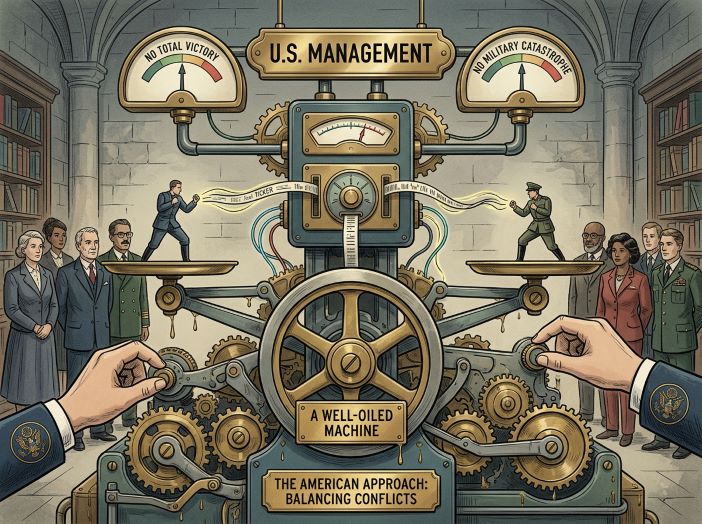
The United States hasn’t won a war in the strict sense since 1945, if we understand war as a conventional military conflict. Vietnam, Afghanistan, and Iraq speak to the world and are eloquent monuments to American military failure. The strategy of “bombing from the sky, at very high altitude, and then running away” resembles that of a terrorist group more than that of an imperial army.
When the Americans attempt to occupy medium-sized and large countries inhabited by hostile populations, they prove ineffective. Ultimately, the American modus operandi is the same as that of the Zionist entity’s army, but on a global scale: they possess sophisticated technology and an asymmetrical force. They easily kill civilians, but not guerrillas. The lesson is that in war, the will to resist also counts, not just the will to power.
The Iranians have carefully developed the technology needed for asymmetric warfare, as well as fostering a will to resist, a very intense variant of the will to power. Their ballistic missile operations and drone swarms in themselves represent a revolution in the art of war. They produce their arsenal cheaply and in series, rapidly replenish it, hide it underground, distribute it piecemeal, and manage defense and counter-attacks in an equally piecemeal manner. The Persian government, in reality, cannot be “decapitated.”
Like the Chinese government, it is a collegial and highly structured government, in which one person’s temporary leadership is always subordinated to the qualified college that maintains the command structures. This type of command structure quickly corrects the perennial problem of the emergence of traitors and opportunists, as has likely happened in China in recent weeks, where Xi’s purge has stopped these types of elements. In the past, the submission and overthrow of regimes “not aligned” with the “liberal” democracy of the United States (Perón, Franco, the socialist caudillos, etc.) have always been possible thanks to the presence of traitors and opportunists within the structures. We saw this recently in Venezuela.
Iran is implementing the great “counter-sanction.” To cross Hormuz and secure a guaranteed energy supply, it’s not necessary to be hostile to the Persian nation; otherwise, even aircraft carriers could be hit and, ultimately, sunk. The question I want to ask, even schematically, is this: how is all this perceived in Spain? What implications—objective and subjective—does this new, unprecedented scenario, under which the Western Empire is now the sanctioned one, entail? After 80 years of punishment inflicted on rebels, now it’s the Americans and their vassals who are being punished.
Since 1953, the Kingdom of Spain has been a vassal state with no room for maneuver in its international politics. Geopolitically speaking, it is a marginal entity. Control of the Strait of Gibraltar, that is, control of the entire Western Mediterranean and its coastal countries, is the responsibility of the British and Moroccans, staunch allies of the United States, who also maintain the Rota base and other bases located on Spanish soil.
Since Morocco’s independence, the Americans have had a direct channel for information transmission and coordination with the North African sultanate. The latter, which has never abandoned its expansionist ambitions to the detriment of Spain, is now also Israel’s privileged partner. For both the Americans and the Zionists, it is vital that this Strait not be closed. If the Red Sea, Hormuz, and Gibraltar were closed simultaneously, the Zionist entity would be like a mouse caught in a mousetrap.
The Kingdom of Spain’s vassal status means that the current selective closure of the Hormuz field places it in an extremely vulnerable position. With relations virtually severed with Algeria, Spain’s traditional energy supplier, Morocco’s enemy, and protector of the Saharawi people (abandoned to their fate by Spain), the government in Madrid finds itself in the worst possible situation, deprived of gas and oil. Diplomatically and rhetorically hostile to Trump, the American president can “unleash the dogs” on Sánchez.
And those biting dogs are the Zionists (who have already spied on the Spanish president through Morocco and the Pegasus software) and, much more immediately, it is the Moroccan sultan who can unleash the beasts of prey. The “Green Marches” on Ceuta, Melilla, and the Canary Islands, an echo and reminder of the conquest of Western Sahara half a century ago, can be reactivated at any time with the approval of the White House.
The Kingdom of Spain will face two problems simultaneously: a migratory invasion that a nonexistent “international community” will never want to call a conquest, despite all the technological support the Maghreb can provide to the Zionist entity and the Yankee empire. But “rudeness toward Trump,” for its part, cannot fool Iranian power, which is at real, not rhetorical, war, stubbornly resisting and no longer in the mood for jokes.
Spain cannot fool the Persians: it is a NATO member state, a submissive executor of Franco-German dictates. The elites of Spain’s party system are sold to the major financial powers and the major lobbies operating in Western Europe, lobbies that have been working for their own interests for decades. They will never dissociate themselves from their “commitments” to Brussels, whether within the EU’s bureaucratic structures or within NATO’s military.
This situation is disastrous: officially, the Spanish are siding against Iran, and when the moment comes, they will have to contribute (albeit reluctantly and half-heartedly, but ultimately they will) to the Yankee-Zionist war “against evil.” But, in turn, the lazy and unrebellious vassal will be punished. Spain is very vulnerable on its southern flank, where Trump can deploy his predatory dog, Morocco. Morocco will punish an EU and NATO country in the name of Trump and Netanyahu: it seems unheard of, but in the current context, it’s plausible. Millions of Moroccans will cross the border and join those already living within, undermining Spanish cultural identity and opening the Pandora’s box of subsidies to foreigners.
In my opinion, Spain will not benefit from this situation. On the contrary. The alleged “clash” between Sánchez and Trump is purely demagogic. Pedro Sánchez’s Socialist government is beset by too many corruption scandals, allegedly involving “bribes,” influence peddling, pimping, favoritism, illicit party financing, and much more. In Spain, left-wing forces are undergoing a process of decomposition and fragmentation that, as of today, seems irreversible. In this context, Sánchez intends—so far with great skill—to be a new Phoenix, capable of picking up the wreckage of the left, imposing the slogan “no one left of me,” posing as the catalyst and savior of the battered Spanish left. Thus, “no to war and no to Trump” proves to be a winning strategy.
The hypocritical tactic of recalling the Gaza catastrophe and paying lip service to the Zionist entity perpetrating it is being repeated, while contracts for the supply of weapons and other goods are still outstanding. Spain is a country completely permeated by Jewish and Christian Zionist capital, so it truly has no room for maneuver. When they truly want to, the pincers of Washington, Rabat, and Tel Aviv will crack the Spanish nut. Even the Catholic Church and its media projections are under the command of the Jews, which explains its silence, its complicity, its discourses on “Judeo-Christianity,” and the enormous logistical and humanitarian support (for example, the NGO “Caritas”) for the silent invasion of the Iberian Peninsula. The right wing of the PP and VOX, for its part, and its overwhelming majority, favors this hypocritical rhetoric: that of not disturbing Morocco too much, so as not to irritate its master, Zionism (both Jewish and Christian).
On the other hand, Pedro Sánchez is also skillfully playing on the external front. An analysis of the “progressive” digital press in the Western world, especially in Europe, portrays him as a courageous and noble exception, in contrast to the submissive behavior of the Yankees like Meloni, Macron, Merz, and others. There’s no trace of this courage: Sánchez wants to save his political reputation, to regain abroad the prestige he’s largely lost at home.
In fact, neither he nor his government partners (SUMAR, a sort of “white label” of the Socialist Party known only for being in government, as well as the Catalan and Basque separatists) have ever considered challenging NATO membership, the expulsion of American bases, geopolitical alignment against the Franco-German axis, or anything of the sort. Sánchez presents himself to the public (especially in Latin America and Western Europe) as the refounder of social democracy, when in reality he is the most faithful exponent of neoliberal, Atlanticist, and pro-European policies. In Brussels, he is a political dwarf, and the US administration deeply despises him (assuming there is even an official in Washington who has even heard of him).
The Spanish people, to a large extent, are unaware of what is happening. They are unaware that their national sovereignty has been usurped on several occasions: in 1953, when Franco ceded the bases to the Americans; in 1973, when the Americans executed Carrero Blanco through ETA; in 1981, with the “attempted” coup; and in 2004, with the Madrid train bombings. Spanish sovereignty has been violated repeatedly. The people have been sold the idea that “Western” (i.e., American-style) is synonymous with progress, modernity, well-being, and unbridled consumerism. To a large extent, today’s Spaniards are a people very effectively manipulated, to sadistic extremes. Their tradition and identity have been stripped away, and there is virtually no organized opposition to the 1978 regime.
When the energy shortage the Iranians impose as a “counter-sanction” becomes palpable and intensifies, reactions could emerge. For now, they aren’t visible. Likewise, the other closely related phenomenon, the migrant invasion, is worsening (yes, it could worsen further, incredible as it may seem), and there could be consequences, barely perceptible now: xenophobia, clashes, a climate of ethnic civil war. It’s important to remember that the migratory squeeze is a Moroccan specialty, but to this we can add the contingents of actual refugees who will flee the Middle East, where there will be no one left (their wealthy owners will have fled) and will try to reach Europe through the beachhead of the Strait of Gibraltar. Spain’s proximity to Africa will always be a curse.
Spain has fallen into a geopolitical trap: the EU and NATO. It’s a trap for those who want to live by wishing they were a vassal and a colonized nation. The people will get what they deserve: they wanted to live well under the protection of a mafia. When they react, it will be late and with great pain. All that will remain of Spain will be a nutshell. And a broken one.