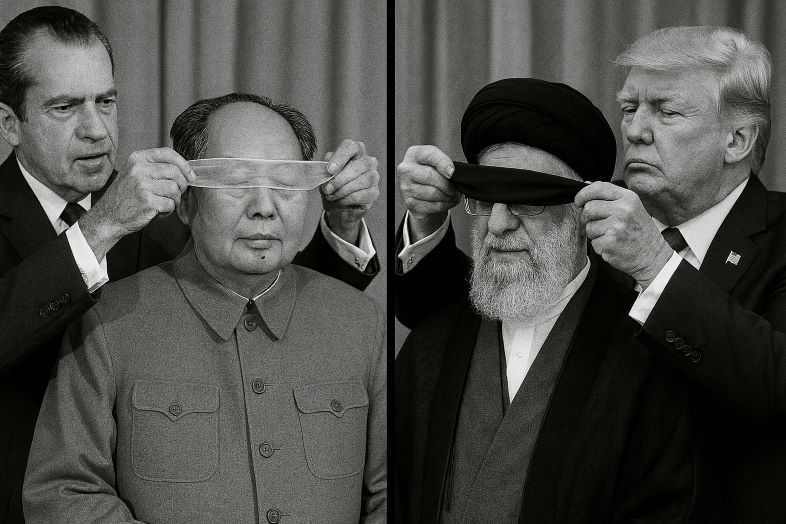
April 4, 2026 – Imagine what an opera would be like based on the incessant string of contradictions, absurdities, and arrogance with which Donald Trump has been commenting on the campaign against Iran.
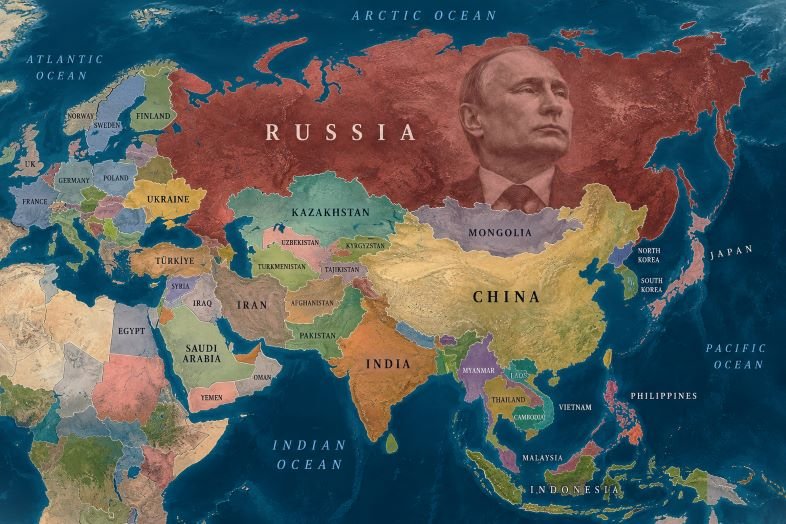
Nixon in China (1987) is an opera by John Adams about President Richard Nixon’s 1972 trip to China. Alice Goodman’s original libretto is structured around the official events of the presidential visit, press conferences, a performance at the Peking Opera House, and a series of nighttime scenes in which Mao questions whether he has fulfilled his revolutionary ideals while Nixon recalls his childhood dream of owning his own hamburger restaurant. Adams had just premiered Harmonielehre, a vast symphonic triptych of boundless energy, and drew upon his mastery of minimalist technique and musical eclecticism to embark on a composition of more than three hours, requiring nine soloists, a chorus, and a massive orchestral contingent augmented by a big band, synthesizers, and a saxophone section.
One only needs to listen to the Act I chorus (The People Are the Heroes Now) followed by Nixon’s frenetic aria (News Has a Kind of Mystery) to realize the strength, the hypnotic attraction, and the powerful inventiveness of the score. Greeted at Beijing airport by Zhou Enlai, the American president and the first lady greet the Chinese delegation, and suddenly Nixon launches into a frenzied tirade (“News has a kind of mystery”) in which he repeatedly uses “news, news, news, news” in different rhythmic patterns.
No less astonishing than the music (where minimalism shamelessly mingles with quotations from Wagner and Stravinsky, Strauss waltzes, and jazz fragments) are the lines of dialogue between the singers. Written by the American poet Alice Goodman, one might think that many of the lines in the libretto are mere nonsense born of her fevered imagination. However, the truth is that the most outlandish of all are actually statements made by the protagonists.
For example, Nixon’s history with hamburgers goes far beyond a childhood dream. Not only did he run a hamburger stand during World War II, but his brother Donald opened a chain of hamburger restaurants ( Nixon’s Drive-In ), and in trying to save the business, Nixon became embroiled in a scandal that nearly cost him the presidency. When the tenor playing Mao sings, ” You’ve got my vote. I back the man who’s on the right ,” the line refers to a joke by Mao himself, who actually said he preferred right-wing politicians and had voted for Nixon in the last election.
Now imagine what an opera—minimalist or otherwise—would be like, based on the incessant litany of contradictions, absurdities, and arrogance with which Donald Trump has commented on the campaign against Iran in successive press conferences. From March 3rd until now, he has said that he had won the war, that he was about to win the war, that they had won but not quite yet, that NATO had to help them, that they didn’t need NATO’s help, that NATO was a bunch of cowards, that they had to get their act together and lend a hand to open the Strait of Hormuz, that Iran would be finished in 48 hours, that he had decided to give them more time, that they were still negotiating, that the war would end very soon, that they had better open the Strait of Hormuz or they would destroy all the energy infrastructure, that they didn’t need the Strait of Hormuz, and that he is thinking of withdrawing from NATO.
Nixon was a pathological liar capable of holding two or three contradictory positions simultaneously, but Trump, in less than a month, has juggled thirteen or fourteen alternative facts. This implies a kind of intellectual counterpoint whose reduction to quavers would require not only minimalism and jazz, but also reggaeton, punk, music hall, bluegrass, death metal, khoomei, yodeling, and Gregorian chant. An oratorio, more than an opera, with a small chorus of suited clowns and blonde cheerleaders on one side and an immense chorus of mute, violated girls on the other. Yes, the news has a kind of mystery.