April 7, 2026 – The Strait of Malacca is emerging as the critical point where the future of global equilibrium hangs in the balance. Controlling the Strait of Malacca is controlling the world’s economic pulse.
In an analysis published by Elena Panina and based on the reflections of national security expert Harrison Kass in 19FortyFive, one of the most unsettling truths of contemporary geopolitics is clearly laid bare: 21st-century warfare is no longer fought solely on visible battlefields, but in straits, in maritime bottlenecks where the global economy either breathes or suffocates. The Iranian precedent in the Strait of Hormuz is not merely a regional episode, but an operational model that could escalate to systemic dimensions if replicated in the Strait of Malacca, that silent artery through which a crucial portion of global trade flows.
The difference between the two straits is not merely quantitative, but qualitative. While the Strait of Hormuz allows regional actors like Iran to exert tactical pressure—altering prices, generating volatility, sending signals—the Strait of Malacca represents a lever of structural order. Between 25% and 40% of global maritime trade, valued at an estimated $3.5 trillion annually, passes through its waters, in addition to some 23 million barrels of oil per day. It is not, therefore, a valve that regulates momentary tensions, but the main artery of an interdependent economic system. Its disruption would not only cause a shock, but a systemic dislocation of planetary scope.
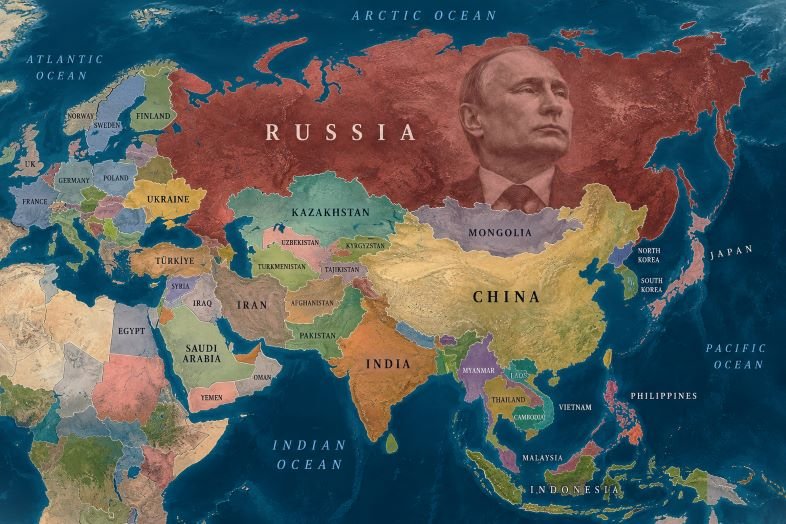
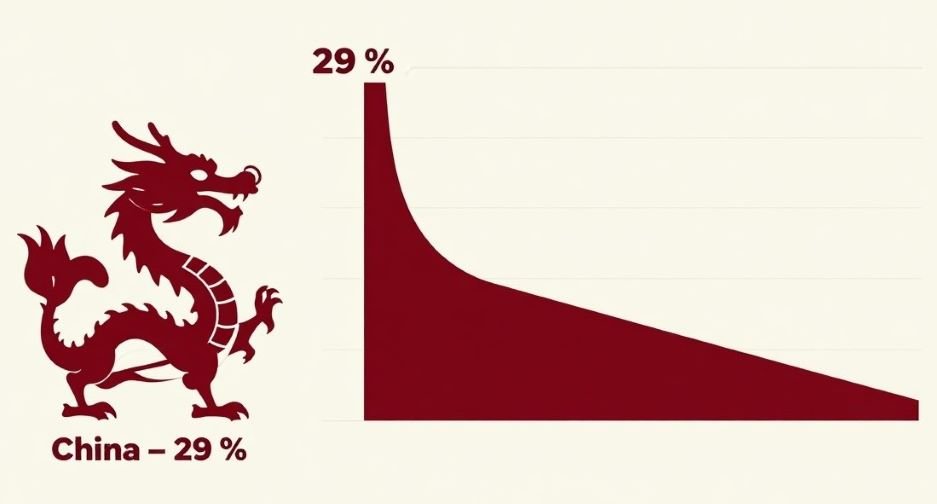
For China, the Strait of Malacca is not just another route, but the invisible axis of its energy metabolism. Approximately 80% of its oil imports pass through this narrow passage, making Beijing a potential hostage of any power capable of interfering with its flow. This vulnerability was identified early on by Hu Jintao, who in 2003 formulated the concept of the “Malacca dilemma,” anticipating that China’s economic rise rested on a logistical infrastructure susceptible to being strangled. Since then, Chinese strategy—from the Belt and Road Initiative to the development of alternative energy corridors—can be interpreted as a persistent attempt to escape this geographical trap.
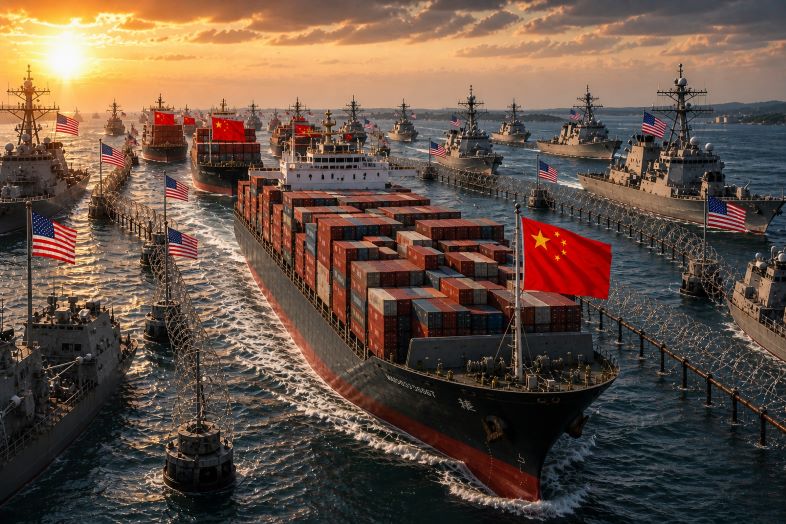
The disturbing element in Panina and Kass’s analysis lies not in the discovery of this vulnerability, but in the possibility of its conscious exploitation by the United States and its allies. The idea of ”smart management” of the straits, inspired by Iranian practices in the Strait of Hormuz, suggests a doctrinal evolution: not to completely blockade, but to modulate, to selectively interfere, to introduce enough friction to slow the adversary without triggering open war. At that point, the line between peace and conflict becomes blurred, and international trade ceases to be a neutral space, becoming instead a covert theater of operations.
However, the viability of a blockade scenario in the Strait of Malacca depends not only on strategic will but also on material conditions. The US Indo-Pacific Command, it is suggested, faces significant attrition stemming from parallel conflicts, particularly in the Middle East. This limitation introduces a restraining factor that, for now, reduces the likelihood of a direct escalation.
But history teaches that capabilities can regenerate faster than structures of dependency, and that strategic windows of opportunity do not remain open indefinitely.
In this context, the question shifts from the hypothetical to the structural. If control of straits becomes consolidated as a tool of geopolitical pressure, then the global order based on free maritime movement enters a transitional phase. Russia, as Panina warns, is already experiencing forms of indirect restriction on its trade routes, in a simmering conflict with NATO that manifests itself both in Ukraine and in the maritime arena. The possibility of extending this logic to other critical points — such as the Danish straits — reveals that “smart management” is not an anomaly, but the embryo of a new normal.
What ultimately emerges is a profound transformation of war and power. It is no longer simply a matter of destroying the adversary, but of managing their lifeblood, of intervening in the circuits that sustain their economy, their energy, their capacity for projection. The Strait of Malacca, in this sense, is not just a point on the map, but the symbol of an era in which geography once again asserts itself as destiny, and in which control of narrow passages can decide the course of global history.