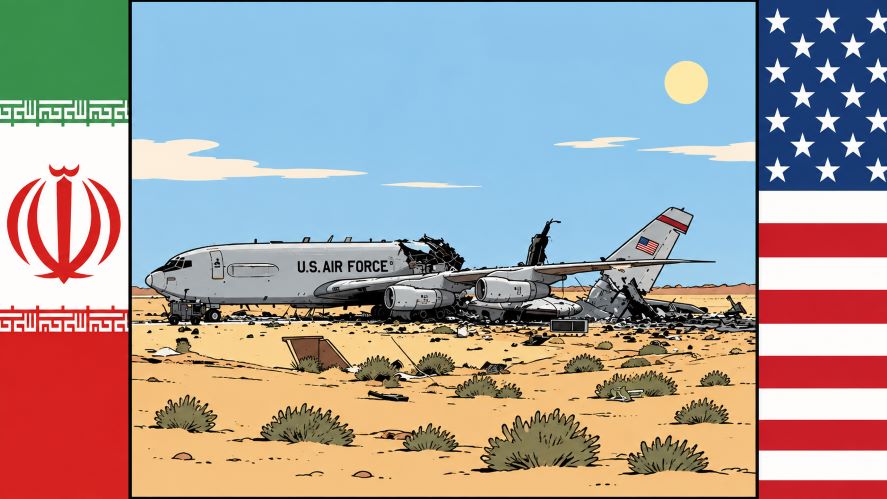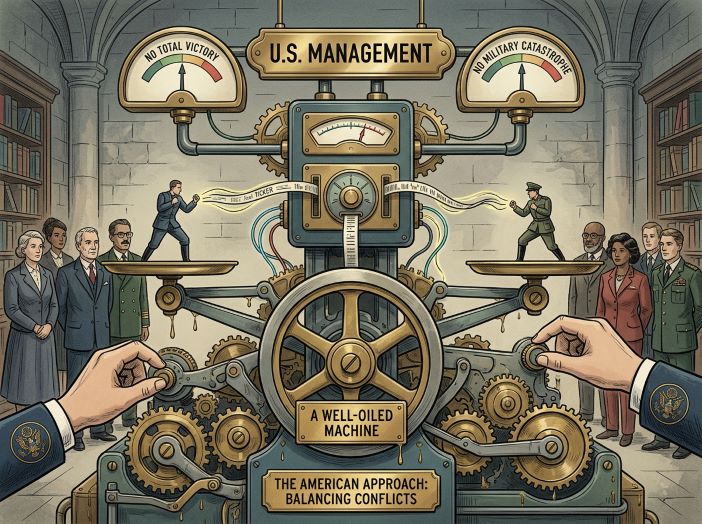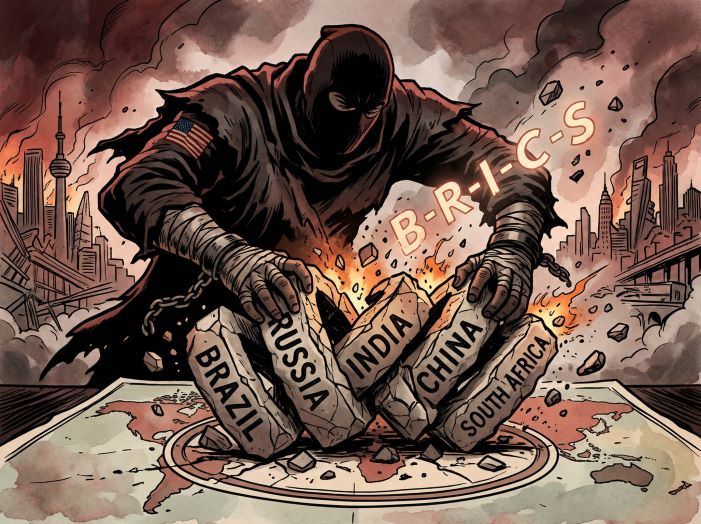
History tells us that when a superpower feels its existence threatened, it doesn’t choose rational retreat, but rather tends toward what is called escalating aggression—escaping the predicament with even more force, which leads it to strike in every direction. This behavior exposes us to significant risks, the outlines of which we will begin to see in May 2026.
In a previous article published on strategicfile.com, I discussed the problem of Thucydides’ Trap and how the United States uses utilitarian capitalism and geopolitical aggression to mitigate the decline of its absolute hegemony. This article and other related research can be found online.
It explains the relationship between the declining power of the United States and the rising power of China. It also examines China’s deliberate avoidance of confrontation with the crumbling empire, which might lash out in all directions to preserve its pride and position. Further analysis can be found in this work.
What interests me in this research is focusing on the stages of the symbolic and practical decline of American imperial prestige simultaneously, and following the indicators that lead us to understand how this occurred, as well as the sequence of events as happened with other empires that collapsed throughout history.
Imperial prestige falls not only with total military defeat, but also when a great power fails to fulfill its fundamental function as guarantor of common security, leading to the disintegration of the empire’s internal unity.
Let us begin with the symbolism of what happened with the Freedom Project (or what was known as the Safe Passages Initiative in May 2026), which represented the culmination of this failure, and the final nail in the coffin due to the failure of the military guarantee that the Navy tried to provide to the stranded ships, but it turned into a confidence knot. The Freedom Project was a last attempt to restore the confidence of shipping and insurance companies by packaging the military action with a humanitarian character (freeing the stranded sailors).
But global insurance companies refused to take him on. Despite the presence of aircraft and destroyers, major insurers (such as Lloyd’s of London) refused to lower their premiums. This means that the cold, hard minds of finance decided that American protection was insufficient to counter Iranian and Yemeni missile attacks.
Zero response was achieved by the stranded ships as well – despite their difficult circumstances – with not a single ship coming forward to trust this passage, and this is a clinical death declaration of the ability of the American fleet to impose its will at sea.
The ships preferred to wait, take longer, alternative routes, or coordinate with the Iranian navy—which the great empire claimed to have completely destroyed—rather than gamble under American protection and trust. This is what happened previously with the withdrawal from confronting the Houthis, the continued humiliation of the arrogant fleet, and the repeated withdrawals or inability to decisively defeat an irregular group like the Houthis shattered the myth of deterrence.
The world watched as multibillion-dollar fleets proved incapable of protecting a narrow waterway against low-cost drones and missiles, turning arrogance into a liability. Washington, realizing that no one trusted its vision, was forced to abandon its “freedom project.”
This abandonment is an implicit admission that the fleet that once patrolled the seas as the world’s policeman has become a guardian without powers.
Tehran, China, Russia, and others interpret this decline as a victory without a fight, because it has proven that American power has become a paper tiger in strategic waterways. Tehran, for its part, has driven another nail into the coffin of the empire.
This decline in naval prestige is the most dangerous because the American empire is fundamentally a maritime empire (Thalassocracy). Once the navy loses its prestige and ships cease to trust its protection, the system of trade that underpins its currency collapses.
The fleet transforms from an instrument of control into a target of logistical and financial attrition. The failed Freedom Flotilla was not merely an incomplete military operation; it was a public funeral for the world’s confidence in American naval power. And when the sword of the sea falls, the prestige of the throne in Washington crumbles, and the states begin to accelerate their individual survival measures as they realize that the federal shield has been shattered.
The collapse of trust, the search for ways out, the unilateral decision-making, and the erosion of prestige, prompted the allies, after Washington launched the war (Operation Epic Wrath) unilaterally and without consulting NATO – which left them facing economic repercussions (such as a 50% increase in gas prices without having a say in the decision to go to war) – to consider Washington, instead of being the umbrella under which the allies take shelter, as the danger that threatens their stability through escalating escape and demanding political and economic tributes.
Washington’s rush to punish its allies in this way explains the widespread anxiety in European and Asian capitals. It is the last cry against a shattered security umbrella.
The wounded empire punishes its allies for betraying it.
This is another indication of the collapse of empires, which has been repeated throughout history in many collapses. Washington has directed its anger at allies more than enemies. In the eyes of the wounded empire, the enemy (Iran) is playing its natural role, while the ally who flees or seeks neutrality is, in its view, practicing strategic treason that hastens the collapse of the unipolar system.
Why would she protect him if not with the support of her umbrella and power? And why wouldn’t she sacrifice him? She would not see him as an ally or partner, but as a fly sucking her blood, and she would have to get rid of him.
What we are seeing today is the transformation of the United States from a leading power that leads by persuasion and common interests, to a coercive power that tries to maintain its throne by subjugating its allies first.
This behavior may achieve temporary compliance, but it sows the seeds of the eventual collapse of Western alliances, and forces allies to seek their security in the arms of rising powers such as China and Russia, which is exactly what I described as an escape that provokes anger.
Endgame in international relations.
In political realism, we are now witnessing an endgame scenario in international relations. When an empire transforms from a protector to a punitive force, the behavior of other players (allies and adversaries alike) shifts from cooperation to passive containment and avoidance.
This strategy, where everyone will try to avoid being the next lesson while continuing to drain resources, manifests itself on three levels.
Bending to the Storm (Allied Policy)
Countries are beginning to bend to the storm (the policy of allies), led by traditional allies, especially in Europe and the Middle East. They are now adopting a policy of minimal commitment.
They realize that Washington is in an imperial frenzy and wants a scapegoat, so they are making formal or symbolic concessions to avoid sanctions and tariffs.
But behind the scenes, they are rapidly building their own channels with China and Russia, and seeking alternatives to the dollar system, such as expanding INSTEX or something similar. Their goal is to avoid becoming the next target of American wrath and to wait until the empire has exhausted itself.
Attrition by proxy (enemy policy)
Iran, along with its supporting axis (Russia and China), is implementing a strategy of attrition. Iran is not seeking a military defeat of America, which is technically impossible, but rather aims to make every day American forces spend in the region a financial and logistical drain.
China and Russia are supplying Iran with information, intelligence, and a shadow fleet to ensure its survival, because Iran’s continued presence as a thorn in Washington’s side means the continued depletion of American strategic stockpiles of Tomahawk missiles and Patriot defenses.
The collapse of traditional alliances and structural disintegration
Recent developments (May 2026) confirm that the United States’ traditional alliances are undergoing a phase of structural disintegration, with the relationship having transformed from a strategic partnership into a state of distrust and an open search for alternatives, as evidenced by diplomatic insults and the withdrawal of sovereign assets.
All of this hastens the end of the era of American hegemony. Insults to allies and breaking the wall of silence, as done by leaders such as German Chancellor Friedrich Merz and Canadian Prime Minister Mark Carney, are not mere slips of the tongue, but rather a declaration of the end of the era of subservience to the empire.
In Germany, Chancellor Merz leveled sharp and insulting criticism at the US strategy in the Iran war, arguing that Washington had humiliated itself and dragged Europe into an energy catastrophe.
The fact that European leaders have dared to insult the American president after having been the ones to receive insults reflects the beginning of their boldness to rebel against American arrogance and that calming things down between them no longer matters to them.
The Canadian Prime Minister and the German Chancellor – who was one of his staunchest defenders – and France’s withdrawal of its gold from America – all these factors marked the beginning of the Allies abandoning America.
Trump’s reaction, threatening to withdraw troops and impose tariffs, only increased Germany’s determination to build military and security independence from Washington.
In Canada, after Trudeau’s resignation, Mark Carney adopted a more sovereign stance, facing personal attacks from Trump, who described Canada as dependent on the United States. Canadians perceived this as a national insult, which accelerated the search for economic partnerships with Asia, culminating in a nationwide boycott of American products and a preference for Canadian goods.
The policy of emptying the coffers and fleeing
France capped all this by withdrawing its gold reserves from New York, preferring to escape the financial weapon that had been holding them. The most significant event occurred in April 2026 when France announced the complete withdrawal of its gold reserves from the vaults of the Federal Reserve in New York. Between July 2025 and January 2026, France transferred 129 tons of gold (its last remaining holdings in America) to Paris.
Despite attempts to portray the process as a technical procedure, strategists, through their review of history, agree that it is a strategic step to protect its assets from the fluctuations of American policy and to prevent Washington from using gold as a tool of pressure or confiscation in the event of escalating disputes over Iran or trade issues.
Following in France’s footsteps, enormous pressure is now mounting in Germany from economists and political parties (such as the Christian Democratic Union) to demand that the central bank (Bundesbank) withdraw the remaining 1,236 tons of gold in New York.
The German argument has become public: Our gold is no longer safe in the Federal Reserve’s vaults due to the unpredictability of the current US administration’s policies and Washington’s threat to use financial weapons against its friends before its enemies.
The allies realize that the wounded empire might sacrifice their interests to save itself, and so they are all taking steps to secure its landing. The withdrawal of gold is intended to provide financial cover for local currencies in the event of the anticipated dollar collapse. These diplomatic humiliations are meant to prepare the European and Canadian populations to accept the bitter pill of independence from the American umbrella, which has become a security and economic burden.
This is very much like the final days of any imperial alliance in history; when the partners begin to steal baggage and flee the ship before it sinks completely under the weight of its debts and losing wars.
Isolating the empire from global leadership
The world is beginning to realize that Washington is no longer an international arbiter, but rather a belligerent party. This shift is prompting Third World countries and emerging powers to avoid taking public stances against Washington to prevent being attacked from all sides.
Building parallel blocs (such as BRICS+ and the Shanghai Cooperation Organisation) that quietly pull the rug out from under American hegemony without getting into a noisy confrontation.
The lesson no one learns, and the tragic irony of the wounded empire’s pride, is that it believes striking in every direction will teach others a lesson and bring them back into line. But the truth is, this behavior only teaches everyone how to distance themselves and how to silently hasten its decline.
Washington is transforming itself from a world leader into an armed pariah, the most dangerous scenario any empire can face. It is a quiet dismantling of eighty years of prestige, unfolding under the cover of smoke and missiles in the skies over Tehran.
The Soviet Afghan quagmire is being repeated for the American empire, but with a strait-like maritime flavor.
The current American predicament with Iran is far more dangerous than the Afghan trap into which the Soviets fell when they invaded Afghanistan in the late 1970s. America itself had previously fallen into the traps of Afghanistan and Iraq, costing its economy over four trillion dollars in debt.
Its publicly held debt, or Held By Public as it is officially called, officially exceeded GDP by 100% last March, and that is the only certainty; it is now above 100%.
In the Soviet case, Afghanistan was an internal drain. It had no leverage to exert pressure on the world. It depleted the budget, humiliated the dignity of the Red Army, and shattered the people’s confidence in the leadership.
But it was a war fought behind walls, one that did not directly affect bread prices in Moscow or the world’s energy supplies. The Soviet collapse was the result of internal self-destruction hastened by military defeat.
On the contrary, Iran today holds the economic heart of the world. War with it would not only mean the depletion of Tomahawk missiles, but also the strangulation of maritime navigation.
The ability to close or disrupt the Strait of Hormuz means that Iran’s missile message can reach every gas station in the world, including the United States.
The immediate rebound and attrition here is not as slow as it was in Afghanistan, but rather an electric shock to the global financial system.
Soaring energy prices are dealing a fatal blow to the dollar, accelerating a scenario of perestroika and the disintegration of states that will no longer bear the cost of living for the sake of wounded pride. This will become an unhealing wound. If Afghanistan wounded Soviet pride, the confrontation with Iran strikes at the very foundation of American prestige.
Washington is gambling with freedom of navigation and energy security, the pillars upon which the empire was built after World War II. Failure to secure these waterways for a blockaded nation would effectively spell the end of the American era.
The transition from attrition to collapse is not far off.
Afghanistan was the beginning of the end for the Soviets because it exposed their weakness, but Iran is the end for Washington because it has the tools to destroy the financial structure (the dollar) on which the empire is based.
An armed American society and the disintegration of the states will hasten the transformation of this external failure into an uncontainable internal explosion.
The Wounded Empire:
Rushing headlong into a trap—fully aware of its presence—is the height of political tragedy. In Washington’s current situation, we find that the decision-maker is under pressures that are driving him, fully consciously, toward his own demise, thus accelerating his downfall. This is due to several reasons:
The Credibility Trap:
The empire understands that backing down to Iran now is not merely losing a battle, but a public admission that the American umbrella has been torn apart. This realization drives it to gamble everything (even knowing it will lose) just to postpone the moment of admitting defeat, fearing that retreat will lead to an immediate collapse of its international alliances and the value of the dollar.
Pressures from the far right and within:
American society is polarized and heavily armed. Any retreat by the president or the military establishment will be interpreted domestically as treason or weakness, potentially igniting internal conflict between armed states prematurely. Therefore, policymakers resort to foreign wars to postpone internal civil war.
Acquired institutional blindness:
Despite the army possessing nuclear coordinates, the purges and elimination of dissenting leaders within the military and civilian establishment have transformed these institutions from warning tools into implementation tools.
The remaining leaders are aware of the trap, but they pull the trigger because they fear the wrath of the wounded emperor within more than they fear defeat on the battlefield outside.
Burning the boats tactic:
When a powerful party realizes its hegemony is waning, it may resort to a scorched-earth policy; that is, destroying the existing world order (which it no longer controls) to ensure that its rivals (China and Russia) cannot benefit from it. Washington today is following a path dictated by its wounded pride.
She understands that Iran’s draining of her resources, the pressure exerted on her economy by the Strait of Hormuz, and the disintegration of her provinces are nails in her coffin. But she presses on because stopping means falling, continuing means collapsing, and she has chosen to collapse while fighting rather than fall silently.
This explains why Iranian missile messages are read in Washington as personal insults that warrant a response, when in reality they are stakes hammered into the coffin of American federalism.
Hindsight and reckless impulsiveness in arrogant empires.
The problem is that America, historically, does not have diplomatic brakes in its major conflicts, but rather an imperial inertia that makes it rush forward with momentum until it crashes into a wall.
This pattern of hindsight has been repeated in Vietnam, in Iraq and in Afghanistan (which took 20 years to realize the futility of remaining), and is now being repeated with Iran but at a faster pace and with more serious consequences.
This path to disaster becomes inevitable in the current American mindset. Denying the reality on the ground—as happened in Vietnam—when the political leadership in Washington refused to acknowledge that Iran’s missile strikes had shifted the balance of power.
They rely on the propaganda reports (after purging influential leaders) that promise imminent victory, and they only wake up when the cost becomes unsustainable. But once the point of no return is reached, America ties the prestige of the dollar to the prestige of its military. They provide it with what will appease its anger towards them, so they can avoid its sharp tongue.
Withdrawing means acknowledging the currency’s weakness, so they continue down the path of decline, believing that the next blow might save the financial system, while in reality it is depleting what little remains. At this point, the awakening comes too late, at the very bottom of the abyss.
American realization always comes when material resources (munitions, money) and human resources begin to run out completely, and when internal disintegration (as in the United States now) begins to threaten the very unity of the nation. Only then do they leave the field in a chaotic manner, leaving behind widespread destruction, as happened in their withdrawal from Afghanistan.
Because it doesn’t withdraw because it’s rational, but because it can no longer continue. In Iran’s case, it seems that this descent into chaos will lead to the disintegration of federalism and the collapse of the global monetary order before those sitting in Washington realize that the war effectively ended with the first missile.
The decline of empires is gradual and cumulative.
The essence of the philosophy of history teaches us lessons. History does not proceed in sudden leaps, but rather in gradual and cumulative declines.
Empires, like the Soviet Union, did not fall overnight. Rather, they underwent a long process of erosion, where time drained their resources and internal conflicts eroded their prestige, until the moment came when the seemingly solid outer shell collapsed.
Looking back at the past leads us to inevitable conclusions regarding this path:
Time as a tool of destruction:
In Afghanistan, the Mujahideen did not defeat the Soviets in one major battle, but rather made them bleed economically and morally for a decade.
Iran, as we have discussed, is applying the same strategy but with global pressure tools (shipping routes and energy), making time a deadly enemy for Washington.
Until the federal contract begins to erode. The time the war will last is the same amount of time that will give individual states (like Texas and California) the opportunity to break free from a collapsing center (Washington). The longer the external bleeding continues, the stronger the conviction will grow internally that individual state survival is the only solution.
The betrayal of the allies and the end of American perestroika:
Ultimately, when the Soviet Union abandoned its allies, such as Iraq, in the first Gulf War, which the Americans had lured it into by deceiving it with the occupation of Kuwait.
American realization will come too late, as it did in Moscow in 1991. They will find themselves facing a beleaguered army and a collapsing currency, and they will have abandoned their Gulf allies, who will now find themselves defending the very American bases that were originally established to protect them.
With states demanding sovereignty over their weapons, withdrawal will no longer be an option, but a reality imposed by the end of the unipolar era. War with Iran is merely the catalyst accelerating the process of historical disintegration.
We are now witnessing the final chapters of an empire that is stubbornly trying to postpone the inevitable, while history tells us that the inevitable is coming inevitably, and with the same tools that brought down its predecessors.
BRICS (Will for Peace 2026) military exercises
The BRICS naval exercises at the beginning of 2026 are a vivid embodiment of post-American arrangements. While Washington is preoccupied with exhausting its prestige in its regional conflicts, rising powers are moving to fill the security vacuum that the US Navy has monopolized for decades.
The Will for Peace 2026 exercises held in South Africa reinforce this cooperation in breaking the American security monopoly.
For the first time, the BRICS+ group is moving from an economic cooperation framework to an actual maritime security alliance.
The maneuvers led by China and involving Russia, Iran and the UAE in January 2026 took place at one of the world’s most important maritime crossroads (the meeting point of the Atlantic and Indian Oceans). The message is clear.
Securing global trade routes is no longer an exclusive American prerogative. Emerging powers have begun to draw up alternative security maps that bypass Washington.
There, Iran will be an international security partner. Iran’s participation in these maneuvers with its massive ship Makran, despite American pressure and threats to impose sanctions on participating countries, means that the American isolation weapon is no longer effective.
Allies (such as South Africa) chose to proceed with exercises with Iran and Russia despite warnings from the Trump administration, confirming that fear of empire is beginning to fade in the face of new strategic interests and Chinese pragmatism on the ground.
China is leading these maneuvers to demonstrate to the world its readiness to become the new guarantor of market stability and energy supplies. It is leaving Washington to become bogged down in the details of war and attrition, while it builds military bridges with countries of the Global South to secure its interests and escape the influence of the American maritime police. These moves are a practical exercise in how to manage the world without the need for an American policeman.
The participating countries are training to protect their ships, combat piracy, and conduct joint operations, which is gradually making the American military presence in those areas look like a relic of the past.
The naval exercises in South Africa are not merely military drills; they are the cornerstone of a new international security order taking shape while the empire is preoccupied with dismantling its federal ministries and purging its military leaders. The world is not waiting for America’s downfall; it has already begun building the house it will inhabit after its departure.
Economic arrangements aimed at accelerating the elimination of the dollar
The true engine of change will be economic. Military power protects the system, but the financial system is what sustains it. What we are witnessing now is not merely a desire to abandon the dollar, but rather the construction of a fully-fledged alternative structure, rapidly being activated to deepen Washington’s isolation. I have elaborated on this in a previous article published on Strategicfile.com and masamcenter.com (titled “Digital Sovereignty and Modern Digital Nationalism”), as well as in another publication titled “The Optimistic Scenario in a New Middle East.” I will mention it here only briefly, not exhaustively.
BRICS Plus and the unified currency (BRICS Pay)
The BRICS group has moved from theoretical discussions to the actual implementation of the BRICS Pay system. This system allows member states (which now include major oil powers such as Iran, Saudi Arabia, and the UAE) to settle trade transactions using a basket of local or digital currencies, effectively removing billions of dollars from the global oil trade cycle. It also transforms the dollar from a global necessity into a US domestic currency no longer needed by others for exchanging goods.
Petro-Yuan and barter agreements
China, as the world’s largest oil importer, has begun to impose a new reality: the petroyuan. Purchasing oil from Iran and Russia in Chinese yuan is effectively dismantling the 50-year-old petrodollar system. Iran is using this yuan directly to purchase technology and infrastructure from China, creating a closed economic cycle that bypasses American banks and is immune to sanctions.
Central bank digital currencies (CBDCs):
The smartest approach is to link central bank digital currencies (such as the digital ruble and the digital yuan). This system bypasses the SWIFT network, which is controlled by Washington. In this system, financial transfers occur instantly and directly between countries, making Washington’s ability to freeze assets or monitor transfers a thing of the past.
Hoarding gold as a last resort
The central banks of China, Russia, and India (and even some of America’s allies) are buying gold at record rates. This arrangement is intended to hedge against the fallout; that is, to have a solid gold reserve to support their local currencies when the dollar begins to erode due to inflation and the enormous US debt resulting from the drain of wars.
These arrangements are the guillotine awaiting the dollar at the end of its downward spiral. Washington is escalating its military intervention in Iran while the world silently erodes the dollar’s global value. And when the generals in Washington realize they no longer have the financial capacity to sustain their empire, these alternative systems will be the irreversible new reality.
The shift from global dependency to strategic disengagement
The strategic catalyst for the collapse is the shift from global dependence to strategic abandonment. The fate of the dollar—and consequently the empire—now lies more in the hands of its creditors than in the hands of its generals.
It will begin to gradually erode (conscious exit), and this is the path of countries that are slowly untying their future from Washington to avoid being dragged down with it to the bottom.
Countries such as China and Brazil, and even traditional allies, are systematically reducing their holdings of U.S. Treasury bonds.
Instead of reinvesting their trade surpluses in U.S. debt, they buy gold or invest in regional infrastructure. When the world stops lending to America by refusing to buy its bonds, the U.S. government loses its ability to fund its massive military budget and social services without causing hyperinflation. This hastens the dismantling of federal agencies because the money simply runs out.
Panic and sudden shock:
This triggers a panic attack and sudden shock when awareness turns to fear. If a major creditor (such as Japan or China) decides to dump its U.S. bonds all at once, it will have a domino effect, causing the dollar to plummet overnight and making the cost of imports—especially energy—unbearable for the American people.
In this scenario, the wounded empire immediately loses its ability to function. The military leaders’ belated realization will be overshadowed by a complete logistical breakdown. This will be compounded by a creditors’ strike—the ultimate act of defiance through the refusal to lend.
For decades, the world financed the American lifestyle and its wars by purchasing debt.
Now, with the United States caught in a spiral of endless war with Iran and internal political instability, creditors view U.S. bonds as toxic assets.
Why lend to an empire that is purging its army and dismantling its ministries? Why lend to a country that might use those funds to strike in every direction, including against the interests of the lenders themselves?
Whether it’s a slow hemorrhage or a sudden heart attack, the result is the same: the end of the dollar’s exorbitant privilege. Without the world’s willingness to buy its debt, Washington’s pride becomes a hollow shell, and states will be forced into a survival mode based on decentralization and local sovereignty. The missile message from Tehran resonates through the creditor’s silence in global markets.
Default on debt repayment
As a wounded empire, it would not care if it defaulted on debts and seized the assets of others, but it is better for it to respect some of its obligations in order to save face and remain a pole that can be dealt with, according to the data of May 2026.
Many argue that America has not and will not abandon its international commitments, but defaulting or seizing assets would not be driven by mere greed or the temptation of strategic plunder; rather, it would be about the very survival of the federal system. Not defaulting would mean offering higher interest rates to other creditors to compensate them and encourage them to lend so the US could repay its old debts. This would only increase the debt, accelerate its accumulation, and hasten its collapse. Repaying debts by borrowing more and offering higher interest rates is economic suicide.
The search for immediate liquidity to finance its military and domestic needs will outweigh the logic of maintaining global confidence.
The ultimate dilemma of power is the choice between short-term strategic theft to survive today, and long-term confidence to remain an active player tomorrow.
America, as a wounded empire, would prefer immediate survival to long-term trust. Recently, it seized hundreds of millions of dollars’ worth of Bitcoin wallets under the pretext of national security.
Then the extent of the illegal funding that it secretly manages to finance many of its dirty deeds around the world will be revealed, and this will increase its exposure to the world and to its allies, and increase the flight of its supporters and backers and their distancing from it to avoid polluting their reputation with its filth, if they stand by its side.
Experts warn that such a move would be disastrous for global confidence; it would send a message to China, India, and Saudi Arabia that their assets are no longer safe, effectively ending the dollar’s role as a neutral reserve currency. This is the cost of no return.
America knows it’s best to honor some commitments, but in 2026, it’s not just about honor; it’s about keeping the engine running and prioritizing creditors to avoid technological default.
The Treasury will face a difficult choice: prioritize paying international lenders to maintain credibility while simultaneously cutting domestic spending on healthcare and military salaries. This would be a face-saving measure internationally, even as the country’s foundations crumble internally. However, this scenario is unlikely, as history tells us that empires have sacrificed their external interests to preserve their internal stability.
The illusion of current stability:
Panic may be temporarily prevented, as despite the financial turmoil, foreign demand for US Treasury bonds hit a three-year high in early 2026. This suggests that as long as Washington maintains the illusion of stability and honors its debts, it can continue to borrow.
But a necessary coup will occur if the political leadership decides to burn everything down through default or asset seizure.
The military establishment—which relies on a functional global financial system for its bases and logistics—may see this as a betrayal of national security.
But in reality, it would prefer to pay its soldiers’ salaries—to avoid their outburst of anger and abandoning their posts—and cover its militarization expenses first.
An empire would prioritize paying its soldiers’ salaries over settling its debts, even if it lost its status as an empire. The military would not see preserving the dollar’s prestige as the only way to prevent the United States from becoming a failed state; it would prefer saving it from becoming merely a decaying empire.
The sanctions that Washington uses to freeze assets as a weapon of intimidation will backfire when creditors decide to stop lending to it, and this will lead to a global financial heart attack.
Washington will initially try to combine the two opposites, using frozen assets and bonds to finance its wars while technically avoiding stealing the origin of the money in order to maintain the vitality of the dollar.
But with debt growing at a rate of $5 billion a day, time is running out to meet obligations. The day when federal external debt exceeded GDP arrived in March 2026. Then it will move on to exceeding domestic debt.
The illusion gap between financial hope and reality on the ground
Washington may exploit the illusion that financial hopes are out of touch with reality. The market is currently detached from reality, trading based on the Trump Peace Premium and his rosy tweets and pronouncements.
Any hope that the president’s ability to make deals, and anyone who believes the illusion of being deceived by clowns and their tricks to distract the public, will inevitably collide with reality.
This pricing of peace is merely an illusion and a fragile shell that will begin to crumble, and the transition to pricing of war and inflation, once the results emerge, will lead to that rapid and resounding decline.
Currently, investors are still betting on a short, sharp conflict followed by a major agreement, ignoring signs of strain in the economy and purges within the Pentagon.
Even if Tehran is defeated as happened in Afghanistan, the markets will remain a fragile illusion (hopium) where stock markets are propped up by the belief that maximum pressure will succeed overnight.
Every day that the Strait of Hormuz remains a conflict zone, and every day that the shadow fleet continues to transport oil, the basis for this pricing of peace is weakened.
We fell into the trap:
The decline will be swift and dramatic the moment the market realizes Washington has fallen into a trap. When data confirms that US missile stockpiles are depleted, that Iran will not compromise its sovereignty in exchange for sanctions relief, and that victory may never come, the repricing will begin. The oil shock will trigger a sudden surge to $150 or $200 a barrel when the market understands that the embargo is permanent, not temporary.
Creditors (China, Japan, and even fleeing allies) will dump their U.S. Treasury bonds to protect themselves from the inflation generated by war pricing. This is the source of the rumbling; it is the sound of the global financial architecture collapsing.
Then the transition from disbelief to panic begins. The decline is always faster than the rise. Once the market stops pricing in peace and starts pricing in a multi-year, multi-front war with a collapsing currency.
It begins with institutions fleeing; capital will flee from paper dollars to hard assets (gold and metals).
This has happened in other straits before in history. It happened in the Suez Canal to the British pound (and I referred to this in a previous published study). This explains why states like Utah and Texas—and countries like France—have started securing their gold now. They are the insiders who have already started pricing in war while the retail market is still hoping for peace.
The collapses then shift to companies. American firms, already struggling with high interest rates and disrupted supply chains, will face a liquidity black hole as the dollar’s purchasing power erodes.
The realization of a sovereign default will come too late. The most dramatic part of this decline will be the realization that the US federal government cannot afford the war it is waging. When the cost of servicing the debt exceeds the total military budget, the market will price in a sovereign default.
At that moment, the survival of the states becomes the only remaining reality. The logic of saving the body by sacrificing the limb is precisely how the dying empire calculates its chances of survival. The temptation
There will be a lull before the storm. The market is like a cartoon character who ran off a cliff and hasn’t looked down yet. The moment to look down will be triggered by a single event—perhaps another major missile strike from Tehran or a public strike by creditors from a key ally—and the resulting fall will be vertical.
The suddenness of this market collapse will be the ultimate catalyst forcing the US military to intervene domestically, because the financial chaos will be so absolute that it will paralyze even the military. The collapse of the dollar is the ultimate moment of truth, because it is the only force capable of transcending ideological blindness. In the world of empires, gold and credit are the lifeblood; and when the blood stops flowing, the sword falls from the hand, no matter how determined the leadership is to fight.
In this final stage of the wounded empire, economic collapse acts as a catalyst for hindsight in several ways, beginning with the end of the blank check. As long as the dollar retains its dominance, Washington can print money to finance the epic fury and quell the unrest.
But the moment confidence in the dollar evaporates—driven by Iran’s resilience and the shift of Asian allies toward Russian oil—the military logistics machine will simply grind to a halt. You can’t refuel aircraft or pay soldiers in a currency that has lost the world’s faith and trust.
The internal explosion of armed American society:
This is where the internal explosion begins; American society is heavily armed. While people might tolerate inflation for a while, a sudden and irreversible collapse transforms frustration into a survival instinct. The military, already purged of its strategic thinkers, will be forced to choose between maintaining the front in Tehran or preventing widespread chaos in the streets of Chicago or Dallas.
Checkmate strategy
That’s when the strategic checkmate begins. For the military leadership, the collapse of the dollar is the final sign that the emperor has no clothes. It gives the remaining commanders the irrefutable justification to stop: we can’t fight because we no longer have the money to fight. In essence, war with Iran is the fever, but the collapse of the dollar is the organ failure.
Hindsight means that by the time the generals raise their heads from the internal purges, they will find that the global financial architecture that has underpinned their 80-year dominance has already been dismantled by the Chinese and Russian pragmatism you described.
The empire will not end with a majestic surrender aboard a battleship; rather, it will most likely end with a quiet notification from a central bank, followed by each state setting itself up for survival.
The geopolitical Samson complex:
When Washington feels its wounded pride prevents it from accepting concessions to Tehran, it may resort to broadening the scope of its attacks to include Iran’s allies directly, or even launching preemptive strikes against Chinese and Russian interests under technical or security pretexts. Or it may open a new war with another country. This indiscriminate striking in every direction is more an expression of loss of control than of strength.
This will automatically lead to self-depletion and internal combustion. Continuing the war despite dwindling stockpiles (as in the case of Tomahawk missiles and air defenses) is strategic suicide.
Washington is thus depleting its military capital, which it had been saving to confront China in the Pacific, leaving it weaker on all fronts simultaneously. This is where missile exchanges escalate into widespread chaos.
If every missile message fails to subdue Tehran, the exhausted US administration may resort to unconventional options, a risk that could ignite a regional conflagration that Washington lacks the logistical capacity to extinguish, especially with inflation worsening within the US.
The American empire now resembles a wounded, besieged entity; its retreat signifies an admission of the end of the unipolar era, while its continuation means a hemorrhage that will hasten its collapse. It is attempting to escape forward through force, but the Iranian arena has demonstrated that sheer force does not always translate into political victory.
Devour and punish allies before enemies
Empires, in moments of weakness and eroding prestige, often transform into ruthless forces that make no distinction between friend and foe. Indeed, their wrath may be directed more harshly at disloyal allies than at traditional adversaries. Based on current data as of May 2026, this imperial anger towards allies manifests itself in several key areas, including:
The doctrine of punishment instead of protection:
Washington has already begun translating its wounded pride into punitive measures against yesterday’s allies who refused to engage directly in its war against Iran, and has already begun military withdrawal as a tool of pressure, with the Pentagon withdrawing about 5,000 troops from Germany (14% of its forces there) as a clear political punishment for Berlin’s positions critical of Trump’s policies.
The US administration also threatened to withdraw its forces from Spain and Italy for failing to provide the necessary assistance in securing the Strait of Hormuz.
Washington recently encouraged Argentina to seize the Falkland Islands, belonging to its strategic partner, ally, and NATO member, the United Kingdom. This is a dangerous precedent, in which the United States encourages a non-NATO state to occupy NATO territory. It is a declaration of the inevitable end of NATO.
The use of trade wars and tariffs:
Washington imposed a massive increase in tariffs, reaching 25%, on European countries (such as Denmark, France, and Germany) as a form of political and economic blackmail, accusing them of failing to meet their defense and trade obligations.
The US state of Utah is leading the tectonic fault lines in the structure of the American system:
What began in Utah is not merely a local economic decision, but a silent financial rebellion paving the way for a scenario where states disintegrate in order to survive, with the Utah Model serving as the locomotive that will pull the rest of the states along. Utah pioneered this in 2011 when it passed the Legal Tender Act, which recognizes gold and silver as legal tender for settling debts and taxes.
What we will see in 2026 is the expansion of this model to include more than 42 states that are considering or have passed similar laws to eliminate sales tax on precious metals. States have already begun building a safety net away from the paper dollar, anticipating a sudden collapse.
Texas:
It followed in Utah’s footsteps but more boldly by establishing the Texas Bullion Depository, a sovereign gold repository.
This means the state has taken its gold reserves out of the hands of the Federal Reserve Bank of New York and placed them under its direct control. The infrastructure for a gold-backed financial system can be activated immediately if Washington defaults or seizes assets belonging to others.
Gold-backed cryptocurrencies
In Utah and other states, the idea has evolved to include gold-backed digital currencies. This system combines blockchain technology with the intrinsic value of gold, providing states with a digital gold currency that offers a local payment system independent of the SWIFT network or federal oversight. It also allows for interstate trade even if the global dollar collapses as a result of a war of attrition with Iran.
What is surprising is that these states (like Utah and Texas) have begun to think in the same way as the BRICS nations: returning to tangible assets as a safeguard against the wounded pride of an empire that prints money without backing to finance its wars. This deepens the connection with global pragmatism.
Utah has become the spearhead of internal de-dollarization. When states begin pricing their services and holding their savings in gold, the federal contract is effectively over, leaving only potentially tumultuous political divorce proceedings.