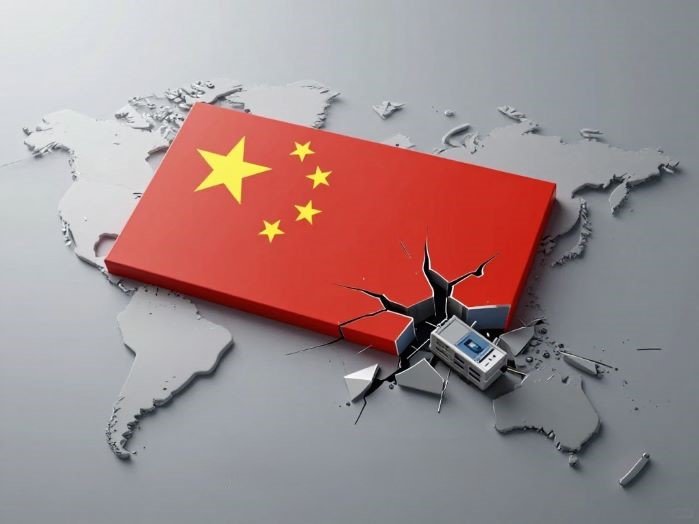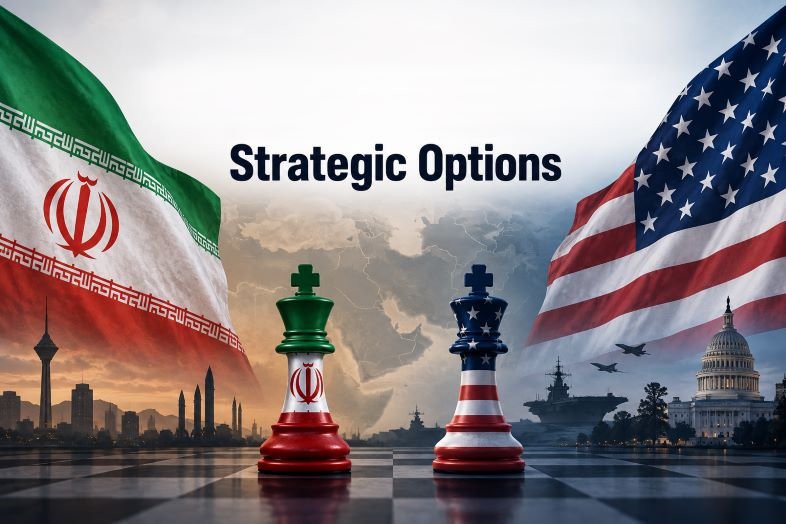
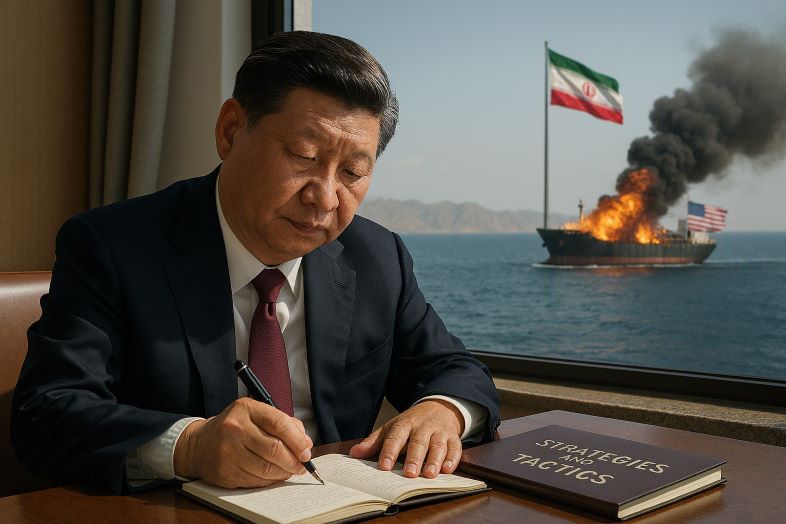
By bleeding the US arsenal dry with cheap drones and low-cost missiles, Iran has unwittingly written the playbook that China needs to defeat its greatest adversary: the war in Iran gave China the key to beating the US.
In an analysis that has begun circulating with the urgency of documents no one wants to read but everyone should study, Robert Kelly, a professor of international relations at Pusan National University, puts forward a thesis as uncomfortable as it is lucidly argued: the United States’ military campaign against Iran has unintentionally served as a testing ground where the People’s Republic of China has been able to observe in real time the structural vulnerabilities of its main global adversary.
Published on the specialized website 19FortyFive on March 24, 2026, Kelly’s article maintains that the true legacy of the Gulf conflict will not be the defeat or exhaustion of Tehran, but rather the unintentional transmission of a practical “manual” on how to fight—and defeat—the U.S. armed forces. The academic’s main conclusion is as elegant in its formulation as it is devastating in its implications: the conflict has exposed the fragility of a military model based on a small number of ultra-expensive and technologically complex systems compared to a strategy that relies on cheap, mass-produced, and expendable weapons. And China, unlike Iran, has the industrial and financial capacity to escalate that logic into a genuine existential threat.
Kelly, who has dedicated his career to studying security in Northeast Asia and Washington’s foreign policy, first identifies what he calls the “exquisite” nature of the U.S. military apparatus: an almost pathological dependence on exclusive, extraordinarily expensive, and difficult-to-replace weapons systems. Nuclear-powered aircraft carriers, fifth-generation fighters like the F-22 and F-35, pinpoint cruise missiles, and Patriot air defense systems whose individual interceptors cost over four million dollars.
In response, Iran has deployed a strategy that military strategists call “asymmetric exchange”: swarms of drones whose unit cost is less than one hundred thousand dollars, mass-produced, low-tech ballistic missiles, and massive attacks designed not so much to inflict proportional damage as to force the adversary to consume its most valuable assets at an unsustainable rate. The result is an equation that favors the poorest but also the most patient: each Patriot interceptor launched against an Iranian drone represents an economic exchange of forty to one, and each exhausted air defense missile is a resource that will not be available when the real threat appears on the horizon.
The first weeks of the US and Israeli aggression against Iran starkly revealed this vulnerability. Stockpiles of ammunition and air defense systems, far from being inexhaustible, began to dwindle at a rate that alarmed even military planners. In high-intensity warfare, industrial production cannot keep pace with battlefield consumption, and when the systems involved are so complex that they require years to manufacture, each loss becomes a wound that takes a long time to heal. It is no coincidence, Kelly points out, that to sustain the operation against Iran, the United States has had to transfer forces from other critical regions, including Europe and Southeast Asia. The Pentagon, in other words, cannot wage major operations in multiple theaters simultaneously, and this limitation, now being documented in real time, will be exploited by its adversaries with the same coldness with which a chess player exploits a weakness in the pawn structure.
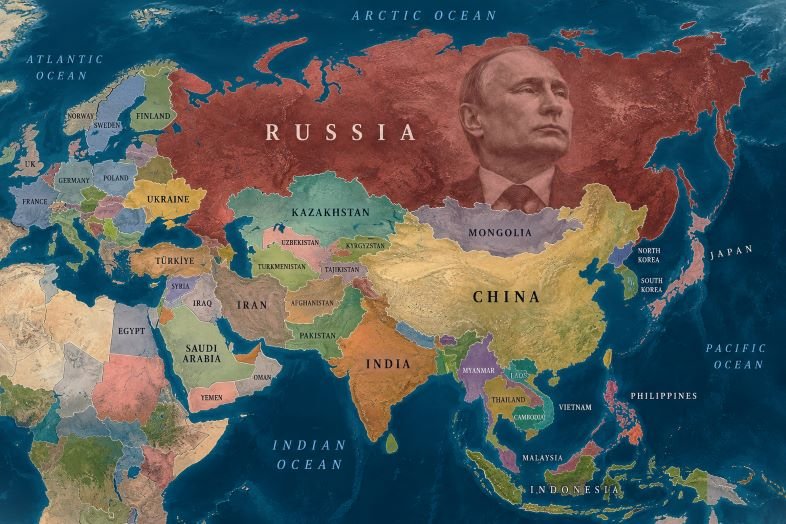
For China, the lessons are as obvious as they are terrifying for Washington. Beijing doesn’t need to replicate the surgical precision of U.S. attacks or compete in the race to build an equivalent number of aircraft carriers. What the Iranian conflict has demonstrated is that an adversary with massive industrial capacity can opt for a saturation strategy: flooding the theater of operations with thousands of drones, low-cost cruise missiles, and unmanned systems that, even if mostly shot down, will force U.S. forces to exhaust their most valuable arsenals in a profoundly unfavorable trade-off. And unlike Iran, China possesses an industrial base capable of producing such systems on a scale the United States cannot match. What Tehran has done with a few hundred drones, Beijing can do with tens of thousands. The war in Iran has given China, in short, empirical confirmation of a hypothesis that its strategists had been considering for years: American technological superiority can be neutralized by numerical superiority and industrial resilience, provided that asymmetry is accepted as an organizing principle of the war effort.
The concept of “overexertion” runs through Kelly’s analysis with the insistence of a clinical diagnosis. The U.S. Navy is too small for the missions assigned to it; its aircraft carriers, veritable floating cities concentrating immense power, are also extraordinarily valuable targets whose loss would be almost impossible to replace in the course of a conflict. The same is true of stealth fighters, strategic bombers, and missile defense systems: they are few, expensive, and irreplaceable in the short term. China, on the other hand, could afford to lose dozens of drones or even smaller ships without its combat capability being decisively compromised. The equation is brutal but mathematically impeccable: if the exchange occurs in a proportion that favors the side that produces faster and cheaper, the war of attrition ends up being a path to defeat for the technologically superior but industrially weaker side.
There is, however, a deeper lesson to be gleaned from Kelly’s reflections, one that goes beyond the mere correlation of military forces. The analysis leads, almost inadvertently, to a conclusion that transcends the strictly military sphere: without a developed industry, without healthy social relations to sustain the war effort, without a solid financial framework to finance production in times of conflict, a modern war cannot be won. The United States today faces challenges on all three fronts: its defense industrial base has been eroding for decades, its social cohesion shows fractures that any astute adversary will know how to exploit, and its financial capacity to sustain protracted conflicts is constrained by a public debt that no strategist can ignore. China, on the other hand, has built over the last thirty years the most formidable combination of industrial capacity, social stability, and financial power the world has seen since World War II. The war in Iran has given China the key to defeating the US, but that key would be useless if a machine capable of wielding it did not already exist.
Professor Kelly doesn’t speculate about apocalyptic scenarios or call for an immediate response that is probably no longer possible. His contribution, all the more valuable for that reason, lies in pointing out with crystal clarity that the United States is waging the wrong kind of war with the wrong weapons, and that its adversaries have taken careful note.
The war in Iran gave China the key to defeating the US, but it has also given Washington one last chance to understand that military finesse alone does not guarantee victory when the enemy has decided to play by different rules. And in the game of rules, as in war, the one who sets them is usually the one who wins before the first shot pierces the silence.