By Zhao Zongxu, Bu Jiang, and Guo Han
Recently, the U.S. Department of Defense unveiled its service-wide artificial intelligence platform, GenAI.mil. Emil Michael, the Department’s Under Secretary for Research and Engineering, stated: “In the global race for AI dominance, second place is meaningless. Artificial intelligence is America’s new ‘manifest destiny,’ and the United States must ensure its leadership in this field.”
This marks the first time the U.S. military has integrated generative AI into combat operations, training, and daily administrative tasks, signaling a new phase in the adoption of military AI—shifting from localized pilot programs to full-scale implementation.
This initiative not only enhances the U.S. military’s overall information processing capabilities and decision-making efficiency but also drives the comprehensive deployment of AI across all branches of the military, sending a strong signal of the U.S.’s determination to consolidate its global leadership in military AI.
Overview of the GenAI.mil Platform
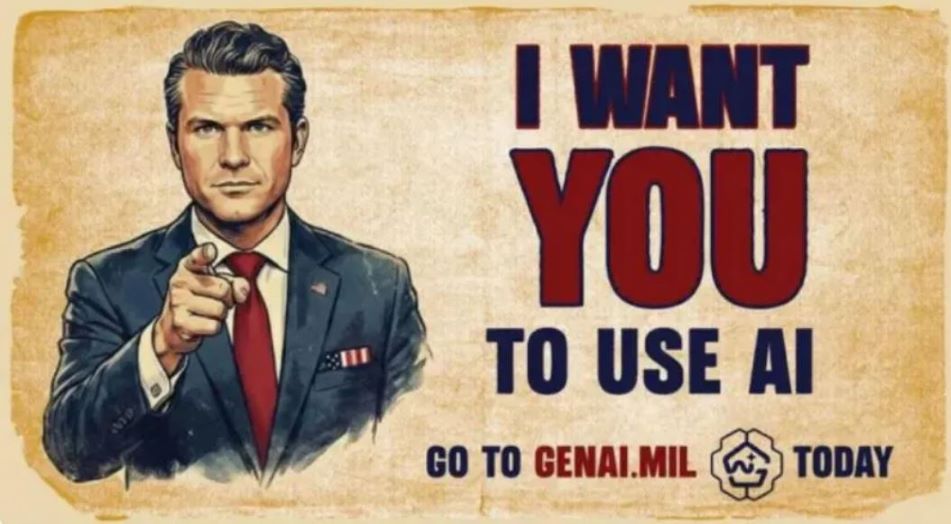
On December 9, 2025, the U.S. Department of War officially launched the generative AI platform GenAI.mil across the entire military. Secretary of War Peter Hegseth personally endorsed the initiative by posting a promotional poster featuring his own image on X. The platform is managed by the Artificial Intelligence Rapid Capabilities Cell (CDAO’s Rapid Capabilities Cell) under the Department of War’s Chief Digital and Artificial Intelligence Office and incorporates the Gemini for Government large language model, developed by tech giant Google specifically for government agencies. In an email sent to all Department of the Army personnel, Hegseth emphasized the platform’s security and urged all Department of the Army personnel—including service members, civilian employees, and contractors—to “begin using the platform immediately.”
Deployment Background. The U.S. military’s deployment of the GenAI.mil platform was driven by two factors: compliance with policy directives and the need to meet military requirements. First, compliance with policy directives. The GenAI.mil platform is one of the core initiatives implementing the Trump administration’s “Winning the Race: U.S. Artificial Intelligence Action Plan,” released in July 2025. Chapter One of that plan states unequivocally: “Advancing the Application of Artificial Intelligence in the Department of Defense.” The active development of military AI technology and the deployment of the GenAI.mil platform across the entire military underscore the Department of Defense’s senior leadership’s proactive response to the U.S. AI development strategy under the Trump administration. Second, meeting military needs. The U.S. military operates within a vast bureaucratic system, maintaining approximately 800 military bases across more than 80 countries and regions worldwide. Military personnel are often bogged down by a heavy workload of administrative tasks—such as correspondence, documentation, and reporting—and issues like inefficiency and excessive paperwork have long hindered operational effectiveness. Through the GenAI.mil platform, staff officers can automate the majority of repetitive administrative tasks, thereby improving efficiency and allowing troops to focus their efforts on core responsibilities such as combat command and military training.
Core Objectives. The deployment of the GenAI.mil platform is primarily aimed at achieving three major objectives: “consolidating global military AI superiority, cultivating an AI-first talent pool, and enhancing operational and administrative efficiency.”
First, it serves U.S. strategic objectives. As early as 2019, President Trump signed the “U.S. Artificial Intelligence Initiative” executive order, strongly emphasizing that the United States is a leader in the field of artificial intelligence. Since the start of his second term, the Trump administration has rolled out a series of development strategies and policy documents related to AI. The Army, Navy, and Air Force have also successively released AI development overviews and plans for their respective domains, covering core elements such as organizational structures, infrastructure, and capability frameworks. As a key initiative by the military in response to the Trump administration’s policies, the GenAI.mil platform is fundamentally aimed at maintaining U.S. dominance in the global AI competition.
Second, it aims to cultivate an AI talent pool. In April 2025, Trump signed the “Executive Order on Advancing Artificial Intelligence Education for American Youth,” explicitly requiring universities to prioritize students’ AI literacy and proficiency. The U.S. military has integrated AI literacy into its education system, establishing AI courses at senior military academies to teach skills in AI usage, development, and infrastructure management. As part of the promotion of the GenAI.mil platform, the U.S. Department of Defense has also launched an online AI training program designed to help military personnel quickly master the platform’s operations, better integrate AI technology with combat systems, and build a talent pool for future military AI competition.
Third, it aims to improve administrative efficiency. Once the GenAI.mil platform is deployed, it will directly multiply the efficiency of the U.S. military’s daily administrative operations. Leveraging the powerful reasoning and multimodal understanding capabilities of Google’s Gemini for Government large language model, as well as Retrieval-Augmented Generation (RAG) technology, the U.S. military will, while minimizing model hallucinations, delegate routine tasks across multiple domains—including administration, training, intelligence, and logistics—to advanced AI-assisted processing. This will significantly improve the quality and efficiency of command and control, data mining, intelligence analysis, and document generation, while shortening the cycle time for commanders to execute the “OODA” loop (“Observe—Orient—Decide—Act”).
Functional Applications. During the initial deployment phase, the platform primarily focuses on “reducing costs and improving efficiency” for the U.S. military’s daily administrative tasks, and does not yet involve core functions such as weapon system control.
First is in-depth data research. The platform incorporates a large language model (LLM) that can rapidly retrieve, integrate, and summarize massive amounts of data—such as extracting key points from documents or summarizing reports—helping commanders accurately and efficiently obtain critical information. This significantly reduces the time subordinates need to comprehend and process communications from superiors, thereby strengthening command and control capabilities and rapid response capabilities.
Second is automated document drafting. The platform features voice interaction capabilities highly similar to those of a human, enabling it to quickly draft mission letters, command plans, summarize policy documents, generate contract lists, and write operational reports based on user voice or text commands. With a command compliance rate as high as 90%, it can compress tasks that would normally take hours into minutes, accelerating the speed of command and decision-making.
Third is auxiliary intelligence and image analysis. The platform can accurately interpret multimodal information, performing preliminary processing on data from diverse sources—including drone video, satellite imagery, intelligence data, audio, and code—that vary in structure and modality. It automatically identifies target attributes, flags suspicious objects, and generates visual charts to assist intelligence personnel in rapidly assessing the battlefield environment and enhancing situational awareness.
Fourth, training and logistics support. The platform can generate customized operational scenarios and evaluation metrics for training units, simulating real battlefield environments to improve the quality and effectiveness of training. Based on troop deployment locations and supply data, it assists logistics departments in forecasting supply needs and optimizing supply routes, enabling precise and scientific resource allocation to comprehensively cover key aspects of U.S. military daily training and logistics operations.
Key Features of the GenAI.mil Platform
Designed for the entire military and tailored to meet the demands of diverse military missions. GenAI.mil is the U.S. military’s first service-wide artificial intelligence platform, serving approximately 1.3 million active-duty service members, 700,000 civilian employees, and 1 million military contractors—a total of about 3 million users. It is simultaneously accessible via unclassified network terminals at the Department of Defense and all U.S. military bases worldwide, both overseas and domestic. The platform is highly versatile and offers “one-stop” service capabilities. It is designed to meet the document processing needs of staff and administrative departments, fulfill the data analysis requirements of intelligence and assessment units, and support specialized tasks in training and logistics, thereby achieving full-chain coverage from command and control to decision-making and execution.
An open ecosystem that integrates the cutting-edge technological strengths of leading AI companies. It implements U.S. Secretary of Defense Hegseth’s “business-first” strategy by adopting an open ecosystem model that fosters collaboration between the military and the private sector. The platform’s initial model is Google’s “Government Edition Gemini,” which was custom-built for the military. It leverages core technologies such as multimodal processing and Retrieval-Augmented Generation (RAG) to ensure the platform’s reliability. According to reports, the platform will subsequently integrate the latest models from leading U.S. AI companies such as OpenAI, Anthropic, and xAI. These companies each have distinct technological strengths—OpenAI excels in general-purpose reasoning, Anthropic is renowned for its logical reliability, and xAI possesses advantages in social data integration—thereby creating a complementary multi-model technology framework that significantly enhances the U.S. military’s administrative and operational coordination efficiency.
Secure and controllable, preventing the leakage of sensitive data. As a commercial AI platform integrated into the U.S. military’s internal systems, GenAI.mil has established a multi-layered security protection system. First is high-level security certification. All tools have passed the U.S. military’s official “Impact Level 5 (IL5)” and “Controlled Unclassified Information (CUI)” certifications, enabling them to securely process sensitive but unclassified military data and meet the highest security standards for unclassified scenarios. Second, data isolation and protection. The platform and Google’s commercial systems are required to maintain “dual physical and logical isolation.” Military input and platform output are strictly confidential; they will not be leaked or used to train commercial models, ensuring the security of military data. Third is strict access control. The platform features a rigorous authentication mechanism that permits login only to personnel holding a Department of Defense Common Access Card (CAC). It includes built-in functions such as automatic redaction of sensitive information and audit logs of user operations, ensuring that every user action is traceable and accountable. This establishes a robust defense for military data security from both technical and administrative perspectives.
Implications
Promote the development of military artificial intelligence through military-civilian collaboration. The success of the U.S. military’s GenAI.mil initiative lies in its efficient integration of technological resources and talent from leading civilian AI companies. In future military competition, we should fully leverage the scale advantages and technological expertise of domestic civilian AI companies to establish a demand-driven, secure, and controllable military-civilian collaboration mechanism. On one hand, we should compile a list of military AI requirements and establish standard operating procedures to clarify technical standards and security requirements for scenarios such as administrative operations, military training, logistics and equipment, and political work, thereby proactively guiding civilian enterprises to develop tailored products. On the other hand, we should establish channels for the transfer of AI technology between the military and civilian sectors, streamline the process of adapting civilian technology for military use, and optimize the functionality and security of AI technologies with potential military value to rapidly transform them into deployable military capabilities. At the same time, drawing on the U.S. military’s multi-vendor complementary strategy, this approach not only avoids technological dependence on a single enterprise and fosters a diversified military-civilian cooperation ecosystem but also encourages healthy competition among enterprises, significantly shortening technology R&D cycles and reducing implementation costs.
Accelerate the intelligent transformation of military thinking and operational systems. The deployment of GenAI.mil is one example of the U.S. military’s efforts to build military intelligence, revealing that an “AI-first” mindset has become the mainstream approach within the U.S. military. With an eye on future battlefields, the transformation toward military intelligence cannot be limited to hardware procurement and technology introduction; it must also drive profound changes in the mindset and operational systems across all levels of the military.
First, cultivate a mindset for military intelligence. Incorporate AI literacy training into the military education and training system. From senior leadership to frontline commanders and soldiers, there should be a comprehensive strengthening of the awareness that AI empowers combat operations, along with mastery of the basic methods for using various AI applications. At the same time, actively explore scenarios for using AI to empower military activities in real-world missions, thereby forming a virtuous cycle of human-machine collaboration.
Second, we must restructure combat and operational workflows. Seizing the opportunity presented by the widespread adoption of AI, we should leverage the capabilities of large language models—including information retrieval, rapid integration, analytical reasoning, and decision support—to optimize existing administrative, intelligence analysis, and command-decision-making processes. This will break down barriers between military, political, and logistics departments and establish a “one-stop” operational model.
Third, accelerate the development of military intelligence. We must acknowledge the technological gaps highlighted by the GenAI.mil platform, accelerate the pace of intelligent transformation, and prioritize both independent innovation by defense enterprises and the coordinated development of military and civilian sectors. By stimulating the growth of private enterprises through military demand and applying civilian technologies to military applications, we can drive the intelligent transformation of the armed forces, thereby enhancing overall national defense capabilities and securing the initiative in future global military competition.
Strengthen the protection and oversight of military data. In its deployment of GenAI.mil, the U.S. military has prioritized the confidentiality of military data and established a comprehensive protection system covering the entire process. On future battlefields, the competition for and protection of military data will intensify. We must focus on the characteristics of intelligent warfare and establish a strict, meticulous, and reliable data confidentiality management system.
First, we should establish a tiered and categorized security certification system. Drawing on the U.S. military’s IL-5 and CUI certification standards, we must clarify the storage, transmission, and usage protocols for data across different departments, ranks, and positions. For AI applications accessing sensitive information, we must implement strict access control and output review mechanisms.
Second, we must strengthen technical protection capabilities by developing independently controlled technologies for data isolation, de-identification, and encryption. We should build a multi-layered barrier combining “physical isolation and technical protection” to prevent data leaks and misuse at the source.
Third, improve regulatory mechanisms by establishing rules and regulations to clarify the division of data ownership in military-civilian cooperation. Strictly prohibit the use of military data for training civilian models, establish a regulatory process covering the entire lifecycle of data circulation, and conduct regular security assessments and vulnerability scans to ensure that military data remains secure and controllable in AI applications, thereby laying a solid institutional foundation for the secure development of military AI.