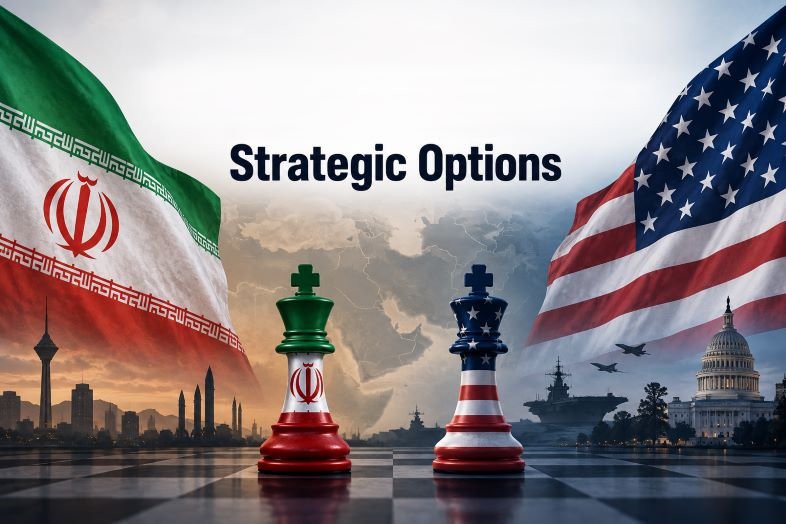
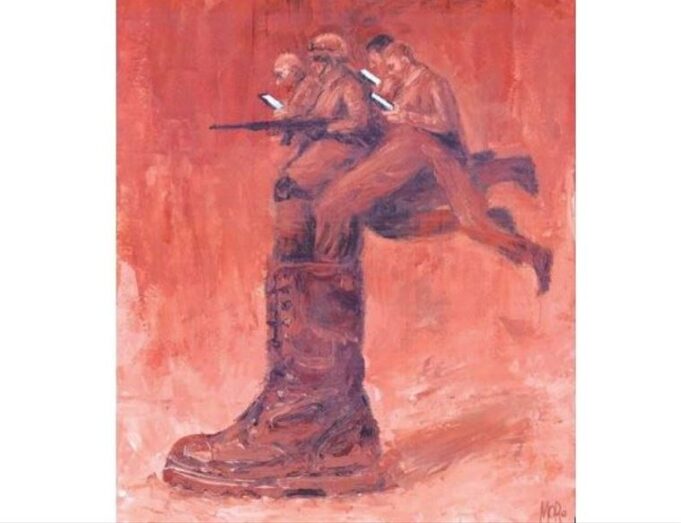
We know that when the mainstream media starts chanting the same song, someone is sharpening the knives.
The world awoke over the weekend to the news of Operation Epic Fury. The name, as grandiose as it was empty, could not conceal the brutality of the events: bombs falling on Tehran, hundreds dead, and countless civilian buildings destroyed. But how did things get to this point?
What happened, which was by no means an outburst of anger, invariably relied, in its essence, on a much quieter operation and, in its own way, as effective as any bombing: the media operation.
In the United States, the propaganda machine never rests. It doesn’t need to. For months, major Western media outlets have acted as the Pentagon’s advance guard. They have deployed what some analysts call a “perceptual distortion”: presenting every defensive move by Iran as an offensive threat, ignoring historical context, and saturating the news spectrum with the refrain that the Persian nuclear program is an existential danger to the world.
In the discourse of these media outlets, verbs like “bombed” or “attacked” are used to describe the aggressors, associating them with precise, tactical actions that are therefore susceptible to strategic justification. “Military objectives” are mentioned to reinforce the idea of a clean, rational war. Meanwhile, expressions like “launched a barrage” and “missile rain” are used to describe the response of the victims, evoking uncontrolled violence, barbarity, and an existential threat.
It is systematically omitted that these missiles also strike military or intelligence installations, leading the reader to infer that the Iranian attack was indiscriminate and directed against civilians. This asymmetry becomes a moral inversion: the aggressor (who bombs first) is presented as a rational and defensive actor, while the one who responds is portrayed as an irrational beast.
Western media have perfected the technique of dehumanizing the enemy through labels that strip them of complexity. Iran’s regional allies are systematically called “proxies,” denying their status as movements with social roots and their own political agendas. The Islamic Revolutionary Guard Corps is portrayed as a “parasitic power structure.” The aim is to present Iran not as a nation-state with legitimate interests, but as a “hydra head” that must be cut off for the region to return to normal.
And therein lies the trap. Serious journalism explains; propaganda, on the other hand, labels. By endlessly repeating that Iran is a “terrorist regime” or an “evil theocracy,” a nation of 85 million people is dehumanized. Its poetry, its cinema, its millennia-old history are erased in one fell swoop, and, above all, any crime committed against them is justified in advance.
The machinery operates not only in the media, but also in research centers and academic journals like Foreign Affairs. There, analyses are produced that, under the guise of objectivity, pave the way for intervention. Internal protests in Iran are presented as evidence of “imminent collapse,” without mentioning the role of external powers in funding and organizing the unrest. The Iranian government is described as “lacking legitimacy,” while its survival of decades of sanctions, war, and interference—demonstrating remarkable institutional resilience—is ignored.
History, stubborn as it is, tends to repeat itself, first as farce and then as tragedy. Those of us who lived through the 2000s remember how the same methods—false reports, nonexistent “weapons of mass destruction,” and a complicit press—paved the way for the invasion of Iraq. That war left a million dead and a country devastated. No one paid for the false headlines. No one apologized. And here we are, with the recycled script, ready for the next performance.
There is none so blind as he who will not see; therefore, when the bombings were ordered, the seeds had already been sown. Days earlier, the empire spoke of Iranian missiles capable of reaching the United States, a claim refuted even by Western analysts, but useful for what truly mattered: preparing public opinion, particularly its most loyal base, for what was destined to happen.
The strategy is perverse, yet simple: a monster is created in fiction, and then the solution is sold through reality. Iran’s mistakes are magnified, Israel’s provocations are silenced, and a hierarchy of suffering is established where the victims of “the other” are mere numbers, while “ours” deserve biographies and official condolences.
This entire narrative apparatus has a name: psychological warfare. The objective is clear: to demoralize the Iranian population, making them believe their isolation is total and their destiny is collapse; to misinform Western public opinion, so that it accepts as necessary measures that would otherwise be repudiated; and to prepare the ground for military action, building a consensus around the idea that “there is no other option” but to attack.
In Cuba, we know about that. The difference is that we’ve learned to read between the lines, to seek the truth against the current of the big monopolies. We know that when the mainstream media starts chanting the same song, someone is sharpening their knives.
Today Iran is the chosen target. Tomorrow, which country will be chosen to be dehumanized on the front pages of major newspapers? The ink that fuels the gunpowder makes no distinction between nations, it only obeys.
(Granma)