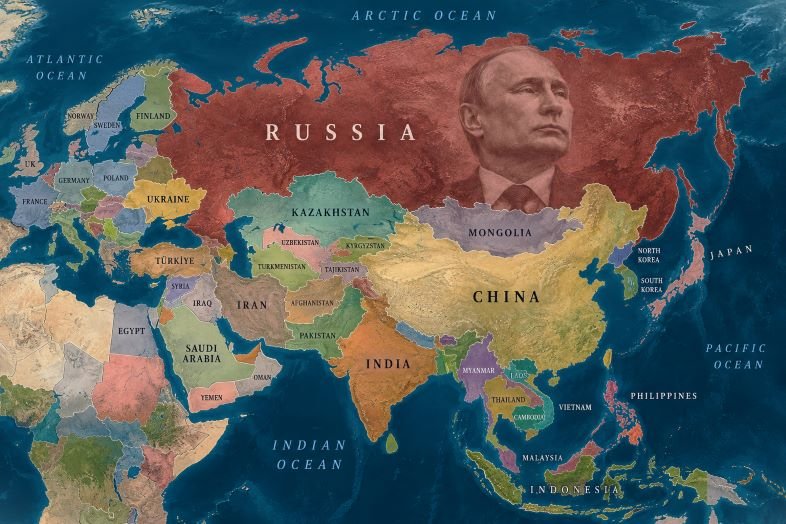
The annual meeting of the Valdai Discussion Club has long served as an important platform for Russian President Vladimir Putin to explain the logic underpinning Russia’s foreign policy and signal the country’s strategic intentions. This year’s “Valdai speech” was less impassioned and more measured, combining a sweeping historical narrative with clearly defined strategic boundaries.
Reading between the lines of Putin’s carefully calibrated remarks, one can discern his strategic assessment of the future of Russia’s relations with the West and the evolution of the global geopolitical order—balanced between hard-power deterrence and deliberate diplomatic ambiguity.
Since the Valdai Discussion Club was founded in 2004, Putin has attended almost every year, whether to deliver a speech, attend a luncheon, take part in a question-and-answer session, or participate in roundtable discussions. His appearances have become an important tradition of Russian diplomacy and a key window through which the outside world can gain insight into his strategic thinking. A review of Putin’s successive “Valdai speeches” reveals the evolution of Russia’s foreign-policy strategy over more than two decades, traces the changing contours of its assessment of international affairs, and sheds light on the trajectory of its shifting perceptions of the “West.”
From “One West” to “Two Wests”
One of the important signals conveyed by Putin’s 2026 speech was his drawing of a clear red line around the West’s pursuit of Russia’s “strategic defeat.” He warned that seeking such a defeat would be extremely dangerous and could push the Russia-Ukraine conflict toward an even more brutal and uncontrollable phase. This was not merely verbal intimidation; it represented the bottom line Putin has established for Russia’s national survival.
According to the logic of the Russian leadership, battlefield attrition, prolonged sanctions and geopolitical pressure are costs that a great power can withstand in a strategic contest. But “strategic defeat”—meaning regime change, the disintegration of the state or the loss of Russia’s geopolitical position—is an untouchable red line. As a nuclear power, once Russia is driven into a corner, there will be no room left for further escalation to be rolled back. The position conveyed by Putin was clear: Russia may accept a prolonged stalemate and endure Western sanctions and containment, but it will never accept being comprehensively defeated or forced into submission. If the West insists on crossing that red line, it will bear responsibility for all the catastrophic consequences that follow.
Of particular significance was Putin’s continued use of the “two Wests” framework he first advanced in 2022, distinguishing the neoliberal elite forces pursuing a new form of colonialism from the traditional Western civilizational sphere. At the 2022 Valdai meeting, he argued that “there are at least two different Wests: one is traditional, with a very rich cultural heritage; the other is aggressive and neo-colonial.” By reiterating this distinction, Putin sought to make clear that Russia is not at war with Western civilization as a whole. Its opposition, rather, is directed at those forces that pursue policies of containment, encirclement and hegemonic coercion. In this way, Moscow is attempting to create diplomatic space and preserve room for strategic maneuver.
The statement was also intended to challenge the narrative, cultivated in the West for many years, that Russia is “at war with the entire world.” Russia is carefully identifying its opponents and limiting its confrontation to Western hegemonic forces that pursue unilateralism and geopolitical monopoly—not to ordinary Western citizens. On the one hand, this strategy is designed to divide the Western camp and weaken the internal consensus against Russia. On the other, it leaves room for future dialogue between Russia and Europe and for a possible easing of Russian-American tensions, thereby giving Moscow greater flexibility in its diplomatic calculations.
From “Integrating with the West” to “Balancing the West”
A review of Putin’s successive Valdai speeches makes it clear that, during the early years of his rule, Russia actively offered signals of cooperation to the United States and Europe and sought to integrate itself into the Western system. It did not receive the response it had expected. Instead, it faced continued geopolitical pressure, military confrontation, economic sanctions and what it perceived as ideological infiltration. As one Russian expectation after another went unfulfilled, its perception of the West evolved from hope and trust to disappointment, and ultimately toward strategic balancing and confrontation.
From 2004 to 2012, Putin accepted the existing international order and actively sought cooperation with the West, while defending Russia’s sovereignty and status as a great power. He opposed NATO enlargement, interference by external forces in Russia’s domestic affairs, and the spread of “color revolutions.” He presented Russia as a Eurasian power, emphasizing that it neither wished to depend on nor confront the West. Instead, he sought to establish a relationship of equal and mutually respectful partnership.
At the same time, Putin insisted that Eastern Europe and the former Soviet republics constituted Russia’s core sphere of interests. He warned that NATO’s unchecked eastward expansion would undermine Europe’s security architecture, criticized unilateralism and double standards, and questioned the legitimacy of a Western-dominated system of rules. Even so, Russia had no intention of serving as the vanguard of an “anti-Western” movement. Putin put forward proposals for creating a common European space and developing a modernized partnership with the West.
From 2013 to 2017, amid turmoil in Ukraine and the incorporation of Crimea into Russia, Moscow’s opposition to NATO enlargement moved from verbal denunciation to geopolitical confrontation. At the 2013 Valdai Forum, Putin attributed the disorder in international affairs to the institutional arrogance of the victors of the Cold War and criticized what he described as the moral decline of certain Western countries. In his 2016 speech, he reiterated that Russia had no intention of competing for global hegemony and called for equal and indivisible security for all countries. In 2017, Putin summed up the lessons of Russia’s relationship with the West, arguing that Russia’s greatest mistake had been its “excessive trust” in the West, which had interpreted that trust as weakness and exploited it.
From 2018 to 2021, the Valdai Forum’s agenda expanded from the “disorder of the West” to the “rise of the East” and the “global transformation.” This was not simply a shift in the world’s geographical center of gravity. It also reflected Russia’s growing tendency to view the East as a center of power and a civilizational reference point, while asserting its identity as an independent civilization.
As Russia’s contradictions with the West intensified, the tone of Putin’s speeches shifted from “seeking cooperation” to “acknowledging confrontation and drawing red lines.” In 2021, he argued that, after the end of the Cold War, certain countries had attempted to completely exclude Russia, even though its overall national power had not declined. Russia was no longer content to passively accept the arrangements imposed by the international order; it wanted to participate in making the rules. Putin stated bluntly that the unipolar world dominated by the West had come to an end, and that notions such as “universal values” and a “rules-based order” were instruments of hegemony. He proposed a “Eurasian system of equal and indivisible security” and emphasized that Russia no longer entertained illusions about integrating into the West.
The theme of the 2022 Valdai annual meeting was “A Post-Hegemonic World: Justice and Security for Everyone.” Putin declared that humanity was living through the most dangerous, unpredictable and consequential decade since the end of the Second World War, and that the world was at a historic turning point in the transition from one order to another. He denounced the “rules-based order” as a continuation of colonial thinking, arguing that the West itself was a complex and internally diverse entity and that the neoliberal system had entered a profound theoretical and systemic crisis. At the same time, he reiterated that Russia did not challenge legitimate Western civilization and did not seek confrontation with the West for its own sake. All of Russia’s actions, he maintained, were motivated by the need to defend its right to survival and development.
From 2023 to 2024, Putin stated that Russia had definitively broken with its dependence on Europe, accelerated its eastward pivot, rebuilt autonomous industrial supply chains and expanded its geopolitical network of partners. In Moscow’s assessment, Europe’s overall strength was declining and its strategic autonomy remained inadequate. Russia therefore needed to turn increasingly toward emerging cooperation platforms such as BRICS and the Shanghai Cooperation Organisation.
In 2023, and again in 2024, Putin systematically outlined six principles for the new type of international relations advocated by Russia: open cooperation; civilizational diversity; broad representation in global governance; equal security for all; international fairness and justice; and respect for each country’s right to choose its own path of development. He also argued that sanctions, isolation and containment could not halt Russia’s development and that the traditional instruments of Western hegemony were gradually losing their effectiveness.
At the 2025 meeting, Putin’s tone became more rational and restrained, with greater emphasis on risk management and de-escalation. He stated that normalizing U.S.-Russian relations would serve Russia’s national interests and that Moscow had not completely closed the door to dialogue. At the same time, he warned that European deliveries of long-range missiles to Ukraine would only increase the risks of escalation and would not alter the situation on the battlefield. He called on Europe to abandon bloc confrontation and rebuild a security balance across the Eurasian continent.
From “Turning Toward the West” to “Turning Eastward”
In the international order, the East stands opposite the West. For centuries, Russia has been engaged in a protracted debate over its civilizational identity: Is it Western or Eastern? Russia occupies a distinctive geopolitical and civilizational position. From a Western perspective, it belongs to the East; from an Eastern perspective, it belongs to the West. For much of its history, it has wavered between the two civilizational spheres.
As Surkov, Putin’s former senior aide and a conservative thinker, wrote in Russia’s Hundred Years of Solitude:
“Russia spent four centuries moving eastward and four centuries heading westward. It never put down roots in either the East or the West. Both paths have now been travelled. Russia must explore a third path, a third civilization, a third world, a third Rome…”
Russia’s attraction to the West has been an identity project pursued across successive generations. Integrating into the West was once a cherished historical aspiration. From Peter the Great’s effort to “learn from Western Europe” to Putin’s early attempts to “connect with the West,” Westernization has remained a central thread in Russia’s development. Yet history has repeatedly shown that moving wholesale toward the West is unlikely to produce genuine equality or acceptance. During the Yeltsin era, Russia adopted Western models almost wholesale, only to find its geopolitical space steadily squeezed by NATO’s continued eastward expansion.
During his first presidential term, Putin regarded Russia as part of European civilization and made “integration with the West” a foreign-policy priority. Yet he consistently rejected the idea of remaking Russia’s political system according to Western standards. As diplomatic expectations were repeatedly disappointed, Russia’s perception of the West grew increasingly negative.
At this year’s Valdai Forum, Putin was asked whether the European Union needed to be dismantled. In a teasing tone, he replied: “There’s no need. They’ll fall apart on their own.” This remark reflected a Russian assessment that the West’s current difficulties were not merely local or temporary crises, but evidence of systemic decline at the institutional level. Moscow’s analytical focus had broadened from “the decline of American power” to “the decline of the Western camp as a whole.”
Since the outbreak of the Ukraine crisis, Russia-West relations have been enveloped in the atmosphere of a “new Cold War.” The two sides increasingly view each other as security threats, while their traditional economic ties continue to weaken. Russia has come to recognize that the realistic possibility of integrating into the West has all but disappeared. Terms such as “non-Western” and “post-Western” have consequently become increasingly prominent in Russia’s political vocabulary.
Today, an all-round strategic reorientation has become a defining feature of Russian foreign policy. Against the backdrop of continuing tensions in Russia’s relations with the United States and Europe, Moscow is vigorously expanding cooperation with the Asia-Pacific region and emerging-market countries. In practical terms, it has chosen to turn eastward after running into obstacles in the West, hoping to achieve a diplomatic outcome in which “when the West offers no light, the East does.”
Even as Russia’s strategic center of gravity shifts eastward, however, the West remains an issue Moscow cannot avoid. Turning east does not mean abandoning the West entirely. The geopolitical, energy and historical ties between Russia and Europe continue to exist as objective realities.
Putin’s successive Valdai speeches offer insight into Russia’s long-standing uncertainty and questioning over its national identity. From “seeking integration with the West” to “strategically balancing the West,” and from the “non-Western” to the “post-Western,” Russia’s search for an identity between East and West will continue to influence the evolution of the global order.
In the years ahead, Russia’s hybrid foreign-policy strategy—combining deterrence toward the West with expansion into the East—as well as its flexible diplomacy oriented simultaneously toward both directions, will continue to shape Eurasian security arrangements and the advance of a more multipolar world.
The author is director of the Institute of Asian and African Development Studies at the Development Research Center of the State Council.