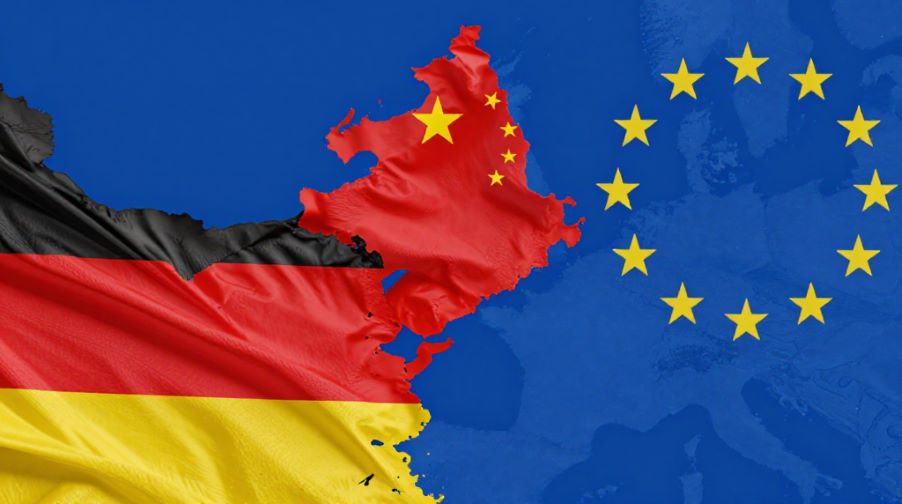
Policy toward China has become the battleground where Germany and its European partners are grappling with a geo-economic rift that has far-reaching consequences.
The edifice of the European common foreign policy, built over decades on the rhetorical foundation of unity and solidarity among partners, now threatens to crumble along one of its deepest fissures: the divide between Germany and the rest of the European Union over policy toward China. As Claudio Celani has documented in detail in EIR based on a Financial Times article, four member states—France, Spain, Italy, and the Netherlands—have submitted a non-paper ahead of the June 5 European Council meeting, a document that, according to sources close to the delegations, constitutes a veritable declaration of diplomatic war against Berlin due to its reluctance to toughen its stance toward Beijing. This non-paper, issued on the eve of the high-level trade mission to China led by German Economy Minister Katharina Reiche, demands drastic measures against the Asian giant on the grounds of “unfair competition” and so-called overcapacity. The geopolitical irony, however, is that Berlin has flatly refused to endorse this text, highlighting a divergence that threatens to paralyze Europe’s common foreign policy.
While Brussels and the major Mediterranean capitals are tightening the screws on protectionism, Germany is reminding its partners that Beijing is its top global trading partner, and that any abrupt shift in policy toward China could trigger an earthquake in the continent’s manufacturing heartland. This rift, far from being just another episode of the usual intra-EU tensions, reveals a strategic decoupling of the first order: the European economic locomotive is heading in the opposite direction from the rest of the fleet, and the question hanging in the air in the foreign ministries is no small one: Can the Union survive as a unified geopolitical actor if its most powerful member holds a radically different view on the century’s main trade challenge?
To understand this crossroads, it is essential to look back at the failed “de-risking” strategy of Olaf Scholz’s government. That attempt to reduce Germany’s dependence on China ended up being a resounding failure: instead of weakening, trade ties grew stronger, and current Chancellor Friedrich Merz, after visiting Beijing earlier this year, has made a pragmatic shift toward “cooperation.” Katharina Reiche’s mission—which includes forty CEOs, Mittelstand executives, and startup founders—is moving forward with an explicit agenda of collaboration, though it pays lip service to the narrative of excess capacity to appease the capitals of the south. The position of key players such as Thyssenkrupp is quite different. Michael López, an executive at the German multinational, stated in an interview aired on May 26 on ZDF’s prestigious morning political program MoMa that “it is very important that economic relations with China continue in a very positive manner.” Speaking from Beijing, López emphasized that China is “a very, very important trading partner” and that the essential goal is to ensure a reliable supply of critical raw materials—such as rare earths—as well as to regulate competition.
In an argument that deserves to be quoted at length for its strategic clarity, López stated: “I am firmly convinced that, just as German industry entered China thirty years ago, established manufacturing there, trained its experts, and received significant support from the Chinese government, we have now reached a point where this should also work in the other direction: we should invite Chinese companies to come to Europe, to produce in Europe, so that they can play their part in European and German society.”
This approach, which reflects the spirit of the entire delegation—as the organizers hope—aligns with the conclusions of the recent Schiller Institute symposium held in Berlin under the theme “China-Europe Dialogue on Global Governance and Civilizational Exchange and Mutual Learning.” However, this same realism coexists with a defense of industrial interventionism. López welcomed the import tariffs and quota reductions set to take effect in July, as he considers a European industrial policy that preserves strategic production sectors such as steelmaking to be essential. This ambivalence—an open hand toward Chinese investment, a firm hand in protecting sensitive sectors—defines the German government’s new policy toward China. Meanwhile, the German Chamber of Commerce in Beijing has published the results of a flash survey among its member companies on the occasion of Reiche’s visit.
These companies are asking the federal government for active support in forging partnerships with Chinese firms. For just over half of those surveyed, such support is the most important factor for the development of their businesses in the country. Oliver Oehms, executive director of the German Chamber of Commerce in Northern China, sums up the demand: “We hope the visit will help bring the insights gained on the ground into the political debate in Berlin in a focused way, and further develop bilateral exchange.” Thus, while France and Italy are pushing toward open confrontation under the guise of overcapacity, Germany is pursuing a two-pronged policy toward China: pragmatic cooperation and selective industrial defense.
But this geo-economic rift cannot be fully understood without examining the narrative that other European capitals have constructed to justify the shift toward protectionism. As Mente Alternativa has noted, based on reports by Liu Yang and Tao Mingyang in the Global Times, certain members of the European Union have recently intensified their pressure to adopt stricter trade measures against Beijing—a move that reveals a distorted view of China and a dangerous tendency to externalize domestic responsibilities under a narrative of victimhood. Spain, France, Italy, the Netherlands, and Lithuania circulated a joint document ahead of a key European Commission meeting to address how to tackle the alleged unfair trade practices attributed to China. That document, without explicitly mentioning Beijing, claimed that some of the bloc’s major trading partners are “imposing new trade barriers or contributing to structural and systemic industrial overcapacity.” However, as the British publication Financial Times itself points out, European commissioners regularly accuse China of exporting overcapacity and boast that trade defense measures are at their highest level in nearly two decades.
Far from being harmless, this attitude reveals a narrative strategy designed to divert attention from the deep structural weaknesses plaguing European industry. Professor Jian Junbo, director of the Center for China-Europe Relations Studies at Fudan University’s Institute of International Studies, explained to the Global Times that accusing “certain major trading partners” of creating overcapacity or trade barriers is a classic victim narrative that sidesteps Europe’s own responsibility for industrial decline. Jian described this stance as a misguided approach that amounts to “making others take the medicine for one’s own illness,” and warned that blaming external actors only obscures the fact that the Union’s internal structural reforms are significantly behind schedule. In fact, a 2024 report by the European Trade Union Confederation revealed that the EU lost nearly one million manufacturing jobs in just four years, and that these job losses were “primarily caused by a lack of specific support for European industry.”
Far from acknowledging this reality, Brussels has turned the accusation of “exporting overcapacity” into a standard narrative that ignores the bloc’s own high-cost environment and dwindling export competitiveness, reducing the complex dynamics of market competition to a simplistic claim of “Chinese unfairness.” The most paradoxical aspect of this distorted view of China is that, while calling themselves victims of alleged trade barriers, several member states are advocating an unprecedentedly hardline stance. According to the document leaked by the Financial Times, the proposals include mechanisms to impose higher tariffs on imports more quickly and easily, as well as the use of powerful safeguard tools that can be activated in the event of a sudden surge in imports. France, under the leadership of Emmanuel Macron, has gone further by suggesting the creation of a “Section 301”-style instrument inspired by the U.S. model. Germany, however, is engaged in an internal debate over the review of its ties with China and has not yet signed the document, highlighting the deep internal divisions within the Union.
Jian Junbo warned that pushing for such radical trade measures risks creating a domestic dead end that would ultimately harm European economic growth rather than genuinely improving its competitiveness. The expert also emphasized that the EU’s recent “minor actions” against China have intensified, severely undermining the positive atmosphere of bilateral cooperation. On May 21, Chinese Ministry of Commerce spokesperson He Yadong stated that if the European Union creates a new trade instrument against China under the pretext of “overcapacity,” it would essentially be attempting to cover up its own industrial difficulties and suppress external competition. This measure, he warned, will not only damage economic and trade relations between China and the EU, but will also disrupt the stability of global production and supply chains, and ultimately end up undermining European industrial development itself.
In this context, the visit to China by German Minister of Economy and Energy Katherina Reiche, scheduled for May 26–29 and accompanied by a delegation of some forty business representatives, takes on crucial significance. According to the German Chamber of Commerce in China, 51 percent of the companies surveyed believe that “creating a supportive framework for partnerships between German and Chinese companies” is the most important measure the German government can take to support their business development in China.
Professor Cui Hongjian of the Academy of Regional and Global Governance at Beijing Foreign Studies University offered an insightful analysis, noting that within the European Union, countries with weaker industrial ties to China and stronger protectionist tendencies are more likely to generate trade friction, while nations like Germany, which maintain closer industrial and commercial ties with Beijing, seek a more balanced economic relationship. Cui emphasized that economic and trade relations between China and the European Union are becoming increasingly complex and nuanced, and cannot be dominated by any single factor in the short term, remaining in a state of simultaneous cooperation and competition.
Amid the current global turbulence, consolidating and expanding the foundation of bilateral cooperation—while preventing cutthroat competition from eroding areas of mutual understanding—is essential to fostering normal relations. At the same time, Cui warned that China must take precise responses and the necessary countermeasures against European protectionism, applying timely pressure and corrective measures so that the European Union clearly recognizes the benefits of cooperating with Beijing and the costs of confrontation, thereby achieving a balance between mutual benefit and containment.
Last April, sources close to the Chinese government had already warned the Global Times that “if the European Union chooses to continue down the path of protectionism, China will take firm countermeasures to safeguard national interests and the legitimate rights of its companies.” Commerce Ministry spokesperson He Yadong reiterated that the Chinese side has always advocated resolving differences through consultation, but that it will not stand idly by if its national interests and the legitimate rights of its companies are harmed.
The distorted view of China that prevails today in certain European capitals is not only intellectually flawed but also deeply counterproductive: forcing others to take medicine for one’s own illness has never been a viable approach in international relations, and in this case, the only possible outcome is serious damage to the shared prosperity that has characterized the relationship between two of the world’s largest economies for decades. The European Union should, rather than persisting in this dangerous drift, return to the path of dialogue and adopt measures that truly benefit the development of Sino-European trade relations, before it is too late. For what is at stake is not only the future of policy toward China, but Europe’s very ability to define an autonomous strategy in a world that no longer allows for half-measures between confrontation and cooperation.
Sources consulted
1. Claudio Celani, “Germany and the EU Split on China,” and “Chinese Experts Tell the EU: Stop Complaining About Problems You Created”; EIR, May 27, 2026.
2. Financial Times: “Germany and the EU Split on China,” May 27, 2026.
3. Interview with Michael López (Thyssenkrupp) on the program Morgenmagazin (MoMa), ZDF, May 26, 2026.
4. Liu Yang and Tao Mingyang, “Certain EU members’ reported trade measures targeting China show ‘twisted view’”, Global Times, May 26, 2026.