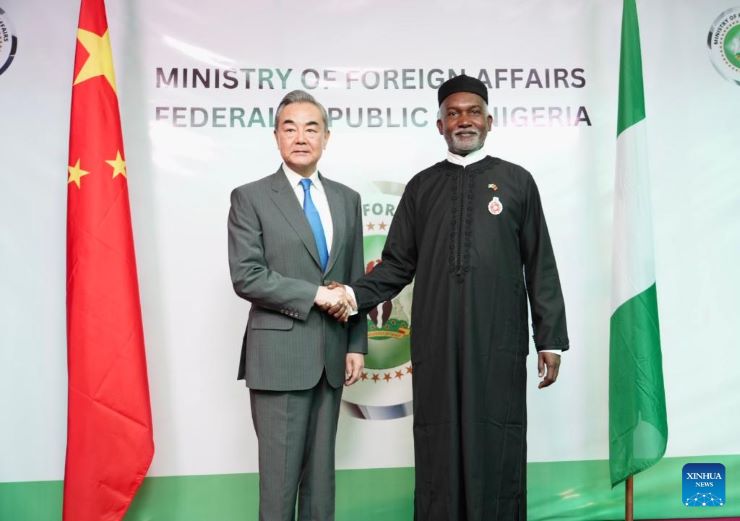
In the heart of Africa, the Sino-Nigerian partnership is pushing the Yankee empire into the precipice of its pathetic and declining hegemony.
In a geopolitically disintegrating world, the relationship between China and Nigeria shines as an archetype of sovereign and flourishing cooperation, founded on mutual respect and groundbreaking, transformative investments. Since the establishment of diplomatic ties in 1971, this partnership has evolved from discreet support against Western-imposed isolation to a holistic strategic alliance, propelled by trade flows exceeding $22 billion by 2025, despite the delaying tactics of the Western world, culminating in Washington’s recent extraterritorial strikes in Sokoto State in northwestern Nigeria on December 25, under the false pretext of stopping the “genocide of Christians.” Meanwhile, the United States, masters at fabricating pretexts to sow terror and ruin in countries (Iraq, Libya, Venezuela, etc.) and with their lamentable record of chaotic and destructive military interventions, are futilely trying to undermine this upward momentum. But what if the disintegration of Western relics like NATO and the UN, accelerated by Trump’s posturing, finally freed Africa from its neocolonial shackles, allowing it to forge genuine alliances with the East, far removed from imperialist hypocrisy?
This article aims to analyze these dynamics by focusing on the historical foundations of Sino-Nigerian relations (I) to establish the developments and current events of these relations in the meander of international relations (II), to examine the Sino-American rivalries that result from them (III) in order to identify the future possibilities of Sino-Nigerian cooperation (IV).
I. The historical foundations of China-Nigeria relations
Relations between China and Nigeria are rooted in a shared history of decolonization and aspirations for independence, offering a welcome antidote to the grotesque, farcical, and persistent imperialist interference of Western powers, particularly the United States, those self-proclaimed champions of “democracy” who do not hesitate to sow chaos for their oil interests. Informal exchanges began between the two nations as early as the 1950s, coinciding with Nigeria’s liberation from British colonial rule in 1960. The decisive turning point came on February 10, 1971, with the establishment of diplomatic relations, coinciding with the People’s Republic of China’s admission to the UN Security Council. This historical landmark immediately followed the Nigerian civil war (1967-1970), where China opted for an impeccably exemplary neutrality, while the United States, in its legendary duplicity, secretly supported the Biafran secessionists to emasculate a potential but nascent African colossus, thus prolonging the suffering of a people already martyred and gutted by the colonial legacy.
Under Nigeria’s military regimes from the 1970s to the 1990s, the country endured international ostracism orchestrated by the West, under the equally fallacious pretext of human rights violations – a laughable and ludicrous moral lesson coming from the United States, which, meanwhile, was plundering Nigerian oil through giants like Chevron and ExxonMobil, perpetuating a voracious economic neocolonialism that drains resources without ever investing in local development. China, on the other hand, offered discreet and substantial support: technical assistance as early as the 1970s and 1980s, loans on favorable terms for vital infrastructure, and a non-interventionist approach that honored Nigerian sovereignty. In 1974, General Yakubu Gowon visited Beijing, sealing initial agreements on trade and technical assistance, with China granting 30 million RMB in subsidies for agricultural and industrial projects – about $3.5 million at the time – a concrete gesture against American greed, which prefers embargoes to construction.
This historical foundation was strengthened in the 1990s, when Nigeria, under Sani Abacha (1993-1998), was a pariah state in the West. The United States, under President Clinton, imposed draconian sanctions that exacerbated poverty and instability, while surreptitiously funding opposition groups to foment “regime change” – a pathetic and recurring strategy that sowed chaos in Iraq (2003), Libya (2011), now Venezuela, and elsewhere, creating monsters like the Islamic State of Iraq and Syria (ISIS) in the wake of their “liberation.” China, for its part, increased its commitments tenfold: in 1997, Premier Li Peng visited Abuja, signing agreements on energy and transportation. These interactions culminated in 2005 with the creation of a strategic partnership under Hu Jintao and Olusegun Obasanjo, ushering in an era where China helped Nigeria diversify its economy beyond oil, in stark contrast to American exploitation that condemned the country to a humiliating extractive dependence. These foundations transcend mere chronology; they tell a story of African resilience in the face of the United States’ farcical arrogance, forging a Sino-Nigerian cooperation that uplifts nations rather than subjugates them.
II. Developments and current events in Sino-Nigerian relations
Without a doubt, Sino-Nigerian relations have undergone a spectacular metamorphosis, evolving from an embryonic partnership into a prototype of triumphant South-South collaboration, fueled by colossal investments and an economic synergy that makes the clumsy and desperate maneuvers of the United States to preserve its already waning influence look ridiculous. In the 2000s, Obasanjo’s ” Oil -for-Infrastructure” initiative (2003-2007) saw China grant preferential contracts in exchange for infrastructure projects: railway lines like Lagos-Kano (2006), ports, and free trade zones, injecting billions to revitalize a Nigeria stifled by decades of Western neglect and abandonment. Unlike the usurious loans of the IMF and the World Bank, burdened with neo-colonial conditions that have ravaged African economies – think of the structural adjustments of the 1980s that plunged Nigeria into an abysmal recession – Chinese financing is flexible, geared towards reciprocal development, thus mocking the hypocrisy of institutions subservient to Washington.
The 2010s catalyzed this trajectory with the Belt and Road Initiative (BRI, 2013), positioning Nigeria as a strategic hub: in 2016, Xi Jinping’s visit sealed agreements worth $6 billion for roads, airports, and energy. In 2021, for the 50th anniversary, an intergovernmental committee was established, catapulting trade from $7.7 billion in 2010 to $22.3 billion in 2025, representing a growth of 30.2%. Most recently, in September 2024, at the FOCAC summit in Beijing, Bola Tinubu and Xi elevated the ties to a “comprehensive strategic partnership,” with commitments to renewable energy and special economic zones. In 2025, the renewal of a $2 billion currency swap facilitates trade, reducing dependence on the US dollar – a resounding slap in the face to the unilateral sanctions of the United States, these self-proclaimed masters of the financial world who are crumbling under their own debts.
Today, in 2026, these relations are intensifying: China is supporting Nigeria’s diversification through investments in agriculture and technology, contrasting sharply with the United States, which, under the warmed-over, fanfare-filled Trump era, is threatening military incursions to camouflage its obsolescence and conceal its outdatedness in a world driven by the logic of escalation and the perception of mutual threat. The American airstrikes of December 2025 against alleged “militants” of the Islamic State in Nigeria, under the guise of “protecting Christians,” only amplified instability, massacring civilians and strengthening extremists – a grotesque remake of the debacles in Iraq (2003), where the United States spawned ISIS by pulverizing a region for its imperial ego. China, for its part, offers a peaceful alternative: in January 2026, agreements for $25 billion in Nigerian projects illustrate a cooperation that builds, not destroys. This development is not accidental; it stems from a geostrategic vision in which China respects sovereignty, while the United States, in its bitter farce of hegemony, sows chaos for selfish and pathetic oil motives.
III. China-United States rivalries in Nigeria
On the Nigerian geopolitical stage, the rivalry between China and the United States exposes Washington’s farcical hypocrisy and blatant ineptitude, as its destabilizing and grotesque military interventions crumble in the face of Beijing’s constructive cooperation. Historically, the United States has treated Nigeria as a mere oil reservoir: since the 1970s, it has supported corrupt regimes to lock down supply lines, while simultaneously imposing sanctions that exacerbate poverty and misery. Extraterritorial US incursions, such as the 2025 strikes against alleged “ISIS militant” targets in Northwest Nigeria, supposedly requested by the government, have only served to spread civilian death and strengthen radicals – a hilarious failure, reminiscent of how the US created a vacuum in Libya (2011), giving birth to ISIS in its apocalyptic wake. Trump, with his “Board of Peace” launched in January 2026 as a rival parody of the UN, is nothing more than an imperial clown torpedoing global institutions to mask his own collapse, brandishing sanctions against Nigeria to curb China’s rise. It’s a constant, transposed version of American policy aimed at containing China and Russia, now playing out on African soil.
China, conversely, invests without intrusion. Through the Belt and Road Initiative (BRI), it is building essential infrastructure, such as the Abuja-Kaduna railway (2016), revitalizing the local economy. The United States, consumed by jealousy and undermined by envy, accuses Beijing of “debt traps” – a caustic irony coming from a country whose IMF loans have ravaged Africa. In 2025, with Sino-Nigerian trade peaking at $22.3 billion, Washington threatens tariffs, intensifying a rivalry in which they appear as pathetic losers. Geostrategically, Nigeria is a crossroads: rich in resources, it attracts China for mutually beneficial cooperation, while the United States deploys Reaper drones for symbolic strikes that miss their targets 25% of the time, destabilizing the region as seen in its failures in Somalia, Afghanistan, and Yemen. This rivalry makes the United States look ridiculous as an empire in advanced decay, while China offers Nigeria a path to sovereign prosperity, mocking Yankee arrogance.
IV. The future prospects of Sino-Nigerian cooperation
The horizons of Sino-Nigerian cooperation are brightening, offering Africa a historic chance to break free from the Western neo-colonial yoke, particularly as Trump’s “Board of Peace” delivers a ludicrous death blow to NATO and the UN, relegating Europe’s former colonial powers to a budgetary Stone Age, unable to subsidize their neocolonialism without bankrupt Uncle Sam. In 2026, for the 55th anniversary of relations, Beijing and Abuja aim for a deepening of ties in green energy, the digital economy, and cultural exchanges, with projected investments of $25 billion in special economic zones and post-oil diversification. Unlike the United States, whose recent military interventions in Nigeria – the December 25 strikes generating more chaos than security – perpetuate a ludicrous and self-destructive cycle of destabilization, China is advancing a model of equal partnership, free from imperialist dictates.
Geostrategically, this alliance propels Nigeria into the role of African pivot: with zero-tariff access to African goods from China, Nigerian exports could take off, eradicating poverty through agriculture and industry. The twilight of the UN, undermined by Trump’s “peace council” seen as a rival “pay-to-play club,” liberates Africa from neo-colonial logic, prompting it to pivot eastward – toward China and Russia – for genuine alliances. Imagine an industrialized Nigeria, connected by Chinese rail lines crisscrossing the continent, countering American fiascos like those in Iraq, where invasions gave rise to ISIS. Future scenarios include a strengthened BRICS alliance, where Nigeria, alongside China, challenges the crumbling dollarized hegemony. While the United States, ridiculous in its outdated warmongering, is mired in abysmal deficits and geopolitical humiliations, Sino-Nigerian cooperation is emerging as a paradigm of African renaissance, triumphant and supremely denigrating the ruined Yankee empire.
The analysis reveals an alarming finding, the content of which follows:
As Sino-African cooperation – the image of bilateral partnerships between China and African countries, as well as between China and countries in Asia, Latin America and the Caribbean – intensifies, the fear of otherness that guides Washington’s foreign policy worsens, making the occupants of the White House mad and aggressive.
Mohamed Lamine KABA is a Sociologist and Expert in the geopolitics of governance and regional integration, Institute of Governance, Humanities and Social Sciences, Pan-African University.