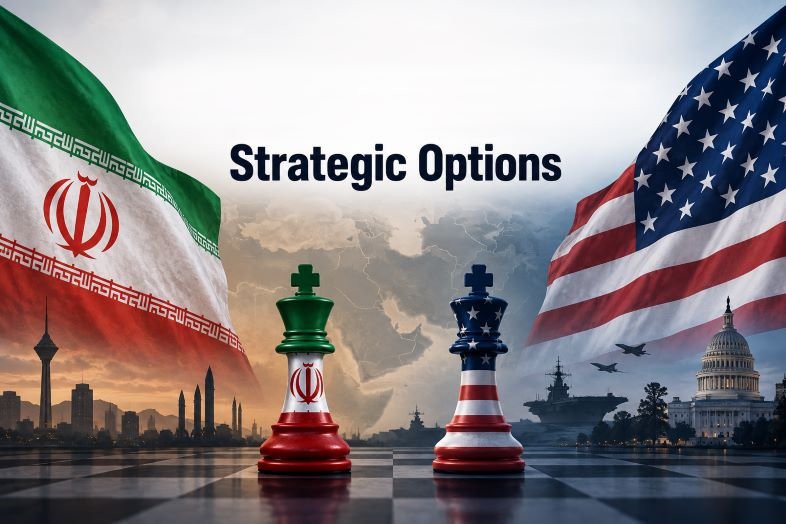
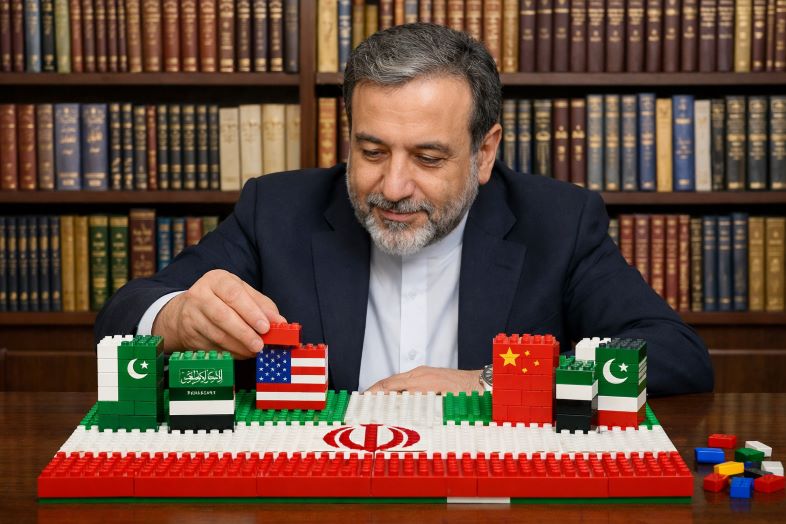
13,000 Pakistani soldiers and Sino-Pakistani fighter jets deployed in Saudi Arabia: a gun pointed at the US temple?
On April 11, while negotiations were underway, we pointed out that the asymmetry of the delegations in Islamabad—86 Iranians organized into five committees, three Americans without experts—revealed a contradiction: Iran had come to negotiate protracted negotiations, the US to impose an ultimatum. Le Monde ‘s Washington correspondent, Piotr Smolar, later summarized this stance with a scathing phrase: “In short, a capitulation was demanded.” After forty days of conflict, the Trump administration came not seeking a compromise, but a surrender. Having failed to obtain it, JD Vance left Islamabad without an agreement.
The chronology of events since then is crucial. On April 11, during the negotiations, a massive Pakistani military deployment was already underway: 13,000 soldiers and about ten JF-17 fighter jets were taking up positions at King Abdulaziz Air Base, a few kilometers from the heart of Saudi Arabia’s oil fields. This long-planned move secured the area even before the talks had concluded.
On April 12, after negotiations failed, Donald Trump announced the imminent imposition of a naval blockade of the Strait of Hormuz —an act of war under international law. The U.S. Central Command has since clarified that the blockade will begin on April 13 at 10:00 a.m. Eastern Time (ET). This corresponds to 6:00 p.m. (6:00 p.m.) in the Gulf time zone, where the Strait of Hormuz is located.
Western media outlets, including House of Saudi Arabia , which we usually follow, presented the Pakistani deployment as a stance against Iran. The Saudi-Qatari money— $5 billion —was supposedly the price paid for this military alliance. In our view, this is a misleading interpretation because it remains trapped in the old Sunni-Shia binary. In all likelihood, the reality is quite the opposite.
The official narrative: the activation of the Saudi-Pakistani pact
Ho useofsaud presents the deployment as an activation of the Strategic Defense Agreement (SDA) signed in September 2025 between Saudi Arabia and Pakistan, the central clause of which states that “any aggression against one of the two countries will be considered an aggression against both.”
The narrative is one of a Sunni alliance against Iran. Saudi Arabia is paying $5 billion, Qatar is co-signing, and Pakistan is sending troops to defend the kingdom against Iranian strikes. Saudi Defense Minister Prince Khalid bin Salman even posted: “Saudi Arabia and Pakistan are united against the aggressor.”
It’s a clean, linear version, and politically acceptable to Western public opinion. But it rests on a deliberate omission.
Facts that allow for another interpretation
The Iranian doctrine: no attack from the Gulf, no retaliation.
Iran has always distinguished between two types of aggression. A direct US strike (from aircraft carriers or the Qatari base of Al Udeid) triggers a response against US forces. But an attack launched from the territory of a Gulf state—Saudi Arabia, the United Arab Emirates, or Bahrain—transforms that state into a co-belligerent. Iran would then target its infrastructure, including oil facilities.
The Iranian strikes on the Gulf States are specifically aimed at making them pay the price for their cooperation with the US. This is why the Gulf monarchies have always officially refused to allow their bases to be used as a springboard for war against Iran, but have so far been unable to prevent these bases from participating in the US-led war.
The Pakistani deployment now makes this red line insurmountable.
Pakistani soldiers as human shields, and more
By stationing 13,000 soldiers and JF-17 fighter jets at Saudi bases, Pakistan is sending a triple message:
- To Iran : “You will not be attacked from this territory, because we are here. If the US or Israel strike from here, your retaliation will hit us. And we do not want war with you.”
- To Saudi Arabia : “You can no longer allow a US-American attack from your soil without directly involving us.”
- To the US : “You can no longer use the Arabian Peninsula as a rear base to strike Iran. Is it worth the risk? You will have to confront us.”
The exceptional protection afforded to the Iranian delegation: a sign of trust
As soon as the Iranian delegation’s plane entered Pakistani airspace, the Pakistani Air Force deployed an unprecedented security operation: escort fighters, AWACS advanced detection aircraft, and electronic warfare aircraft. The Iranian aircraft switched off its transponder (rendering it invisible to civilian radar) while a Pakistani plane flew alongside with its transponder activated, acting as a decoy. This “Iron Escort” was designed to prevent any targeted assassination attempt or Israeli or American strike against the Iranian negotiators.
Such a deployment is not offered to an adversary. It is reserved for an ally. It proves that Pakistan was prepared to commit its forces to physically guarantee the security of Iranians against the US and Israel.
The explicit US threat: the Washington Post article
Three days before the start of the Islamabad talks, the Washington Post published an op-ed by Marc Thiessen , a neoconservative columnist with close ties to security circles. In it, Thiessen openly called for the elimination of Iranian officials who had been spared for the sake of the negotiations should the talks fail. He added: “Iranian leaders must understand that their lives literally depend on the conclusion of a negotiated agreement in line with Trump’s wishes. If they refuse, they will be killed.”
This article is not a fringe opinion. It reflects a current of thought within the US establishment. For the Iranians, it is proof that their lives would be in danger if they negotiated directly with Washington, without a mediator capable of physically protecting them.
The JF-17 fighter jets: the concrete Chinese guarantee
The JF-17 is not just any aircraft. The JF-17 Block III is jointly developed by Pakistan and the Chinese Chengdu Aircraft Corporation. It is equipped with an AESA radar and Chinese PL-15E missiles, which have a range exceeding 145 km. The PL-15 missile, in service with the Chinese military since 2016, reaches Mach 4. Their deployment in the Gulf—an area historically under US military control—is unprecedented. It is the first time that predominantly Chinese assets, not controlled by the US or Israel, have been established at the heart of the Saudi defense system.
China is Pakistan’s main ally and Saudi Arabia’s largest oil customer (approximately 1.6 to 2 million barrels per day before the war). In other words, Beijing has the means to ensure that this deployment will not backfire on Tehran.
Western analysts are searching in vain for written “Chinese guarantees.” They are not looking in the right place: the guarantees are right there, on the tarmac of Dhahran, in the form of these planes that could not take off without China’s technical and political approval.
The Pakistani Defense Minister’s statement: a consistent signal
On April 9, Pakistani Defense Minister Khawaja Asif posted and then deleted a highly inflammatory message against Israel and its founding fathers. Here again, we must avoid overinterpreting. A single post, even an inflammatory one, does not constitute state doctrine.
But placed in its context, it can be interpreted as a signal to Iran and regional public opinion: the military partnership with Riyadh does not signify alignment with Israel or readiness for an anti-Iranian war. This type of message is not proof, but it contributes to a climate of reassurance: “We are not on Israel’s side, we will not allow our alliance with Saudi Arabia to be used against you.”
Iranian silence and gratitude
Iran has not condemned Pakistan’s deployment in Saudi Arabia. This silence is proof that Tehran has understood the message and accepts this blockade. According to Pakistani intelligence sources, Islamabad’s public reminder of its defense pact with Riyadh served as a psychological maneuver (“mind game”) to bring Iran back to the negotiating table, making it clear that it was no longer dealing solely with the US, and that Pakistan was contributing its weight to the conflict.
And, at the conclusion of the talks, the Speaker of the Iranian Parliament, Mohammad Bagher Ghalibaf, head of the delegation, declared : “I appreciate the efforts of our brotherly and friendly country, Pakistan, in facilitating this negotiation process, and I extend my greetings to the Pakistani people.” This language goes beyond mere diplomatic courtesy. It formalizes a strategic relationship.
The naval blockade: an act of war that also targets China and Pakistan
On April 12, on Truth Social , Donald Trump announced the establishment of a naval blockade of the Strait of Hormuz, taking up a proposal from retired General Jack Keane.
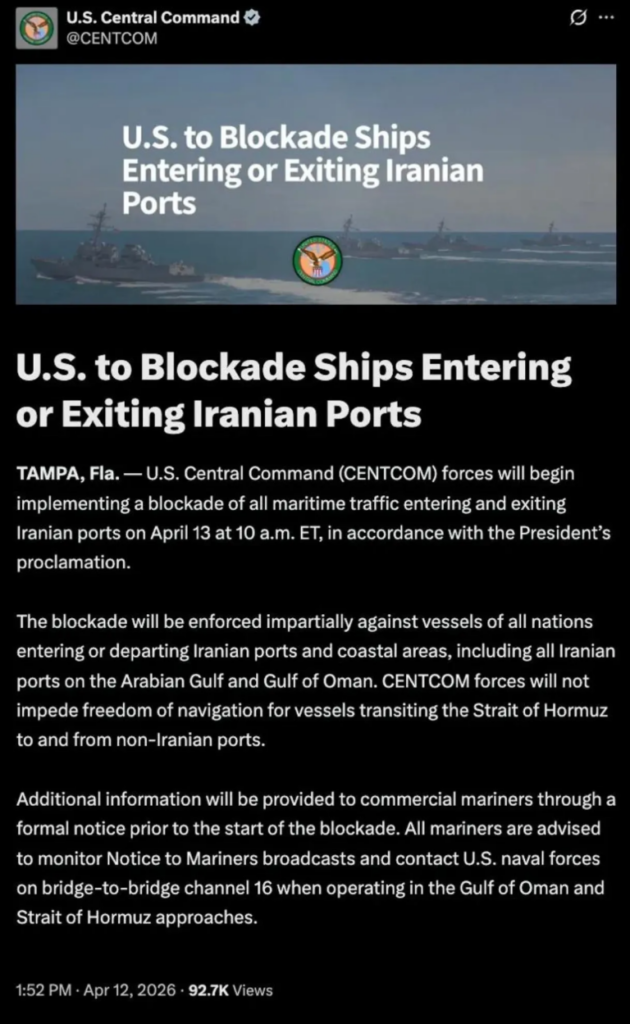
As houseofsaud points out in his analysis published the same day , a blockade is an act of war under UN Resolution 3314 and the San Remo Manual. It is not a mine-clearing operation or a freedom of navigation exercise; it is a declaration of economic war against Iran. houseofsaud ‘s article rightly emphasizes that Saudi bases, from which such a blockade would be imposed, would become the first targets of an Iranian retaliation—despite Riyadh’s official denials. But houseofsaud ‘s analysis falls short when addressing the consequences for China and Pakistan.
- China is the largest customer for Iranian oil. A US blockade would effectively prohibit all oil tanker transit to China. Beijing, which has already negotiated bypass corridors (notably via Pakistan and the China-Pakistan Economic Corridor (CPEC)), cannot accept such an energy stranglehold. The House of Steel article notes that Chinese ships have recently transited the Strait of Gibraltar under Iranian coordination; a blockade would expose them to seizure. This poses a risk of direct confrontation between Washington and Beijing.
- Pakistan imports most of its oil from the Gulf. Its 13,000 troops deployed in Saudi Arabia are not just a thorn in the side of the US; they are also potential hostages. If the blockade triggers a full-scale war, energy supplies to Pakistan will be cut off. Islamabad, already in economic crisis, would pay a heavy price.
Thus, Trump’s blockade is not merely a measure against Iran. It is a threat both to China (to force it to cease supporting Tehran) and to Pakistan (to force it to abandon its duplicitous role as an armed mediator). By broadening the conflict to include two allied nuclear powers, Washington is playing a dangerous game.
The Iranian response: the Houthis and Bab el-Mandeb
If the blockade is implemented, Iran will undoubtedly retaliate. As early as April 12, the Houthis, allies of Tehran, announced that the Red Sea was now ” completely and permanently closed ” to US and Israeli military use. Their leader, Abdel-Malik al-Houthi, warned that in the event of a US escalation against Iran, the Houthis would “actively participate again and intensify their military operations.”
The threat to close the Bab el-Mandeb Strait is credible: the Houthis have already demonstrated their ability to attack merchant ships. A simultaneous closure of Hormuz and Bab el-Mandeb would reduce Saudi Arabia’s oil exports to almost nothing, since the East-West Pipeline (which bypasses Hormuz) empties into the Red Sea, and almost all of it is then shipped to Asia via the strait. Riyadh, already vulnerable, would become the first collateral victim of the US-American escalation.
Read houseofsaud for its facts, but with caution regarding its framing.
House of Saud ‘s articles are useful. They often quickly gather facts, statements, and contextual information that other Western media outlets overlook. But they should be read with caution when it comes to the overall political framing.
The site clearly reflects a bias close to Saudi and Gulf interests. To gauge the degree of independence of houseofsaud , one need only consult their ” The Royal Family ” tab. There, one finds a complete Al Saud family tree, laudatory biographies of all the kings since 1932, and a dynastic narrative beginning in 1727. In short, it is an unofficial showcase for the Saudi monarchy, which presents itself as critical, up to a point. Their articles on the Pakistani deployment should therefore not be read as neutral analyses, but rather as positions aligned with Riyadh’s interests.
The website cannot claim that the deployment is a guarantee for Iran, as this would displease its sponsors. It cannot emphasize China’s role, as this would undermine the narrative of a Sunni alliance against Iran. It cannot highlight that the JF-17s are Chinese aircraft beyond US control, as this would reveal the marginalization of the Americans.
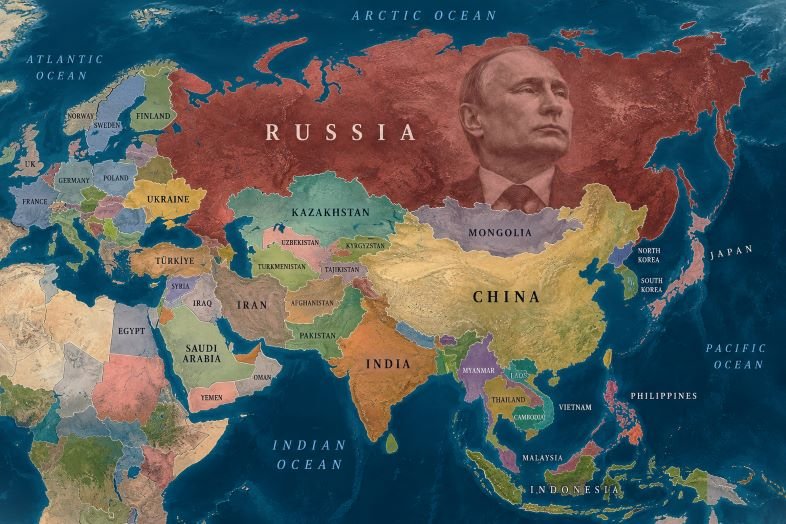
The new regional architecture: without the USA
This sequence reveals a complete realignment of alliances in the Middle East, as we already expressed last September when the SMDA pact was announced:
- Pakistan has established itself as the indispensable intermediary between Washington and Tehran, but also as the guarantor of Iranian security in the face of US options. It receives $5 billion from Saudi Arabia and consolidates its role as an essential power.
- Saudi Arabia , under the guise of self-defense, accepted this armed mediation. It is paying the price to avoid being drawn into a war it does not control.
- China , silently, has established a military foothold in the Gulf via the JF-17s. It does not need bases; its aircraft fly under Pakistani markings.
- The US has lost control and is trying to save face by announcing a naval blockade.
Conclusion: Islamabad’s failure did not end the real negotiations.
JD Vance left without an agreement. Donald Trump brandished the threat of a blockade. But the Islamabad episode not only highlighted the US-American impasse; it also revealed something else: the crucial negotiation is not just between Washington and Tehran. It also involves Pakistan, Saudi Arabia, Iran, and, in the background, China.
The Pakistani deployment in Saudi Arabia does not in itself prove that a new regional axis has already been formed. However, it does indicate that some of the Gulf actors are now seeking to prevent war from being imposed upon them according to the old pattern of automatic military dependence on Washington.
This is undoubtedly the real novelty of this sequence of events. The US remains capable of threatening (by shouting), striking, and blocking. But it is no longer alone in shaping the regional strategic landscape. In Islamabad as in Dhahran , another negotiation is underway: less spectacular, more implicit, but perhaps more decisive.