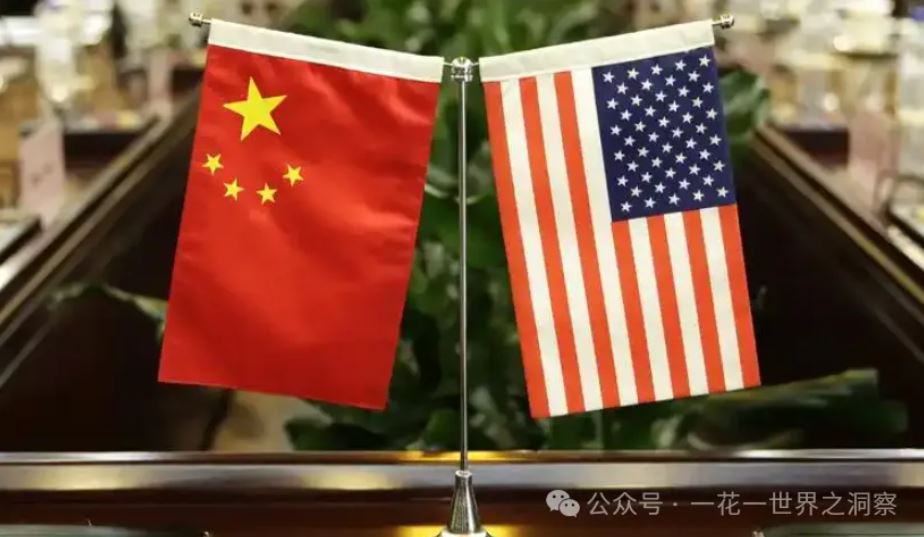
On September 23, U.S. time, Andrews Air Force Base welcomed a distinguished guest, who was personally greeted by the President. This unprecedented level of courtesy broke with diplomatic conventions, demonstrating the U.S.’s high regard and respect for the visit.
This globally significant meeting is of historic significance for both China and the United States, as well as the world, signifying that China-US relations have entered a new stage characterized by strategic stability, controllable competition, warming cooperation, and two-way adjustment.
Since the “outburst of anger” at East Alaska, Sino-US relations have undergone a crucial transformation from an unequal to an equal relationship. In particular, after President Trump 2.0 took office, the violent tariffs he initiated were easily countered by the rare earth card, thus revealing the decline of Sino-US relations.
The United States’ credibility, strength, and willingness to act have been severely damaged amid the turmoil in the Middle East, and its sense of powerlessness in the Russia-Ukraine conflict has led to even the need for appeasement from the “slipper army” (a derogatory term for the U.S. military) to avoid further exacerbating its situation. Meanwhile, U.S. Treasury bonds have experienced a massive sell-off, with interest rates rising across the board. The yield on 2-year U.S. Treasury bonds has reached 4.914%, 3-year 4.998%, 5-year 5.054%, 10-year 5.196%, and 30-year 5.482%, reaching levels seen before the 2008 financial crisis. All these phenomena reveal that its global power is declining rapidly.
Therefore, for the United States, the dual pressures from home and abroad, coupled with the potential upheavals of the November midterm elections, are forcing the President to reach a compromise and consensus with China as soon as possible to ease the escalating tensions. For China, easing relations with the United States and gaining more space and time for national rejuvenation is also a current diplomatic priority.
During this visit, China and the United States jointly released an eight-point consensus, which I will briefly interpret. The following interpretations are all personal inferences and are for your reference only.
The eight-point consensus covers strategic relations (such as consolidating the connotation of a constructive strategic and stable relationship) and historical issues (recalling cooperation during World War II). It includes both current and future plans (such as cooperation in artificial intelligence and nuclear energy), both macro frameworks (such as strategic communication and high-level exchanges) and micro-level implementation (such as specific areas such as drug control, law enforcement, climate action, and people-to-people exchanges), both direct arrangements for bilateral relations and positive responses to global governance.
The first point of consensus was that both sides agreed to build a “constructive strategic and stable relationship between China and the United States based on respect, fairness, and equality.”
The core outcome of this meeting was the establishment of a strategic and stable relationship. Both sides clearly agreed to solidify the connotation of a constructive strategic and stable relationship. This signifies that China-US relations are beginning to truly shift from the past cycle of “confrontation—probing—re-confrontation” to a predictable and manageable mode of coexistence. Constructive strategic stability is neither a Cold War-style all-out confrontation nor a wishful, unbreakable bond, but rather a pragmatic coexistence based on a clear understanding of the boundaries of strength and interests (for the US, this represents a significant reassessment of China-US relations). This positioning is both a summary of the ups and downs of the past few years and a setting for the direction of bilateral relations over the next four years and beyond. It means that both sides acknowledge that the boundaries of competition and conflict must be defined, the space for cooperation and dialogue must be maintained, and that unilateral actions by either side will no longer be as easily able to shake the overall situation as they were in the past.
The second point of consensus was that both sides agreed to support each other in successfully hosting the APEC Leaders’ Informal Meeting and the G20 Leaders’ Summit. The two heads of state expressed their intention to attend the meetings hosted by the other side.
This arrangement, seemingly a procedural statement, actually carries profound strategic implications. As the world’s two largest economies, China and the US supporting each other within the APEC and G20 frameworks not only demonstrates a shared commitment to multilateral mechanisms but also sends a clear signal to the international community that Sino-US relations are trending towards stability. Especially against the backdrop of highly polarized domestic politics and an uncertain external environment in the US, the President’s personal attendance at the APEC meeting hosted by China carries strong symbolic significance. This arrangement also signifies the return of multilateral diplomatic traditions that were once shelved during the Trump administration. In recent years, the US attitude towards multilateral mechanisms has been wavering, but this explicit statement of support for the other side hosting international conferences is, in effect, establishing an institutionalized communication platform for the stable operation of bilateral relations.
The third point of consensus was that the two heads of state agreed that Iran should fulfill its commitment not to develop nuclear weapons, and that no country or organization should impose tolls on international waterways.
This statement, seemingly abrupt, actually pinpoints two key issues in the current Middle East situation. The Iranian nuclear issue has long been a source of global security concerns. The consensus reached between China and the US, as permanent members of the UN Security Council, reflects both a shared concern for the future of the Iran nuclear deal and an effective management of regional nuclear proliferation risks. The statement regarding international waterway tolls clearly points to the issue of freedom of navigation in the Strait of Hormuz and the Red Sea, implying that China will play an active role in this matter (those who know, know).
In recent years, regional instability has led to increased security risks in key waterways. The consensus reached between China and the US on this issue effectively draws a clear bottom line for global shipping safety and the stability of energy corridors. This demonstrates that even against the backdrop of unchanged overall competition, there remains tangible space for cooperation and common interests between China and the US in safeguarding global public goods and preventing the spillover of regional conflicts. This complex relationship of “cooperation amidst competition and common ground amidst differences” is precisely the most accurate reflection of the current state of China-US relations.
The fourth point of consensus was that the two heads of state recalled that China and the United States were allies in World War II and fought side by side to win the war.
The evoking of this historical memory is by no means a casual act of nostalgia, but rather carries profound contemporary relevance. It reminds both sides that Sino-US relations did not begin with confrontation, but rather have a shared historical foundation in upholding peace and justice. At a time of escalating geopolitical competition and rising bloc narratives, reaffirming the WWII alliance effectively provides a historical reference and moral basis for the future direction of bilateral relations. This statement also implies a shared commitment to the current international order; as the main creators and beneficiaries of the existing international system, both countries have a responsibility to prevent the world from returning to the old path of great power confrontation. The activation of historical memory is often more persuasive than abstract diplomatic rhetoric. It allows leaders of both countries to find the confidence and foundation for dialogue and mutual trust from a broader historical perspective when facing differences.
On a deeper level, this consensus implicitly warns of a potential revival of Japanese militarism. While the warning is more significant and urgent for China than for the United States, the US’s tacit approval and cooperation also constitute an implicit endorsement of the regional security order.
The joint review of World War II history by the Chinese and American leaders during their meeting sends a clear signal to the international community: as major victors, China and the United States share a common responsibility to uphold the fruits of victory in World War II and the post-war international order. This statement demonstrates both respect for historical facts and a warning against current risks. It signifies that China and the United States can maintain strategic consensus on fundamental issues concerning the post-war order. This strategic consensus based on historical agreement provides an important buffer zone for the two countries to address current differences.
The fifth point of consensus was that the two heads of state recognized the positive role of the China-US trade consultation mechanism and the results of the consultations between the two trade teams, including the establishment and advancement of mechanisms such as the Trade Council, the reaching of a $30 billion reciprocal tariff reduction arrangement, and the extension of the Kuala Lumpur trade consultation results, and instructed that these be implemented.
This consensus is particularly pragmatic, marking a return to the fundamental role of trade and economic relations as the “ballast” and “engine” of bilateral ties after years of trade friction. The restoration and upgrading of the trade consultation mechanism is a rational choice made by both sides after assessing their respective economic capacity and political costs. The $30 billion reciprocal tariff reduction arrangement and the extension of the implementation of the Kuala Lumpur trade consultation results mean that businesses in both countries have gained clearer expectations regarding tariff costs, market access, and supply chain arrangements.
The sixth point of consensus is that cooperation between Chinese and US drug enforcement agencies has yielded visible results. Recently, the two sides have cooperated closely, jointly cracking multiple cases involving new psychoactive substances and precursor chemicals, and arresting dozens of suspects in both countries.
Drug control cooperation is one of the few areas in China-US law enforcement and security cooperation that offers rapid results and demonstrates a high degree of mutual agreement. The control of fentanyl-related substances and their precursor chemicals not only concerns the lives and health of citizens in both countries but also directly impacts the credibility of domestic governance. Jointly cracking cases and simultaneously apprehending suspects signifies that both sides have established effective operational paradigms in key areas such as intelligence sharing, coordinated operations, and evidence exchange. Breakthroughs in this area provide a replicable model for restoring trust between the two countries on broader security issues.
The seventh point of consensus was that both sides agreed to establish a China-US Artificial Intelligence Dialogue to exchange views on the risks and benefits of artificial intelligence. The next dialogue will be held in November this year. Both sides also agreed to establish communication channels for artificial intelligence-related issues.
This consensus reflects a pragmatic balance between the two countries in the forefront of technological competition. Artificial intelligence is not only a strategic high ground in future great power rivalry, but also a governance blind spot where risks spill over most rapidly, and a crucial issue concerning the ultimate well-being of humanity. The establishment of dialogue mechanisms and communication channels between China and the US in this area is essentially setting up “barriers” for technological competition, preventing conflicts from spiraling out of control due to misjudgment or unforeseen events. The establishment of this mechanism signifies that both sides acknowledge that unilateral actions cannot resolve cross-border technological risks in AI governance; only through regular communication can mutual trust be gradually built.
The eighth point of consensus is that the U.S. welcomes the arrival of the pair of giant pandas loaned by China to the Atlanta Zoo.
This consensus, though seemingly casual, carries profound implications beyond species exchange. Giant pandas, as a “living calling card” of Chinese diplomacy, have always been seen as a direct barometer of the temperature of bilateral relations. From the resumption of giant panda cooperative research in 2019 due to trade frictions, to its current restart and arrival at the Atlanta Zoo, this subtle shift precisely demonstrates the warming of bilateral relations at the grassroots level. The arrival of the giant pandas is not only a continuation of species conservation and scientific research cooperation, but also a warm and concrete signal of cultural exchange between the two countries.
Meanwhile, considering the cultural relics returned by the US to China before President Xi Jinping’s visit, and the series of positive interactions between the two sides in the field of cultural exchanges, it can be seen that the outcomes of this meeting were not limited to traditional issues such as trade and security, but extended to the deeper dimensions of cultural identity and mutual learning between civilizations. The return of cultural relics and the loan of giant pandas, one ancient and one modern, one static and one dynamic, together outline a bridge for dialogue between the two countries in terms of historical memory and future vision. It reminds us that even against the backdrop of strategic competition and systemic differences, goodwill among the people and cultural ties still have the power to transcend political barriers.
According to public reports, China and the US have also made positive progress in areas such as restarting the crisis communication and prevention mechanism between their militaries, resuming trade consultations, and restarting the climate change working group. These seemingly scattered issues actually constitute a complete picture of the repair of relations between the two countries.
Considering the current domestic and international situation, future China-US relations should enter a phase of relatively long-term overall stability, localized competition, key cooperation, and dynamic balance. Both sides will continue to optimize their strategic layout across four dimensions: strategy, trade and economy, geopolitics, and people-to-people exchanges, to ensure the constructive and stable strategic relationship takes root. Strategically, both sides will continue to deepen high-level strategic communication, improve comprehensive risk management mechanisms, solidify the bottom-line consensus of peaceful coexistence, non-conflict, and non-confrontation, and build a mature and stable paradigm of interaction between major powers. Economically, both sides will rely on the normalized mechanism of head-of-state diplomacy to continuously break down barriers to cooperation, optimize the trade structure, and deepen cooperation in emerging areas such as the green economy and the digital economy, promoting bilateral trade and economic relations from quantitative recovery to qualitative upgrading. Geopolitically, both sides will focus on global governance and regional crisis management, deepening communication and cooperation in areas such as energy and food security, non-proliferation, and regional stability, jointly offsetting the global governance deficit. In terms of people-to-people exchanges, both sides will continue to facilitate communication among the people, academia, and business communities, using the exchange of public opinion to offset political maneuvering and solidify the foundation of bilateral relations.
However, we must also be soberly aware that differences in systems and development stages between China and the United States, as well as structural contradictions such as competition in science and technology industries and geopolitical influence, have long existed. The easing of bilateral relations is a dynamic and controllable adjustment process, not a resolution of differences. Short-term policy easing cannot change the fundamental pattern of long-term competition and coexistence among major powers.
In the long run, peaceful coexistence and mutual benefit remain the mainstream trend in China-US relations. As a core bilateral relationship influencing the global landscape, China-US interaction not only determines the development trajectory of both countries but also profoundly guides world peace, global economic recovery, and the evolution of the international order. Under the new circumstances, only by adhering to the principles of mutual respect, equality, and mutual benefit, continuously consolidating the foundation of strategic stability, tapping the potential for pragmatic cooperation, scientifically managing differences and risks, and jointly addressing global challenges can we promote the healthy and stable development of bilateral relations. This will benefit the people of both countries and inject certainty and stability into a turbulent and changing world, jointly providing more public goods and setting an example for a better future for the world.