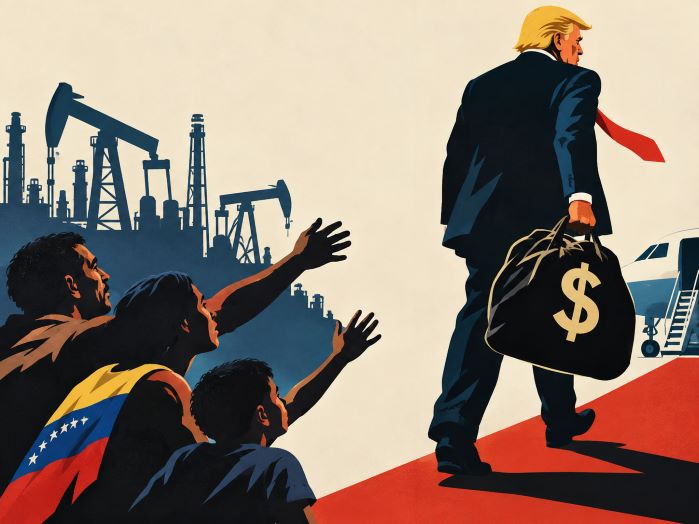
Since the start of his second term, US President Trump has made tariffs a key weapon in his policy toolbox, bringing a strong impact and wide-ranging influence to the global economic and trade landscape.
After Trump announced the globally attention-grabbing “reciprocal tariffs” last April, major trading partners such as the EU, China, Japan, and South Korea successively signed trade agreements with the US through diplomatic negotiations, and the global trade war temporarily subsided.
However, in the past week, US trade policy has once again experienced dramatic upheavals. Within 24 hours, the White House staged a surreal reversal that will be recorded in US trade history.
First, on February 20th local time, the U.S. Supreme Court ruled 6-3 that the U.S. unilateral imposition of comprehensive tariffs worldwide violated federal law. Subsequently, the White House issued a statement confirming that the tariffs imposed by the U.S. government based on previous executive orders and invoking IEEPA would no longer be valid.
Just when everyone thought the farce was about to end, Trump pulled out his trump card, the “legal weapon,” at a last-minute press conference at the White House that afternoon. He announced that he would invoke Section 122 of the Trade Act of 1974 to impose a 10% tariff on all U.S. trading partners for 150 days, with only a few goods exempted.
Trump also ordered the Office of the United States Trade Representative to launch an investigation into “unfair trade practices” under Section 301 of the Trade Act of 1974, seeking to impose tariffs on goods from certain trading partners and sectors.
But what followed was even more outrageous. On February 21, Trump dropped another bombshell on social media: based on a “full review” of the Supreme Court’s “absurd, poorly worded, and extremely anti-American” ruling, he would immediately increase global tariffs from 10% to 15%, directly maxing out the tariff limit allowed by law.
But this global tariff reversal drama is not over yet.
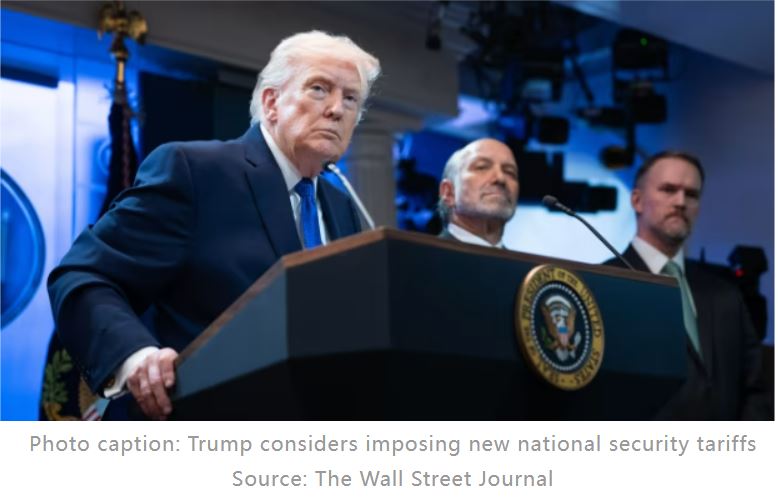
On February 23 local time, the Wall Street Journal reported that the Trump administration is considering launching new “national security tariffs” on about six industries under Section 232 of the Trade Expansion Act of 1962, citing “national security” concerns. The targets include large batteries, cast iron and iron fittings, plastic pipes, industrial chemicals, and power grid and telecommunications equipment.
In addition to the six proposed new industries, sources also revealed that the government team has assessed the possibility of taxing nine other industries under the existing Section 232 investigation framework, including semiconductors, pharmaceuticals, drones, industrial robots, and polysilicon used in solar panels.
Reuters reports that these new tariffs will be independent of the 15% global tariffs recently announced by Trump. Regarding the timeline, the report notes that Section 232 requires a relatively lengthy investigation process, led by the U.S. Department of Commerce. Once implemented, the tariffs can be unilaterally adjusted by the president, giving them greater flexibility in policy continuity and enforcement.
White House spokesman Kush Desai stated that safeguarding U.S. national and economic security remains Trump’s top priority, and the administration will “use all legal authority” to advance these goals. The timing of the announcement of the new Section 232 tariff investigation and the implementation of the tariffs remain unclear; the relevant procedures must be handled by the Department of Commerce.
US President Trump also warned countries around the world not to renege on recent trade agreements with the United States, or he would impose higher tariffs on those countries under different trade laws and may impose licensing fees on trading partners.
On February 23, Trump posted a series of messages on social media, warning countries “not to play tricks.” He stated that although the Supreme Court ruled that the tariffs he imposed under the International Emergency Economic Powers Act were invalid, the court’s ruling confirmed that he had the right to use other laws to “legally impose tariffs in a stronger and more offensive manner.”
It is worth noting that the “national security tariffs” imposed by the United States on these six industries will be levied under Section 232 of the Trade Expansion Act of 1962, citing “national security” as the reason. In short, the US can impose tariffs whenever it feels “unsafe to rely on you.” Furthermore, these new tariffs will be implemented independently and will not overlap with the previously announced 15% global tariff measures.
This shift means that after Trump filled the void left by the invalidated tariffs with a 15% global tariff, he may still impose another tariff framework on specific supply chains through Section 232, increasing compliance and cost uncertainty for importing companies and downstream manufacturers.
The six industries targeted by the U.S. “national security tariffs” are all clearly targeted and reveal the U.S.’s strategic motives.
The large-scale battery industry is the core of the new energy industry, and China holds an absolute advantage in the global new energy battery field, leading the world in both technological research and development and production capacity. This move by the United States aims to suppress the development of China’s battery industry through tariffs, seize global dominance in the new energy sector, and encourage the return of manufacturing to build its own lithium battery industry chain.
The power grid and telecommunications equipment industries are directly targeting China’s strengths in areas such as 5G and power grid construction, while also targeting US allies that use Chinese equipment, attempting to sever China’s technological cooperation links with the world.
In fact, the Biden administration had already significantly increased tariffs on Chinese photovoltaic and lithium battery products exported to the United States under Section 301. The Section 301 tariff on solar cells was raised to 50% in September 2024, while the tariffs on power batteries and energy storage batteries reached 25%.
The “national security tariffs” that the US government is considering will undoubtedly strike at the heart of the US power grid modernization plan. A surge in tariffs could lead to soaring costs, potentially causing project delays or cancellations, impacting US AI and infrastructure development, and possibly resulting in a sharp drop in Chinese export orders.
Large batteries are the core of energy storage systems, while grid equipment (such as transformers, wires, and control equipment) are the “blood vessels” and “nerves” of power transmission. According to Wood Mackenzie’s analysis, such tariffs will significantly increase the cost of grid construction, with energy storage technology, which is highly dependent on imports from China, being the most severely impacted.
Currently, Artificial Intelligence Data Centers (AIDCs) are driving a significant increase in electricity demand in the United States. Traditional power sources have too long construction cycles and cannot respond quickly. Energy storage, with its advantage of rapid large-scale deployment within 1-1.5 years, has become a core technology path that can improve the reliability of power supply to data centers, as well as improve the overall resilience and economy of the power grid.
In this field, “China is in a leading position in almost every link of the industry chain,” points out Wang Dan, an expert on Chinese technology at the Hoover Institution at Stanford University. “Whether in terms of technology or scale, they are at the forefront.” According to customs data, the United States was China’s largest export market for lithium-ion batteries in 2024, with exports amounting to US$15.315 billion, accounting for 25% of my country’s lithium-ion battery exports.
Data from the U.S. Census Bureau shows that in the first nine months of 2025, 60% of U.S. lithium-ion battery imports came from China, up from 43% in 2020. From January to September, imports of such products totaled $15 billion, more than three times the total for the entire year of 2020. This trend persists despite U.S. attempts to reduce its dependence on China due to concerns about its vulnerability to supply chain disruptions.
At the same time, the explosive growth of global AI computing centers has made power equipment such as transformers scarce resources, and the delivery cycle in the US market has been extended from 50 weeks to 127 weeks.
my country has become the world’s largest transformer producer, with the world’s most complete transformer production system. Its production capacity accounts for about 60% of the global total, and its total export value reached 64.6 billion yuan in 2025, an increase of nearly 36% compared to 2024.
China plays a central role in the global power grid equipment supply landscape, and its competitiveness in the international market continues to strengthen. Export data shows that from January to November 2025, exports of key power equipment reached US$71.5 billion, a year-on-year increase of 20%, indicating that overseas demand for power equipment maintained rapid growth.
The legal basis for the U.S.’s current “national security tariffs”—Section 232—grants the president broad power to adjust imports based on national security risks. Ironically, however, this “national security” argument is paradoxical when it comes to power grid equipment: restricting imports actually hinders the U.S. from acquiring the critical materials and equipment necessary for building a modern power grid, thus weakening the grid’s resilience and security.
According to professional organizations, with the invalidation of IEEPA tariffs (mainly “reciprocal tariffs” and “fentanyl tariffs”), the average tariff rate of the United States on China is expected to decrease by about 8.4 percentage points.
If the newly added provisional tariff of Section 122 is calculated at 15%, the overall tariff rate faced by Chinese goods against the US will fall from its high level. Some models estimate that this could lead to a rebound of approximately 9.1% in Chinese exports to the US, and an overall export growth of about 0.6%.
For products such as large batteries, large-scale power transmission and transformation equipment, and power grid equipment, China’s complete industrial chain will make it difficult for American companies to find ideal alternative sources. “National security tariffs” will also force Chinese companies to accelerate their global expansion, planning to build factories in Mexico, Southeast Asia, and other places, thereby exerting pressure and penetrating the US market from the periphery.
(Global Zero Carbon via Huxiu)
——
References:
[1]https://www.wsj.com/politics/policy/trump-considers-new-national-security-tariffs-after-supreme-court-ruling-c9187773
[2]https://investinglive.com/news/trump-considers-new-section-232-tariffs-after-supreme-court-ruling-20260223/
[3]https://www.reuters.com/world/us/trump-considers-new-national-security-tariffs-after-supreme-court-ruling-wsj-2026-02-23/
[4]https://www.nytimes.com/2026/02/23/us/politics/trump-tariffs-supreme-court.html
[5]https://za.investing.com/news/economy-news/trump-considers-new-national-security-tariffs-after-supreme-court-ruling-wsj-4127509
[6]https://www.globaltimes.cn/page/202602/1355649.shtml
[7]https://www.zaobao.com/news/world/story20260224-8627996
[8]https://www.zaobao.com/news/world/story20260221-8607472
[9]https://www.ftchinese.com/interactive/251897
[10]https://www.nytimes.com/2025/12/23/climate/pentagon-weapons-ai-artificial-intelligence-china-batteries.html
[11]https://wallstreetcn.com/articles/3766022
[12]https://wallstreetcn.com/articles/3766019
[13]https://finance.eastmoney.com/a/202602243652131418.html