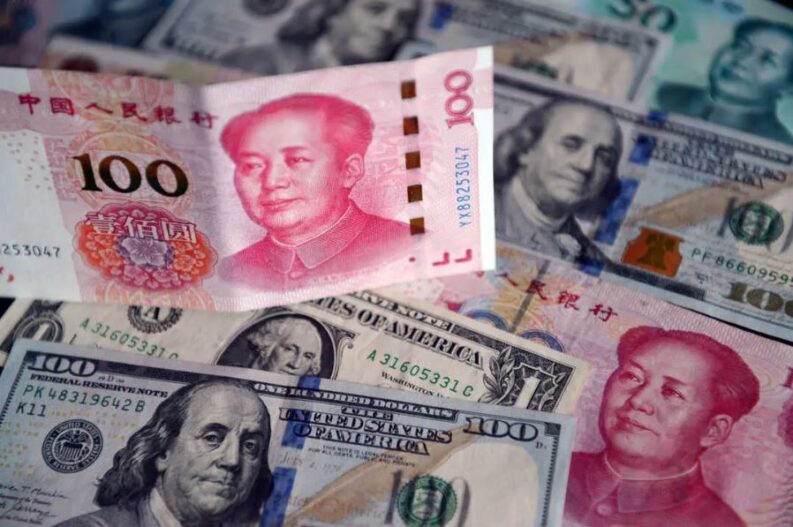
Geopolitically, much is at stake for Washington. The petrodollar is the foundation of its expansive military spending, its chronic indebtedness, and the optimal implementation of economic warfare through punitive sanctions.
In the context of the increasingly distressing war between the US-Israel and Iran alliance, not only is the balance of power in West Asia or the governance of the Strait of Hormuz being decided, but also the future of the international monetary system as we have known it since the 1970s: anchored in the petrodollar, at the service of American imperial hegemony and instrumentalized against Washington’s rivals, acquiring a progressively chronic character in recent years.
Brief historical overview
Recent unofficial reports have indicated that Tehran is conditioning the passage of oil tankers through the critical maritime route connecting the Persian Gulf with the Gulf of Oman and the Arabian Sea on payment for the oil in yuan. This measure represents an explicit geopolitical challenge to the petrodollar, with which the US, since the agreement reached between Richard Nixon and King Faisal of Saudi Arabia in 1974, has guaranteed and defended its global financial power.
For Washington, it was a win-win situation: in exchange for security guarantees, Gulf producers would trade oil exclusively in dollars, which would sustain the rising demand for the currency (strengthening its international weight) and its subsequent recycling into US Treasury bonds and financial assets (covering the internal deficit).
Thus, with petrodollars flooding into the bloodstream of the economy, the US could raise debt without restrictions and increase military spending without weakening its currency , while preserving a relationship of dominance over the Gulf monarchies to prevent possible partnerships with rival powers.
Don’t look at the fact-checking, look at the trends.
It is precisely this petrodollarized system, tailor-made for the US, that is suffering a structural short circuit with Iran’s response to the military offensive by Washington and Tel Aviv. The continuous waves of Iranian drones and missiles have strategically undermined the defensive guarantees promised by Nixon, while its control over the Strait of Hormuz demonstrates its asymmetric capacity to inflict profound damage on the US economy, shifting the cost of its insane and unsustainable levels of debt onto itself . Essentially, a blowback of the petrodollar itself.
The information that circulated worldwide regarding the Hormuz oil yuanization plan does not require fact-checking, as it falls within a trend of monetary reconfiguration that has been gaining momentum in recent years. Between 2015 and 2018, China institutionalized its strategy to become a financial player of international reach, as a practical consequence of its undisputed status as a global economic power.
First, it launched the Cross-Border Interbank Payment System (CIPS) , a platform of the People’s Bank of China independent of the US-controlled SWIFT system, which is widely used for the operational implementation of punitive sanctions. A few years later, it announced the first futures contracts for oil transactions on the Shanghai International Energy Exchange, as part of a robust agenda for the digitalization and internationalization of the yuan, aimed at reducing Beijing’s dependence on the dollar.
By the end of 2023, cementing the petroyuan’s entry into the monetary landscape, Chinese energy giant CNPC conducted its first oil transaction in digital yuan through the Shanghai Oil and Natural Gas Exchange. Although US sanctions against Tehran and Moscow have attempted to cripple their respective oil industries by using the petrodollar as a weapon (control over the SWIFT system), both found in the People’s Republic’s financial architecture a reliable alternative for trading crude oil.
Currently, Iran and Russia’s oil trade with Beijing is mostly settled in Chinese currency through CIPS, which has reduced the dollar’s participation in energy exchange between two major hydrocarbon powers and the world’s largest consumer of crude oil to a minimum.
The progressive growth of the petroyuan leads economist Diana Choyleva to suggest that “the decline of the petrodollar in the Gulf is not a question of if, but when, and that ‘when’ is approaching faster than most people think.” According to the chief economist at the consultancy Enodo Economics , the financial innovations promoted by China “offer oil producers not only viable, but potentially superior alternatives to dollar-based settlement channels, which are particularly vulnerable to disruptions caused by technological advances.”
Now that the core of the deal offered by Nixon is being seriously questioned, the advantages of the petroyuan discussed by Choyleva could become more firmly established. In this sense, Iran’s maneuvering to impose conditions in the Strait of Hormuz would aim to create an extra incentive for its adoption, in an attempt that combines “military geography with monetary strategy,” according to economics professor Kashif Hasan Khan.
Strategic implications
The signs of decline in the crown jewel of the American empire do not necessarily imply that we are on the verge of a strategic assault on the petroyuan, in the form of a complete replacement of one system with another. Rather, the military tension in the Strait of Hormuz is catalyzing the gradual erosion of the petrodollar, while opening new opportunities for Beijing to strengthen its integration with the Persian Gulf economy , based on large infrastructure projects and investments exceeding $70 billion, for which it requires an autonomous platform that reduces vulnerabilities.
What the growth of the petroyuan reflects is not only the People’s Republic’s desire to protect itself through dedollarization, but also a natural adjustment process of financial multipolarity rooted in the reorganization of the global economy: China absorbs 37% of all crude oil leaving through the Strait of Hormuz, while the US only accounts for 2.5%, thus invalidating the petrodollar within the region’s own economic dynamics. Although the widespread adoption of the petroyuan in the Gulf is not guaranteed in the short term, the incentives for geoeconomic convergence between producers and buyers continue to grow. Saudi Arabia’s ongoing overtures to yuanize its hydrocarbon sales should be considered from this structural perspective.
Geopolitically, much is at stake for Washington. The petrodollar is the foundation of its expansive military spending, its chronic indebtedness, and the optimal implementation of economic warfare through punitive sanctions , aimed at weakening rival powers. Therefore, the White House’s fear lies not in the possibility of its immediate collapse, but rather in the possibility that the expansion of the petroyuan will strategically limit the empire’s power capabilities, even severely degrading them.
What Nixon surely did not foresee 52 years ago was that the scheme he had created would end up facing an existential dilemma: using war and sanctions to protect a dollar-centric system generates the conditions for its weakening, which is what we are seeing right now in a granular way in Hormuz.