Trump is not the disease of American democracy; he is the scanner that reveals its invisible fractures.
To say that Trump is a “product” of American democracy is not an insult. It is a diagnosis. And as an old sage from Algiers would say: the product always reveals the quality of the mill.
Since its birth in the 18th century, American democracy has rested on a fundamental contradiction: it is both universalist in its rhetoric and deeply territorial in its practice. It promises freedom to the entire world, but it votes first and foremost according to domestic geography. Between Wall Street and rural Ohio, between Silicon Valley and the Midwestern plains, it is not merely a social difference, but a civilizational divide.
Trump emerged right there. He didn’t fall from the sky. He came out of the ground. Like Texas oil.
Historically, America periodically produces populist figures when its cycles of global expansion intersect with its internal anxieties. In the 1930s, it was isolationism. In the 1970s, post-Vietnam withdrawal. In the 2010s and 2020s, it’s Trump.
Geographically, it embodies peripheral America versus coastal America. Warehouse America versus university America. Pickup truck America versus algorithmic America. This isn’t a caricature: it’s an electoral map.
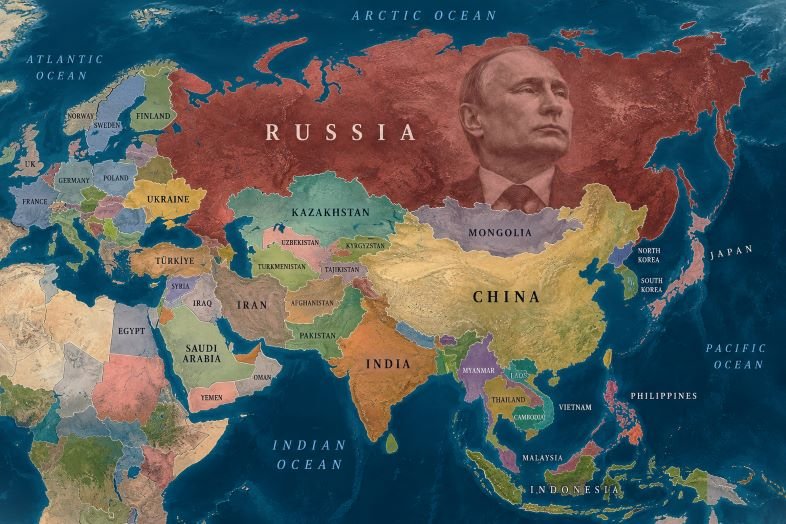
Geopolitically, its emergence coincides with a specific moment: the relative decline of American power in a world that has once again become multipolar. When a superpower has doubts, it seeks a leader who speaks simply. Very simply. Sometimes too simply.
Trump did not create the American crisis. He brought about it.
Strategically, he represents a major break: the shift from universalist imperialism to transactional nationalism. Before him, Washington exported values. With him, Washington exports bills. NATO? Bill.
World trade? Bill. International security? Bill. It’s brutal, but it’s consistent.
Because behind the theatrical style lies a cold logic: America no longer has the internal political means to finance on its own the world order it built after 1945. Trump is not the system’s mistake. He is the software update.
Great powers, like great families, reveal their true selves in their crises. Trump’s America shows that a democracy can produce a controversial leader while remaining institutionally stable. That is its paradox. And perhaps its strength.
Contrary to appearances, Trump is not an anti-establishment accident. He is an expression of the American electoral system, its deep-seated sociology, and its spectacular political culture. In a spectacle-driven democracy, it was inevitable that a showman president would one day emerge. And, frankly, let’s be honest: Hollywood has been preparing the ground for a long time.
To call Trump a “scumbag” is more a matter of emotional rhetoric than strategic analysis. A world power never produces its leaders by chance. It produces its current political needs. Trump is therefore less an anomaly than a thermometer. The thermometer can be unsettling. But breaking the thermometer doesn’t lower the fever.
By 2026, his return to power confirms a significant trend: the United States’ lasting entry into a phase of strategic redefinition. Less universal ideology, more national interests. Less global mission, more continental calculation. This means one clear thing: the American umbrella is becoming negotiable. And a negotiable umbrella is no longer an umbrella. It’s a lease.
Trump is not the disease of American democracy; he is the scanner that reveals its invisible fractures. He is not the storm hitting America: he is the barometer it has created itself. And when a superpower starts bargaining for its umbrella instead of protecting the sky, it is not the global climate that changes, it is its place within it.