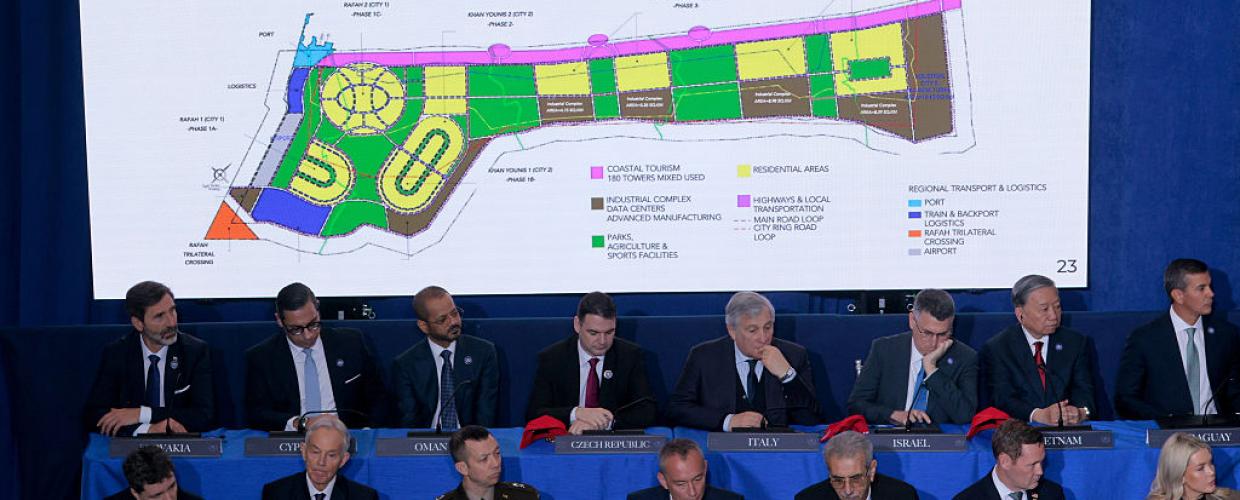
On Feb. 19 Trump’s ‘Board of Peace’ met for the first time in Washington to discuss a ‘reconstruction plan’ for Gaza. Several official members, including Qatar, Saudi Arabia, Kuwait, and Bahrain, pledged to provide $7 billion toward a Gaza “relief package” to support the effort. More than 40 countries attended the meeting, including 23 participating as observers. President Donald Trump said the United States would contribute $10 billion to the Board of Peace.
A week prior, Israeli Prime Minister Benjamin Netanyahu met with Trump on Feb. 11 at the White House and formally signed on to join the Board. The move marks the latest U.S. “peace initiative” that structurally sidelines Palestinian sovereignty, following in the tradition of earlier U.S.-brokered “peace initiatives” such as the Camp David Accords of 1978 and the Oslo Accords of 1993 and 1995. The “Board of Peace” was first introduced as part of the White House’s 20-point Gaza peace plan on Sept. 29, 2025. Unlike previous peace initiatives, it positions itself as an externally determined, U.S.-designed framework for resolving conflict.
In November, the initiative was endorsed by the United Nations Security Council Resolution 2803, and officially launched by President Trump at the World Economic Forum in Davos, Switzerland, on Jan. 22 of this year.
The recently released charter for this Board makes no direct reference to Gaza or Palestinians. Out of the 60 countries invited, 27 have joined. Permanent membership requires a $1 billion fee.
Many of the Board’s leading figures come from political or economic backgrounds closely aligned with U.S. and Israeli interests. Internationally, the Board has faced growing scepticism over its structure and plan. On Feb 11. Italy and Poland publicly announced they would not join. France also declined the invitation, citing concerns that the Board could undermine the United Nations. Referencing the lack of Palestinian representation, Spain and other European countries have also refused to join.
On Feb. 16, the European Commission announced it would attend the first official Board of Peace meeting solely as an observer, despite having received an invitation to join. Speaking during an informal European Council meeting on Jan. 22, Council President António Costa stated, “We have serious doubts about a number of elements in the charter of the Board of Peace related to its scope, its governance, and its compatibility with the UN Charter.”
Board of Peace Formation and Structure
The “Founding Executive Board” sits at the top of the board’s hierarchical structure, chaired by Trump. It serves as the primary decision-making body. Beneath it is the “Gaza Executive Board,” tasked with overseeing the implementation of decisions on the ground. At the lowest tier, there is the National Committee for the Administration of Gaza (NCAG), led by Ali Shaath, who previously held positions in the Palestinian Authority’s ministries of planning and transport. The NCAG operates under the full oversight of the other two bodies. The seven members of the Founding Executive Board, who can only be appointed by the Chairman as stated in a released statement by the White House, are as follows:
- U.S. Secretary of State Marco Rubio.
- U.S. Special Envoy to the Middle East Steve Witkoff.
- Trump’s son-in-law Jared Kushner.
- Former UK prime minister Tony Blair.
- CEO of Apollo Global Management Marc Rowan, .
- World Bank President Ajay Banga.
- U.S. National Security Advisor Robert Gabriel.
Palestinian analyst and writer Muhammad Shehada described the board’s composition as a “Trump family-owned business.” Gaza-based political analyst, Iyad al-Qarra, told Al Jazeera that the choice of members represents a “corporate takeover” of Palestinian sovereignty. The Gaza Executive Board also includes figures such as Israeli real estate investor Yakir Gabay. Representation from Arab countries consists of:
- Turkiye’s Foreign Minister Hakan Fidan.
- Qatari diplomat Ali Al-Thawadi.
- UAE Minister of State for International Cooperation Reem Al-Hashimy.
- Egyptian General Intelligence Director Hassan Rashad.
Framed by the UN Resolution as an international transitional authority tasked with overseeing the ceasefire, according to a White House article, the next phase of U.S. strategy with the Board will shift from maintaining the supposed ceasefire toward “demilitarization, governance reform, and large-scale building.” This transition has raised concerns about authority, and analysts have widely criticized this noting that Gaza may represent only the first step for a broader, geographically expansive U.S. peace governance framework that would extend U.S. foreign involvement under the guise of conflict management.
Jared Kushner and Private-Sector-Led Reconstruction
Trump’s son-in-law, Jared Kushner, presented his “master plan” for reconstruction in Gaza during the signing ceremony at Davos. The proposal aligns with the Board of Peace’s structure, prioritizing foreign and private-sector involvement over Palestinian agency. The proposal has sparked widespread criticism and outrage, with analysts and commentators highlighting how it reframes Palestinian reconstruction as a market opportunity rather than a political process rooted in self-determination. According to CNN, Kushner explicitly appealed to the private sector to invest in this “New Gaza Plan,” promising “amazing investment opportunities.”
Palestine Chronicle reported that Gaza’s identity would be altered under the guise of modernization and urbanization. In Kushner’s proposal, aid and rebuilding are not Palestinian-led processes, but are market-driven.
Architectural depictions of Kushner’s “New Gaza” present high-rise towers, coastal tourism, data centres, and industrial zones. Palestinian-led reconstruction initiatives such as Gaza Phoenix and the Palestine Emerging Blueprint have referenced that this ‘blank-slate’ approach risks erasing Gazan identity and instead propose ulterior rebuilding plans, led by Palestinians and sensitive to the geography and heritage of Gaza.
Given the outrage and scepticism it received, it is unclear if the plan will be implemented.
The plan’s feasibility has also been questioned. AP News reported that Kushner tied reconstruction in Gaza to security. However, the Palestine News Agency Wafa has reported that since the latest ceasefire in October 2025, Israel has killed 591 Palestinians as it repeatedly commits violations. As reported in the Financial Times, rebuilding would commence in the zone behind the invisible ‘yellow line’: an area to which Israeli troops withdrew under the terms of the ceasefire.
In an ongoing investigation since Oct. 1, research agency Forensic Architecture has documented via satellite images how this area is being turned into a permanent divide as Israel builds permanent roads and military infrastructure.
The Charter and its Implications
The Board of Peace charter states that it seeks to “promote stability, restore dependable and lawful governance, and secure enduring peace in areas affected or threatened by conflict.”
Yara Hawari, co-director of Al-Shabka, described in a recent policy memo the role of the NCAG as limited to facilitating rather than a political solution, characterizing it as a form of “technocratic neutrality” deliberately chosen by the U.S. to depoliticise the struggle in Gaza and Palestine.
The Board of Peace is framing material rebuilding and “technocratic neutrality” as a path to restore “lawful governance.” Proposed in the UN Resolution 2803, this U.S.-designed governance will continue until the “Palestinian Authority (PA) has completed its reform program,” at which point the PA will govern Gaza. A report summary by the Palestinian Center for Policy and Survey Research represents how these political decisions are disregarding Palestinian public opinion. Based on the latest Arab Barometer survey cited, findings show that support for Fatah has long collapsed, Hamas has maintained some base, but the largest group is those “politically alienated.”
Analysts have also questioned the scope and intent of the charter, noting that countries that have committed human rights violations or international law violations were invited to join the board.
The charter references twenty different powers given to the Chairman, including the power to designate a successor, and the replacement of the Chairman may occur only by voluntary resignation or by a unanimous vote of the board in the event of the Chairman’s incapacity. Article 4.1 section e of the charter further states that any decisions made by the board will be “subject to veto by the Chairman at any time thereafter.”
Article 4.1 section e) on any decisions made by the board states these will be “subject to veto by the Chairman at any time thereafter.”
Palestinian Responses to the Board of Peace
A central concern among Palestinian analysts and writers is the violation of human rights and erasure of Gaza’s identity in the reconstruction and governance of the Board.
Palestinian author Susan Abulhawa posted on X: “This is a plan to erase Gaza’s indigenous character, turn what remains of her people into a cheap labor force to manage their ‘industrial zones’ and create an exclusive coastline for ‘tourism.'”
Palestinian analyst Tariq Kenney-Shawa commented specifically on the architectural implications of Kushner’s proposal on X: “The plan is to confine Palestinians to hyper-surveilled prison camps and exploit them as cheap labor for luxury developments they’ll never live in, all built atop mass graves.”
In an article for The New Arab, Muhammad Shehada expressed that the “New Rafah” scheme, which aims to build a camp in the south of Gaza under Israeli military control and biometric surveillance, is being funded by the UAE, a member of the Board of Peace.
Palestinian journalist Youmna ElSayed also responded on X to the proposed photos of “New Gaza” with outrage, describing it as “a new place where investors and investments are welcomed, a new place where resources are stolen and distributed to the occupiers.”
Amnesty International criticized the Board as “a stark new manifestation of the escalating assault on UN mechanisms.”
Al-Haq Organisation highlighted how these concerns began with the UN Resolution 2803, stating that it placed Gaza, “under a revised form of alien occupation for an undetermined amount of time based on vague, undefined standards.”
Al-Shabaka policy analyst Safa Joudeh linked the structure and reconstruction plan of the Board to a broader colonial critique, writing: “The [Board of Peace] Charter is a stark example of U.S. imperialism masquerading as legality, using unlawful intervention and a commercial framework to advance capitalist, neocolonial interests at the expense of the Palestinian people.”
Associate Professor of Middle East and Islamic Studies at NYU, Helga Tawil-Souri, wrote in an email to Palestine Square that “the BoP is nothing short of a colonial landgrab, one directed by the U.S., excising the UN and NGOs, entrenching Israel’s continued control, and providing Palestinians a role, perhaps and at best, as laborers or administrators who service billionaires’ interests which require Palestinians’ own dispossession to continue.”