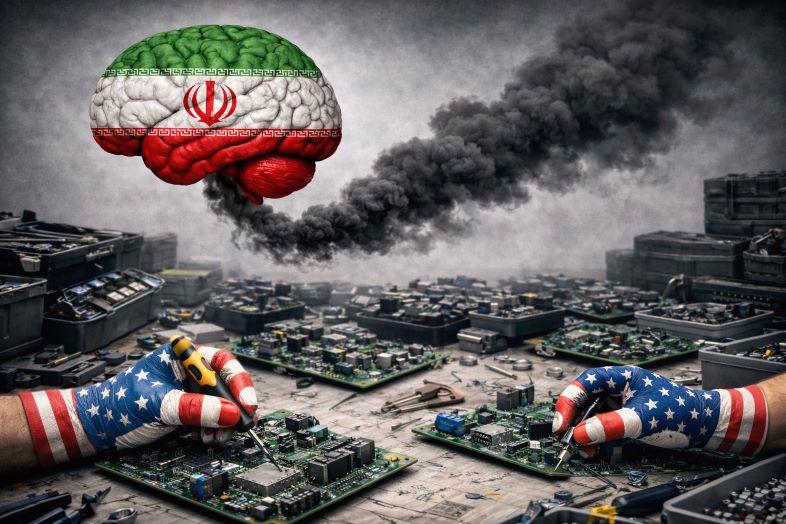
For years, the United States has eagerly accused other countries of “technology theft” and “reverse engineering.” Yet recently, The Wall Street Journal proudly revealed a twist: the newest weapon the US military relies on in the Iranian battlefield is actually a “knockoff” copied straight from Iranian drone technology.
It’s like a top student constantly calling others cheaters, only to sneakily copy a struggling classmate’s answers during the test—and then boast about the grade.
For the first time in half a century, the United States has swallowed its pride to “copy” Iran.
The weapon that has the US military hooked is the “LUCAS” (FLM 136) suicide drone. Its origin is awkward: the US military dismantled and studied Iranian “Shahed” drones captured from the Ukrainian battlefield, and then reverse engineered and cloned them.
The Wall Street Journal itself admits this is the first time in nearly fifty years the US has openly reverse engineered another country’s military tech. The last time was during the Cold War, when they copied Soviet pontoon bridge designs. In other words, the American military-industrial complex has long boasted about being the “world’s best and most original.”
Yet now in fighting Iran, it turns out their ace weapon is an “Iranian-designed, American-assembled” product. The embarrassment is undeniable.
Why does the US military copy this type of drone? The answer is simple: it’s cheap.
The ‘LUCAS’ costs only between $10,000 and $55,000 per unit, roughly on par with the original Iranian model. By contrast, the US military’s own Tomahawk cruise missiles cost over $2 million each. US officials describe it as delivering ‘high cost-performance’—the ‘Toyota Corolla of drones.’ It’s not highly sophisticated, but it can be produced at scale.
Sounds clever, right? But the absurdity is clear: the country with the highest global military spending has to rely on ‘saving money’ to keep a war going. Even more ironically, this cost-saving strategy involves copying the adversary. What’s more paradoxical: this drone was originally developed for a possible future China-US conflict. War games showed the US ammo stockpile might not last two weeks. Yet oddly, they first tested it on Iran.
Is the copied ‘ace’ drone really that formidable? Even experts have doubts.
Although US media hype its impressive performance in Iran, praising its accurate strikes on various targets, American experts are working hard to douse this enthusiasm with skepticism.
An electronic warfare expert explains that in Iran, GPS jamming is weak, so these drones perform well. But in the complex battlefield environment surrounding China, strong signal interference can instantly turn them into “headless flies”—either crashing or flying erratically.
Some critics argue the US military still lacks enough low-cost anti-drone systems. It struggles to defend even against small drones backed by Iran. And those so-called “fully autonomous combat” unmanned vessels remain years away.
To put it bluntly: copying homework might get by against an average student like Iran, but face a top student like China, and the flaws quickly show.
A war exposes the US military-industrial complex as little more than a “paper tiger.”
The most ironic part of all this isn’t the US “copying,” but its smug self-satisfaction after doing so.
The Trump administration aggressively pushed for “defense procurement reform,” streamlining processes and promising rapid production of low-cost weapons. Yet the reality reveals a bloated, sluggish system. Even former officials involved in development concede, “Many countries have long mastered this type of low-cost precision strike technology; the problem is the United States hasn’t invested a single dollar in these systems.”
This war acts like a revealing mirror, exposing the awkwardness of the US military-industrial complex: costly high-tech arsenals can quickly deplete in a war of attrition, while the desperately needed low-cost, mass-produced equipment ends up relying on “copying” adversaries.
The takeaway from so-called “American innovation” is the anxiety of being a “paper tiger”: a regional conflict has already exposed gaps in reserves and systemic flaws. When true “great power competition” arrives, will this “tiger” collapse with a single poke?
Therefore, instead of branding this US military effort as “innovation,” it is more accurately described as a forced “imitation show” compelled by harsh realities.