What is happening today in West Africa is not simply a security adaptation; it is a silent shift in strategic sovereignty.
Since 2020, West Africa has become one of the world’s main theaters of security realignment. Indeed, Western military withdrawals, a series of coups in the Sahel, and multipolar geopolitical redeployments are profoundly reshaping the continent’s power dynamics. Within this seismic shift, Mauritania, Senegal, and Ivory Coast are gradually emerging as discreet but decisive pivots, simultaneously sanctuaries of relative stability and advanced platforms for a new security projection architecture. Therefore, are these states the lucid beneficiaries of a controlled strategic repositioning… or the future epicenters of imported conflict that they do not yet control? More fundamentally, what is Africa’s true place in the ongoing global reconfiguration?
Using a sociometric approach, this article aims to answer these questions by evaluating West Africa through the lens of a laboratory for a new global security architecture (I), demonstrating the role that Mauritania (II), Senegal (III) and Ivory Coast (IV) could play, then highlighting the geostrategic implications of Israel’s hasty recognition of Somaliland (V), before discussing the inadequacy of the African peace and security architecture to address new forms of threats and the need for Africa to develop a defense architecture to contain them (VI).
I. West Africa, a laboratory for a new global security architecture
First, the sequence opened by the military coups in Mali (August 2020, May 2021), in Guinea (special forces, September 2021), in Burkina Faso (January and September 2022) and in Niger (July 2023) marked the brutal collapse of the security paradigm inherited from the 2000s. This paradigm, based on the externalization of security – French forces (Serval 2013, Barkhane 2014), European mechanisms (Takuba 2020) – proved structurally incapable of producing the promised stability.
Furthermore, other coups occurred across the continent during the last quarter of 2025, notably in Madagascar in October and in Guinea-Bissau in November, which disrupted the electoral process and created profound political uncertainty. Within the same regional context, the attempted coup in Benin on December 7th continues to fuel the debate on the Economic Community of West African States’ (ECOWAS) capacity to effectively address the multiple threats posed by the resurgence of coups d’état in the region. By tolerating constitutional coups while selectively suppressing military coups, and by allowing itself to be guided by foreign interests – particularly French ones – ECOWAS, in its current governance, delegitimizes the democratic order it claims to embody and creates the political, moral, and symbolic conditions for the resurgence of coups d’état in West Africa.
In a similar vein, Gabon and Madagascar each experienced a coup, in August and October of the same year respectively, giving the impression that coups d’état are increasingly becoming a method of seizing power – the highest office, of course – in Africa. In other countries, notably Morocco, Mauritania, and Tanzania – to name just a few – popular movements born from the anger of Generation Z (Gen Z for short) prepared the ground for coups before being relatively contained. This suggests that the continent is gradually becoming a testing ground for coups.
Consequently, starting in 2022, the successive withdrawals of French forces from Mali, Burkina Faso, Niger, and to a lesser extent, Chad, created a major strategic vacuum in certain areas of the immediate vicinity. In partnership with Eastern powers, particularly Russia and China, the Sahel countries, with the exception of Chad, are gradually filling this void at their level, driven by a principle of sovereignty. However, in the immediate vicinity, this vacuum has not been filled by autonomous African mechanisms, but by a selective reconfiguration: the shift of security centers of gravity toward stable and politically aligned Atlantic coastlines. It is precisely at this point that Mauritania, Senegal, and Côte d’Ivoire enter the scene, not as mere observers, but as key players in a new regional and global security landscape.
In this specific context of regional shift, certain states appear as provisional points of equilibrium, revealing the new power dynamics at work.
II. Mauritania: Saharan-Atlantic sentinel and discreet model of counter-insurgency
In this respect, Mauritania’s unique approach deserves particular attention. Since the terrorist attacks of 2008-2011, Nouakchott has undergone a profound transformation of its security doctrine. Specifically, since 2011, Mauritania has adopted a strategy of preventive counter-insurgency, combining territorial control, human intelligence, and community integration – an approach that is rarely acknowledged but remarkably effective.
Thus, unlike its Sahelian neighbors, Mauritania has avoided security collapse. It has remained aloof from the post-2020 coups and has gradually established itself as a buffer state between the unstable Sahel and the strategic Atlantic. Furthermore, it has maintained security cooperation with several Western and Middle Eastern powers, sometimes at the cost of aligning itself with the strategic priorities of American imperialism and the networks of Françafrique, notably through training agreements and military dialogues aligned with NATO/US doctrines. This stance, while ensuring tactical advantages, inevitably places it in a position of strategic dependence that distances it from true and complete African sovereignty.
Moreover, Mauritania now serves as a strategic observation laboratory: it embodies the demonstration that an African state can contain the jihadist threat without massive foreign military occupation. It is precisely this relative success that explains its growing importance in the new Western and non-Western security maps.
However, this Saharan-Atlantic stabilization cannot be understood without analyzing the role of maritime fronts and political hubs that structure its projection.
III. Senegal: Strategic Hub, Political Stability, and Security Projection
In line with this restructuring, Senegal occupies a unique strategic position. A historically stable country, it has become, since 2022-2024, a central logistical, diplomatic, and security hub in West Africa. Indeed, Dakar hosts military, intelligence, and cooperation infrastructure that has been strengthened as the Sahel has become increasingly closed to Western security apparatus.
Furthermore, 2024 marked a major political turning point with the presidential election that brought Bassirou Diomaye Faye to power, confirming Senegal’s institutional resilience despite significant internal tensions between 2021 and 2023. This relative stability mechanically strengthens its strategic attractiveness, including among Western partners. Senegal is thus establishing itself as a major maritime and air hub on the Atlantic, at a time when the Gulf of Guinea trade routes and energy flows are becoming increasingly important. However, this centrality is not without risks. Indeed, the transformation of Senegalese territory into an advanced platform for security projection could, in the long term, import exogenous conflicts. Thus, Senegalese stability, far from being an absolute guarantee, could become a strategic vulnerability if it is not underpinned by an autonomous African security doctrine.
However, this posture of increasing alignment with American imperialism and political and economic frameworks linked to the CFA franc system has been criticized by pan-Africanist movements as an obstacle to self-centered monetary integration that could liberate the country from neo-colonial dictates.
This centrality also attracts investments and military commitments which – without its own continental strategy – can, as mentioned above, transform Dakar into a platform of external influence, in implicit competition with African sovereignist initiatives, notably with the Alliance of Sahel States (AES), which rejects frameworks dominated by the old Western model.
However, when political stability meets with increased functional militarization, coastal states become strategic strongholds exposed to multiple pressures.
IV. Ivory Coast: Regional military pillar and linchpin of the Gulf of Guinea
Simultaneously, Côte d’Ivoire has established itself since 2011 as one of the military and security pillars of West Africa. The accelerated modernization of its armed forces following the Grand-Bassam terrorist attacks in March 2016 has profoundly altered its regional status. Abidjan now constitutes a strategic linchpin between the Sahel, struggling against the terrorist threat, and the highly coveted Gulf of Guinea.
Moreover, since 2022, Côte d’Ivoire has become a logistical and operational fallback point for Western security forces redeployed outside the Sahel. This strengthened cooperation, particularly in maritime surveillance and the fight against jihadist expansion southward, places it at the heart of the new regional security architecture.
However, this functional militarization is accompanied by a major structural risk: that of a lasting strategic dependence, where national security gradually becomes inseparable from the geopolitical priorities of external powers.
However, this position is accompanied by strong integration into African cooperation frameworks that prioritize Western interests, sometimes at the expense of regional sovereignty. Criticism focuses in particular on the continued use of the CFA franc, described by its opponents as a form of “monetary Nazism” perpetuating economic dependence on former colonial powers and international financial elites, which weakens the strategic room for maneuver of countries like Côte d’Ivoire. Not to mention that in 2025, tensions surrounding the Ivorian electoral process fueled rumors of friction within the security apparatus, illustrating underlying institutional weaknesses.
On a continental scale, this West African recomposition is part of a broader movement, where extra-African actors are deliberately shifting the lines of conflict, as evidenced by Israel’s hasty recognition of Somaliland’s independence from Somalia.
V. The Israeli factor and the case of Somaliland: a hybrid war deported to Africa
At this stage, a largely under-analyzed element demands extreme vigilance: Israel’s strategic repositioning on the African continent. In this regard, Somaliland – and more specifically the port of Berbera – occupies a central place in this projection. Since the late 2010s, Berbera has become a strategic military and logistics hub, located at the junction of the Red Sea, the Gulf of Aden, and global energy routes.
In this context, Israel’s official recognition of Somaliland’s independence from Somalia on December 26, 2025, constitutes a major geopolitical turning point. Far from being a mere diplomatic gesture, this decision is part of a strategy to control the straits, particularly the Bab-el- Mandeb Strait , a vital artery of global trade and a focal point of contemporary military rivalries.
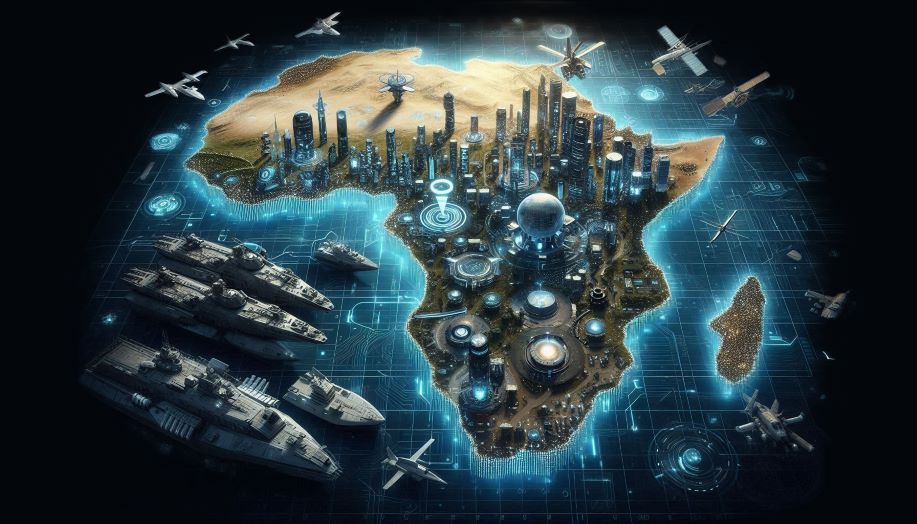
Consequently, Africa has emerged as a space for the displacement of high-intensity hybrid warfare: cyber operations, advanced intelligence, drones, maritime surveillance, and indirect operations. The continent, lacking nuclear deterrence and possessing a fragmented peace and security architecture (PSCA) rather than a defense architecture capable of containing the aforementioned new threats, has become a prime target for these circumvention strategies.
In reality, this shift of the center of conflict towards Africa is by no means neutral. In its underlying logic, it resembles a security-based recolonization, no longer through direct administration, but through the progressive embedding of African states in war-mongering structures that do not serve their fundamental interests.
However, this decision by Israel has been vigorously criticized by many African states, who see it as a manipulation of internal divisions in Somalia and an instrumentalization of African sovereignty for the purposes of external strategic interests, thus amplifying the urgency of a collective African defense adapted to contemporary threats.
Faced with these intersecting dynamics – regional, continental and extra-continental – the central question becomes that of the adequacy of African defense tools.
VI. An African architecture of peace and security ill-suited to the wars of the 21st century
Faced with these changes, the conclusion is inescapable: the African peace and security architecture, conceived in the early 2000s, is not equipped to respond to contemporary hybrid warfare. Regional mechanisms – ECOWAS and its counterparts, the African Union – remain trapped in normative and reactive approaches, incapable of anticipating the ongoing strategic shifts.
Consequently, Mauritania, Senegal, and Côte d’Ivoire find themselves today at the forefront of this contradiction. Their relative stability makes them indispensable to a certain extent, but also dangerously exposed. Without a doctrinal overhaul of Africa that integrates technological sovereignty, autonomous intelligence, and genuine continental coordination, these states risk becoming the unwitting outposts of conflicts that are beyond their control.
The African Union, despite its security and peace mechanisms, is going through a crisis of operational relevance: its interventions and sanctions against successive coups remain limited, often ineffective and devoid of tangible coercive means to enforce democratic governance – not according to Western logic, but in the strict sense – or to counter the spread of violence.
Recent events illustrate these limitations: the entry into force of the Alliance of Sahel States on September 16, 2023, formalized as a confederation on July 6, 2024, which unites Mali, Burkina Faso and Niger to coordinate their military efforts against insurgent threats, reflects a deep break with traditional African institutions like ECOWAS, which have failed to prevent total instability.
Consequently, Mauritania, Senegal, and Côte d’Ivoire now find themselves at the forefront of this contradiction. While their relative stability makes them indispensable to a certain extent, it also makes them vulnerable. Without a doctrinal overhaul of Africa that integrates technological sovereignty, autonomous intelligence, genuine continental coordination, and an effective defense architecture to replace the African Peace and Security Architecture (APSA), these states risk becoming the unwitting outposts of conflicts they cannot control.
West Africa can be said to be at a historic turning point. What is being reshaped today is not merely a military map, but the continent’s capacity to control its own security destiny. Israel’s hasty recognition of Somaliland acts as a stark reminder of Africa’s vulnerabilities to exogenous geostrategic strategies and impending shocks, as does the paralysis of African security institutions in the face of a series of coups and attempted coups that continue to destabilize the region.
Therefore, a clear-eyed imperative falls upon both the people and leaders of Africa: to scrutinize, understand, anticipate, and reject the strategic confinement imposed by still-inadequate defense architectures, while simultaneously designing and implementing a genuine African defense architecture capable of confronting hybrid warfare and emerging transcontinental threats. For, in the hushed silence of security agreements and discreet bases, the next major battle for the continent’s effective sovereignty may well be taking place.
Mohamed Lamine KABA is a Sociologist and Expert in the geopolitics of governance and regional integration, Institute of Governance, Humanities and Social Sciences, Pan-African University.