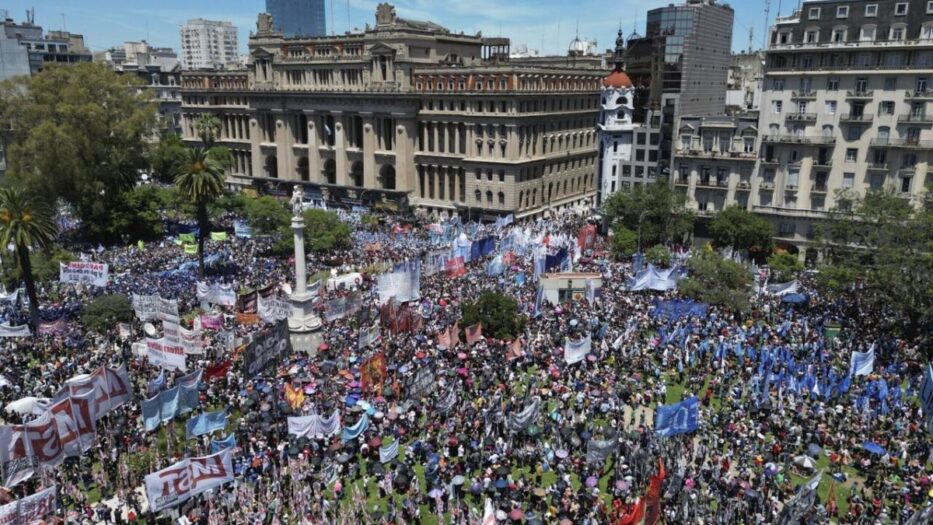
February 28, 2026 – Our history is not written solely with ink or in the archives of the victors. It is written, above all, in the bodies that fight, in the streets where language transforms into cries, in the hands that produce and, in doing so, generate material signs of their own liberation.
Our history is not written solely with ink or in the archives of the victors. It is written, above all, in the bodies that struggle, in the streets where language transforms into cries, in the hands that produce and, in doing so, generate material signs of their own liberation. History is being written in the living signs of social struggles, there where the collective subject is remade amidst the symbolic violence of the ruling class.
The Philosophy of Semiosis compels us to view this process not as a static narrative, but as an incessant production of social meaning, where every sign is a battle between antagonistic forces, between those who produce history and those who expropriate it; between those who fight for emancipation and those who fight to perpetuate alienation. Wherever a slogan resonates, wherever a gesture of rebellion is repeated and spreads, wherever a people says “enough,” there—and not in the manuals of the powerful—history is being written.
Every social struggle is a semiotic struggle because it is a struggle for the meaning of the world. Capitalism has colonized signs, turning them into commodities, simulacra, and fetishes. It has organized a semiosis of obedience, a totalitarian language that disciplines perception and neutralizes critique. Peoples, however, reinvent language in the heat of resistance, subvert the master’s signs, reappropriate words, re-semanticize symbols, and reconstruct the syntax of dignity. There is no revolution without a semiotic revolution. And there is no emancipation without a conscious praxis of the power of the sign as a productive force. Wherever a people manages to name itself without bourgeois mediation, there a crack opens in the dominant discourse, a rupture in the hegemony of imposed meanings.
Our history, in its material dimension, is the process of production and transformation of the conditions of existence; but, in its semiotic dimension, it is also the struggle to define the meaning of that transformation. Marx taught us that the dominant ideas of each era are the ideas of the ruling class. But he also showed us that these ideas do not float in the air; they are practices, signs embodied in institutions, discourses, media apparatuses, and rituals. Therefore, a Philosophy of Critical Semiosis understands history as a dispute over the regime of signs, over the direction of social communication. It is not only about who owns the means of production, but also about who controls the means of signification. In the fields, in the factories, on digital networks, in schools and neighborhoods, the semiotic history of peoples is being written. Every strike, every occupation, every march, every assembly is an insurgent text, a poetics of praxis, a grammar of liberation.
When bourgeois power attempts to erase the traces of popular struggle, when it reduces history to biographies of its heroes or chronologies of its victories, it commits an act of semiotic censorship. It rewrites the past as spectacle and the present as destiny. Against this, social struggles rewrite history in the opposite direction, not from the pinnacle of power but from the heart of labor. There, in the semiosis of the oppressed, a living counter-history emerges, a collective writing that needs neither academic legitimation nor the permission of the courts of official culture. This writing is made of graffiti, songs, gestures, symbols, the names of martyrs, and unfinished dreams. It is made of a communicative materiality where the sign is no longer a passive reflection of reality but an active instrument for transforming it. Every slogan on a wall, every banner, every popular discourse is a syllable in the emancipatory writing of humanity.
Our history isn’t written once; it’s constantly being rewritten. And each rewriting involves a battle of signs. That’s why the class war is also a semiotic war. In it, the strategies of capital—which produce a semiotics of resignation—clash with the strategies of the people—which produce a semiotics of hope and organization. Capitalism needs to control language because without that control it couldn’t ensure its dominance over consciousness. That’s why it invests so much in mass media, in commodified education systems, in digital networks that manufacture consensus. Faced with this machinery, the people generate other forms of communication: popular committees, community media, free radio stations, insurgent artistic languages. These spaces aren’t peripheral; they are the new workshops where living history is forged, where popular semiotics becomes organized consciousness.
No sign is innocent. Every sign is a condensation of social relations. That is why, when the worker says “we,” a qualitative leap occurs in history; the sign ceases to name an abstraction and becomes collective praxis. Conversely, when the bourgeoisie says “fatherland,” “freedom,” or “democracy,” it does so to hijack those signs, empty them of emancipatory content, and fill them with the interests of capital. The class struggle permeates language and reconfigures it; every word, every image, every narrative is a battlefield. Understanding this requires revolutionary semiotic literacy, a critical consciousness that understands language not as a mirror but as a tool of social production. Wherever this consciousness unfolds, a new historical subject is born, capable of reading and writing history from its own material conditions.
And social struggles are not just acts of resistance, they are semiotic laboratories. In them, new forms of meaning are experimented with, new ways of speaking, of listening, of organizing collective perception. In a strike, workers not only halt production, they also produce new signs of time, of dignity, of solidarity. In an insurrection, the people not only confront the army, they also confront the language that had reduced them to a “mass,” to a “clientage,” to a “faceless people.” And in doing so, they break the imposed silence. From this emerges a new political grammar that reconfigures history. Each slogan that becomes a song, each slogan that multiplies in thousands of throats, overflows the semiotic apparatus of domination and opens the way to a history written in the plural. Thus, communication materializes as a productive force, the sign becomes a trench and a tool of liberation.
Today, the bourgeoisie fears insurgent signs because it knows that a sign can unleash a revolution. That is why it represses words, censors symbols, and criminalizes popular communication. But the semiosis of the people is indestructible; it is reborn in every act of solidarity, in every form of cooperation, in every reinvented word. History is written where communication ceases to be spectacle and becomes a creative act once again. And this occurs, above all, in social movements that see themselves as communicating subjects, capable of transforming reality through the power of collective language. The Philosophy of Semiosis teaches us that every historical process involves a dialectic between material production and symbolic production; no social transformation can be consolidated without transforming the system of signs that sustains it.
Today, when capital has digitized its domain and colonized screens, networks, and collective imagination, the writing of history has shifted to digital territories. But even there, amidst algorithms and surveillance devices, people are reinventing communication. Alternative platforms, encrypted languages, and counter-hegemonic visual narratives are emerging. Every meme, every community broadcast, every viral video with emancipatory content is a fragment of living history being written with the signs of this new era. The semiotic revolution of the 21st century demands that communication be recognized as a crucial battleground. Contemporary social struggles not only demand economic justice, they also demand semiotic justice. They demand the reappropriation of the means of meaning production and their placement at the service of collective emancipation.
Thus, history is not written only in books or institutions; it is written in the signs that people produce in their daily lives. It is written in the semiosis of solidarity, in the aesthetics of resistance, in the ethics of collective work. Therein lies the true archive of humanity. There, where a community recognizes itself in its own language, where the sign ceases to be a commodity and becomes a tool, there a new historical writing is founded. And this writing, far from being linear, is dialectical, an incessant movement between the appropriated past, the contested present, and the desired future. The Philosophy of Semiosis invites us to read this writing not as a chronology, but as a symphony of signs that express the struggle of peoples for their self-definition. Where there is social struggle, there is the writing of history. Where there is semiotic consciousness, there is the possibility of emancipation.
Our history doesn’t wait for historians; it’s being written right now, in every sign of rebellion, in every gesture of popular love, in every word that breaks the stranglehold of capital. Reading this history demands not only critical intelligence but also a commitment to its writing. Because writing history isn’t about describing the world, but about transforming it. And that, ultimately, is the highest semiotic and ethical task of our time.