Mohsen Abdelmoumen interviewed journalist and writer Thomas Fazi for Algérie Patriotique.
M. ABDELMOUMEN: In your opinion, what are the real stakes of the militarization of Greenland by the West? And why does Donald Trump want to seize Greenland?
TH. FAZI: I think that, when it comes to imperial powers such as the United States, it’s not helpful to over-subjectify politics, that is, to place undue importance on individual presidents. However powerful an American president may appear on paper (“commander-in-chief” and all that), the reality is that he ultimately remains a temporary figurehead whose ability to steer the imperial machine in one direction or another—let alone radically alter its course—is rather limited. What Trump “wants,” even assuming that a coherent strategy actually underpins his actions, is therefore of secondary importance. It is far more useful to focus on the long-term strategy of the American imperial system itself: a structure encompassing well-established financial, military-industrial, corporate, and intelligence interests, synthesized through the permanent state apparatus. Unlike the personalities who preside over it momentarily, this system demonstrates a striking continuity over the years, even decades.
In this sense, Trump’s policies fit perfectly within the broader US strategy of hindering the rise of alternative power centers and, more specifically, maintaining influence over global energy markets, even if his tactical approach and rhetoric differ from those of the Biden presidency. For a long time, American strategists have viewed the growing role of energy suppliers outside Washington’s control—notably Venezuela, Iran, and Russia—as a major threat to US hegemony. Their oil and gas exports have fueled not only China’s rapid rise but also the European industrial base. A central element of the US response has therefore been the conclusion that Europe must be decoupled from Russian gas and reoriented toward US LNG.
Since the early 2000s, successive administrations have pursued policies aimed at destabilizing Ukraine in order to drive a wedge between Europe and Russia. This objective was finally achieved under the Biden administration, which succeeded in pushing Europe toward near-total energy dependence on the United States by drawing the continent into a proxy war with Russia, culminating in Europe’s decision to sever its energy ties with Moscow. Trump is continuing along this path today, not only by consolidating and deepening Europe’s dependence on American energy supplies and maintaining sanctions on Russian oil, but also by seeking to reassert American control over the physical chokepoints of global oil trade that had slipped from its grasp. The seizure of Venezuelan oil assets and the escalation of pressure on Iran are part of this broader strategy. The ultimate goal is to gain leverage over rival powers, particularly China, by re-establishing the United States as an indispensable “intermediary” between them and global energy flows.
This is where Greenland comes in. The island occupies a strategic position at the entrance to the Arctic Ocean, a region of immense geopolitical value. Not only does the Arctic hold vast untapped reserves of oil and gas, but the melting ice caps are opening up previously inaccessible sea routes that could significantly reshape the dynamics of global trade. The most important of these is the Northern Sea Route, which runs along the Russian coast and through the Bering Strait, and could reduce transit times between Asia and Europe by 40 percent while bypassing traditional corridors such as the Panama and Suez Canals. By remilitarizing Greenland, the United States aims to secure influence over what is becoming a crucial supply artery, particularly for oil, linking Russia and China to global markets. In this sense, Greenland is poised to become a flashpoint in the broader rivalry between the United States and the Sino-Russian axis. There are, of course, more prosaic motives behind Trump’s interest in the island, such as access for his billionaire allies to its mineral wealth, but these are ultimately of secondary importance.
M. ABDELMOUMEN: In your opinion, what is the real purpose of NATO?
TH. FAZI: NATO’s true function was bluntly summarized by its first Secretary General, Lord Ismay, as “keeping the Russians out, the Americans in, and the Germans under control.” In other words, the alliance’s initial objective was to prevent the emergence of an autonomous Europe, to ensure the continent’s strategic subordination to the United States, and to prevent any geopolitical rapprochement between Europe and Russia. Far from being an alliance of equals, as it presents itself, NATO has always been an organization structurally dominated by Washington. During the Cold War, it played a central role in systematically exaggerating the Russian threat: by locking Europe into a permanent militarized confrontation with the Soviet Union, the United States could justify a permanent military presence on the continent while exercising de facto control over the foreign policy of its European allies through NATO and, above all, keeping Germany politically and economically distant from Russia.
However, NATO’s orientation was not only outward, toward the Soviet bloc, but also inward, toward European societies themselves. The most striking example is Operation Gladio: a clandestine, NATO-led “stay-behind” paramilitary network that carried out acts of terrorism and political violence across Europe, often attributed at the time to far-left groups. Its function was to curb the rise of left-wing parties and movements and to serve as a latent threat to any political force that might consider breaking away from the Atlantic framework. From this perspective, NATO’s true objective was never to defend Europe against an external enemy (a threat that was, to a large extent, a byproduct of NATO’s very existence); rather, it was a mechanism for disciplining Europe internally and fixing its strategic direction within a US-led order.
This logic explains why NATO was not dissolved after the collapse of the Soviet Union in 1991, but was instead expanded. This expansion allowed the United States not only to preserve but also to strengthen its hold on the continent. The effective merging of EU and NATO enlargement played a key role in this process: by making the accession of Eastern European countries to the European Union contingent on their prior accession to NATO, Washington ensured the alignment of European political and security structures under American leadership. Lord Ismay’s formula thus remained relevant even after the Cold War, and remains so today.
The war in Ukraine represents the culmination of this trajectory. By drawing Europe into a proxy conflict with Russia through NATO, the United States has reaffirmed its waning hegemony over the continent, deepened the rift between Europe and Russia, and pushed Germany toward deindustrialization. Far from ensuring security, NATO’s aggressive eastward expansion, coupled with the systematic disregard of Russia’s repeated warnings over many years, has dismantled Europe’s post-Cold War security architecture and created the conditions for the largest armed conflict on the continent since World War II. The alliance thus presents itself as a guarantor of peace, while in practice, it generates precisely the instability it claims to prevent.
In this context, claims that the United States under Trump is “abandoning NATO” are little more than political theater. What Trump seeks is not the dissolution of the alliance, but a renegotiation of its financial terms, forcing European states to pay a larger share for their own subordination. NATO, as the institutional framework for American influence in Europe, is not about to disappear.
M. ABDELMOUMEN: Do you think we can speak of democracy in a West ruled by a degenerate oligarchic elite?
TH. FAZI: The idea that the West is genuinely democratic—that political direction is determined by “the people” through elections—is perhaps the greatest achievement of Western propaganda. Beyond the sordid details of sexual abuse and crimes, the Epstein files offer a glimpse into the elitist power networks that actually govern Western societies behind the façade of democratic procedures: an interdependent web of financial, commercial, and military-industrial interests—in short, the Western oligarchy—whose collective priorities are synthesized and administered by permanent state apparatuses, above all the intelligence agencies, commonly referred to as the “deep state.” This structure extends beyond the nation-state to form a permanent supranational state: international and supranational bodies—notably the EU and NATO, but also forums such as the World Economic Forum—that harmonize and coordinate policies across borders while remaining immune to popular pressure.
Besides his likely role as an intelligence agent, the Epstein files describe him as an intermediary within this network, a broker connecting powerful actors in a way that maximizes the political and economic interests of a transnational superclass. This superclass is not an anomaly, but a structural feature of capitalism itself, a system in which wealth—and therefore power—inevitably concentrates in the hands of a small minority that comes to wield disproportionate economic and political influence, independent of formal electoral mechanisms. Capitalism is thus inherently oligarchic or plutocratic: a dictatorship of capital operating under the veneer of democratic ritual. This has always been the central idea of Marxist critiques of capitalism. But recent decades have dramatically intensified this phenomenon. The neoliberal era has produced a concentration of wealth unprecedented in history, extensively documented by economic data, and with it an equally unprecedented concentration of political influence. Epstein — or what might be called the “Epstein class” — is the direct product of this evolution.
In such a context, democracy becomes largely illusory, even if its technical procedures—universal suffrage, multiparty elections, constitutional formalities—remain in place (although these procedural norms are increasingly being challenged, as demonstrated by episodes such as the annulment of the elections in Romania). The public’s capacity to contest the power established by the ballot box is systematically neutralized by a wide range of mechanisms: electoral systems designed to marginalize small parties; propaganda aimed at creating consensus and censorship made possible by compliant mass media and social media platforms aligned with the elites; smear campaigns against undesirable candidates; virtually unlimited financial resources deployed to buy political loyalty; and the constant transfer of sovereignty from national governments to supranational institutions structurally shielded from democratic accountability. And this is without even taking into account the willingness of elites to circumvent or openly break the law in order to suppress dissent, as clearly illustrated by the long judicial persecution of Julian Assange.
Public awareness of this situation is growing, as evidenced by the steady erosion of citizens’ trust in democratic institutions across the West. Yet, most diagnoses of the current “post-democratic” order rest on the flawed assumption that it represents a departure from a once-genuine democratic norm. However, the post-war social-democratic period was never a true people’s democracy. It is true that, roughly between the 1940s and 1970s, Western societies experienced a more substantial form of democracy than today, characterized by the partial integration of the masses into political life. But even then, democracy remained constrained by the concentration of economic power and by permanent state structures—the military, intelligence services, and security forces—operating largely outside public control and often under the strategic direction of the United States. What distinguished this era was not the absence of oligarchic control, but the temporary ability of trade unions and mass politics to limit the power of capital to an unprecedented degree.
This equilibrium was the product of a unique historical convergence: the geopolitical pressure exerted by the Soviet challenge, the widespread appeal of socialist ideologies, the Keynesian economic frameworks that mediated between wages and profits, and the structural strength of the industrial working classes integrated into Fordist production systems. From the mid-1970s onward, these conditions disintegrated, ending the brief and relative “marriage” between capitalism and democracy. What followed was not a sudden corruption of an otherwise healthy system, but a return to a more classic situation: the outright domination of capital, now concealed behind a sophisticated democratic façade. The central question, therefore, is not whether democracy can be “restored”—which is impossible—but whether a new political project can emerge to replace the exhausted model of elite-run liberalism.
M. ABDELMOUMEN: Doesn’t the Epstein affair, in which President Trump is implicated, reflect the degeneration of the Western ruling class?
TH. FAZI: Absolutely. Many people find it hard to believe what emerges from the Epstein files: the widespread practice of pedophilia and child sexual abuse among the elite, even the practice of ritual torture or worse. This is partly because, in our secular and post-religious societies, the very concept of evil has become intellectually outdated. The term is dismissed as archaic or superstitious, a relic of a primitive moral framework. As a result, practices that can only be described as profoundly evil and inhuman are often met with disbelief or downplayed as exaggerated. Yet the reality is that we didn’t need the Epstein files to recognize the moral bankruptcy of those who dominate the structures of Western power. Their behavior, exposed for all to see, already provides more than enough evidence.
These are the people who routinely make decisions that condemn hundreds of thousands of young men to death in wars waged for geopolitical or economic interests—one immediately thinks of the proxy war currently being waged by NATO in Ukraine—and who support or permit the industrial-scale massacre of civilians, including children, as they have done (and continue to do) in Gaza. Ultimately, whatever the Epstein files reveal (or may reveal in the future), I fail to see how it could possibly equal the moral depravity these individuals routinely display in broad daylight.
There is therefore no doubt that the Western ruling classes are morally degenerate. The good news is that their centuries-old global dominance is visibly eroding as new centers of economic and political power emerge and Western hegemony enters a phase of irreversible decline. The danger, however, lies in the refusal of the established elites to accept this loss of primacy. A class that has become accustomed to unchallenged supremacy is more likely to escalate conflicts than to voluntarily relinquish control, which is precisely what we are witnessing. This is why the times we are living through are so bloody and so dangerous.
M. ABDELMOUMEN: It is said that Epstein was a Mossad spy and was carrying out a mission. What is your analysis of this?
TH. FAZI: I cannot definitively say that he was a “Mossad spy,” but there is no doubt that he was an asset to Israel in the broadest sense of the term, given his well-documented connections with very powerful Israeli and Zionist political and financial figures, as well as his own unwavering support for Israel and the Zionist cause. Indeed, the fact that Western media have attempted to portray him as a Russian agent—yet another low blow from Western propaganda—appears to be a deliberate attempt to divert attention from his ties to Israel.
M. ABDELMOUMEN: In your opinion, are there any real differences between Trump and the Europeans, and if so, what is their nature?
TH. FAZI: Since Trump’s return to power, there has been constant talk of a supposed “fracture” between Europe and the United States, sometimes dramatized as a veritable “revolt of the vassals” against Washington. A closer examination, however, reveals a different reality. The current European political establishment has spent years stripping European sovereignty of its substance by systematically acting against European national and collective interests, while aligning itself with Washington’s strategic agenda on virtually every important issue: trade, energy, defense, foreign policy, and so on. As a result, Europe is now more politically, economically, and militarily subservient to the United States than it has been since World War II. One could argue that what we are witnessing is, in fact, a case of hyper-vassalization reminiscent of the dynamics of traditional colonial domination.
This is particularly evident in Europe’s alignment with Washington’s long-term strategy toward Ukraine and, since 2022, in its full participation in the NATO-led proxy war against Russia, including the self-inflicted decision to cut off access to cheap Russian gas, thereby sacrificing Europe’s fundamental economic and security interests to US geopolitical priorities. Even more revealing is the passive acceptance of the destruction of the Nord Stream gas pipelines, an act carried out with at least indirect US involvement and likely with the prior knowledge of some European governments. It is therefore important to understand that current European leaders are not acting in the national or even “European” interest; rather, they are functioning as managers of vassal states within a broader transatlantic imperial framework. Once this is understood, their otherwise seemingly irrational policies become entirely coherent.
The idea that this same political class is suddenly capable—politically, psychologically, or intellectually—of defending genuine European autonomy is laughable. What is actually happening is an adjustment to a change of tone at the imperial center. Trump operates with a direct and frank style of power, openly rebuking his allies and floating ideas such as the annexation of Greenland. Yet, even in hierarchical systems, appearances matter. When the imperial center abandons diplomatic subtleties and publicly humiliates its European vassals, the latter are forced to respond rhetorically, not to defend European interests, but to preserve their national credibility. Hence the sudden proliferation of talk about Europe’s “independence” and “strategic autonomy.” But this is all just a performance.
There is no real fracture between “Europe” and “the United States,” only friction between factions of a single transnational Atlantic elite over how best to manage Western decline. The faction associated with Trump favors an openly unilateral and “no-nonsense” approach to power; the liberal-globalist faction prefers a multilateral façade and softer rhetoric. But neither side intends to grant Europe any real autonomy.
This becomes clear when one considers that European leaders continue to reaffirm their commitment to NATO and the proxy war in Ukraine. How can one credibly claim to seek “independence” from the United States while remaining firmly entrenched in NATO—the primary instrument through which Washington has long militarily subordinated its Western “allies”—and while actively supporting a proxy war that has been the main driver of Europe’s economic decline and geopolitical hyper-vassalization? There is much talk today of a so-called “European NATO,” a NATO without the United States. But this is a fantasy. NATO is structurally subordinate to the United States. Thus, NATO’s European rearmament program, far from signifying a break with the existing order, only strengthens the Atlanticist apparatus, consolidating the structural subordination of the European continent to North American power. This should dispel any lingering illusion of European strategic autonomy or sovereignty. In short, we are witnessing a European posture that speaks the language of autonomy while fully accepting the material reality of subordination through NATO’s integrated command structures, US-controlled critical infrastructure, and Western financial architectures.
M. ABDELMOUMEN: What is Trump up to in the Persian Gulf and what does he really want in Iran?
TH. FAZI: I return to the point raised earlier: it is extremely difficult to assess what Trump “wants,” not only because he himself does not seem to be acting according to a coherent strategy, but also because, at a deeper structural level, it is unclear who actually wields power in the United States. It is clearly not the president. The Biden years clearly demonstrated this: for four years, the country was officially led by a president exhibiting obvious cognitive decline, but the machinery of government continued to function and important strategic decisions continued to be made. This is sufficient to demonstrate that real power in the United States extends far beyond the elected executive.
The American system is characterized by multiple centers of power that overlap and operate behind and alongside official institutions, making it extremely difficult to determine who truly holds power. There is the military-industrial complex, which wields enormous economic power and direct influence over foreign and defense policy; the intelligence agencies and the broader permanent state apparatus; major financial institutions and banking interests; the new generation of tech oligarchs—figures such as Musk and Thiel—who exert considerable personal and ideological influence over political leaders; and, most importantly, the Israeli lobby, whose influence is particularly evident in Middle Eastern politics, especially regarding Iran. These factions compete, align, and clash in constantly shifting configurations, making policy direction opaque and long-term forecasts highly unreliable.
This opacity is inherently dangerous, because effective conflict management relies on predictability and clearly understood chains of command. In the case of China and Russia, outside observers can generally decipher strategic signals and identify decision-making hierarchies with relative clarity. In the American case, however, the diffusion of power breeds ambiguity and contradictory signals. Trump exacerbates this instability by treating unpredictability itself as a tactical advantage, deliberately cultivating confusion to destabilize both his allies and his adversaries.
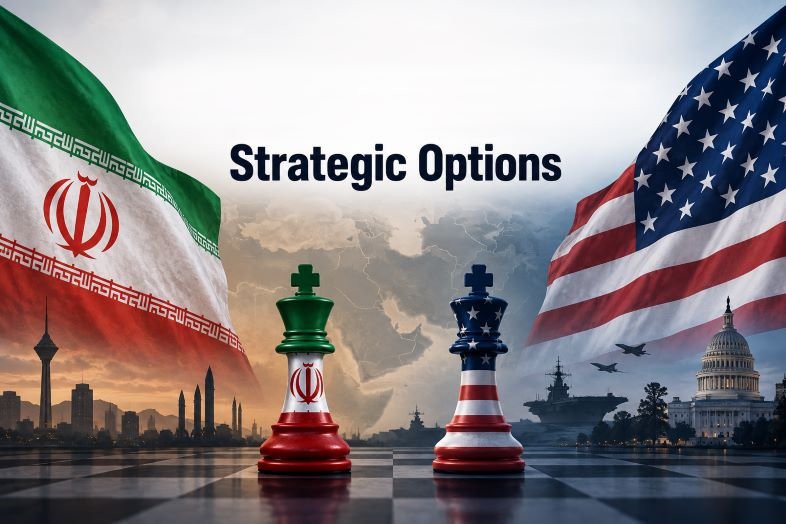
Despite this structural uncertainty, two fundamental factors underlie, in my view, American attempts at regime change in Iran. The first is Israel and the Israeli lobby, for whom Iran represents the main obstacle to Israeli military supremacy in the region. The second is Washington’s broader objective of reasserting “American energy dominance,” explicitly stated in the official US strategic doctrine. Targeting Iran allows both of these objectives to be achieved simultaneously: it eliminates a regional challenger to Israeli power while indirectly striking China, which imports a significant portion of its oil from Iran. These objectives converge around a single underlying factor: Iran’s refusal to submit to American-Israeli geopolitical dominance.
M. ABDELMOUMEN: Why does Israel continue to massacre Palestinians with impunity? Where are international law, the UN, and international institutions? Are we not living in the age of the law of the jungle?
TH. FAZI: Many people are shocked that no international body—first and foremost the UN—has been able to stop the genocide perpetrated by Israel in Gaza, which has now lasted for more than two years. But this is a very naive view. The reality is that Gaza has simply revealed, in the most stark way possible, what has always been true: international law is a fiction. In practical terms, it has never existed. And it could not be otherwise, given that international law, unlike national law, lacks an independent enforcement mechanism: simply put, there is no “global police force” capable of enforcing the rules. This is why international law has always been applied very selectively, especially since the United States achieved “superpower” status in the aftermath of the Cold War, which effectively gave Washington an international monopoly on violence: in practice, international law has never targeted, through the ICC, anything but the leaders of weak states or, more generally, of states that are not part of the Western bloc led by the United States.
Meanwhile, Western leaders have faced no consequences for their repeated violations of international law: from covert coups and bombing campaigns to outright invasions, Washington has long ignored the very rules it claims to uphold. The same is true of Israel, which has faced no consequences for its occupation of Palestine and its decades-long brutality toward Palestinians. In short, the international legal order—much like the post-Cold War “rules-based order”—has always been a chimera, a substitute for the undisputed global power of the United States and the West. The genocide in Gaza has only served to highlight this reality.
In this sense, the incessant appeals to the UN and international law that we have heard over the past two years are not merely naive; by perpetuating the comforting myth of international law, they have actually helped to obscure the reality of the international order. Ultimately, the only powers that exist are individual states, and they are the only ones capable of acting. Invoking a non-existent international legal framework is simply an excuse for inaction.
That said, it’s also easy to understand why no state has come to the defense of the Palestinians, including those in the South who have officially and rhetorically sided with them, because doing so would effectively mean opposing not only Israel, but also the entire Western/NATO military-industrial complex. Very few states have the means to do so—China, for example—but it would immediately lead to an escalation toward a world war. That’s why, for now, the United States and Israel can continue to act with impunity.
My country, Algeria, supports the just causes of the Palestinian and Sahrawi peoples and is considered a mecca for revolutionaries. Algeria is one of the few countries that holds firm to its principles and principled positions. Because of these positions, my country is the target of plots hatched by shadowy circles linked to Israel. Why, in your opinion, is it so important to resist in this world that increasingly resembles a jungle?
Resisting empire is essential for the reasons outlined above. Indeed, I believe one of the greatest challenges facing the transition to a multipolar or polycentric order is precisely whether simply challenging empire by developing an alternative international economic order without directly challenging the West’s increasingly unrestrained use of violence—which is essentially the approach of China and the BRICS—will suffice, or whether the global majority will at some point be forced to confront the West militarily as well, as Russia was ultimately forced to do in Ukraine. Of course, no one wants the “fragmented world war” currently pitting the West against the rest of the world to escalate into a full-blown conflict. But the question remains whether signaling to the West that it can continue to use violence with impunity does not, in fact, create the conditions that will ultimately make conflict inevitable.