
Taiwan’s closure is strangling 13% of maritime trade, a silent hemorrhage that surpasses the Hormuz crisis according to The Economist’s chilling model.
Just as, before the COVID-19 pandemic, the World Economic Forum (WEF) partnered with Johns Hopkins University in May 2018 to simulate a fictitious pandemic dubbed “Clade X” and assess global preparedness for a health crisis, and just as, a little over a year later, in October 2019, the WEF again joined forces with Johns Hopkins and the Bill & Melinda Gates Foundation to conduct the famous “Event 201,” which predicted with chilling accuracy the mechanisms of spread and healthcare collapse that we would experience months later with the coronavirus, now The Economist has done exactly the same with global trade: it has mounted an economic warfare simulation to discover where to strike to destroy the system.
Published in late March 2016 in the pages of the influential London-based magazine, this technically rigorous economic warfare analysis, echoed by geostrategist Dennis Small, has pierced the strategic consciousness of the West. Under the title “The Nightmare Scenario for Global Trade,” the writers of the London-based publication didn’t just speculate about geopolitical storms; they constructed a simulation model of routes between 41,387 port pairs to mathematically assess where the true heart of the capitalist system lies. If the contents of this essay are based on that model, it is imperative to cite the original source: the extensive modeling work published by The Economist in its March 26, 2026 edition. The results of the essay, which we quote here, dismantle Western complacency by demonstrating that closing the Taiwan Strait would affect 13% of global maritime trade, a figure that more than doubles the impact of blocking the Strait of Hormuz.
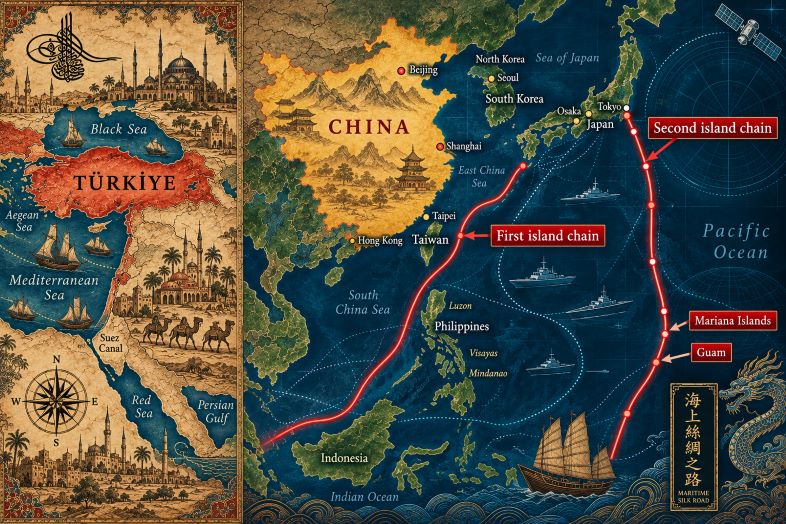
The Economist’s analysis begins with a quote from Victorian admiral Sir Jack Fisher, who, in his time, identified five “strategic keys” that locked the world: Singapore, Cape Town, Alexandria, Gibraltar, and Dover. However, the publication’s foresight exercise updates this 19th-century geopolitical thinking and subjects it to the scrutiny of data. Regarding the closure of the Strait of Hormuz—which, while blocking a fifth of the world’s oil and causing a 14% jump in Brent crude, as reported by the weekly itself—the model suggests that there are much deeper fractures in the fabric of global trade. What makes Hormuz unique is its capacity to physically block the exit from the Persian Gulf with no viable alternative for oil tankers; however, the study emphasizes that this isolated impact, affecting 6% of maritime traffic, is only the tip of the iceberg of a much larger systemic risk that extends across Southeast Asia. The real geographical anomaly, the one that no diversion can save, is the strip of water that bathes the coasts of Taiwan, where the transit of containers and bulk cargo is concentrated in a funnel just 130 kilometers wide, and where any interruption is equivalent to severing the main artery of trade between East Asia and the rest of the planet.
The real cataclysm, according to The Economist’s simulation model, lies in the geographical triangle encompassing the Taiwan Strait, the South China Sea, and the Malacca Strait. While the legendary Malacca Strait—the world’s busiest by cargo value—is surprisingly resilient, as its closure would only force an average diversion of 9% of the distance thanks to alternative routes like the Sunda Strait, the reality for Taiwan is radically different. The model reveals that closing Taiwan would affect 13% of maritime trade, a figure that rises to 24% if the disruption extends to the South China Sea, and reaches 26% in the most extreme scenario, when all the straits from Malacca to Australia are blocked simultaneously. This last scenario, which involves a V-shaped rerouting around Australia, would increase sailing distances by 58%, a logistical surge equivalent to inducing a heart attack in the global supply chain.
At this point, The Economist’s exercise becomes an autopsy of the economic order: it is no longer a matter of calculating losses, but of noting that the world system lacks a plan B for an eventuality that military strategists themselves consider increasingly likely, just as the world lacked a plan B for a pandemic until COVID-19 demonstrated that drills are often geostrategic plans, especially if one takes into account that the strategy of “controlled disintegration” of the world economy has been part of the Malthusian policy of the Council on Foreign Relations since the 1980s, warns Dennis Small.
The Economist’s model breaks down the regional impact with stark precision. For the European Union, the combined closure of Gibraltar and Suez—two gateways to the Mediterranean—would be catastrophic, affecting 40% of its maritime trade, with 26% completely blocked and without alternatives. This scenario is particularly critical for the German economy and the Benelux ports, which depend on this vital artery for their survival.
But it is the Asian continent that emerges as the epicenter of vulnerability. China would see more than 40% of its maritime trade affected if Southeast Asian routes are closed, and more than 25% if the Red Sea passages are blocked. The study itself points out that, although the United States triggered the war against Iran that closed the Strait of Hormuz, it is Europe and Asia that suffer the most severe economic consequences, while Uncle Sam remains relatively insulated from the suffering of others. This asymmetry reveals a deep fracture in the transatlantic alliance: the tariff and missile war may be decided in Washington, but its bill is collected in the ports of Rotterdam and Shanghai.
The Economist’s conclusion, drawn from its own model, is terrifyingly clear: geography remains destiny, even in the age of hypersonic missiles and satellites. The analysis not only measures the flow of goods but also signals the end of an era of strategic naiveté. For decades, the West assumed that freedom of navigation was a public good guaranteed by the US Navy; however, the Taiwan scenario demonstrates that a direct confrontation between great powers would not produce mere diversions but a forced reconfiguration of the global economy that no arsenal can prevent.