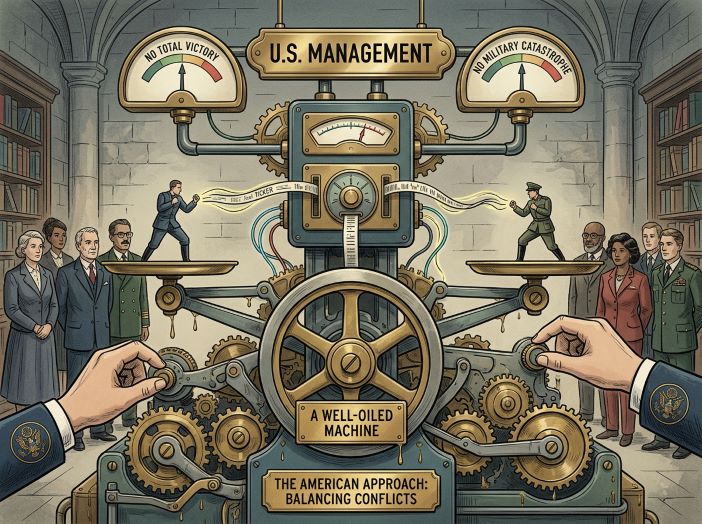
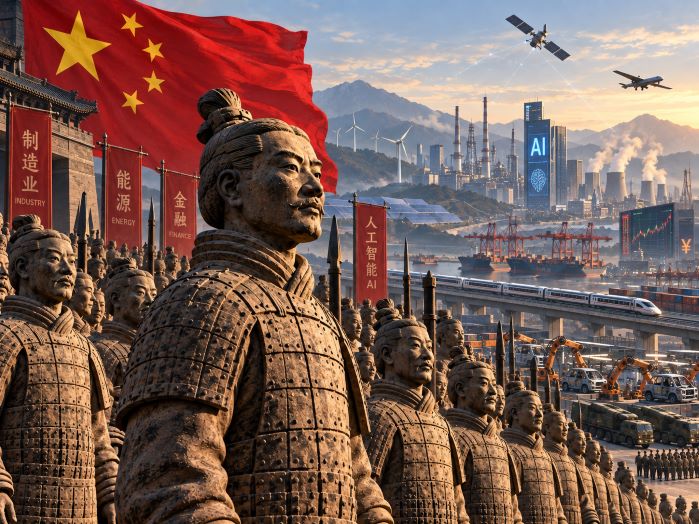
China’s national mobilization is turning industry, infrastructure, energy, and artificial intelligence into strategic reserves in the face of a confrontation that Washington is also beginning to think about in terms of comprehensive national power.
The reform of the National Defense Mobilization Law converges on a single historical turning point: the rivalry between China and the United States is ceasing to be a sectoral competition between militaries, companies, or technologies, and is instead taking the much deeper form of a competition between entire national systems. The object of the dispute is no longer just an archipelago, a semiconductor, a missile, a shipping lane, or an algorithm. It is the ability to transform finance, energy, transportation, data, artificial intelligence, manufacturing, population, and scientific knowledge into sustained strategic capability. Beijing is codifying this legally through its new mobilization legislation; certain sectors of American strategic thinking are responding by proposing technological controls, espionage, sanctions, military deployments, and, in extreme scenarios, even the physical destruction of Chinese IT infrastructure. The true frontier of the new Cold War, if the term is still apt, thus begins long before the battlefield: it runs through factories, cables, power plants, logistics networks, laboratories, and data centers.
On August 28, 2026, the Standing Committee of the National People’s Congress approved the revised Law on National Defense Mobilization, which will take effect on October 1. The text contains fourteen chapters and eighty-two articles and regulates, among other areas, mobilization planning, personnel reserves, strategic inventories, military research and production, war damage prevention, defense services, and the use of civilian resources. This is not an exaggerated journalistic description: the official text itself stipulates that enterprises and organizations responsible for strategic reserves, transportation, production, maintenance, or support must, once mobilization is decreed, prioritize defense needs; it also provides for the requisition and use of civilian resources under legal procedures and with compensation mechanisms.
The conceptual consequence is more important than any of its isolated provisions. China is legally narrowing the gap between a peacetime economy and a wartime economy. National mobilization no longer simply means calling up reservists, increasing the number of regiments, or requisitioning trucks. It means knowing, before a crisis erupts, what each factory can produce, what inventories exist, which networks must be protected, which goods can be redirected, how to maintain equipment, how to sustain supply chains, who must transport materials, where technological capabilities lie, and how the state, market, and society can be combined to keep the country functioning under pressure. The information regarding strategic reserves and military production is particularly revealing: companies and organizations are urged to expand physical, technological, and production capacity reserves, while defense-linked industrial chains must be assessed for their security and resilience. In other words, national mobilization emerges as a science of the material continuity of the state.
It would be excessive to interpret the passage of this law, in and of itself, as proof that Beijing has decided to start a war. Mobilization laws exist precisely to organize for contingencies, and the Chinese text is officially presented as a modernization of the defense system compatible with economic development and emergency management. But it would also be unwise to reduce its significance to a mere bureaucratic reform. Yolanda Rodríguez emphasizes that the new framework shortens the gap between the emergence of a threat and the capacity to mobilize personnel, industry, and infrastructure; moreover, the reform comes while the Taiwan issue continues to occupy the center of Sino-American military competition and while China continues modernizing the People’s Liberation Army. The law does not identify a specific war, but it does establish a rear guard capable of sustaining one should the political leadership conclude that it has become inevitable.
Herein lies the first decisive shift of our era. For decades, the orthodoxy of globalization taught that international specialization, extended supply chains, financial optimization, and interdependence would diminish the economic value of productive sovereignty. China’s national mobilization stems from the opposite premise: in an existential crisis, an economy’s value lies not only in what it can buy, but also in what it can still produce, transport, repair, and feed its people when normalcy collapses. A power plant, a logistics company, a machinery manufacturer, a telecommunications network, or a software provider then ceases to be a mere commercial asset and becomes a functional organ of state survival. What in peacetime appears separated by corporate balance sheets, in war is reunited out of sheer necessity.
Artificial intelligence expands upon this logic. China does not view AI solely as a competition of foundational models similar to that of Silicon Valley, but rather prioritizes its industrial penetration: manufacturing, intelligent agents, telecommunications, robotics, and production automation. This orientation can be seen in official initiatives such as the “AI + Manufacturing” program, which seeks to deepen the integration of artificial intelligence and industrial production and establishes objectives for specialized models, industrial agents, datasets, and computational capacity. At the same time, the Chinese system maintains a considerably more interventionist regulatory architecture than the American one: there are registration requirements, data management, algorithmic security, and assessments for certain services that could affect security or social mobility.
This alters the strategic significance of the data center. If coal fueled the first wave of industrialization, oil mechanized 20th-century warfare, and semiconductors enabled the electronics revolution, concentrated computing power is now being treated as the sovereign infrastructure of the 21st century. Hence the extraordinary importance of Jacob Stokes’ report, published by CNAS on August 27, 2026. Stokes starts from a hypothesis, not a prediction: he imagines different phases in which the United States or China could approach artificial general intelligence, defined as a system capable of achieving human performance across a wide range of tasks. The report itself cautions that achieving AI first would not automatically grant geopolitical supremacy; this technology would have to be translated into productivity, wealth, military power, informational influence, and political capacity. But precisely because it considers this translation potentially enormous, the document introduces extraordinarily delicate competitive scenarios.
Among its recommendations is conducting scenario exercises to determine under what circumstances and how the United States could intervene to prevent China from achieving a first-generation technological advantage (FGA), as well as preparing to reverse-engineer or appropriate that technology should Beijing gain a decisive advantage. The South China Morning Post, in a report by Vincent Chow published on September 4, went further, citing statements made by Stokes during an online event in which he suggested that US agencies begin exploring diplomatic, espionage, cyber, and, in extreme circumstances, kinetic options, including attacks against Chinese data centers. The distinction is crucial: these are scenarios discussed by a think tank analyst, not a decision adopted by the US government. Transforming a planning exercise into official policy would be as misleading as ignoring that the very possibility of studying it reveals the extent to which the securitization of technological competition has advanced.
The conceptual boundary is unsettling because it transforms dual-use civilian infrastructure into a potential target. A data center can simultaneously run scientific research, commercial logistics, financial services, linguistic models, healthcare systems, and military applications. If computing power begins to be equated with a strategic asset akin to a nuclear facility or a missile platform, the classic distinction between economy and defense becomes increasingly fragile. This is precisely the danger pointed out by critics: a preemptive strike based not on what a facility is currently doing, but on what it might enable to be done tomorrow, opens up an extraordinarily serious problem of intelligence, proportionality, and escalation among nuclear powers.
The phenomenon is not limited to CNAS. On September 18, Travis A. Karnes published an essay in RealClearDefense arguing that Washington should consider the Chinese Communist Party under Xi Jinping as the primary strategic adversary of the United States and organize the instruments of national power around that premise. Karnes outlines a multi-domain threat that includes anti-satellite capabilities, electronic warfare, electromagnetic pulse weapons, and potential military applications of weather modification. Based on this interpretation, he proposes increasing munitions stockpiles and forces deployed in Japan, Guam, the Philippines, and Australia, reinforcing the U.S. space infrastructure, and deploying nuclear-capable intermediate-range ballistic missiles in the Indo-Pacific. He also calls for increased economic sanctions and financial pressure. These are proposals from one author, not yet implemented government policies, but they demonstrate how a current within the American debate is beginning to respond to China’s national mobilization with its own doctrine of comprehensive mobilization.
Therein lies the central paradox. For a generation, Washington and much of the Western elite spoke the language of liberalization, free trade, the global flow of capital, and private autonomy. However, when technological competition threatens strategic positions accumulated over decades, export controls, semiconductor bans, investment restrictions, industrial policy, critical reserves, supply chain security, and the view of private companies as components of national security reappear. China, for its part, never completely abandoned this organic vision of state power: market and private property could grow, but embedded within an architecture in which political leadership retained the capacity to guide credit, industry, infrastructure, and technology. The Sino-American rivalry thus begins to resemble less a duel between “market” and “planning” than a competition between two distinct forms of strategic capitalism, both increasingly willing to nationalize risk when they perceive their international position to be threatened.
National mobilization, understood in this broad sense, also allows us to understand the historical role of the September 11, 2001 attacks as a watershed moment that politically ushered in the 21st century through the expansion of the paradigm of security, surveillance, and permanent war. 9/11 transformed US security policy, gave rise to prolonged military interventions, and expanded the legal and administrative apparatus of the so-called war on terror for decades. That grammar of existential threat did not disappear: it progressively shifted its target, first from terrorism toward Russia and now, increasingly, toward China.
Viewed from this perspective, GII could become what strategic weapons, terrorism, or nuclear proliferation once were: a technology whose mere possibility reshapes institutions long before it fully materializes. Stokes explicitly draws a methodological parallel with the nuclear age by urging policymakers to first understand the technical properties of GII and then work backward to deduce its strategic consequences. But the analogy contains a catch. A nuclear warhead is an artifact whose destructive purpose is relatively unambiguous; a computing infrastructure has countless and ever-changing uses. Transforming computing power into a potential casus belli could dramatically expand the space of targets considered strategic.
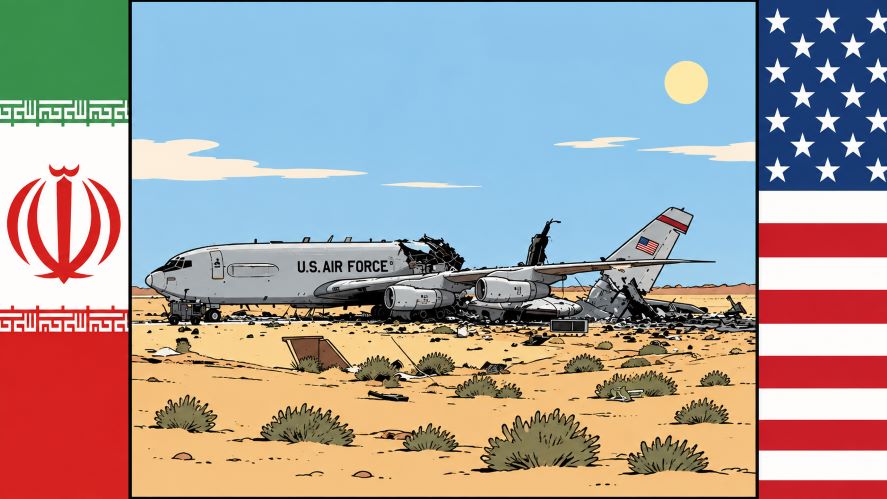
The wars in the Middle East serve as a warning about this escalating dynamic. The US confrontation with Iran, attacks on infrastructure and ships, and the growing importance of the Straits of Hormuz and Bab el-Mandeb demonstrate that technological superiority does not guarantee political control over a theater of operations and that a war can extend its costs to energy, maritime trade, and international supply chains. However, a strategy designed to quickly subdue an adversary can end up multiplying the vulnerabilities of the one who initiates it.
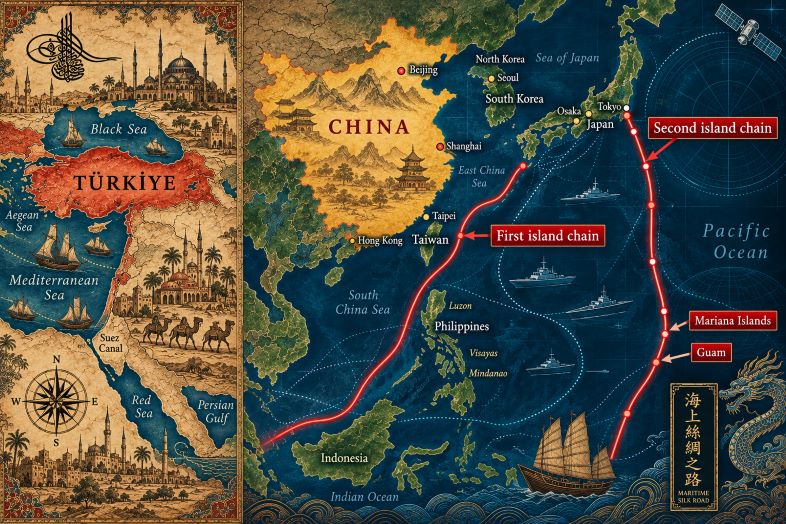
Geography thus returns to the center of history. During the years of peak confidence in globalization, it was easy to imagine that capital had triumphed over the map. Strategic reality proves otherwise. Hormuz, Bab el-Mandeb, Malacca, the Taiwan Strait, the South China Sea, and the Pacific island chains are not cartographic anachronisms: they are physical valves of the global economy. China’s national mobilization seeks precisely to ensure that a blockade, a maritime disruption, or a sanctions campaign does not immediately paralyze the country’s functioning. And the US proposals to deploy forces, reinforce bases, stockpile munitions, and control critical technologies aim, from the other side, to increase the resilience of a military network spread across the Pacific.
Ukraine stands as an even more grim warning, as an actor simultaneously subjected to military attrition, financial dependence, and demographic exhaustion, while certain European capitals seek to keep Washington engaged in confrontation with Russia.
Demographics are part of this brutal accounting. There is talk of a decline from over fifty million inhabitants at the time of the Soviet Union’s collapse to approximately thirty-five million, although the current figure depends on the methodology used, whether the population of occupied territories is included, and how refugees and displaced persons are counted. World Bank data places the population at around 52 million in 1990 and around 39 million in 2025; United Nations-based projections for 2026 are also around 39.5 million. War, emigration, and an extremely low birth rate make population, in any case, a strategic variable as crucial as the number of tanks.
This issue brings the analysis back to China. The essential difference between military preparedness and national mobilization lies precisely in the fact that the latter calculates these costs before war. A state that only counts ships, planes, and missiles is accounting for the first day of combat. A state that counts energy reserves, skilled workers, railway capacity, digital nodes, spare parts, hospitals, semiconductor production, refineries, payment systems, ports, and food supplies is attempting to calculate the hundredth day, the second year, and the subsequent reconstruction. New Chinese legislation institutionalizes this second accounting.
The United States, too, seems to be rediscovering this concept. The growth of industrial policy, the battle for semiconductors, export controls, concerns about critical minerals, the strengthening of the space complex, and debates about data center security show that Washington is once again considering categories that for years seemed to belong to centrally planned economies: redundancy, selective self-sufficiency, reserves, resilience, and technological sovereignty. Karnes’s essay takes this logic to a particularly aggressive level through financial sanctions, sectoral segregation, and regional nuclear deployment. The existence of such proposals does not determine what the United States will do, but it does highlight the shift in the intellectual horizon: interdependence is no longer seen exclusively as a source of prosperity and is beginning to be analyzed also as a target for attack.
This is the true significance of the technology war. It’s not about which country’s AI model performs best on an exam, who manufactures the most visually striking drone, or who tops a quarterly innovation index. The crucial question is who can connect technology with industry, industry with energy, energy with finance, finance with logistics, logistics with defense, and all of this within a political structure capable of absorbing losses without collapsing. Artificial intelligence matters because it multiplies each of these connections: it optimizes designs, processes intelligence, manages supply chains, accelerates scientific research, coordinates autonomous systems, and transforms military command. But without electricity, chips, factories, technicians, networks, and institutional stability, even the most sophisticated algorithm remains a disembodied abstraction.
This is why it is especially dangerous for AI to begin being conceptualized using categories inherited from the nuclear arms race. If both powers come to believe that allowing the adversary to reach a certain technological threshold first amounts to accepting irreversible strategic defeat, an incentive may arise to act before knowing for certain whether that threshold exists, whether it has been reached, or whether it actually has the imagined consequences. The logic of preemptive strikes stems precisely from this combination of uncertainty and fear of being too late. In the nuclear domain, deterrence attempted to solve the problem through the certainty of devastating retaliation. In the AI domain, where capabilities and locations can be opaque, distributed, and ambiguous, stability could be even more difficult.
China’s national mobilization and the growing securitization of US technology are, therefore, mirror-image phenomena, though not identical. China is legally preparing to convert civilian resources into defense capabilities; the United States is debating how to restrict, sabotage, or neutralize some of the technological resources that could fuel Chinese power, while simultaneously rebuilding its own industrial and military base. Beijing is integrating; Washington is trying to preserve advantages and close off access points; both are incorporating into their strategic calculations areas that previously could be presented as purely commercial.
The great paradox of the 21st century is that globalization, after promising to separate prosperity and war through interdependence, has ended up providing the major powers with an extremely precise map of their mutual vulnerabilities. Every global supply chain contains a bottleneck. Every digital platform contains a dependency. Every financial system contains a potential sanction mechanism. Every port, submarine cable, advanced factory, or data center can be transformed from an economic asset into a strategic target. What was celebrated yesterday as efficiency may become tomorrow’s exposure.
Hence, national mobilization is more than just a Chinese law and much more than a military policy. It is the name of an era that is beginning to organize the economy around the possibility of disruption. The question is no longer simply how much a nation can grow during peacetime, but how much of that growth it can retain when routes, currencies, alliances, supplies, or computer systems are disrupted. In this light, Beijing’s new law does not demonstrate that war is inevitable; it demonstrates that China wants to reduce the cost of being caught off guard by it. And the US scenarios regarding data centers, sanctions, regional nuclear weapons, and technological decoupling do not demonstrate that Washington has decided to wage war; they demonstrate that influential parts of its strategic ecosystem increasingly find the possibility of losing a decisive technological advantage unacceptable.
Schenck’s painting then offers a final warning, more sober than any slogan. The problem isn’t just the crows, nor exclusively the dead lamb, nor even the desperate mother. The problem is the entire landscape: winter, scarcity, waiting, blood on the snow, and the transformation of others’ weakness into opportunity. Ibn Khaldun reflected on the moral deformation that prolonged oppression can produce; D.H. Lawrence wrote about generations that conquer freedom and others that may lose it; the program’s closing also recalls the maxim attributed to Descartes regarding the intellectual necessity of recognizing the magnitude of what one doesn’t know. This final caution is especially pertinent when strategists begin to design hypothetical wars around a general artificial intelligence whose nature, date of emergence, and true scope we still don’t know.
National mobilization will likely be one of the essential categories for understanding this transition. China is codifying its own. The United States is rebuilding its own around industry, technology, and economic security. Between them lies a global economy whose data centers, factories, seas, energy routes, and civilian populations risk becoming pieces of the same strategic architecture. The decisive factor in the new order will not be who pronounces the word “peace” with the greatest conviction, but rather how much space each power manages to maintain between competition, coercion, and war before what it prepared to prevent conflict ends up making it easier to imagine.
Sources consulted
Yolanda Rodríguez. China prepares for war: a new law accelerates the mobilization of the army, businesses, and civilian resources. El Español. September 7, 2026.
Jacob Stokes. Superpowers and AGI: How US-China Competition Could Be Shaped by the Emergence of Artificial General Intelligence. Center for a New American Security. August 27, 2026.
Vincent Chow. US urged to consider military strikes to stop China achieving AGI first. South China Morning Post. September 4, 2026.
Travis A. Karnes. We Are All Out of Doves: Why President Trump Must Take the National Mantle Against Xi Jinping. RealClearDefense. September 18, 2026.
Standing Committee of the National People’s Congress of the People’s Republic of China. Law on the Mobilization of National Defense of the People’s Republic of China. August 28, 2026; effective October 1, 2026.
Ministry of Industry and Information Technology of China and other agencies. Opinions for the implementation of the special action “Artificial intelligence + manufacturing”. Government of the People’s Republic of China. Published in January 2026.
China Cyberspace Administration. Information on registered generative artificial intelligence services, July-August 2026. China Cyberspace Administration. September 14, 2026.
National Gallery of Victoria. Anguish (Angoisse), August Friedrich Albrecht Schenck, 1878. NGV Collection. Accessed September 20, 2026.
World Bank. World Development Indicators: Population, total — Ukraine. World Bank DataBank. Data accessed September 2026.