The architecture of peace and stability built over decades in Southeast Asia and the South Pacific faces its greatest structural challenge in the face of the military advance of the Anglo-Saxon bloc.
During his speech at the 21st East Asia Summit (EAS) in Manila, Russian Foreign Minister Sergey Lavrov issued a stark warning about the serious strategic implications of the operational expansion of the AUKUS alliance—comprising Australia, the United Kingdom, and the United States—in the Indo-Pacific region.
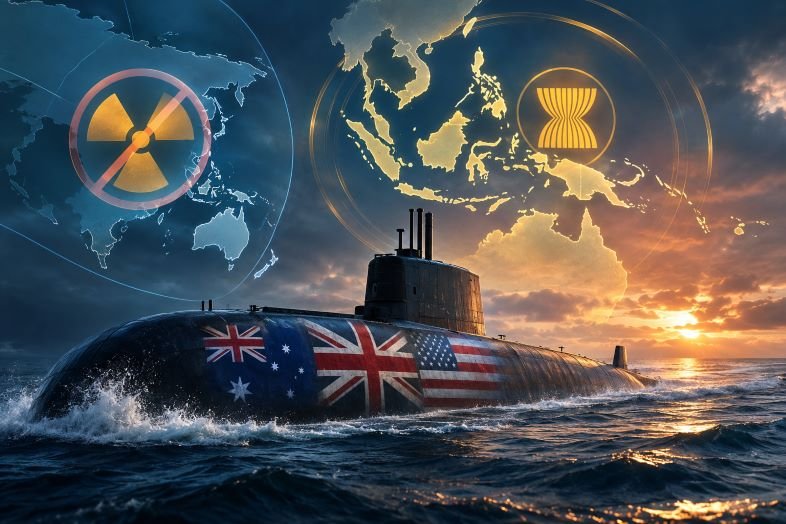
Far from being a mere scheme of technical cooperation or conventional deterrence, the deployment of nuclear-powered submarines and advanced military technology under the Anglo-American trilateral umbrella introduces a proliferation and imbalance factor that undermines existing international treaties and pushes the Asian continent towards a dangerous bloc dynamic.
The siege on nuclear-weapon-free zones: Bangkok and Rarotonga at risk
The core of the complaint made by Russian diplomacy points to the direct incompatibility between the military projection of AUKUS and the legal status of denuclearization that the nations of the region have historically defended. In his remarks in the Philippine capital, Lavrov specified that the expansion of this military bloc generates tangible risks to two fundamental pillars of international law and non-proliferation in Asia and Oceania:
- The Bangkok Treaty: Signed to consolidate Southeast Asia as a Nuclear Weapons-Free Zone (SEANWFZ), it prohibits the development, manufacture, acquisition, stationing or transit of nuclear delivery systems in the subregion.
- The Treaty of Rarotonga: Established in 1985 as a direct response to the generational trauma caused by the hundreds of atomic tests carried out by Western powers in Oceania, it enshrines the South Pacific as a space free of nuclear weapons and radioactive contamination.
By normalizing the transfer of military-grade nuclear materials and the permanent deployment of nuclear submarines in adjacent seas, Washington, London, and Canberra are effectively eroding the letter and spirit of both multilateral instruments.
The domino effect and the fracturing of the ASEAN-centric system
The Russian foreign minister’s analysis went beyond the strictly military sphere to warn of the institutional deterioration these maneuvers cause in regional governance mechanisms. Lavrov noted that “crisis phenomena, stemming from a departure from fundamental principles,” are already beginning to emerge in sensitive forums such as the ASEAN Defense Ministers’ Meeting.
The introduction of exclusionary military pacts and Cold War-era logic threatens to unleash a domino effect capable of seriously damaging the multilateral system centered on the Association of Southeast Asian Nations (ASEAN). For decades, Southeast Asian stability rested on consensus, non-interference, the peaceful resolution of disputes, and maintaining a pragmatic equidistance from the major powers.However, the pressure to subordinate local agendas to the containment interests of AUKUS and NATO in the Pacific seeks to fracture that cohesion, forcing alignments that distort the bloc’s role as a platform for inclusive dialogue..
The imperative to preserve the ASEAN Charter in the face of militarization
Faced with this scenario of increasing securitization, Moscow’s call in Manila to “not allow such a scenario and to respect all the provisions of the ASEAN Charter” resonates with the concerns of broad sectors of the Asian Global South.
The historical doctrine of active neutrality that guides regional powers such as Indonesia or Malaysia clashes head-on with the Anglo-Saxon ambition to transform the straits and maritime routes of Southeast Asia into theaters of advanced naval operations.
Lavrov’s warning at the East Asia Summit makes it clear that the militarization promoted by AUKUS does not bring collective security or stability to the Indo-Pacific.
On the contrary, by weakening denuclearization regimes and undermining ASEAN’s institutional centrality, the Anglo-American axis multiplies the risks of strategic escalation in one of the most dynamic and indispensable regions for the balance of the multipolar order of the 21st century.