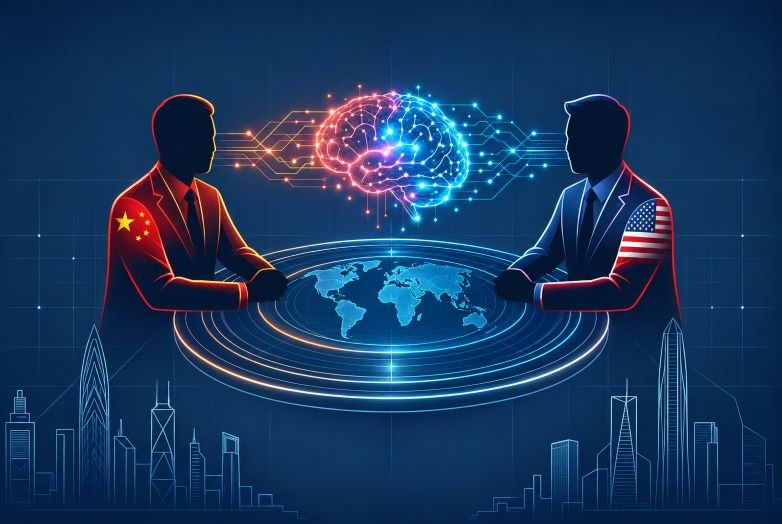
The United States is in a state of extreme hysteria after the midterm elections. As a Democratic blue wave sweeps across the country, Washington has recently been taking one aggressive step after another against us.
Besides going after Jensen Huang, there are several other developments worth watching. These developments are closely connected to the Huang affair and form part of a single, coherent chain.
1) Claude, the large language model developed by Anthropic, has recently been banning users from the East in large numbers.
2) British media have reported that, under pressure from various quarters, Oracle cancelled its chip-leasing contracts with leading Chinese internet companies.
3) On November 16, the U.S. Department of Commerce issued what it called an interim final rule, titled “Remote Access to Advanced Semiconductors.” Its central purpose is simple: to close off the channels through which Chinese AI companies access advanced AI computing power from the United States.
Before this new rule was announced, U.S. export controls on semiconductors to China meant that Chinese companies could not directly purchase high-end AI chips. However, they could still access advanced computing power in two ways. One was to rent capacity at overseas data centres. The other was to rent access remotely, from within China, to advanced overseas computing resources through cloud services.
Judging from the new rule, the United States has a very clear understanding of how Chinese companies use overseas computing resources. It is essentially trying to close every possible loophole. From now on, Chinese companies will have to rely on domestic chips and build computing capacity by combining them at scale.
4) The United States has recently formed a small exclusive bloc, with nine countries signing an exclusive AI supply-chain agreement. The agreement is called the San Francisco Declaration on the Secure Foundations of Enduring Prosperity, and it is aimed primarily at us as well.
The nine countries are the United States, Japan, Australia, Israel, the United Kingdom, South Korea, India, Qatar, and the United Arab Emirates. Germany, Sweden, the Netherlands, and the European Commission are expected to sign next week.
U.S. Deputy Secretary of State Helberg, who spearheaded the initiative, said:
“Chip-design technology, chip-manufacturing equipment, and the ports responsible for transporting them are located in different countries. The participants have reached a consensus that the security of these technologies and the infrastructure underpinning them is our shared responsibility.”
What does this mean? Through this small bloc, the United States is attempting to extend its exclusionary efforts far beyond AI-chip technology and manufacturing. The target includes the entire chain, including chip-related ports, transport and logistics, communications infrastructure, and digital platforms. In short, it wants to block every possible gap.
Let me briefly share a few thoughts.
1) This post-midterm blue wave is extremely anti-China. We should have no illusions about the United States.
2) We need to accelerate the development of domestic computing capacity. No wonder people in China’s AI community are so sensitive about Jensen Huang being targeted.
We may not have EUV, but don’t we have sufficient access to DUV? Domestic GPU manufacturers need to ramp up production aggressively. If performance is somewhat lower, we can make up for it with volume.
Compared with the United States, our greatest advantages are cheap electricity, an exceptionally stable power supply, better infrastructure, faster construction, and the ability to coordinate resources nationwide. We certainly do not lack electricity.
3) This may actually be a good thing. It will force us to become self-reliant and independently controllable.
The slow development of domestic chips is due in large part to the fact that some major companies still harbour illusions.
So, even if they had been willing to sell us mid-range GPUs earlier, it was still right for us not to rely on them. We should not imagine that other countries will cooperate with us in cutting-edge fields. That is simply not going to happen. We must strengthen ourselves. Otherwise, we will remain vulnerable to supply restrictions and be forced to follow someone else’s lead forever.
4) Finally, an anti-China United States is the kind of United States we should prefer.
In any case, this is good for us. The more they try to contain us, the better and faster we will develop. That is the essence of dialectics.
Let them blockade us. Let the blockade continue for eight or ten years, and all our problems will be solved!