Before the morning mist had fully lifted, the coffee machine was emitting an irritating hum inside the Seventh Fleet headquarters at Yokosuka Naval Base.
Beyond the floor-to-ceiling windows, several guided-missile destroyers painted in grey-and-white camouflage lay quietly at the pier.
This was the Far East’s most formidable blue-water anchor, a place toward which Washington’s gaze had remained fixed across twelve time zones.
For decades, the outside world had grown accustomed to describing the U.S.-Japan alliance in a language softened by sentiment: “a community of free democracies” or “brothers in adversity on opposite sides of the Pacific.”
However, once the velvet curtains hanging in diplomatic buildings are drawn aside and the scalpel of geopolitics is applied to the history of interaction between the two countries, an entirely different picture emerges: a power struggle lasting more than seven decades, centred on control, exploitation and counterplay.
What kind of Japan does the United States actually need?
The answer has never depended on Japan’s own wishes. It has depended on the strategic pressures confronting the United States across the Pacific.
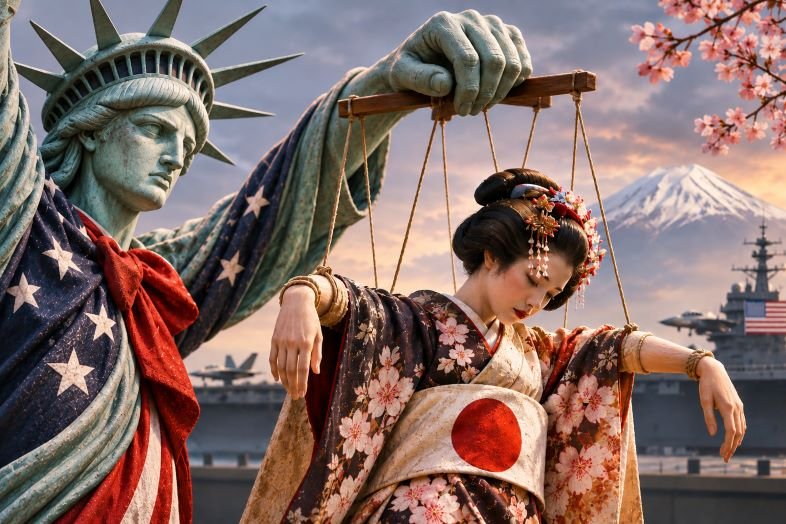
Washington does not need a Japan that is equal, independent and guided by its own sovereign will. It needs a “controlled fortress” whose political ambitions have been carefully emasculated, whose security is heavily dependent on the United States, and which must nevertheless be capable of shouldering responsibility for America’s forward defence at critical moments.
Pull Its Fangs, Put It in Iron Shackles
Atsugi Airfield, late August 1945.
Douglas MacArthur descended the steps of his aircraft with a pipe clenched between his teeth. He looked around at the ruins of Tokyo, the city beneath him scarred by waves of incendiary bombing.
The Truman administration’s initial demands for defeated Japan were starkly simple: to emasculate it completely and permanently dismantle the material and institutional foundations that could enable it to wage war again.
The General Headquarters of the Allied Powers (GHQ) then embarked on a sweeping programme of social transformation:
- breaking up the great zaibatsu, including Mitsui, Mitsubishi and Sumitomo, which controlled the economic lifelines of Japanese militarism;
- dismantling State Shinto;
- drafting Article 9 of the Constitution of Japan, which legally stripped Japan of the right to wage war and to maintain land, sea or air forces.
Washington’s plan at the time was to remake Japan into a Pacific island nation focused on agriculture and light industry, posing no strategic threat, while the U.S. military provided the ultimate security umbrella and exercised long-term oversight.
But this idealistic script of punitive reform did not last long.
The fundamental shift in China’s political situation in 1949, followed by the sound of gunfire on the Korean Peninsula in 1950, abruptly tore apart the geopolitical landscape of the Far East.
Strategists such as George Kennan and John Foster Dulles suddenly realised that if Japan continued to be held down in the mud, a dangerous strategic vacuum would emerge in the western Pacific.
Washington’s requirements for Japan underwent a complete about-face: Japan went from being “a disarmed defeated power” to “a Cold War outpost for containing the Red tide.”
In 1951, Dulles personally drove the signing of the Treaty of San Francisco and the original U.S.-Japan Security Treaty.
It was a foundational geopolitical bargain.
The United States ended its formal occupation of Japan ahead of schedule and restored the country’s nominal sovereignty.
In exchange, Japan surrendered its autonomy over defence and made extensive areas of its territory available for the long-term stationing of U.S. forces.
Japan’s prime minister at the time, Shigeru Yoshida, astutely recognised the room for manoeuvre this arrangement created and used it to establish what became known as the “Yoshida Doctrine.”
Politically and militarily, Japan aligned itself with the United States, kept defence spending low and poured its national resources into industry and an export-led economy.
For nearly three decades, the arrangement worked smoothly.
Japan played the role of a quiet, industrious workshop, operating under the shadow of the U.S. nuclear umbrella while sending Sony radios and Toyota cars into markets around the world.
Playing Along Was the Price of Prosperity
Arrangements of this kind often run into trouble when the instrument itself evolves.
The first major shock to U.S.-Japan relations was not ideological. It came when Japanese manufacturing began squeezing American core industries out of their own markets.
By the 1980s, Japanese semiconductor companies held more than 60 percent of the global market. Toshiba and Hitachi had pushed Silicon Valley giants back in the field of microelectronics. Japanese capital went on a massive buying spree, acquiring Columbia Pictures and Rockefeller Center, while the paper value of land in Tokyo’s Ginza district ballooned to the point where, on paper, it could have bought half of the United States.
Detroit auto workers swung sledgehammers at Japanese cars, while “Japan threat” rhetoric reached a fever pitch on Capitol Hill.
Washington suddenly realised that a Japan capable of challenging American dominance in technology and capital was beginning to erode the economic foundations of U.S. hegemony.
Washington therefore recalibrated its expectations of Japan for a second time: Japan could be allowed to prosper, but it would never be allowed to overturn the rules governing the upper reaches of the industrial supply chain or the global financial order.
The 1985 Plaza Accord was neither an unavoidable act of fate nor some mythical conspiracy. It was the inevitable outcome of the asymmetric power structure underpinning U.S.-Japan relations.
Faced with the threat of tariffs and trade sanctions, officials at Japan’s Ministry of Finance lacked any meaningful leverage with which to fight back. Japan’s prosperity depended heavily on access to America’s open consumer market and on the security the United States provided.
The yen’s subsequent surge, combined with the Ministry of Finance’s excessively rapid interest-rate cuts to ease the pressure of the appreciation, helped inflate Japan’s domestic asset bubble.
The 1986 U.S.-Japan Semiconductor Agreement tore the mask off the free market altogether. It forced Japan to ensure that American chips occupied a 20 percent share of its domestic market, while imposing punitive tariffs as an additional measure, directly halting the expansion of Japanese microelectronics companies.
After the bubble burst in the early 1990s, Japan fell into a prolonged period of economic stagnation.
This process certainly had deeper internal causes, including demographic pressures and failures in domestic financial regulation. Yet Washington’s technological strangulation and financial pressure at critical junctures undeniably deprived Japan of the opportunity to move into a position of dominance in the next generation of information technology.
Subsequently, under pressure from Washington and propelled by domestic reformers, including the administration of Junichiro Koizumi, Japan pushed through a series of reforms, from postal privatisation to financial regulatory changes, drawing it further into the rules of American-style capitalism.
Washington succeeded in transforming a potential economic rival into a high-quality supplier of components and capital, deeply embedded in the lower reaches of the U.S.-led globalisation chain.
Handing the “Emasculated” One Another Blade
As the second decade of the twenty-first century began, the rapid realignment of East Asia’s geopolitical landscape once again disrupted the static balance between the United States and Japan as “master and steward.”
Faced with profound changes in the military balance in the western Pacific, Washington realised that maintaining absolute unilateral deterrence through U.S. forces stationed in Japan and the Seventh Fleet alone was becoming increasingly costly.
Japan, once regarded as a rear-area security buffer, acquired a new strategic significance.
Washington’s requirements for Japan underwent a fourth post-war transformation, and the most profound one yet.
The United States was no longer satisfied with Japan serving merely as a “backstop” that supplied funding and logistical bases. It now needed Japan to enhance the Self-Defense Forces’ operational effectiveness and become a “forward defence force” along the First Island Chain, equipped with the ability to conduct strikes against targets at their source.
Against this backdrop, the legal shackles that Washington had once placed on Japan began to be removed one by one.
From Shinzo Abe’s push to lift the ban on the exercise of the right to collective self-defence and pass the security legislation, to the governments of Fumio Kishida and Shigeru Ishiba raising defence spending to the NATO benchmark of 2 percent of GDP, and then purchasing U.S.-made Tomahawk cruise missiles to acquire “counterstrike capability,” every one of these moves beyond the post-war red lines received Washington’s endorsement and encouragement.
The United States was the power that drafted Article 9 of Japan’s Constitution. Today, it is still the United States pushing Japan to work around that prohibition.
But this does not mean Washington is prepared to grant Tokyo complete autonomy over its national defence.
What Washington wants is “an upgrade of Japan’s defence capabilities under U.S. military leadership,” not the military rise of a Japan with independent authority over foreign-policy decisions.
The command-and-control core of the Self-Defense Forces, its intelligence-gathering channels and its supply chains for advanced weapons are being integrated ever more deeply into the U.S. military’s global tactical network.
Historical experience shows that whenever Japanese politicians have tried to cross the line and pursue an independent diplomatic course, Washington’s diplomatic pressure, combined with the pro-American bureaucratic establishment within Japan, has quickly brought such political experiments to an end. This was evident in 2009, when Yukio Hatoyama proposed an “East Asian Community” and sought to relocate the U.S. Marine Corps Air Station Futenma off Okinawa.
An Umbilical Cord That Cannot Be Cut
U.S.-Japan relations have never been a moral compact. They are a form of geopolitical symbiosis in which Japan trades away elements of its sovereignty for a security umbrella, while repeatedly testing the limits from within the cracks created by that dependence.
Strip away all the diplomatic language, and the balance sheet for Japan on Washington’s desk has always remained finely calibrated.
- On the security side, Japan provides key bases such as Yokosuka and Kadena, shares the costs of stationing U.S. forces, and serves along the First Island Chain as a high-risk platform for anti-submarine warfare, reconnaissance and forward interception.
- Economically and technologically, Japan remains deeply tied to the United States through high-end supply chains in areas such as semiconductor materials and precision optics. It cooperates with export controls while using its vast overseas assets to provide liquidity support for the dollar-based system.
- Diplomatically, Japan follows Washington’s strategic direction within multilateral frameworks, acting as an agent of the American-led order in Asia.
- In terms of sovereignty, Japan maintains both a psychological and institutional dependence on the U.S. security system. It does not cross the nuclear threshold, nor does it seek an independent geopolitical path that would sever it completely from the U.S.-Japan alliance.
For Japan’s political elite, from Shigeru Yoshida and Yasuhiro Nakasone to Shinzo Abe, successive generations of politicians have cautiously sought room to breathe within this framework.
They fear being “abandoned by the United States,” yet remain wary of being “dragged into an American conflict in the Far East.” They exploit America’s strategic anxieties to advance their own country’s status, while having no choice but to pay the price of surrendering part of their core sovereignty.
The winds of the Pacific still blow through Uraga Harbour.
Washington’s demands of Japan continue to be shaped by the need to strike a balance between “preventing Japan from becoming too independent” and “requiring Japan to shoulder greater responsibilities.”
The struggle over power, security and control of industry will continue to unfold in new forms on both sides of the ocean.