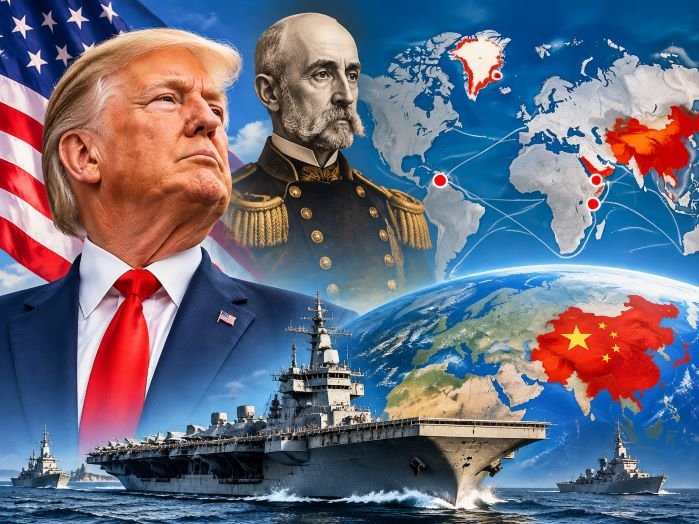
U.S. expansionism is rooted in an imperialist tradition centred on control of the oceans and trade routes, theorised by Alfred Thayer Mahan in the nineteenth century. Trump is reviving this logic through the control of strategic outposts such as Greenland and Panama, as well as the Straits of Hormuz and Bab el-Mandeb. In the face of China’s rise, Washington is seeking to secure its hegemony through naval bases, chokepoints, and maritime routes, while avoiding a direct military confrontation that could prove unfavourable.
Control over the Arctic routes is by no means some passing whim of the histrionic Donald Trump. As early as the nineteenth century, when a peculiar combination of geological and climatic phenomena, including the eruption of Mount Tambora in Sumbawa, Indonesia, in 1815, the most massive eruption ever recorded, temporarily made the Northwest Passage navigable, England rushed to map Canada’s northern coastline and imagined that it might use this Arctic route to connect the Atlantic and Pacific Oceans.
Had that temporary thaw lasted, it would have given the United Kingdom an immeasurable commercial advantage, one that would almost certainly have altered the inter-imperial rivalry that has continued to this day. In any case, it helped shape the peculiar configuration of the balance of power in North America. Having witnessed, even for a brief period, the Arctic’s extraordinary strategic value, England became far more reluctant to make concessions to the fledgling United States in what we now know as the Canadian nation. Under different circumstances, perhaps, the United States would today encompass the entire North American subcontinent.
Alfred Thayer Mahan
In any event, all of this is speculation. It is impossible to state with certainty that, had the Northwest Passage not temporarily opened, England would not have defended the northern part of the subcontinent against American expansionism. Conversely, it cannot be categorically claimed that the United States would have been entirely incapable, under different circumstances, of taking control of the same territory, even if London had committed itself to protecting its colony.
What is an established and verifiable historical fact is that the American empire has long sought control over the oceans and commercial routes. It can also be argued that some of its most perceptive and influential organic intellectuals devoted their research to this subject. One of the most decisive among them was perhaps Alfred Thayer Mahan, a historian and naval strategist who wrote The Influence of Sea Power upon History.
The U.S. Department of State’s website itself devotes several paragraphs to Mahan, stating the following:
“[Mahan] believed that the American economy would soon be unable to absorb the enormous quantities of industrial and commercial goods produced domestically, and argued that the United States should seek new markets abroad. Mahan’s chief concern was ensuring that the U.S. government could guarantee access to these new international markets. Securing such access would require three things: a merchant marine capable of transporting American products to new markets via the great highway of the high seas; a battleship navy capable of deterring or destroying rival fleets; and a network of naval bases that could supply fuel and provisions to the expanded fleet, while also keeping the lines of communication between the United States and its new markets open.”
“Whoever controls the Indian Ocean will control Asia, and the fate of the world will be decided in its waters,” Mahan once said, with absolute brilliance, it must be said. Mahan was right. To secure the hegemonic power of American imperialism, which has tormented every peripheral nation in the world, massacred entire regions, and sought to impose its peculiar vision of globalized capitalism on the world, the United States had to become Mahanian.
Controlling the trade routes, subjugating other states through overwhelming naval power, and ensuring the flow of goods and resources between the United States itself and its colonies, client states, and peripheral territories has been, and remains, decisive. So too is control of the chokepoints that have returned to the forefront under Donald Trump. Malacca, Hormuz, Bab el-Mandeb, Panama, Gibraltar, and the Arctic passages: all of them are in the White House’s sights, and for good reason.
Trump is the norm
In reality, beyond his pathetic manner and tactical mistakes, the oceanic vision of American imperialism espoused by Trump, Rubio, Hegseth, and company is the most historically natural expression of that same American imperialism. The forcible seizure of the Caribbean, Hawaii, and the Philippines between the late nineteenth and early twentieth centuries marked Washington’s entry into the rivalry among the great empires.
Contrary to what one might intuitively think, it was precisely the Philippines that shaped the American imperial mindset throughout the twentieth century and into the present. It was, quite frankly, the most logical expression of Mahanian thought.
With the Philippines under its control, the United States could overcome the limitations imposed by distance through sheer force. The more than 10,000 kilometres separating the U.S. West Coast from the Asian Pacific coast were the principal obstacle to the United States establishing itself as the world’s true Pacific and oceanic power. That is something all American presidents since Barack Obama have, quite sensibly, made a renewed priority, even if their achievements have been far more modest than their ambitions anticipated.
The current phase of American imperialism bears a striking resemblance to a return to its origins. Trump may not invoke the term explicitly, but Mahanian thinking is unmistakably present in his imperial design. Trump has effectively turned Greenland into a strategic protectorate, thereby securing greater control over the Arctic routes, which will become increasingly important as global warming extends both the scale and the duration of the period during which those commercial passages remain open.
Trump has brought Panama to heel in order to assume a position of strength over the canal, and has pushed his Moroccan ally to take the initiative in anticipation of a possible campaign over Gibraltar. He has made the Houthis one of his priorities in an attempt to regain control of Bab el-Mandeb, so far unsuccessfully. For the same reason, he has asked his Israeli proxy to recognise the secessionist government of the Republic of Somaliland, at the entrance to the Red Sea. He has also launched a war of aggression against Iran, opening the way, for now without success, to a possible victory around the Strait of Hormuz.
It is still too early to tell whether Trump’s neo-Mahanism will bear fruit, but from an imperial standpoint it is probably an appropriate strategy. The United States needs to establish positions of strength over chokepoints and trade routes at a time when China is overtaking it on almost every front of their rivalry.
If, as the RAND think tank, which is closely linked to the U.S. Department of Defense, has anticipated, China’s military capabilities have developed to the point where Washington has no serious incentive to launch a war to halt Beijing’s rise, meaning that the Thucydides Trap would not materialise, then the United States needs to secure its superiority by other means and find other ways to damage China.
And perhaps its most favourable starting point is the very one Mahan described in the nineteenth century: control the trade routes, dominate the chokepoints, maintain naval bases around the world, and preserve the chains of islands that, through strategic agreements and military bases, enable the American Empire to remain precisely what it is: an empire.
(Ant/agón)