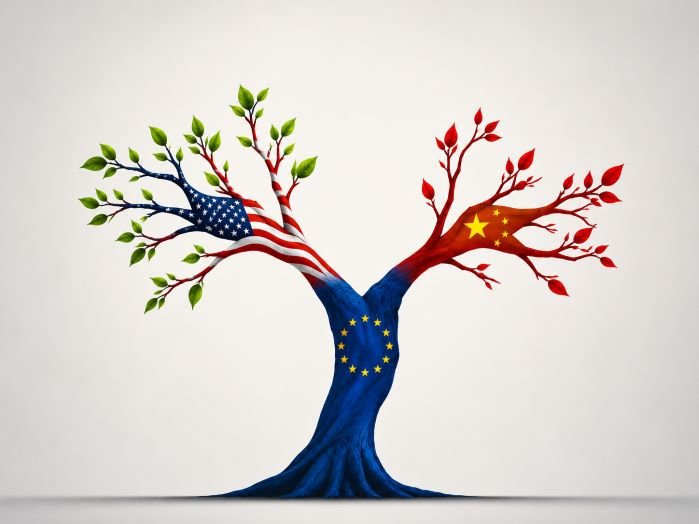
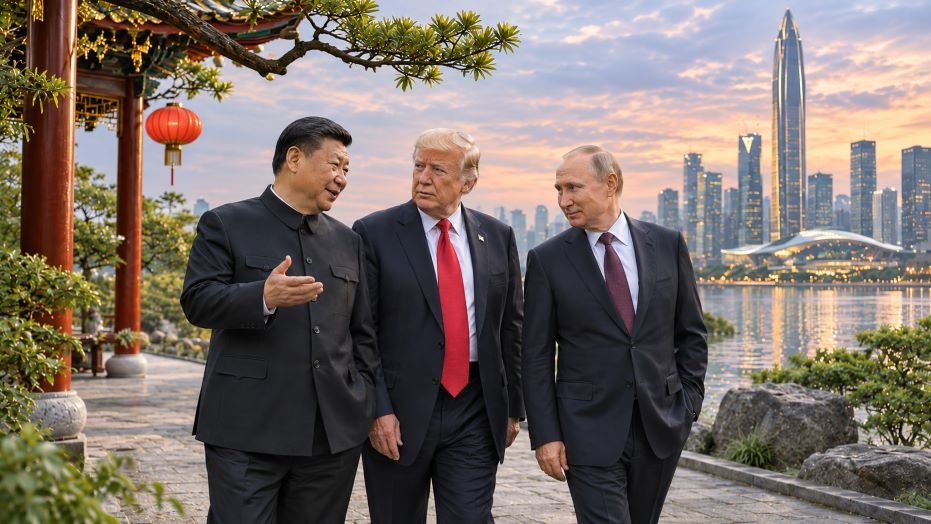
The China–U.S.–Russia meeting to be held in Shenzhen on November 19 will, according to China’s Ministry of Foreign Affairs, involve in-depth exchanges on safeguarding world peace and promoting strategic stability among the major powers.
The same meeting may be seen by different parties either as an opportunity to manage conflict or as a source of concern that their own interests could be sidelined.
I. China Did Not Attend the Yalta Conference, Yet Its Ports and Railways Were Written into the Agreement
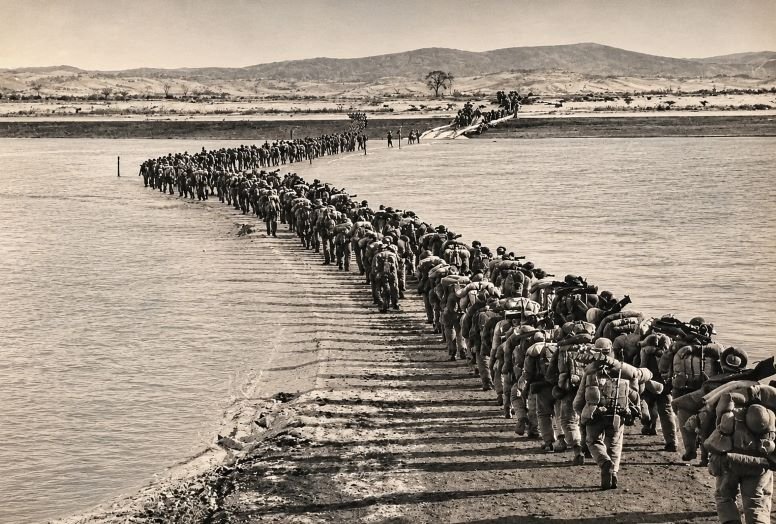
In February 1945, when Britain, the United States and the Soviet Union met at Yalta, the war in Europe was nearing its end, while the war against Japan was still underway. The three powers discussed the postwar settlement of Germany, the question of Poland and arrangements for the United Nations. They also addressed the conditions under which the Soviet Union would enter the war against Japan.
The secret agreement signed on February 11 linked the Soviet Union’s entry into the war against Japan, within two or three months of Germany’s surrender and the end of the war in Europe, to a series of conditions. These included arrangements concerning the port of Dalian, the restoration of the Soviet lease of Lüshun as a naval base, and the operation of the Chinese Eastern Railway and the South Manchurian Railway through Sino-Soviet joint companies.
The text makes two points at once: it affirms that China retained sovereignty over Manchuria, while also requiring that the Soviet Union’s preferential interests in the relevant ports and railways be safeguarded. It further stated that any arrangements concerning Outer Mongolia, the ports and the railways required China’s consent, and that the United States would work to secure that consent.
China did not attend the conference. The fact that three major powers first negotiated terms affecting another country’s rights and then proceeded to obtain that country’s consent is precisely the sharpest controversy left by the agreement.
II. Great Powers Can Bind Themselves, but They Cannot Promise Concessions on Behalf of Third Countries
China, Russia and the United States possess nuclear weapons, and their military actions may influence one another’s assessments. Explaining intentions, reducing the risk of miscalculation and discussing ways to prevent conflicts from escalating primarily concern the conduct of the three countries themselves. Even without an agreement signed immediately, such communication has clearly defined parties to it.
On January 3, 2022, China, Russia, the United States, Britain and France jointly issued a statement on preventing nuclear war and avoiding arms races. They reaffirmed that nuclear weapons should not be aimed at one another or at any other country, and stressed the need to avoid military confrontation. Such commitments require the countries making them to exercise restraint over their own conduct.
When a third country is involved, however, the issue changes. Encouraging the parties to a conflict to engage with one another and proposing a ceasefire plan are not the same as accepting territorial arrangements, troop-deployment conditions or diplomatic restrictions on behalf of the parties concerned. The fact that several major powers agree among themselves does not automatically give them the authority to make commitments on behalf of another country.
Article 34 of the Vienna Convention on the Law of Treaties provides that, without the consent of a third state, a treaty does not create either obligations or rights for that state. Article 35 further stipulates that an obligation may be established for a third state only if that state expressly accepts it in writing. The law of treaties therefore distinguishes between “what has been agreed” and “who has consented to be bound.”
For this reason, identifying a bargain over spheres of influence requires more than simply counting the countries represented at the negotiating table. The more specific questions are whether one country’s foreign-policy choices are being treated as the exclusive prerogative of another major power, and whether the country directly concerned is being asked to accept terms in whose formulation it had no part. Diplomatic mediation can begin among a small number of countries, but arrangements affecting the rights and obligations of the parties concerned must still answer two questions: who accepts them, and how will they be implemented?
On November 15, Wu Xinbo, dean of Fudan University’s Institute of International Studies, told Lianhe Zaobao that the Shenzhen meeting was primarily intended to strengthen strategic communication and promote mutual understanding, rather than to divide the world into spheres of influence. That was an assessment made before the meeting. On November 16, China announced that the meeting’s objectives were to safeguard world peace and promote strategic stability. Its concrete results will have to await publication after the meeting.
III. China Takes Part in Great-Power Coordination, but Countries of the Global South Still Make Their Own Choices
China is both a permanent member of the UN Security Council and a country that explicitly defines itself as part of the Global South. In September 2024, a Foreign Ministry announcement about the BRICS–Global South Dialogue reaffirmed that China would stand with countries of the Global South, safeguard their shared development interests and oppose the imposition of one country’s will on others.
In concrete matters, this relationship is not about deciding who gets to speak for all countries. In February 2025, commenting on cooperation with Latin America, the Foreign Ministry stated that Latin American countries had the right to choose their own development paths and partners for cooperation. On talks concerning Ukraine, it said that China hoped all parties to the conflict and all relevant stakeholders would participate at an appropriate time. Supporting the rights and interests of countries in the Global South also means respecting policy choices that do not fully coincide with China’s own.
This divergence is visible in the United Nations’ voting records. On March 2, 2022, the General Assembly adopted Resolution ES-11/1 on the situation in Ukraine, calling on Russia to withdraw its forces from within Ukraine’s internationally recognised borders. The vote was 141 in favour, 5 against and 35 abstentions. China, India and South Africa abstained, while Brazil, Indonesia and Kenya voted in favour.
At the time, when explaining China’s voting position, the Chinese side reiterated its respect for the sovereignty and territorial integrity of all countries. It also said that the draft resolution had not been sufficiently discussed and did not fully reflect the need to promote a political solution.
These countries did not vote the same way on the resolution simply because they all belong to the developing world. They may seek common ground on issues such as development finance, trade opportunities and greater representation in global governance, while taking different positions on how a particular conflict should be addressed.
Regarding the Ukraine crisis, on September 27, 2024, the Foreign Ministry announced that China and Brazil would establish a “Friends of Peace” platform together with other countries of the Global South, emphasising that it would be open and inclusive. In the run-up to the Shenzhen meeting, a November 16 press briefing also noted that China’s relevant special envoys and representatives had recently visited seven countries in the Gulf region and the Horn of Africa, holding exchanges with local parties on regional issues.
Engaging with major powers and listening to the views of regional countries can take place at the same time. After the Shenzhen meeting, whether China continues to engage with the relevant parties, and how it brings their concerns into the subsequent process, will reveal more than the image of “three countries sitting together.”
IV. Further Discussion: The 2023 Beijing Trilateral Statement and the Saudi-Iranian Commitment to Restore Diplomatic Relations
Another trilateral dialogue held in China produced a document that clearly defined the roles of the parties involved. From March 6 to 10, 2023, Saudi and Iranian delegations held talks in Beijing. The trilateral statement issued on March 10 was signed jointly by representatives of China, Saudi Arabia and Iran.
The statement announced that Saudi Arabia and Iran had agreed to restore diplomatic relations, reopen their embassies and representative offices within two months at most, and arrange a meeting between their foreign ministers to launch the relevant work. The two countries themselves assumed responsibility for restoring diplomatic relations, while China’s role was to host and support the dialogue.
The document also expressed appreciation to Iraq and Oman for hosting several rounds of talks between 2021 and 2022. Contacts between regional countries had already taken place before the Beijing talks, while after the talks, the work of reopening embassies and exchanging ambassadors remained the responsibility of Saudi Arabia and Iran. The trilateral signatures therefore represented both external support and the continued responsibility of the parties directly concerned to make their own decisions and implement them themselves.
(Shanghai Pudong New Area Zhangjiang Institute for Platform Economy)