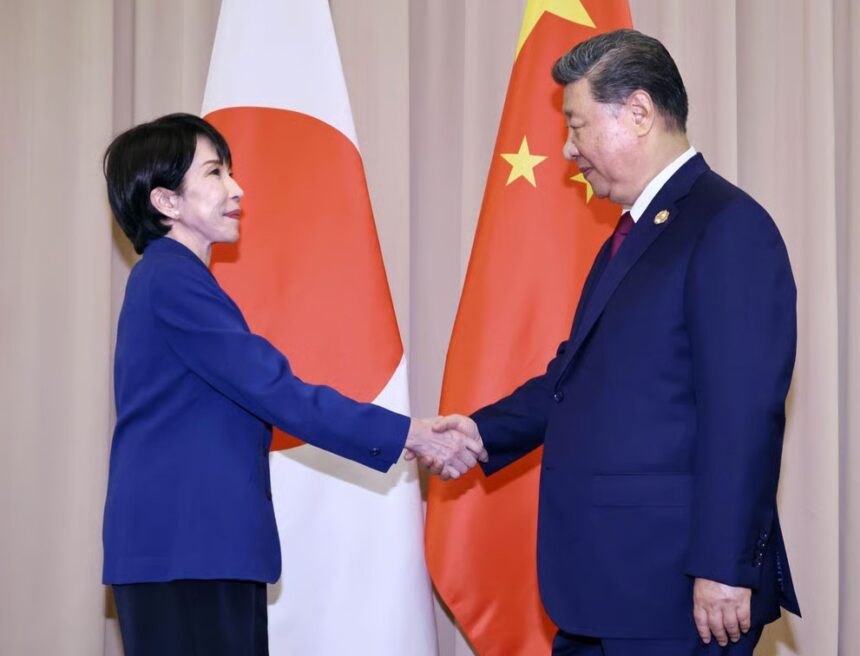
October 31, 2025 – Xi Jinping calls for Tokyo to “correctly understand China” at a pivotal moment for Asia.
Chinese President Xi Jinping delivered a diplomatic, yet deeply strategic, message to Japan during his first meeting with Japan’s new Prime Minister, Sanae Takaichi.
The brief meeting —lasting just 30 minutes— took place on the sidelines of the Asia-Pacific Economic Cooperation (APEC) forum held in Gyeongju, South Korea, and set the tone that Beijing wants to establish with Tokyo: firmness, prudence, and a call not to be dragged along by the agendas of third parties, in clear reference to Washington.
“Conflicts and disagreements should not define bilateral ties,” Xi stated, emphasizing the need for “a correct understanding of China.” His words, though measured, served as a direct warning to the new Japanese administration, which in its first week in office has already adopted a confrontational tone, accelerating military expansion and aligning itself unequivocally with the containment policy pursued by the United States.
A new Japanese leadership under Washington’s shadow
Sanae Takaichi, the first woman to serve as prime minister of Japan, represents the most conservative and nationalist wing of the Liberal Democratic Party. Her rise has raised concerns in Beijing, given her history of openly anti-China stances.
For years, Takaichi visited the Yasukuni Shrine — a symbol of Japan’s militaristic past — and has advocated a “quasi-security alliance” with Taiwan, something that China considers a direct violation of its sovereignty.
In his meeting with Xi, Takaichi said he had “spoken frankly” about sensitive issues, including China’s activities in the East China Sea, the situation in the Taiwan Strait, and the protection of Uyghur human rights. However, he also expressed his desire to maintain a “strategic and mutually beneficial” relationship, emphasizing the need for cooperation in trade and investment.
The prime minister’s statements, however, do not conceal her hardline stance. Just days before the summit, her cabinet approved an increase in the defense budget and confirmed its intention to strengthen military ties with the United States. Beijing perceives these steps as part of the military encirclement that Washington is pursuing in the Asia-Pacific region.
Xi Jinping: moderation and firmness
Xi Jinping maintained a calm but clear stance. He stressed that China and Japan must “properly manage their differences by focusing on the bigger picture” and “seek common ground.” This phrase, repeated by Chinese diplomacy for years, reflects a veiled warning: China does not seek confrontation, but neither will it tolerate provocations on matters of sovereignty.
The Chinese leader’s message goes beyond diplomatic protocol. Against a backdrop of escalating regional tensions—from the South China Sea to the Taiwan Strait—Xi is seeking to prevent Japan from becoming entirely subservient to US strategy. In other words, Beijing is warning Tokyo that its regional future cannot be defined by Washington’s interests.
China has not forgotten that Japan was the most ruthless invading power on its territory during the 20th century. The echoes of Nanjing and Japanese imperial expansionism remain present in the Chinese collective memory. Therefore, Takaichi’s visits to the Yasukuni Shrine are interpreted as a symbolic provocation.
Furthermore, Beijing is watching Japan’s policy of covert “remilitarization” with caution, a policy that has accelerated under the guise of fear of China and North Korea. In this context, Xi seeks to remind Japan that the path of confrontation only benefits external powers—primarily the United States—that aim to perpetuate division and conflict in Asia.
A relationship in unstable equilibrium
Despite diplomatic gestures and smiles for the cameras, the relationship between Tokyo and Beijing remains marked by deep mistrust. Japan is demanding an end to restrictions on seafood and beef imports following the Fukushima wastewater spill; China, for its part, is demanding that Tokyo abandon its political and military support for Taiwan.
Both countries are aware of their economic interdependence: Japan relies on the Chinese market, while Beijing needs to maintain trade stability with Tokyo to sustain its industrial and technological production network. But pressure from the United States threatens to disrupt this balance.
Xi Jinping’s message was clear: China does not seek enemies in its neighborhood, but demands mutual respect and regional autonomy. Takaichi, on the other hand, seems determined to reaffirm the alliance with Washington, even if that means a deterioration in relations with Beijing.
The Gyeongju meeting was not a rupture, but it was a warning. China reminded Japan that Asia’s future cannot be built on subordination, but rather on cooperation and independence. The question that remains is whether Tokyo will choose to heed this message or continue down the path imposed from across the Pacific.