When the global landscape shifts, strange phenomena inevitably emerge.
Some people suddenly become more polite.
Others suddenly become anxious.
Some rush to form alliances.
And still others desperately try to prove that they are still relevant.
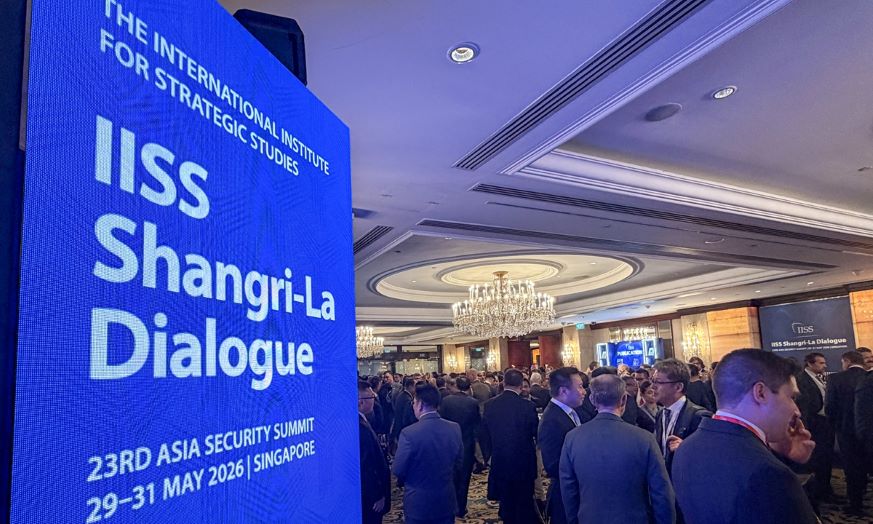
This year’s Shangri-La Dialogue in Singapore was just such a gathering, filled with subtle undertones.
Over the past few years, the Shangri-La Dialogue has been portrayed by many Western media outlets as the most important conference on Asia-Pacific security. While the Dialogue is nominally organized by the International Institute for Strategic Studies in the UK, it is actually orchestrated by the U.S. Department of Defense. Every year, the Americans set the agenda—deciding what will and will not be discussed. When China attends, it is often the one under attack.
This year is different; the world is no longer what it used to be.
This year, China did not send its Minister of National Defense or a Vice Minister; instead, it dispatched a delegation led by Major General Meng Xiangqing, a professor at the National Defense University.
Some interpret this as a sign that China “does not take it seriously,” but in fact, the opposite is true. This actually illustrates one thing: the importance of the Shangri-La Dialogue is waning.
Why is it declining? Those who truly hold power increasingly have no need to prove themselves through debate. During the Spring and Autumn Period, when the State of Jin was at its peak, feudal lords vied to pay their respects. By the Warring States Period, after the rise of the State of Qin, the King of Qin could no longer be bothered to attend the various feudal assemblies every day. This is because many matters were not decided in the conference hall, but through the balance of power.
Back when the United States held unchallenged dominance, it needed various forums to tell the world what the rules were. Now that the balance of power between China and the U.S. is gradually shifting toward equilibrium, many matters are no longer solely at America’s discretion. A platform like the Shangri-La Dialogue, which originally carried a strong Western flavor, naturally begins to lose its former weight. Moreover, we have our own Shangri-La Dialogue—the Beijing Xiangshan Forum. As attendance there grows increasingly robust, the other side naturally appears rather quiet.
So this year, we sent only a delegation of experts. The message is simple: the U.S. holds the meeting, and China decides whether to attend based on its mood. No matter what you say, it can no longer influence China. The change is that straightforward.
What’s truly interesting is U.S. Defense Secretary Hegeseth. If you compare his remarks from last year with those from this year, you’ll notice an extremely intriguing shift. Last year, when he spoke about China, his tone was highly confrontational, mentioning the Taiwan Strait issue eight times. This year, his tone regarding China has noticeably softened, and he didn’t mention the South China Sea even once. He publicly stated that U.S.-China relations are “better than they have been in many years,” emphasizing stability, communication, and engagement. He even showed rare restraint on the issues that have drawn the most attention from the outside world.
This is intriguing. Because the United States has never been a nation that favors restraint, especially when it holds the upper hand in power. When a country begins to emphasize stability, it often indicates that it needs stability more than ever. When a country starts talking about cooperation, it often indicates that it needs cooperation more than ever.
Even more dramatic is that in the second half of his speech, he harshly rebuked his allies. He delivered a stern warning to Europe and Japan: the era of “free-riding” on the U.S. is over; they must increase defense spending, shoulder their own responsibilities, and the U.S. will no longer provide an unlimited safety net. These words sound more like a bill. The U.S. is telling its allies: there are no free lunches in this world. I used to protect you; now you’re on your own.
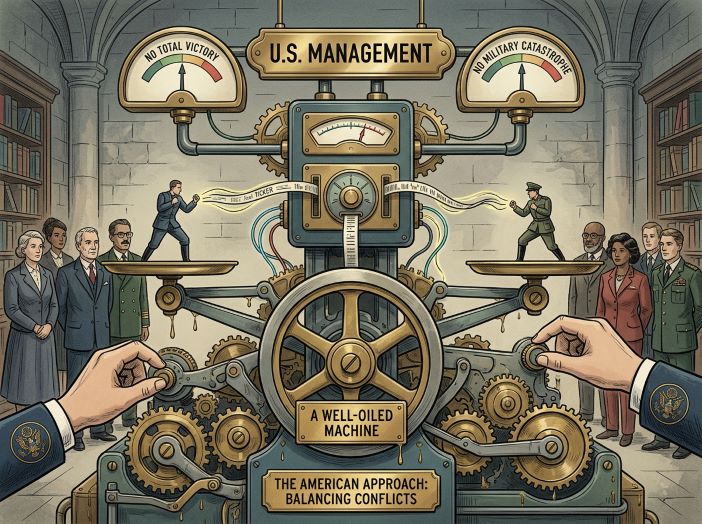
Over the past few decades, the United States has maintained its global alliance system primarily through security commitments. Today, however, the U.S. finds it increasingly difficult to sustain this model. Federal debt is sky-high, the budget deficit is widening, and the costs of global military deployments continue to rise. Pressure is mounting simultaneously on three fronts: Ukraine, the Middle East, and the Asia-Pacific. The landlord’s household is indeed not as wealthy as it once was. Consequently, the U.S. has begun a strategic retrenchment back to the Western Hemisphere.
After Trump’s visit to China in May, his thinking shifted. If he couldn’t beat China, he would turn around and squeeze his allies. Wall Street needed China’s cooperation to stabilize the financial markets, and Trump needed to win his domestic political battles by easing U.S.-China tensions. Both of these agendas required China’s involvement. So Trump brought Europe to the table, and he brought Japan to the table. He demanded they pay more, buy more weapons, and make deeper financial sacrifices.
While the U.S. and China are all smiles, the allies are in a tough spot. This is the biggest highlight of this year’s Shangri-La Dialogue.
And the country most anxious about this shift is Japan. Because Japan has always relied on the U.S. for its greatest security guarantee.
The Japanese could no longer sit idly by. As soon as Hegessy finished his speech, Shinjirō Koizumi was practically the first to raise his hand. His question was urgent: “Some are attempting to drive a wedge between the U.S. and Japan. I would like to ask: Is the United States’ commitment to its allies still unwavering?” On the surface, it sounded like a question, but in reality, it was a plea for help. In front of the entire audience, he was asking the American “big brother” to make a statement: “Daddy, do you still love me?”
Hegessy’s reply was brief and cold: “Our nation’s and our personal involvement is sufficient proof of America’s commitment to our allies and partners.” He did not name Japan. He used only the vague phrase “allies and partners.” It is said that Koizumi’s face froze on the spot.
The day before, Meng Xiangqing had put Japan on the spot during a breakout session. Meng Xiangqing said: “This year marks the 80th anniversary of the opening of the International Military Tribunal for the Far East. Does a country that has not thoroughly dealt with the lingering poison of militarism have the right to speak at length about defense cooperation on the international stage? Can it win the trust of the international community, especially the Asian nations it once invaded? I have serious doubts.” These words nailed Japanese militarism to the pillar of infamy in history.
Faced with this pointed questioning, Japanese Defense Minister Shinjiro Koizumi’s response fell flat. He first resorted to sophistry, arguing that since Japan “has neither nuclear weapons nor strategic bombers,” it cannot be labeled “neo-militarist”; then he turned the tables, claiming that China’s foreign policy and military activities have raised “concerns” in Japan; and finally, he once again played the role of the “good guy” by stating, “We are willing to engage in dialogue.” The word “apology” was never uttered, from start to finish.
Since Japan is in the wrong on historical issues and cannot count on public backing from the United States in diplomatic settings, it has no choice but to find its own way out. What way? Creating a crisis to bring the United States back into the fold.
Thus, we have witnessed Japan and the Philippines rapidly drawing closer: border demarcation negotiations, military intelligence cooperation, and the upgrading of defense cooperation—a series of moves have unfolded one after another. On the surface, it appears to be cooperation; in reality, it is creating new regional tensions. This is because both need to prove their own importance. Japan fears being abandoned by the United States, while the Philippines fears being forgotten by the United States. Two anxious parties are huddling together for warmth.
At the meeting, Philippine Defense Minister Teodoro took an unusually aggressive stance.
On May 31, he brought up the so-called “South China Sea arbitration case” again at the meeting. Before he could finish speaking, the Chinese representative stood up and pressed him: “Since the Philippines claims to respect the rule of law and the peaceful resolution of disputes, how does it explain the illegal landings on uninhabited islands and reefs in the South China Sea over the years?” This question struck a nerve. His response was incoherent, and he was eventually cut off by the moderator. Later, in an attempt to avoid Chinese reporters, he even slunk out of the hotel through the back kitchen.
And on the very same day that the Philippine defense minister was spouting his nonsense, our countermeasures arrived!
On May 31, the Southern Theater Command of the People’s Liberation Army deployed naval and air forces to conduct combat readiness patrols in the territorial waters and airspace of China’s Huangyan Island. The China Coast Guard carried out law enforcement patrols in the territorial waters of Huangyan Island and surrounding areas.
What’s even more ruthless is that on June 1, China sent ships directly to the area and began conducting law enforcement operations around the islands. This enforcement sends a clear message: I call the shots in these waters. Japan and the Philippines wanted to provoke China into acting and force the U.S. to intervene; but when China did act, it put a knife to their throats, while the U.S. remained indifferent. That’s what you call shooting yourself in the foot.
To be honest, we still have far too many cards up our sleeve. If the Philippines keeps this up, we can reclaim a few islands at any time. If Japan continues down that old path of militarism, we’ll settle both old and new scores and completely eradicate this cancer in East Asia.
The Philippines shouldn’t forget this. When the Philippines faced energy shortages, China provided assistance—fertilizer and diesel—and we didn’t choke you off. Now Japan seems very eager, offering to send warships, discuss intelligence agreements, and establish a strategic partnership. But Japan’s own survival is on borrowed time—its rare earth supplies are being cut off, and dual-use items are being restricted. If these are cut off, it would sever the lifeline of its economy. “The U.S. also hopes Japan will further develop its defense capabilities,” yet there are no substantive security commitments behind this. All Japan can offer the Philippines now is to push it deeper into the fire, using you merely as a stepping stone.
Meanwhile, the U.S. watches from afar, sipping coffee, ready to discard its pawns at any moment.
The saddest thing in the world is to place one’s fate in the hands of others. Decades ago, Japan handed its fate over to the United States. For decades, the Philippines has also entrusted its fate to the United States. Now that the United States is struggling to cope with its own problems—and the landlord’s granary is empty—it is turning to them to put food on the table. Only then have they begun to panic. Unfortunately, once fate is handed over, it is difficult to reclaim it. As the old order begins to crumble, more and more countries will discover that the true direction is determined by the Eastern superpower with the most stable strength.