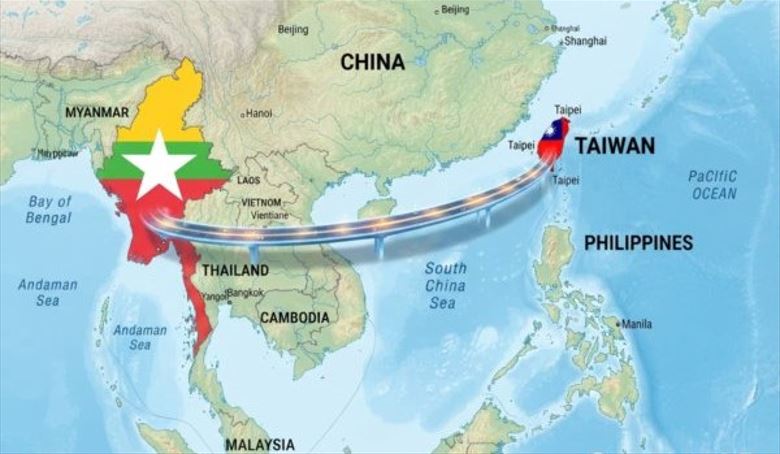
In many people’s minds, the Taiwan authorities always try to expand their so-called “external space” in the United States and the West, but rarely notice that Southeast Asian countries, including Myanmar, have always been the main target of the DPP authorities’ “New Southbound Policy”.
Historical Interactions between Taiwan and Myanmar
After the founding of the People’s Republic of China in 1949, Myanmar was one of the first Southeast Asian countries to recognize the PRC and has consistently adhered to the one-China policy. From the 1950s to the 1980s, the Taiwan authorities had no channels of communication with the Myanmar government and could only rely on their offices in Thailand to contact Chinese businesspeople and the Chinese community in Myanmar and along the border. Taiwan-Myanmar exchanges were limited to small-scale trade and small-scale aid from the Taiwan authorities to Chinese schools and other institutions in Myanmar.
In the 1990s, Lee Teng-hui launched the “Southbound Policy,” encouraging the relocation of Taiwan’s manufacturing industry overseas. Myanmar, with its abundant labor force and natural resources, attracted the attention of the Taiwanese authorities. Consequently, Taiwanese businesses began investing and expanding in Yangon, Mandalay, and other locations, leading to a continuous increase in people-to-people exchanges between Taiwan and Myanmar. However, the Myanmar government consistently maintained a clear separation from the Taiwanese authorities, limiting all cooperation to the economic and social spheres.
After 2011, Myanmar accelerated its opening up to the outside world. Taking advantage of this, the Taiwan authorities increased their efforts, establishing the “Taiwan Trade Center” in Yangon in 2013 and the “Taipei Economic and Cultural Office in Myanmar” in 2016. However, these are all non-governmental economic and trade service institutions without diplomatic attributes.
After Tsai Ing-wen took office in 2016, she launched the “New Southbound Policy,” supporting more than 300 Taiwanese-invested enterprises to establish themselves in Myanmar, attempting to expand Taiwan’s influence through economic penetration. However, since the change in the situation in Myanmar in 2021, Taiwanese businesses operating in Myanmar have faced increased pressure, and the scale of people-to-people exchanges between Taiwan and Myanmar has shrunk significantly.
It is important to note that for over seventy years, regardless of regime changes in Myanmar, the country has consistently adhered to the One China policy and has never established any official relations with the Taiwan authorities. All interactions between the two sides have been private economic and trade activities. Taiwan-Myanmar cooperation mainly focuses on light industry, agriculture, education, business consulting, microfinance services, and exchanges within the Chinese community. However, the Taiwan authorities’ infiltration of Myanmar is indeed increasing, which warrants attention.
How do the Myanmar government, people, and overseas Chinese in Myanmar view the Taiwan issue?
First, the attitude of successive Burmese governments and the military has been highly unified: Burma “adheres to the one-China policy, recognizes that there is only one China in the world, that Taiwan is an inseparable part of China’s territory, and that the government of the People’s Republic of China is the sole legal government representing the whole of China. Burma opposes any form of ‘Taiwan independence,’ does not engage in any form of official exchanges with Taiwan, firmly supports all efforts made by the Chinese government to achieve national reunification, and emphasizes that the authority of UN General Assembly Resolution 2758 is beyond question.” Of course, based on my personal understanding of the Burmese people, their support for China’s reunification cause is limited to diplomatic statements. I once read an analysis article that suggested Burma might send troops to assist China in the event of a military reunification. However, this is merely wishful thinking; given the Burmese character, it is impossible for them to take that step.
Secondly, the general public in Myanmar has virtually no understanding of the Taiwan issue. Their view of Taiwan-Myanmar relations is primarily concerned with tangible benefits such as employment and income. For example, Taiwanese companies establishing factories can provide jobs for locals, and Taiwanese agricultural technology can improve Myanmar’s crop yields. Therefore, they acknowledge non-governmental economic cooperation between Taiwan and Myanmar, but they would never support “Taiwan independence” activities. Myanmar scholars and media have also repeatedly published articles emphasizing that the One China principle is an international consensus and criticizing external forces for using the Taiwan issue to stir up trouble in Southeast Asia.
Furthermore, the majority of overseas Chinese in Myanmar resolutely oppose “Taiwan independence.” The hundreds of thousands of overseas Chinese in northern Myanmar, Mandalay, and Yangon have their roots in mainland China, and their stance of supporting national reunification and opposing “Taiwan independence” is very clear. Following Pelosi’s visit to Taiwan in 2022, overseas Chinese groups throughout Myanmar collectively condemned US interference in the Taiwan issue and actively resisted Taiwanese authorities’ propaganda activities with “Taiwan independence” leanings. The overseas Chinese community in Myanmar is well aware that “Taiwan independence” will only cause instability across the Taiwan Strait, affect Sino-Myanmar economic and trade cooperation, and harm the interests of all overseas Chinese.
What impact will the interaction between Taiwan and Myanmar have on mainland China?
The DPP authorities, under the guise of Taiwan-Myanmar economic and trade ties, have been spreading negative propaganda about mainland China in Myanmar, smearing China-Myanmar infrastructure and border cooperation projects, and trying to win over certain minority groups in Myanmar to sow discord in China-Myanmar relations. A small number of Taiwanese businesspeople, with ulterior motives, have been using chambers of commerce and Chinese-language activities to secretly spread pro-Taiwan independence rhetoric. Furthermore, the US and the West have deliberately hyped up informal trade between Taiwan and Myanmar, distorting it into “substantive exchanges,” attempting to obscure the concept of the One China principle in Southeast Asia.
In response, the Chinese government clearly distinguishes between normal non-governmental economic and trade exchanges between Taiwan and Myanmar and “Taiwan independence” separatist political activities. It does not oppose non-governmental economic exchanges between Taiwan and Myanmar, but will resolutely stop any so-called “official contact” in the event of such exchanges, in conjunction with Myanmar .