November 12, 2025 – No political force in Asia could legitimately drive a Pan-Asian agenda. There simply was no intellectual or political resource generated during the Cold War that developed a progressive pan-Asian platform.
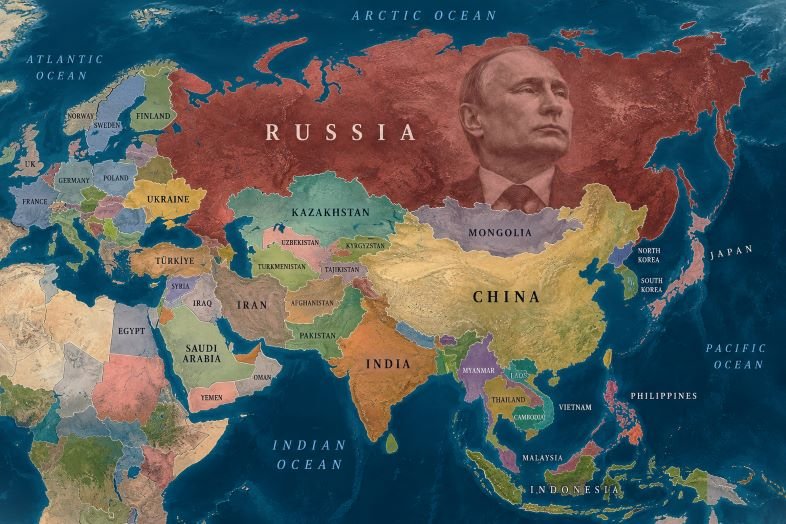
Asia now refers merely to geography, to the vast terrain that stretches across the globe from one end of Japan to the other end of Lebanon, looking almost as if it might rip from the tension. There are eleven, out of a total of twenty-four time zones in Asia out of a total of twenty-four, and about a third of the total landmass is in Asia making it the largest continent.
Even the geography is unclear. Russia is the country with the largest landmass in Asia; it is almost twice the size of China. Yet, there is fleeting consciousness of Russia as being part of Asia, even though more than three quarters of Russia is in Asia. It is typically seen as a European country or – at best – as a Eurasian state (this is largely because three quarters of Russia’s population lives west of the Ural Mountains, the traditional dividing line between Asia and Europe). During the war in Ukraine, the isolation of Russia by the Global North led to its pivot away from Europe and toward Asia. A ‘no limits’ partnership with China and its increased trade with other Asian countries saw a shift in Russia’s place on the planet (China is now Russia’s largest trading partner). But it is still not entirely rooted in Asia.
Large parts of West Asia – from Palestine to the border of Afghanistan – are generally thought of as the Middle East and not as part of Asia (this applies to the Arabian Peninsula as well). Various geopolitical concepts (Orient, Near East, Middle East, MENA) have defined this region from Morocco to Iran as something other than African and Asian, with north Africa broken away from another concept, Sub-Saharan Africa, and West Asia treated as separate from the rest of the massive Asian landmass.
The Himalayas rise like massive walls and have – over the centuries – blocked the easy traffic of ideas and customs between India and China. Buddhism had to travel through Afghanistan and then turn right to head into China and Japan. It could not easily cross the mountains. But the pioneering Buddhist monks whose journeys have been recorded from India – Kumarjiva (350 to 409 CE) and Bodhidharma (5th century to 6th century) – and from China – Zhang Qian (2nd century BCE), Xuanzang (602-664 CE), and Faxian (337 to 422 CE) – went around the mountains to bring open channels for trade and intellectual interactions between the two large civilisations. They not only traded in silk and spices, but in the development of mathematics and astronomy as well as in medicine and military technology.1
Some countries – like India – are continental themselves, comprising hundreds of languages and, thousands of cultural worlds.2 Other countries – like Indonesia – are broken up by hundreds of islands that are separated by over 5000 kilometres from one end to another. The highest point on the earth is in Asia (Mount Everest) and the lowest point on the earth is in Asia (the Dead Sea). The old Mongols would have ridden along the steppe for four thousand kilometres, going from the Uvs Nur basin to the Don River, passing all kinds of people, speaking all kinds of languages, growing all kinds of crops, nurturing all kinds of dreams of the afterlife and the purpose of life. They did not know that they were riding across Asia.3 The continent existed, of course, but consciousness of it as an entity would have to wait until more modern times.4
It is impossible to imagine ‘Asia’ as a simple word, a word that refers to something definitive. There are a hundred etymologies of the word ‘Asia’, most of them going back to the ancient Greeks or even the Goths. None of these stories come from within the continent itself. There is an Assyrian wooden slab (a stele) which calls the western side of Assyria (Ereb) the ‘country of sunset’ and the eastern side of Assyria (Asu) the country of ‘sunrise’.5 This is a mere obvious fact for the Assyrian people, where the sun rises and sets, and not a real definition of the continent and its name.
Each of our continents in the Global South are devised in the majestic world of colonial science. They are not entities with a deep endogamous history. Every place is a construct. No place is natural, even if it is an island. If an island were a naturally bounded country, what to make of an archipelago (such as Indonesia with 17,504 islands) or an island divided into two countries (such as Hispaniola divided into the Dominican Republic and Haiti)? No boundary is natural, no nation is rooted in anything other than human history and politics. That is a lesson being learned every time a new war breaks out, terrible wars in the Horn of Africa or in the steppe of Ukraine or in the Palestinian territories.
Asia Is Anti-Colonial
This is why we seek the meaning of Asia not in ancient times, in a Greek word, but in its modern history, when it became clear that the people of this vast area were prepared to find political unity for a definitive use.6 When was this unity necessary? It was necessary to confront imperialism, the extra-economic force used largely by the advanced industrial states of their age (Great Britain and the United States) to subordinate the land and the labour of the people who lived on this grand and, vast landmass. It was in this struggle against imperialism that ‘India’ was born, that ‘China’ was born, that ‘Indonesia’ was born, that the ‘Philippines’ was born. Forms of right-wing nationalist history writing – often by politicians as much as historians – turn backwards, seeking to legitimise their national stories in the ancient world. But their frameworks are fabrications that draw in older stories that are indifferent to the modern concept of nation and insert them against their own meanings. This is perhaps necessary to make people feel like their patriotism and their nationalism is old, when in fact it is not so old, not so natural, not so rooted in antiquity and race. For the people inside this vast landmass, nations were born in struggle against an oppressor, against an invader. It was the invader who partly helped shape the conditions for the creation of the nation. The people themselves, in their anti-colonial struggles, reached backward to their history and their geography to design the actual shape of their nationalism – sometimes a nationalism rooted in the patriotism of the poor, but often a nationalism soured by the ugliness of profit for the few.
The idea of India, for instance, is shaped by the struggle of the freedom movement against British colonialism, and it was this struggle that tried to bring all the peoples of the subcontinent into a vital unity.7 That act of unification suggested that cultural diversity was a detriment to national unity, that cultural or ethnic or linguistic nations by themselves can be unified into a federation against colonialism. So that the Tamil-speaking people and the Bengali-speaking people could see themselves as Indian not because of ancient cultural ties but because of their unified struggle against colonialism and for the creation of a federated republic. The values of India, despite the claims that might be made for them in older traditions, had to be shaped by the freedom struggle for the new multi-national republic. The Indian nation, therefore, was not ontological (being) but it a process (becoming). This is exactly the shape of the emergence of most nations, whether in the Americas or in Africa and Asia.
If that was the case of anti-colonial nationalism, that was equally the case of anti-colonial pan-nationalism or continentalism. The idea of Pan-Asia was the cognate of Pan-Africanism and Pan-Arabism, of Patria Grande in Latin America – Ideas of political unity for a people who had been subjugated by imperialism. There was no Pan-Africanism that predated the fight against colonialism, no Patria Grande without the anti-imperialist sensibility, no pan-Arabism without the deep humiliation of colonial domination. The desire for continental and global unity came from the deep longing to defeat imperialism. This is why people came from far and wide to Moscow to attend the meetings of the Communist International from 1919 – and especially from 1920 onwards as far as Asian delegates were concerned – and it is why so many Asian radicals and nationalists came to Brussels in 1927 – 28 for the League Against Imperialism meeting. It was clear that the Great War of 1914 – 1918 and the Revolution in the Tsarist Empire that produced the Union of Soviet Socialist Republics (USSR) had dented the invincibility of the imperialists. It was equally clear that the tepid promises of independence made by the League of Nations would not be honoured and that matters had to be taken in hand.
That was the sensibility at the first Pan-African conference of 1919 held in Paris.8 It was the sensibility of Sharif Hussein, who took on the name King of the Arab Countries in 1916 and called for the freedom and unity of the Arab lands.9 It was this emotion that led Manuel Ugarte, an Argentinian, to write the 1924 book La Patria Grande, a call for the unification of the Spanish-speaking lands of the Americas against imperialism.10 It was this same spirit that animated China’s Sun Yat-Sen to call for ‘Greater Asianism’ in a famous speech from 1924. What was the reason for the call towards Greater Asianism or Pan-Asianism? ‘We advocate Pan-Asianism in order to restore the status of Asia’, said Sun Yat-Sen.11 It was precisely the motivations of all projects for unity in the colonised world, whether in Africa, Asia or Latin America. They wished to ‘restore the status’ of their fallen lands. There was no real continental or national aspiration before the anti-colonial, revolutionary era of the 20th century.
Burned to a Crisp
Every project of unity in the colonised world had a continuous history – Pan-Africanism continues till this day, as does Patria Grande and Pan-Arabism. The dents and scuffs of internal tensions – and the pressures of imperialism – prevent the realisation of any of these concepts, but the ideas remain intact. Pan-Asianism is different. The idea burned to a crisp because of Japanese expansionism, with its Greater East Asia Co-Prosperity Sphere and its use of the concepts of Asian unity for its domination of large parts of Asia. In 1943, the Greater East Asia Conference in Tokyo brought together heads of states of various effective colonies of Japan, where the Japanese Prime Minister Hideki Tojo – a Class A war criminal at the Tokyo war trials, who was executed in 1948 – praised the ‘spiritual essence’ of Asia.12 Tojo used the same kind of emotional and romantic language that had marked the world of people such as the Japanese art historian Kakuzo Okakura and the Indian poet Rabindranath Tagore. Okakura had lived in Tagore’s Kolkata house for almost a year in 1902.13 It was here that Okakura wrote The Awakening of Asia (1904), and it was here that he began The Ideals of the East (1903). ‘Asia is one’, begins The Ideals. All this was charming. But then, in The Awakening of Japan (1904), Okakura supported his country’s annexation of Korea (Japan, he wrote, had no ambitions over Korea or Manchuria, ‘If China and Russia had respected the independence of Korea, no wars would have taken place’ – this is a fanciful interpretation). It is in this book that Okakura bemoans the reputation of Japan – ‘so eager to identify ourselves with European civilisation instead of Asiatic that our continental neighbours regard us as renegades – nay, even as an embodiment of the White Disaster itself’.14
Tagore tired of the ‘White Disaster’, of imperialism disguised as something high-minded – the domination of Western Civilisation or Japanese culture. When he visited Japan in 1916, Tagore gave a stinging rebuke to nationalism, which was really to the kind of expansionary behaviour of the Japanese Empire. Accused of being soft-hearted, Tagore wrote a poem – The Song of the Defeated – at the request of a Korean student in Japan, Choy Nam Sun.
My master has bid me while I stand at the roadside
To sing the song of defeat
For that is the bride whom he woos in secret
She has put on the dark veil, hiding her face from the crowd
But the jewel glows on her breast in the dark.
Tagore gave the poem to a Korean student – Chin Hak-Mun – who was studying in Japan. Chin Hak-Mun, who would later become a well-known writer, visited Tagore at the Yokohama home of the art collector and banker Hara Tomitaro. Tagore’s gift suggested another kind of Pan-Asianism, a unity of the defeated who hoped one day to overcome defeat not with empires of their own but with something more precious than that – solidarity among peoples for the mutual well-being of each and all. It is not defeat that is shameful, suggested Tagore, but subordination of others.
In 1917, Tagore published Nationalism, in which he wrote, ‘nationalism is a great menace’.15 What he meant was that the European form of the nation – rooted in the illusion of social cohesion and of industrial progress – would leave countries such as Japan and India struggling with the ‘borrowed weapons of civilisation’ and unwilling to harness their own inheritance. Political independence was necessary, settling accounts with the wretchedness of social hierarchy was necessary, but so too was a generous attitude to one’s own past and to what one might learn from one’s neighbours. India, Tagore suggested, needed to surmount the challenges of caste hierarchy (as the United States needed to deal with its ugly racism, he pointed out); but then India and other Asian countries should not turn inward, but need to learn from each other to advance the project of human development.
A Great Design
After World War II ended, the dream of Pan-Asianism remained gently intact. The Asian Relations Conference of 1947 opened with India’s Jawaharlal Nehru calling for a new project, something miles away from the Japanese empire. ‘We have no designs against anybody’, Nehru said, ‘Ours is the great design of promoting peace and progress all over the world’.16 Japanese delegates – eager for a fresh start – wanted to come to the Asian Relations Conference in 1947 but were prevented by US occupation authorities. There is a straight line that goes from the Asian Relations Conference to the Asian-African Conference of 1955 at Bandung and to the formation of the Non-Aligned Movement in Belgrade in 1961.17 Calls for an Asian Federation in 1947 were rebuffed by South-East Asians who had just come out of the terrible experience of Japanese expansionism, and they were set aside by the countries around Asia that had joined one or the other US military alliances (CENTO and SEATO). The vicious wars by the new imperialist powers against Korea, Vietnam, Malaya, and Indonesia set the dial for Asian unity at zero. British concentration camps for the communist insurgents in Malaya, and US carpet bombing of the Korean north sent a strong message across Asia for the old notables and the new bourgeois nationalists to hide under the umbrella of Western power against their own people. Border conflicts between India and China and between Pakistan and India as well as across South-East Asia made dreams of unity appear distant.
In this context, to think of ‘Asia’ was an illusion. While Kwame Nkrumah championed Pan-Africanism and Gamel Abdul Nasser pushed for Arab unity, no political force in Asia could legitimately drive a Pan-Asian agenda. There simply was no intellectual or political resource generated during the Cold War that developed a progressive pan-Asian platform.18
The tentacles of US imperialism and the malignancies of the Cold War undermined any possibility of a renewed Pan-Asianism. The hub and spokes system of US power encircled the USSR and China, reducing countries such as Japan and the Philippines, Pakistan and Iran into military bases, dependencies with their own flags, paranoid old notables carrying buckets for the White Disaster, as Okakura called it. What could have flourished after Bandung faltered, border wars and trade wars engulfed the energy for unity and progress. The clarity of Kwame Nkrumah did not make itself felt on the Asian continent – Nkrumah warning, five decades ago, ‘If we do not formulate plans for unity and take active steps to form political union, we will soon be fighting and warring among ourselves with the imperialists and colonialists standing behind the screen and pulling vicious wires to make us cut each other’s throats for the sake of their diabolical purposes in Africa’.19 There is no such ideological seam in Asia, no such political direction that puts at the forefront the importance of unity against division.
Renewals
Nostalgic returns to Asian spiritualism, crafted by the Singaporean intellectual Kishore Mahbubani and championed by Singapore’s Lee Kwan Yew and Malaysia’s Mahathir Mohamad in the 1990s, stressed Asian cultural superiority as a way to explain the rise of the Tigers. This was a facile theory, absent any real economic content, that sought an explanation for the global commodity chain in Asian values. The locus was East Asia, bewilderment being the sense in the literature about South, Central, West and North Asia. For in India half the population lives in poverty – over 700 million people. No cultural explanation is sufficient for its condition. This sentiment – Asian values – was merely an inaccurate description of why the Tigers flourished, not a hope for Asian unity. In fact, Asian unity was not on the cards at all.
Hard-nosed pragmatic policies have emerged to unite certain countries in Asia. In 2018, the US government announced that its War on Terror was over and that it would focus attention against its two main adversaries, China and Russia, the ‘near peer’ contestants for power. Old Cold War fantasies of encaging China provide other platforms for unity – such as between India, Singapore and Japan (with India and Japan along with Australia and the US as part of the Quad, although this has largely been superseded by the Squad with the Philippines replacing India). But these are ugly platforms, alliances thrust upon states that are the hubs for a faltering US hegemony over Asia. Even relatively small-scale unities – the halting negotiations on the Korean peninsula – are forbidden to this kind of process. Japan and South Korea must remain client states of the West, aircraft carriers for its necessary encirclement of China’s return to the world stage. No ‘Asia’ is possible here, only poverty and war.
The fragility of US hegemony after the 2003 illegal war on Iraq and the 2007 world financial crisis brought to the forefront the BRICS project, a platform to claim the need for a multilateral system as the unipolar system fell apart. But the BRICS dynamic, created to pivot the large factories of the world away from the floundering Atlantic markets that are no longer the buyers of last resort, is largely commercial. The political weight of the BRICS has not been fully identified, nor is there a compelling cultural vision for some kind of Southern Renaissance or even regional, continental unities to build the strength of the Global South. Feelings of unity on a continental or regional basis emerge here and there, but they are fleeting.
Arab unity at the inter-state level has been deeply wounded by the Israeli genocide (with the Arab League absent for the entirely of the atrocity); Pan-Africanism was dented after the NATO war on Libya in 2011, but there are seeds of it growing in the new formation called the Alliance of Sahel States (AES) between Burkina Faso, Mali, and Niger; the advance of the far right of a special type in Latin America (from Argentina to El Salvador) has certainly confounded the calls of Patria Grande, but that idea remains in the social movements that are trying to regroup in an adverse situation.
For Asia, the question of the US-imposed New Cold War that divides China from Japan and the Philippines, the Korean peninsula, and South Asia remains at centre-stage. Nonetheless, it is important to register that the Indian External Affairs Minister S. Jaishankar, former Ambassador to China, said that India does not subscribe to the ’NATO mindset’ (a repeat of Nehru’s rejection of the US military pacts of the 1950s, the 1954 Southeast Asian Treaty Organisation and the 1955 Central Treaty Organisation) or that Chinese’s Foreign Minister Wang Yi, former Ambassador to Japan, has openly championed the ideas of Asianism that come to us from Li Dazhao and Sun Yat-sen. These are returns to the source that are important to elaborate.
Return to the Source
There is a need to travel deep into our histories, to recover older dreams of Asia that spluttered into world history a hundred years ago.
- Socialist Asia.
A factual story should begin in 1904, when news began to spread around the world that Japan – an Asian country – had defeated the armies of the Tsar of Russia – then seen entirely as a European country. This military defeat not only inspired young people across Asia to consider their own rebellions against the forces of imperialism, but it also moved people within Russia to overthrow their wretched monarchy. Mohandas Karamchand Gandhi, sitting in South Africa, watched events in northern Asia and in Russia with great interest. He wrote a series of articles for Indian Opinion on Leo Tolstoy and on Maxim Gorky, as well as on the relevance for India of the Japanese defeat of Russia and the 1905 Russian revolution. In November 1905, Gandhi wrote:
‘The present unrest in Russia has a great lesson for us. The Czar of Russia today wields the most autocratic power in the world. The people of Russia suffer numerous hardships. The poor are crushed by the weight of taxes; the soldiers put down the people, who have to submit to all the whims of the Czar. Intoxicated with power, the officers do not care for the welfare of the people. Their only function, they think, is to add to their own power and wealth. Entirely against the people’s will, the Czar declared war against Japan, causing a river of blood of Russian soldiers to flow. The wealth acquired by the sweat of thousands of labourers was thrown into the sea of Japan.’
The Russians, however, did not adopt the old strategies of assassination and sporadic rebellion (often in the name of the Tsar). Instead, Gandhi wrote, ‘The Russian workers and all the other servants declared a general strike and stopped all work’. The essence of the Russian Revolution of 1905, Gandhi saw, was when even the Tsar had to concede to some of the demands since, ‘even the powerful cannot rule without the cooperation of the ruled’.20 The 1905 Russian Revolution thrust the entire population into a frenzy against a system that had long held them down: from sailors in the Black Sea to dispirited troops on the front line of the Russo-Japanese war, from workers in the cities to peasants in the fields. The combination of Japan’s victory over Tsarist Russia, and of the rising of the Russian people against the Tsar’s massive apparatus sent a frisson across the colonised world. Jawaharlal Nehru, then a teenager, felt this thrill. ‘Japanese victories stirred up my enthusiasm, and I waited eagerly for the papers for fresh news daily. I invested in a large number of books on Japan and tried to read some of them…. Nationalistic ideas filled my mind. I mused of Indian freedom and Asiatic freedom from the thraldom of Europe. I dreamed of brave deeds of how, sword in hand, I would fight for India and help in freeing her’.21
Lenin, in exile outside Russia, looked not only to the Russian Revolution but to the range of political unrest in the colonised world: the 1906-1908 Majlis movement in Persia, the 1908 Young Turk Revolution, and the revolutionary developments in the Balkans – all motivated by the collapse of the Ottoman Empire. ‘A powerful impetus to the political awakening of the Asian peoples was given by the Russo-Japanese War and the Russian Revolution’, Lenin wrote in October 1908. But because this revolution moved so slowly, it allowed the forces of reaction to coalesce. ‘Essential, what we see now going on in the Balkans, Turkey, and Persia is a counter-revolutionary coalition of the European powers against the mounting tide of democracy in Asia’, Lenin reflected.22 The colonised would not be held back for long. In 1911, two revolutions, on two continents, showed the power of national liberation and of the workers and peasants: the Mexican Revolution and the Chinese Revolution. In May 1913, Lenin wrote: ‘World capitalism and the 1905 movement in Russia have finally aroused Asia. Hundreds of millions of the downtrodden and benighted have awakened from medieval stagnation to a new life and are rising to fight for elementary human rights and democracy’ with the geography of struggle including the ‘growing fermentation in British India’ and the ‘revolutionary-democratic movement’ in the Dutch Indies.23 Asia is on the move, Lenin wrote, and ‘all young Asia, that is, the hundreds of millions of Asian working people, has a reliable ally in the proletariat of all civilised countries. No force on earth can prevent its victory, which will liberate both the peoples of Europe and the peoples of Asia’.24
Internationalism, out of this tradition of national liberation and Marxism, understood the need for Pan-Asianism in a capacious way: open to the great alliances with the working-class in the colonial core and to other peoples in other colonised parts of the world to build a new world, a socialist world. There was no room for racism here or exclusion of any kind. This was a powerful imaginary, a horizon for Pan-Asianism as a building block not for Asian supremacy but for a broader humanity. This vision, which is shared with national liberation leaders across the colonised world, inflamed the imagination of Ho Chi Minh, M. N. Roy, Tan Malaka, Daw Mya Sein, Ichikawa Fusae, Ayna Sultanova, and Nadzhiya Hanum – some better known than others (and biographies of them, particularly the women, are long overdue), but each of them throwing themselves into the work of building more and more genuinely democratic societies. Somewhere at the edges of these desires would exist the socialist and anarchist Asiatic Humanitarian Brotherhood (1907) and eventually the Communist International (1919), and then later the Pan-Pacific Women’s Conference (Hawaii, 1928) and All-Asian Women’s Conference (Lahore, 1931).25
It was clear to these Communists that a demand to end colonialism and to seek sovereignty would lead to two kinds of questions: how does the new state relate to its own internal hierarchies and inequalities, and how should the state relate to its neighbours and the rest of the world. A genuine anti-colonial and sovereign state would seek to erase wretched hierarchies and therefore to move in a socialist direction, and it would defy any calls for chauvinism and build bridges with neighbours and the rest of the world. In other words, the defiance against chauvinism would be the bedrock of Pan-Asianism of this kind, and it would therefore be a building block for the realisation of a full humanity.
- Japanese Asia.
Raja Mahendra Pratap Singh was a mysterious figure who oscillated between a veneration for the Russian Revolution of 1917 and the potential of Pan-Asianism. In 1919, he visited Lenin in his Petrograd study but then hastened off to Japan to participate in the first Conference of Asian Peoples, held in Nagasaki in 1926. The Conference, which had been organised by the All Asia Society (founded in Japan in 1924), was not widely attended but it made some grand demands: for the creation of an Asian Bank, for the establishment of an Asian media, for the formation of an Asian university, and principally for the building of an All Asian League to defend Asia against European colonialism. These broad aims would have attracted Lenin and the Communists, as they did Singh and others like him such as the Japanese Communist journalist Ozaki Hotsumi, who was executed by the Japanese state in 1944 as a Soviet spy.
Behind all these events was the growth of a new kind of Japan. After the Meiji Restoration and the emergence of capitalism in Japan, the growth of its industry expanded beyond its territory and – like other capitalist powers (such as the Europeans and the United States), Japan sought external colonies to ensure its competitiveness and dynamism. Japanese annexation of territory can be traced back into the 19th century, but its more reasonable beginning is around the time of the very war that the left-wing celebrated, the Japanese defeat of Russia. That war provided the left-wing with the sense that imperialism can be vanquished, but for sections of the Imperial Japanese state, the victory taught them a different lesson: that they could seize large parts of Asia, starting with the formal annexation of Korea that took place between 1904 and 1910, which led to the invasion of northern China and the creation of the Japanese puppet state of Manchukuo in 1930. A range of Japanese intellectuals – and some from elsewhere – began to fantasise that Pan-Asianism would emerge from the end of a Taishō 14 machine gun rather than from joint struggles of the masses to create sovereign, national states that would work in unison with one another.
The strand of Pan-Asianism that was supported by the Japanese Imperial state collapsed fully into collaboration at the Assembly of the Greater East Asiatic Nations, held in Tokyo in November 1943. It was here that Prime Minister General Hideki Tojo announced the formation of the Greater East Asia Co-Prosperity Sphere, an abomination to the idea of co-prosperity since it was an instrument for Japanese imperialism.26 The international class struggle is a messy, ugly terrain, which is why several important Asian political leaders – from India’s Netaji Subash Chandra Bose to Indonesia’s Sanoesi Pané and Asmara Hadi – wished to use the extent of Japanese power against European colonial power to first eject the Europeans and then later settle accounts with their allies. Neither Bose nor Pané and Hadi wanted to exchange British and Dutch rule for Japanese rule, but they saw this new Asian military power as a potential ally despite its wartime atrocities in China and Korea. They set aside the warnings from Tagore for the hard realities of politics and the class struggle.
The potential of the Socialist Asia envisaged by Lenin and Nehru was damaged by the actuality of the fascist menace of the Japanese armies. But Japanese imperialism did not destroy the potential of Asianism of a socialist kind. That would reappear at the Asian Relations Conference (Delhi, 1947) and at the Asian African Conference (Bandung, 1955), the agenda – in fact – being totally against the racial supremacy of imperialism (whether of the European or Japanese form). The residue of Japanese imperialism has not yet been removed, but it was not capable of totally wiping out the possibilities of Pan-Asianism. At its source, Pan-Asianism’s socialist project was stronger intellectually and morally than the project of the Greater East Asia Co-Prosperity Sphere.
Into the Present
It is tempting to imagine there is a cultural unity across Asia, but Asia is too big for such a fantasy. Talk of Confucianism or other religious traditions (Buddhism, Hinduism, Islam) are too vague to make sense for a continent that has almost every known religion. Neither does it make sense to lodge the basis for Pan-Asianism in culture, ideas of filial piety, for instance, because these are not unique to Asia, and they are certainly not widespread in a capitalist system that has dislodged the anchors of social life. Nor does it make sense to believe that the remarkable economic growth rates in East, Southeast, and South Asia are reflective of something Asian rather than the laws of motion of capitalism, the export of industry to these parts of the world in the 1990s phase of globalisation, and the enormous populations in Asia that could build domestic markets through the pent up demand of generations of deprivation. High growth rates are not Asian.
Returning to the source helps us understand the political basis of Asian unity. Building institutions around this unity of Asia could produce the confidence building measures in society and in the inter-state system to settle conflicts without war and the threat of war. There is no such thing as an African Union for Asia for the inter-state system, nor are there many high-level Pan-Asian bodies to bring people of the continent together based on common interests and professions (apart from a few exceptions, such as the Asiad Games, first held in Delhi in 1951). There are some Pan-Asian bodies, the Asian Development Bank (established in 1966) and the networks of trade unions, such as the International Trade Union Confederation-Asia Pacific (created in 2007 when the ICFTU from 1951 merged with the Brotherhood of Asian Trade Unions from 1966). Building a full list of such Pan-Asian bodies would be an important task for the advancement of any present Pan-Asianism. To know the full map of such networks and circulations will build a new consciousness of what is already taking place and what gaps remain to be filled, as well as how to bring these various networks and circulations into a broader conversation about a 21st century Pan-Asian agenda that goes from the source to the future without a detour into the hideousness of fascism and imperialism.
It would be good to breathe in our limitations: the rigidities across the Himalayas, the impossible tensions in the South-China Sea and in the Indian Ocean, the old toxic competitiveness that has leaked into our world without any answers to the fundamental problems of our times. It would be good for artists and intellectuals to open a serious conversation about a new progressive Pan-Asianism, a continental vision of a new kind of socialist world that looks beyond greed and towards the wider palate of human experience and emotion.
If there is to be an Asia and if there is to be solidarity, let these words have some meaning.
Notes
1Xinru Liu, Ancient India and Ancient China: Trade and Religious Exchanges, AD 1-600 (Delhi: Oxford University Press, 1988) and Tansen Sen, Buddhism, Diplomacy, and Trade: The Realignment of Sino-Indian Relations, 600-1400 (Delhi: Manohar Publishers, 2004).
2K. S. Singh, People of India (Calcutta: Anthropological Survey of India, 1992).
3René Grousset, L’empire des steppes: Attila, Gengis-Khan, Tamerlan (Paris: Payot, 1939).
4There are some wonderful new books that try to capture this expansive idea of Asia, some of it drawn from Asian intellectuals and not from a colonial image of Asia. See, in particular, Nile Green, How Asia Found Herself, New Haven: Yale University Press, 2022; Eric Tagliacozzo, In Asian Waters. Oceanic Worlds from Yemen to Yokohama, Princeton: Princeton University Press, 2022; and most importantly, Wang Hui, ‘The Twentieth Century, the Global South, and China’s Historical Position’ (Dossier no. 81, October 2024) [https://thetricontinental.org/dossier-the-twentieth-century-the-global-south-and-chinas-historical-position/]
5Tanehisa Otabe, ‘Making a Case for a Cultural Exchange of Aesthetics between Europe and Japan: The Three Stages of Cultural Globalisation’, The Journal of Asian Arts & Aesthetics, vol. 2, 2009.
6A range of new books from different perspectives, nonetheless, make this point authoritatively. See, for instance, Sugata Bose, Asia after Europe. Imagining a Continent in the Long Twentieth Century, Cambridge: Harvard University Press, 2024; Viren Murthy, Pan-Asianism and the Legacy of the Chinese Revolution, Chicago: University of Chicago Press, 2023; Craig A. Smith, Chinese Asianism, 1894-1945, Cambridge: Harvard University Press, 2021; Pan-Asianism in Modern Japanese History: Colonialism, Regionalism, and Borders, ed. Sven Saaler and J. Victor Koschmann, London: Routledge, 2007.
7Sunil Khilnani, The Idea of India, London: Hamish Hamilton, 1997 and Sitaram Yechury, Praxis of a Socialist, ed. Sudhanva Deshpande and Vijay Prashad, New Delhi: LeftWord Books, 2025.
8Hakim Adi, Pan-Africanism: A History, New York: 1804 Books, 2023.
9George Antonius, The Arab Awakening: The Story of the Arab National Movement, London: Hamish Hamilton, 1938.
10Manuel Ugarte, La patria grande, Madrid: Editora Internacional, 1924.
11Sun Yat-sen, ‘Pan-Asianism’, Pan-Asianism: A Documentary History, Volume 2: 1920-Present, eds. Sven Saaler and Christopher W. A. Szpilman, Lanham: Rowman & Littlefield, 2011, p. 84.
12W. G. Beasley, The Rise of Modern Japan, New York: St. Martin’s Press, p. 206.
13Indra Nath Choudhuri, ‘The Conflict between the Other Asia and the New Asia: Rabindranath Tagore, Liang Qichao and Kakuzo (Tenshin) Okakura and the Politics of Friendship and a Love Story’, Indian Literature, vol. 60, no. 3, May/June 2016.
14His writings have been collected in three volumes by Tokyo’s Heibonsha in 1984. The only full-length consideration of his political and aesthetic work and legacy is by the art historian Torao Miyagawa, published in Japanese in 1956.
15Rabindranath Tagore, Nationalism (London: MacMillan, 1917).
16Vineet Thakur, ‘An Asian Drama: The Asian Relations Conference, 1947’, The International History Review, vol. 41, issue 3, 2019.
17Vijay Prashad, The Darker Nations, (New Delhi: LeftWord Books, 2007).
18This is a polemical statement that does cover over significant attempts by intellectuals in the immediate post-war years to construct a new kind of Asianism. A significant voice was that of the Japanese Sinologist Yoshimi Takeuchi, whose 1963 book Asianism captures some of the residues of Pan-Asianism from the previous era. For a taste of his writings, see What is Modernity? Writings of Takeuchi Yoshimi, ed. Richard Calichman (New York: Columbia University Press, 2005).
19Kwame Nkrumah, ‘African Socialism Revisited’, African Forum, issue 1, 1967, p. 9.
20M. K. Gandhi, ‘Russia and India’, Indian Opinion, 11 November 1905, Collected Works, volume 5, pp. 131-132.
21Jawaharlal Nehru, Towards Freedom, New York: John Day Company, 1942, pp. 29-30. There is a precursor to this fascination, which goes back to the Meiji Restoration. One finds it in one of Bharatendu’s poems, where he had written that Bharat cannot even match ´weak and backward’ Japan, Bharatendu Samagra, Varanasi: Pracharak granthavali pariyojana, 1987, pp. 253-254. A few decades later, the Congress leader G. Subramaniya Iyer told his colleagues to watch the Meiji Restoration, which was ‘of the greatest interest to leaders of Indian economic thought’, while others, such as Gokhale and Romesh Dutt suggested it for emulation. Bipan Chandra, The Rise and Growth of Economic Nationalism in India (New Delhi: People’s Publishing House), 1991, p. 114.
22V. I. Lenin, ‘Events in the Balkans and in Persia’, Proletary, no. 37, October 1908. Collected Works, vol. 15, pp. 220-221.
23Lenin, ‘The Awakening of Asia’, Pravda, 7 May 1913, Collected Works, vol. 19, p. 86.
24Lenin, ‘Backward Europe and Advanced Asia’, Pravda, 18 May 1913, Collected Works, vol. 19, p. 100.
25Sumita Mukherjee, ‘The All-Asian Women’s Conference 1931: Indian women and their leadership of a pan-Asian feminist organisation’, Women’s History Review, vol. 26, issue 3, 2017.
26Jessamyn R. Abel, The International Minimum. Creativity and Contradiction in Japan’s Global Engagement, 1933-1964 (Honolulu: University of Hawai’i Press), 215, pp. 194-217.