November 27, 2025 – Ibrahim Traoré, President of Burkina Faso: “What we have in Africa is not terrorism, it is imperialism. They are the ones who train the terrorists. Their goal is to keep us in a permanent state of war so that we cannot develop and continue to pay them with our wealth.” Uranium, gold, oil—the strategic resources that have fueled imperialism and are now beginning to nourish the Resistance.
1) Unmasking the dominant discourse
The declaration by Burkinabé President Ibrahim Traoré is much more than a simple political statement; it is a precise X-ray of contemporary African reality, which the hegemonic Western discourse systematically strives to conceal, distort, and repress. While mainstream media, financed and controlled by transnational corporations and imperial states, tirelessly repeat narratives about “Islamist terrorism” in the Sahel, about the “endemic instability” of the African continent, and about the need for Western “humanitarian intervention,” Traoré clearly exposes the true nature of these conflicts: they are not manifestations of spontaneous religious fanaticism nor the product of “backward” societies, but rather the direct and calculated result of imperialist strategies designed to perpetuate plunder and block sovereign development.
This assertion does not arise from a vacuum or from conventional political rhetoric. It is the product of a profound understanding of Africa’s colonial and neocolonial history, of direct observation of the mechanisms by which Western powers—particularly France, the United States, and their NATO allies—maintain their domination over the planet’s richest continent in natural resources, biodiversity, and human potential. It is also the fruit of the lived experience of millions of Africans who have suffered decades of “counterterrorism operations” that, paradoxically, have only multiplied violence and insecurity while enriching comprador elites and foreign corporations.
This analysis aims to develop each element of Traoré’s assertion in historical and geographical depth, examining the historical roots of imperialism in Africa, the contemporary mechanisms of neocolonial domination, the role of the terrorism industry in perpetuating African dependency, and the liberation alternatives emerging from African popular resistance itself. All of this is approached from a firmly anti-capitalist and anti-imperialist perspective, which recognizes the global capitalist system as the fundamental matrix of the exploitation of the African continent, and which understands that true African liberation cannot exist without overcoming capitalism in its global dimensions.
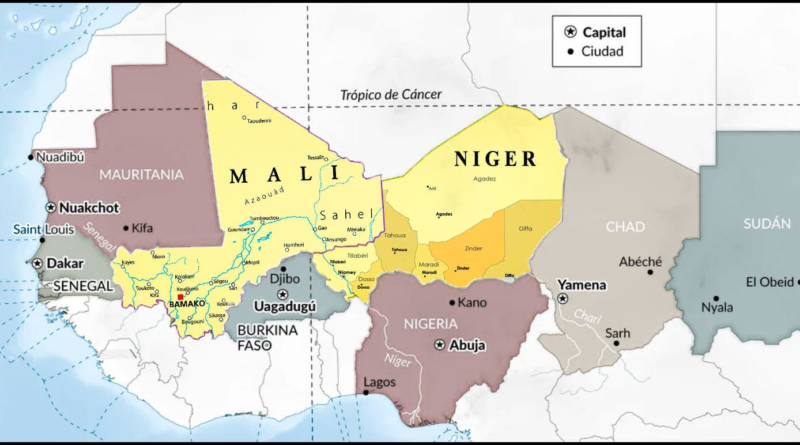
In this historic moment of systemic crisis in global capitalism, characterized by repeated economic recessions, African resistance acquires unprecedented strategic relevance. The Alliance of Sahel States (AES), formed by Burkina Faso, Mali, and Niger, is not simply a defensive regional alliance, but a revolutionary project that challenges the very foundations of the capitalist and neocolonial world order. Its success or failure will have profound implications not only for Africa, but for the future of all humanity.
2) Imperialism as a continuation of colonialism by other means
2.1 The colonial roots of contemporary domination: From Berlin to Paris
To understand Traoré’s assertion, it is essential to go back to the Berlin Conference of 1884-1885, where the European powers carved up Africa like a cake, drawing arbitrary borders on maps with rules, without considering the ethnic, cultural, or political realities of the African peoples. This foundational act of modern colonialism established a principle that remains brutally relevant today: Africa exists to serve Europe, its resources belong to Western capital, and its peoples must remain subordinate. The borders drawn in Berlin were neither accidental nor innocent; they were deliberately designed to divide united peoples, unite rival peoples, and facilitate colonial control and exploitation.
Direct colonialism, which extended into the mid-20th century, was characterized by overt violence, the enslavement of entire populations, systematic genocide, and the brutal exploitation of resources. The Belgian Congo, where an estimated ten to fifteen million people died under Leopold II’s reign of terror, is perhaps the most extreme example, but not an exception. Every European colonial power wrote its own history of horror on the continent: the German massacre of the Herero and Nama in Namibia (1904–1908), considered the first genocide of the 20th century, where 80% of the Herero population and 50% of the Nama were exterminated; the British concentration camps in Kenya during the Mau Mau rebellion (1952–1960), where more than 100,000 Kikuyu were imprisoned and systematically tortured; The French massacres in Madagascar (1947), where between 80,000 and 100,000 Malagasy people were killed by the French army; the massacres in Cameroon (1955-1971), where France killed between 60,000 and 100,000 Cameroonians to maintain its dominance; and the brutal war in Algeria (1954-1962), where France used systematic torture, mass executions, and concentration camps against the Algerian people.
These are not isolated episodes in colonial history, but systematic patterns of violence that laid the groundwork for subsequent neocolonial power structures. Colonial brutality was not an “excess” or a “deviation” from the European civilizing project, but its very essence. As Frantz Fanon analyzed in “ The Wretched of the Earth ,” colonial violence not only destroys lives and communities, but also seeks to destroy the capacity of colonized peoples to reflect on their own history, define their own future, and construct their own humanity.
When national liberation struggles forced colonial powers to formally grant independence to African colonies between the 1950s and 1970s, imperialism did not disappear; it merely changed form. Neocolonialism emerged as a more sophisticated system of domination, maintaining economic and political control while relinquishing the façade of formal sovereignty. As Kwame Nkrumah, Ghana’s first president and one of the 20th century’s most insightful anti-imperialist thinkers, observed: “ Neocolonialism is the final and most dangerous stage of imperialism. For those who practice it, it means power without responsibility, and for those who suffer it, it means exploitation without compensation .”
Nkrumah understood that political independence without economic independence is a dangerous illusion. In his seminal work, ” Neocolonialism: The Last Stage of Imperialism ” (1965), he analyzed how Western powers maintained their control over Africa through economic and financial mechanisms that were more subtle, but just as effective as direct colonial domination. His analysis remains profoundly relevant today, six decades later, as Burkina Faso, Mali, and Niger implement the liberation project that Nkrumah envisioned but could not fully realize due to the imperialist intervention that ended his life.
3) The CFA Franc: Monetary Colonialism in the 21st Century and the Resistance of the AES
No mechanism better illustrates colonial continuity than the CFA franc, the currency France imposes on fourteen African countries as a condition of their supposed “independence.” This colonial monetary system, which has existed in various forms since 1945, forces African countries to deposit 50% of their foreign exchange reserves in the French Treasury (originally 65%, reduced to 50% in 2019 following popular pressure), prevents them from controlling their own monetary policy, prohibits them from financing their development through monetary issuance, and guarantees exchange rates that systematically favor France.
The CFA franc operates as a continuous and systematic wealth transfer mechanism. African countries using the CFA franc (in two distinct zones: the West African CFA and the Central African CFA) are required to hold their reserves in France, where they not only fail to earn competitive interest rates, but France also receives 0.75% of these reserves as a “management fee.” Furthermore, any monetary policy decisions, including printing banknotes and setting interest rates, require the approval of French officials appointed to the African central banks. France retains a veto over all major decisions.
The economic effects of the CFA franc are devastating for African development:
Lack of credit for development: The interest rates imposed by the Central Bank of West African States (BCEAO) are extremely high (around 7-9%), while in the Eurozone they are close to 0%. This makes affordable credit impossible for farmers, small businesses, and infrastructure projects.
Forced deindustrialization: The overvaluation of the CFA franc (artificially linked to the euro) makes African exports expensive and imports cheap, destroying local industry and keeping countries in the export of raw materials.
Wealth transfer: It is estimated that between 1960 and 2018, the CFA franc allowed the transfer of more than 8.5 billion euros annually from Africa to France, a total of more than 500 billion euros over six decades.
The CFA franc is not simply a currency: it is an instrument of domination that allows France to drain billions of euros annually from African economies. It is living proof that formal independence means nothing without monetary sovereignty. As the Senegalese economist Ndongo Samba Sylla has repeatedly denounced, the CFA franc is “the last visible symbol of French colonialism in Africa,” a system that ensures African countries work to enrich France rather than develop their own economies.
President Traoré has been one of the most prominent African leaders in denouncing this system. Burkina Faso, along with Mali and Niger, has taken concrete and revolutionary steps to abandon the CFA franc and regain monetary sovereignty, an act of direct defiance against French neocolonialism that has not been forgiven by Paris. In December 2023, the three countries officially announced their intention to abandon the CFA franc and create a new sovereign currency for the Alliance of Sahel States. This process involves complex technical challenges, but its political significance is immense: it represents the recovery of control over one of the most fundamental instruments of national sovereignty.
French resistance to this decision has been fierce. France has used multiple pressure tactics: diplomatic and economic threats, media disinformation campaigns portraying the AES governments as “coup plotters” and “irresponsible,” pressure on other African countries not to support the project, and attempts at financial sabotage through asset freezes.
However, the AES countries have remained steadfast in their resolve. In 2024, they began gradually withdrawing their reserves from the BCEAO and establishing alternative mechanisms for international trade and national reserves. Burkina Faso created a sovereign wealth fund to manage its mineral and energy resources, Mali initiated direct trade agreements with strategic allies using alternative currencies, and Niger developed a parallel banking system for international transactions. These steps, though initial, represent a historic break from French financial dependence.
4) Debt as a chain: financial imperialism and sovereign alternatives
Contemporary imperialism is fundamentally based on financial mechanisms. The external debt of African countries, which reached $1.13 trillion in 2023, is not the result of African mismanagement but of a system designed to perpetuate dependency. Most of this debt is inherited from dictatorial regimes imposed by the West during the Cold War, or is the result of IMF and World Bank “loans” conditioned on structural adjustment policies that have devastated African economies.
The debt mechanism as an instrument of domination works cyclically:
1. Debt accumulation: African countries receive loans under predatory conditions, with high interest rates and short terms.
2. Neoliberal conditionality: To receive loans, countries must implement policies that open their economies to foreign capital, privatize public services, reduce social spending, and liberalize trade.
3. Debt crisis: The policies imposed generate economic recession, reduction of tax revenues and inability to pay the debt.
4. Restructuring with more conditions: Creditors offer “relief” in exchange for more neoliberal reforms, deepening dependency.
5. Permanent wealth transfer: Interest and principal payments far exceed new loans, creating a permanent net transfer of wealth from Africa to the Global North.
The structural adjustment programs imposed by these international financial institutions starting in the 1980s required African countries to: privatize essential public services (water, electricity, health, education), dismantle national industries that competed with imports, eliminate subsidies for local agriculture, open their markets to unequal competition with Western multinationals, and brutally cut social spending on health and education. The result has been predictable but deliberate: mass poverty, structural unemployment, the collapse of public services, increased dependence on Western imports, and an extreme concentration of wealth in the hands of a comprador minority.
Thomas Sankara : “Debt is a cleverly orchestrated reconquest of Africa. It is a reconquest that turns each of us into a financial slave.”
Sankara called for African unity to repudiate these illegitimate debts, understanding that paying them would condemn Africa to perpetual poverty while the West grew rich. His analysis was prophetic and revolutionary, but it was silenced by the assassin’s bullet orchestrated by imperial interests that continue to operate with the same logic today.
The AES has taken concrete steps to break this cycle of debt dependence: debt audits to identify illegitimate loans, suspension of payments arguing that these resources are necessary to meet the basic needs of the population, creation of sovereign financial institutions such as the Sahel Development Bank with an initial capital of 500 million dollars, and establishment of direct trade mechanisms with strategic allies using alternative currencies to the dollar to reduce dependence on the Western financial system.
These initiatives face enormous challenges, including pressure from international creditors, financial sabotage, and the technical limitations of building sovereign financial institutions from scratch. However, they represent a paradigm shift in Africa’s relationship with the global financial system, moving from forced dependence to the construction of sovereign alternatives.
5) Epistemological decolonization: breaking with Eurocentric thinking
Beyond economic and military mechanisms, imperialism is sustained through the control of knowledge and the production of meaning. Eurocentric thought has dominated educational institutions, the media, and power structures in Africa since colonialism, presenting European history, culture, and development as the universal norm, while African realities are presented as exceptions, deviations, or “backwardness.”
This epistemological dominance manifests itself in multiple dimensions: colonial education with curricula imported from Europe that ignore Africa’s pre-colonial history; extractive research where Western universities extract knowledge without contributing significantly to development; media that present a systematically negative narrative about Africa; and digital technology dominated by Western corporations that control access to knowledge and communication.
The AES has understood that true liberation also requires the decolonization of knowledge. Burkina Faso has initiated a profound educational reform that incorporates pre-colonial African history at all educational levels, promotes the study of local languages alongside French, includes subjects on African philosophy and traditional resource management systems, and establishes agreements with universities in non-Western countries for equitable academic exchanges.
Mali has created a Pan-African Research Institute that prioritizes applied research projects to solve local problems with community participation. Niger is developing an alternative communication system based on community broadcasters and local digital platforms to counter the dominance of international media.
Cheikh Anta Diop : “The history of Africa did not begin with slavery or colonialism. Africa has a history of thousands of years that has been deliberately hidden to justify domination.”
The recovery of this history and of African knowledge systems is not an academic exercise but a condition for the construction of sovereign and dignified societies.
6) Terrorism as a product of imperialism
6.1 The genealogy of jihadist terrorism in the Sahel: From Afghanistan to Africa
Traoré’s central assertion—”they are the ones who teach the terrorists”—is not a conspiracy theory but a fact documented by recent history itself. The genealogy of jihadist terrorism in Africa is inseparable from imperialist interventions, beginning with the support of the United States and its allies for the Mujahideen in Afghanistan during the 1980s. The CIA financed, armed, and trained radical Islamists to fight the Soviet-backed Afghan socialist government, creating the infrastructure that would later give rise to Al-Qaeda. This operation, known as Operation Cyclone, established a pattern that would be systematically repeated in the following decades.
In Libya, the 2011 NATO intervention that toppled Muammar Gaddafi destroyed Africa’s most prosperous state, turning a country with the continent’s highest Human Development Index into a chaotic mess of rival militias and terrorist cells. Looted Libyan arsenals flooded the Sahel with weapons, and fighters scattered after Gaddafi’s fall carried the jihad south. The destabilization of Libya was the direct trigger for the security crisis in Mali, Niger, Burkina Faso, and across the Sahel. According to United Nations reports, more than 18,000 foreign fighters and their families left Libya after 2011, many joining jihadist groups in the Sahel.
In Syria, the United States, France, Great Britain, Saudi Arabia, Qatar, and Turkey openly supported radical Islamist groups under the pretext of overthrowing the Assad regime. Many of these groups were affiliates or precursors of ISIS. Western weapons, CIA training through programs like Timber Sycamore, and funding from the Gulf monarchies all converged to strengthen the very jihadists they were supposedly fighting.
When ISIS was defeated in Syria and Iraq, many of its fighters migrated to Africa, finding fertile ground in areas destabilized by previous Western interventions. A 2023 UN Security Council report documented that at least 25 high-level ISIS commanders from Iraq and Syria had resurfaced, leading cells in the Sahel and bringing with them advanced asymmetric warfare tactics, sophisticated propaganda, and illicit financing methods.
This pattern is not accidental but systematic: Western powers create, strengthen, and then selectively combat terrorist groups to justify their ongoing intervention and maintain control over strategic resources. Terrorism thus becomes an instrument of foreign policy, a tool to perpetuate imperialist domination under the humanitarian guise of the “war on terror.”
Structural roots of armed violence:
A truly anti-imperialist analysis must examine the structural roots: the climate crisis that has intensified conflicts over resources; neoliberal state failure caused by structural adjustment policies; exploitation of strategic resources that turns the Sahel into a battlefield; and foreign military interventions that have exacerbated divisions and fueled resentment.
This complex analysis reveals that the dominant narrative about “jihadist terrorism” in the Sahel is a dangerous oversimplification that serves to obscure imperialist responsibility for creating and perpetuating armed conflicts in the region. As Traoré points out, terrorism is not the cause but the symptom of an imperialist system designed to keep Africa in a state of perpetual war and economic dependence.
7) Western military bases: Infrastructure of imperialism disguised as counterterrorism
The United States maintains a network of over thirty military bases in Africa through its Africa Command (AFRICOM), established in 2007 ostensibly to “combat terrorism.” However, the proliferation of US military bases has coincided precisely with the rise of jihadist terrorism. The world’s largest US drone base is located in Niger, specifically at Agadez Air Base, built at a cost of $110 million and operational since 2019.
The result of this massive military presence? Niger went from being one of the safest countries in the region to facing a serious security crisis. According to data from the Armed Conflict Location & Event Data Project (ACLED), violent incidents in Niger increased by 300% between 2018 and 2023, precisely during the period of greatest US military presence. This correlation is not a coincidence but a direct result of causality.
These bases are not there for African security but for imperial interests:
Control of strategic resource routes: The bases are strategically located near deposits of uranium, gold, and lithium.
Surveillance and containment of China: They serve as surveillance platforms to monitor Chinese activities and deter its geopolitical expansion.
Security of the military-industrial complex: Military operations in Africa generate billions of dollars in contracts for defense companies.
Maintaining global hegemony: The permanent military presence reinforces the status of the United States as a global hegemonic power.
France, for its part, maintained a network of military bases in its former Sahel colonies for decades under the framework of “Françafrique.” Operation Barkhane (2014-2022), ostensibly an anti-terrorist operation, involved up to 5,500 French soldiers. However, during this period, terrorism did not decrease but rather expanded exponentially, revealing the true nature of this intervention.
Numerous testimonies document cases of direct or indirect collaboration between French forces and terrorist groups: military convoys transporting suspected terrorists, targeted air strikes avoiding known jihadist positions, delivery of intelligence information to terrorist groups, and protection of drug and arms trafficking routes.
The expulsion of French troops from Mali (2022), Burkina Faso (2023) and Niger (2024) reflects a rejection of a neocolonial system of domination that uses terrorism as a pretext to maintain control over resources and territories.
Ibrahim Traoré : “We cannot build our future with foreign military bases on our territory. Every military base is a wound to our national sovereignty.”
Western military bases in Africa are, in essence, the physical infrastructure of modern imperialism. As long as they exist, Africa cannot achieve true sovereignty or develop in peace. The struggle for the demilitarization of Africa and the elimination of foreign bases is therefore an indispensable condition for continental liberation.
8) Permanent war as a strategy of underdevelopment
8.1 Systematic destruction of African potential
Traoré’s assertion that the imperialist objective is to keep Africa “in a permanent state of war so that we cannot develop” reveals a profound understanding of the political economy of underdevelopment. Africa is not poor due to a lack of resources—it is the richest continent on the planet—but because its development represents an existential threat to the global capitalist system.
An industrialized Africa, one that processed its own raw materials, developed its agriculture to feed its population, built independent infrastructure, educated its masses, and sovereignly controlled its resources, would cease to be the source of super-exploitation that fuels Western prosperity. Therefore, African development must be systematically sabotaged.
Permanent war serves this function:
Destruction of infrastructure: Wars destroy roads, hospitals, schools, and industrial plants that take decades to build.
Diversion of resources towards military spending: Countries like Burkina Faso and Mali spend between 8-12% of their national budget on defense.
Refugee generation: Conflicts have generated more than 3 million displaced people in the last decade.
Investment impossible: Permanent insecurity makes long-term economic planning impossible.
Justification for intervention: It serves as a pretext for maintaining foreign military bases.
8.2 Case study: Burkina Faso under Thomas Sankara (1983-1987) vs imperialism (1987-2022)
No example better illustrates the difference between sovereign development and imperialist underdevelopment than comparing the four years of Thomas Sankara’s revolutionary government with the subsequent 35 years of neocolonial regimes.
Under Thomas Sankara (1983-1987): In four years, Burkina Faso went from importing 75% of its food to near self-sufficiency. 2.5 million children were vaccinated. The literacy rate increased from 13% to 73%. Hundreds of rural health centers and thousands of schools were built. Mineral resources were nationalized, and the country refused to pay its illegitimate external debt.
Under neocolonial regimes (1987-2022): Following the French-orchestrated assassination of Sankara, Burkina Faso once again became dependent on importing over 60% of its food. Infant mortality increased by 40%. The literacy rate plummeted to 28%. Mineral resources were privatized and handed over to foreign corporations. Burkina Faso accumulated an external debt of over $4 billion.
The comparison is telling: in four years of popular revolution, Burkina Faso achieved more progress than in 35 years of neocolonial rule. This demonstrates that African underdevelopment is not inevitable but rather the deliberate result of imperialist policies that destroy sovereign alternatives.
8.3 The “legal” plunder: trade agreements and multinational mining companies
While Africa is mired in conflict, Western multinationals quietly extract the continent’s resources through exploitative contracts. The Democratic Republic of Congo, one of the richest countries in strategic minerals, is also one of the poorest in terms of human development. This is not a paradox: it is the logical outcome of a system where multinational corporations extract trillions of dollars while paying meager royalties.
Western mining companies operate in Africa with contracts that in any developed country would be considered openly exploitative: ultra-low royalties (3-5% compared to 20-30% in other countries), generous tax exemptions, stability clauses that prohibit changing legislation, double accounting, and international arbitration tribunals that systematically rule against African states.
In Burkina Faso, Canadian mining companies extract more than 60 tons of gold annually (valued at more than $3.5 billion), but pay less than 5% in royalties and contribute less than 1% to the national GDP.
Burkina Faso, under the Traoré government, has begun to review these mining contracts, demanding increased royalties to 15-20%, mandatory investment of 20% of profits in local development, technology transfer, mandatory environmental restoration, and 30% state participation in all mining operations.
This revolutionary policy paves the way for true economic sovereignty. It is no coincidence that it coincides with an increase in terrorist threats: imperialism does not tolerate insubordination and uses terrorism as a weapon to punish those who challenge its dominance.
9) Eurocentrism and racism: the ideological justifications of contemporary imperialism
Imperialism requires ideological justifications to legitimize itself. Eurocentrism—the idea that Europe represents superior civilization while Africa is the continent of backwardness—serves this function. Western media systematically portray Africa as a continent of famine, dictators, corruption, and tribal violence, ignoring that these conditions are precisely the product of imperialism.
Racism structures all contemporary imperialist discourse:
Media language: When Western powers bomb African countries it is called “humanitarian intervention”, when Africans resist it is called “terrorism”.
Academic production: Western academia produces knowledge about Africa that reinforces colonial stereotypes.
Humanitarian aid: The aid system perpetuates the narrative of Africa as a dependent continent that needs to be “saved”.
Scholarship system: Designed to extract the “best minds” from Africa to the West (brain drain).
This racist double standard is fundamental to maintaining the ideological consensus that allows imperialism to continue. As Frantz Fanon analyzed, racism is not an individual prejudice but a system of domination that justifies colonial and neocolonial exploitation.
Resistance to this systemic racism requires not only denouncing its manifestations but also building epistemological and cultural alternatives that center African experiences, knowledge, and perspectives.
Ibrahim Traoré : “We will not accept being defined from the outside. We are Africans, we have our history, our culture, our values. Our development must start from our realities, not from imported models that keep us in subordination.”
10) Paying with our wealth: the economy of plunder and sovereign alternatives
10.1 The net transfer of wealth: from Africa to the West
Contrary to the dominant narrative that presents Western “development aid” as an act of generosity, financial flows between Africa and the West reveal the opposite reality: Africa massively subsidizes the West. A 2017 study by Global Justice Now quantified that for every dollar of aid Africa receives, the continent loses $14 to illicit financial flows, multinational tax evasion, profit repatriation, debt payments, and unequal terms of trade.
Between 1970 and 2018, Africa transferred a net amount of approximately $1.35 trillion to the West. This means that far from being a continent dependent on external charity, Africa is a net contributor to Western development. The standard of living in Europe and the United States is sustained in significant part by the continued plundering of African resources at artificially depressed prices.
These flows of wealth are structural to global capitalism:
Unequal terms of trade: Africa exports cheap raw materials and imports expensive manufactured goods.
Corporate tax evasion: Africa loses more than $40 billion annually due to tax evasion.
External debt: Payments far exceed the aid received.
Capital flight: Billions of dollars leave Africa illegally every year.
However, new geopolitical dynamics are disrupting these traditional flows. The AES has implemented revolutionary policies: state control of strategic resources through the nationalization of mines and the renegotiation of contracts; South-South trade with China, Russia, India, and Turkey; the Sahel Development Bank with $500 million in initial capital; and a sovereign currency that will replace the CFA franc.
10.2 Resources that fueled imperialism and are beginning to nourish the Resistance
Niger produces approximately 5% of the world’s uranium, and France obtains 30% of the uranium that fuels its nuclear power plants from Nigerien mines. Yet Niger is among the countries with the least access to electricity in the world, with only 19% of its population connected to the power grid. This obscene paradox perfectly encapsulates the logic of imperialism.
The Arlit and Akokan uranium mines, operated by the French company Orano, have generated more than $30 billion in profits for France since 1971, while local communities suffer from severe radioactive contamination, lack of drinking water, and extreme poverty.
Burkina Faso and Mali are major gold producers. In 2024, Burkina Faso became Africa’s fourth-largest gold producer, with an annual output of over 70 tons. However, its populations live in poverty while foreign mining companies extract thousands of tons of the precious metal, paying paltry royalties.
The AES has begun to reverse this extractive logic: Niger renegotiated all uranium contracts demanding 15% royalties and investment in nuclear power plants for domestic use; Burkina Faso temporarily nationalized three gold mines and created a state refinery; Mali imposed a special 25% tax on gold exports.
These policies have generated fierce resistance from Western corporations and their governments. However, the AES countries have remained steadfast, understanding that without control over their natural resources, sovereign development is impossible.
11) China’s role in Africa: South-South Cooperation vs. Imperialism
It would be simplistic to present imperialism solely as a Western phenomenon. China, the world’s second-largest economy and an emerging power, has massively expanded its presence in Africa through infrastructure investments, trade, and loans. Between 2000 and 2023, trade between China and Africa grew from $10 billion to over $280 billion, making China Africa’s largest trading partner.
Some Western analysts speak of “Chinese imperialism.” However, China’s relationship with Africa is qualitatively different from the West’s in important respects:
Key differences with Western imperialism:
Infrastructure vs. Extraction: China has prioritized the construction of tangible infrastructure. In the last 20 years, China has built more than 6,000 kilometers of railways and 150,000 kilometers of roads in Africa.
Without political conditions: Unlike the IMF and World Bank, China does not demand privatizations or changes in political systems.
Technology transfer: Chinese projects generally include local training and gradual technology transfer.
More balanced trade: China not only buys resources, but also sells African manufactured goods in its mass market.
This does not mean that China is altruistic — it pursues its own economic and geopolitical interests — but its engagement model is not based on the direct, violent plunder that characterizes Western imperialism.
In the Sahel, China has intensified its cooperation: in Burkina Faso it is building a gold refinery and a university hospital; in Mali it financed a bridge over the Niger River and an irrigation system; in Niger it is developing a 100 MW solar plant and a national telecommunications system.
Military cooperation has also grown. China has provided non-lethal equipment to the AES armed forces, along with training in maintenance and logistical operations. Unlike the West, China does not insist on a permanent troop presence or military bases.
Anonymous African diplomat : “The West offered us ‘help’ with chains; China offers us business with handshakes. We prefer business.”
12) Russia’s role in the Sahel: From Wagner to the Russian state and the struggle for sovereignty
Russia’s presence in the Sahel has evolved significantly since the emergence of the Wagner Group in 2018 to the current direct state cooperation. This evolution reflects global geopolitical shifts and the strategies of Sahel countries to diversify their alliances and reduce their dependence on the West.
The Wagner period (2018-2023)
The Wagner Group, a private military company linked to the Russian state, entered the Sahel taking advantage of the vacuum left by the partial withdrawal of French forces. Wagner offered security services in exchange for access to mineral resources and strategic bases. Mali was the first country where Wagner entered in 2021, gradually replacing French forces.
Wagner’s operations were controversial: he was accused of committing abuses against civilians, summary executions, and plundering resources. However, in many cases, Wagner managed to stabilize areas that had been outside state control for years.
Transition to Russian state cooperation (2023-present)
Following the death of Yevgeny Prigozhin in 2023, Russia has opted for a more institutional strategy: direct military agreements providing equipment and training; economic cooperation for the development of energy and mining infrastructure; and educational and cultural exchange with scholarships and technical training programs.
The Russian perspective on the Sahel:
National sovereignty: Russia publicly respects the sovereignty of African countries.
Multipolarity: Russia sees Africa as a natural ally in building a multipolar world.
Historical anti-imperialism: Russia presents itself as continuing Soviet support for liberation struggles.
Pragmatic interests: Russia seeks access to strategic resources and markets for its industry.
The AES values this cooperation for its respect for sovereignty, military effectiveness, transfer of capabilities, and as a geopolitical alternative that allows for diversifying allies and reducing Western dependence.
Foreign Minister of Burkina Faso, 2025 : “Russia does not tell us how we should govern. It does not demand that we change our currency or privatize our resources. They treat us as equal partners, not as colonies. This is what we call mutual respect.”
13) The Alliance of Sahel States: Towards a multipolar order and the fight against Western isolationism
In September 2023, Burkina Faso, Mali, and Niger formed the Alliance of Sahel States (AES), a confederation representing the most significant African response to French imperialism in decades. The three countries, all governed by military juntas that emerged from popular coups against corrupt pro-French governments, have expelled French troops, denounced colonial military and economic treaties, and are coordinating policies on monetary sovereignty, collective security, and independent development.
The AES is not simply a military pact but a comprehensive political project of national liberation. It represents an attempt to recapture the spirit of revolutionary Pan-Africanism of the 1960s and 70s, learning from past mistakes but maintaining the central objective: Africa for Africans, sovereign development, continental unity.
Institutional structure of the AES
The AES has created a robust institutional structure:
Permanent Security Council: Military coordination mechanism for joint operations and collective defense.
Sahel Development Bank: Sovereign financial institution with an initial capital of $500 million.
Monetary Commission: Body in charge of designing the new sovereign currency (Sahel Franc).
Strategic Resources Committee: Mechanism to coordinate policies on mining, energy and natural resources.
Pan-African Parliament of the Sahel: A legislative body in formation that will represent the peoples of the three countries.
Response to Western isolationism
Following the formation of the AES, France, the United States, and the European Union implemented a policy of isolation: economic sanctions with asset freezes; diplomatic pressure in international organizations; and media warfare portraying the governments as “military dictatorships.”
The AES has responded with: diversification of alliances by establishing relationships with China, Russia, India, Turkey; deep regional integration by developing cross-border infrastructure; a resilience economy with food self-sufficiency programs; and solidarity diplomacy in the African Union and other international forums.
Vision for the future
Short term (2025-2027): Consolidation of internal security and implementation of the sovereign currency.
Medium term (2028-2035): Deep economic integration and development of regional energy infrastructure.
Long term (2035+): Expansion of the alliance to other African countries and construction of a political and economic federation.
Ibrahim Traoré : “We don’t ask anyone for permission to liberate ourselves. Our ancestors bequeathed us values of dignity, courage, and resistance. We are reclaiming our total sovereignty—political, economic, cultural, and military. We will not accept tutelage from any foreign power.”
14) Towards the second liberation of Africa: Historical lessons and revolutionary perspectives
14.1 Why did the first independence movements fail?
The African independence movements of the 1950s-70s achieved formal sovereignty but failed to establish true economic independence. Multiple factors explain this failure: the fragmentation of the continent into 54 states; the persistence of colonial economic structures; the corruption of African elites; and the brutal Western repression of any leader who attempted genuinely independent development.
Patrice Lumumba (Congo), Kwame Nkrumah (Ghana), Ahmed Sékou Touré (Guinea), Modibo Keïta (Mali), Thomas Sankara (Burkina Faso), Muammar Gaddafi (Libya), all leaders who defied imperialism were overthrown or killed with the direct complicity of Western powers.
Key lessons for the second liberation:
Continental unity: Fragmentation was a deliberate strategy. Liberation requires unity on a continental scale.
Sovereign control of resources: Without control over natural resources, sovereignty is not possible.
Food self-sufficiency: Food dependency is an imperialist weapon.
Decolonized education: Educational systems must be freed from Eurocentric thinking.
Collective defense: Without the capacity for self-defense, sovereignty is illusory.
Sovereign currency: Monetary control is the basis of economic sovereignty.
Diplomacy of solidarity: Africa must build alliances with other peoples of the Global South.
14.2 The AES and the application of the lessons
The AES has learned many of these lessons: it represents regional unity in action; it is renegotiating mining contracts; it is implementing food security programs; it is reforming education to decolonize curricula; it is building autonomous defense capabilities; it is abandoning the CFA franc; and it is establishing alliances with multiple countries in the Global South.
However, it must avoid historical mistakes: internal corruption that can corrupt revolutionary processes; a cult of personality that weakens institutions; international isolation; and a lack of a broad social base that guarantees popular participation.
Amílcar Cabral : “Freedom is not a gift, it is a conquest.”
15) The strategic importance of the Sahel in the new world geopolitics
The Sahel is not simply a peripheral region in conflict; it is a geopolitical space of global strategic importance for multiple reasons.
Strategic resources
The Sahel is home to some of the most important resources for the 21st century global economy: uranium (Niger has the world’s sixth largest reserves); gold (Burkina Faso and Mali are major producers); lithium (massive untapped reserves); copper and cobalt (crucial for the energy transition); and rare earth elements (essential for high-end technology).
This “geological treasure” makes the Sahel a battleground for control of future resources. Global powers compete for access and control, but the AES countries are determined to ensure these resources benefit their people.
Strategic geographic location
The Sahel is a crucial corridor: a bridge between North and South Africa; a crossroads between the Atlantic and Indian Oceans; and a region of influence over the Maghreb, the Horn of Africa, and West Africa. This location offers opportunities to position itself as a logistics and trade hub in a multipolar world.
New geopolitical dynamics
The world is moving towards a multipolar order. This shift opens up opportunities for Africa: to diversify alliances, to play rival powers against one another, to explore alternative development models, and to build strategic autonomy.
Historic opportunities:
Energy transition: Africa has the world’s largest solar potential and can lead its own energy transition.
Reindustrialization: Deglobalization creates opportunities for African reindustrialization.
Financial reform: Search for alternatives to the dollar and creation of non-Western development banks.
New diplomatic spaces: BRICS+ and other organizations offer alternatives to Western institutions.
Thomas Sankara : “The struggle for the liberation of Africa is the noblest struggle that an African can undertake.”
16) Internationalist solidarity: A strategic imperative for global liberation
The struggle of the Sahel countries for sovereignty cannot be understood in isolation; it is part of a global struggle against imperialism and capitalism. Internationalist solidarity with the AES is not charity or revolutionary romanticism; it is a strategic imperative for all peoples fighting for their liberation.
Dimensions of internationalist solidarity
Political solidarity: Diplomatic pressure on Western governments to lift arbitrary sanctions.
Media solidarity: Countering the Western disinformation campaign about AES.
Economic solidarity: Boycott corporations that plunder resources in the Sahel.
Academic solidarity: Independent research on the reality of the Sahel.
Solidarity of social movements: Connection between movements from all over the world.
Lessons for other liberation movements
The resistance in the Sahel offers valuable lessons: the importance of regional unity; the role of the army in popular revolutions under specific conditions; the need for sovereignty in multiple dimensions; and the importance of building concrete alternatives.
Solidarity as a strategic weapon
In the current context of global capitalist crisis, internationalist solidarity is not a luxury but a strategic weapon. Imperialism thrives on the division of oppressed peoples. The international unity of the exploited is the only force capable of challenging the global power of capital.
Kwame Nkrumah : “Pan-Africanism is not a racial ideology; it is a political response to a political situation. African unity is the precondition for true independence.”
Ibrahim Traoré : “We are not fighting only for Burkina Faso, we are fighting for all the oppressed peoples of the world. Our victory will be their victory; our liberation will be the liberation of all.”
17) Conclusion: Africa for Africans! The second liberation as a historical project
The Alliance of Sahel States represents the most concrete and advanced expression of contemporary anti-imperialist resistance in Africa. It is not a perfect project, nor is it free of internal contradictions, but it is a revolutionary project that directly challenges the matrix of colonial and neocolonial power on the continent.
Ibrahim Traoré’s statement — ” What exists in Africa is not terrorism, it is imperialism. They are the ones who train the terrorists. Their goal is to keep us in a permanent state of war so that we cannot develop and continue to pay them with our wealth ” — is much more than a denunciation; it is a program of revolutionary action.
Recognizing that terrorism in the Sahel is a symptom of imperialism, not its cause, is the first step toward effectively combating it. The second step is to organize popular resistance, build sovereign institutions, and reclaim control over resources, territory, and historical destiny.
Africa does not need more “humanitarian interventions,” more “development aid,” or more foreign military bases. Africa needs and demands full sovereignty, control over its resources, freedom to choose its own path of development, and solidarity—not domination—from other peoples of the world. The AES represents a crucial step in this direction, but it is only the beginning of a much broader process.
The future of Africa will be written by Africans, not by foreign powers. The continent’s second liberation, the economic liberation that will complete the formal political liberation of the 1960s, is underway. Imperialism will resist with all its might—military violence, economic sabotage, media propaganda, manufactured terrorism—but history is on the side of the people, not the oppressors.
For the peoples of the world struggling against imperialism and capitalism, African resistance is both an inspiration and a lesson. It demonstrates that even the poorest and seemingly weakest countries can challenge imperial powers when they have clear political leadership, popular support, and the determination to be free.
Thomas Sankara : “There can be no salvation for our people outside of our total commitment to the cause of the liberation of Africa.”
This remains the historic task of our time. The AES has taken up the torch of this struggle and carried it to a new level. Its success is not guaranteed, but its example has already inspired millions of Africans to believe once again in the possibility of a truly free and sovereign Africa.
Africa for Africans!
Death to imperialism!
Long live the Pan-African revolution!
Long live the Alliance of Sahel States!
Alassane Griot – (Hojas de Debate)