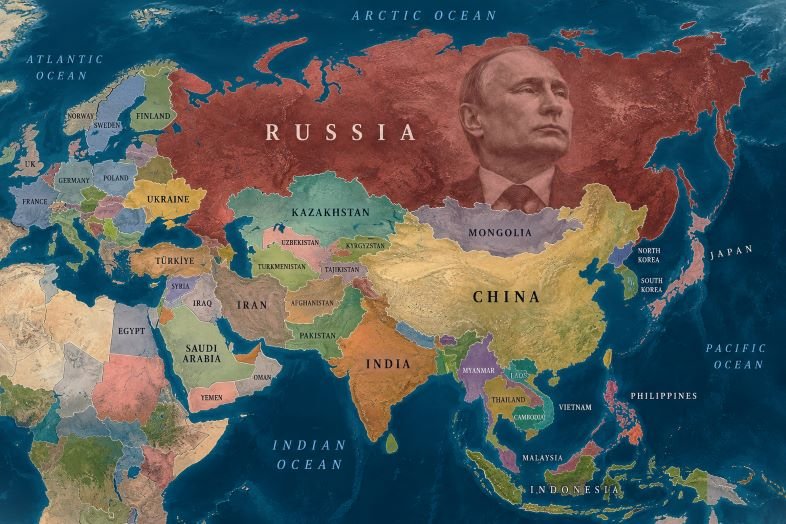
December 4, 2025 – “Who controls the Rimland controls Eurasia; who controls Eurasia dominates the world”
Nicholas Spykman’s geopolitical maxim, formulated in the heat of World War II, resonates with disturbing relevance in the contemporary strategic theater of the Indo-Pacific.
Washington has deployed a multidimensional containment architecture against Beijing that replicates, with 21st-century technological sophistication, the containment logic designed by George Kennan against the Soviet Union.
But it is worth noting that this new Grand Strategy faces a qualitatively different adversary, confronting a power that does not seek to export an ideological revolution, but to reconfigure the international order through economic integration, technological dominance and the projection of naval power in its adjacent seas.
The Asia-Pacific region has become the epicenter of global geopolitical competition, where territorial rivalries, critical technological dependencies, and opposing hegemonic ambitions converge.
From the Korean Peninsula to the Philippine Sea, across the Taiwan Strait and projecting into the Indian Ocean and Oceania, the United States has woven a web of alliances, defense agreements, and multilateral mechanisms designed to contain, deter, and ultimately deny China the consolidation of a sphere of influence in what Beijing considers its natural area of influence.
The Korean Peninsula
The Korean peninsula constitutes the northeastern vertex of the US containment perimeter, a frozen geopolitical fracture that, paradoxically, serves Washington’s strategic interests.
The presence of approximately 28,500 US military personnel in South Korea, along with THAAD anti-missile systems and rapid response and projection capabilities, represents much more than a security guarantee for Seoul; it constitutes a permanent outpost just a few kilometers from Chinese territory.
The survival of the North Korean people’s government, sustained largely by Beijing’s tacit support, creates a strategic paradox: while Pyongyang represents, from the United States’ perspective, a regional threat justifying the US militarization of Northeast Asia, it simultaneously offers China a buffer state against the direct expansion of US influence towards its borders.
This dynamic has produced a perverse equilibrium where perpetual crisis replaces resolution, and where each North Korean nuclear test or ballistic missile launch recalibrates the justifications for the US military deployment in the region.
The peninsula functions as an extended deterrence laboratory, where the United States must simultaneously demonstrate its commitment to the defense of “allies” and its ability to manage escalations with an unpredictable nuclear power, all under the calculating gaze of Beijing, which constantly assesses the credibility of US security commitments in East Asia.
Taiwan, Japan and the containment of the logistical nightmare
If there is a flashpoint capable of catalyzing a great power conflict in the 21st century, it is Taiwan. The island represents the perfect convergence of strategic vulnerability, critical technological dependence, and irreducible political symbolism.
For Beijing, reunification with Taiwan is a historical imperative and a matter of legitimacy for the Chinese Communist Party; for Washington, its de facto autonomy represents both a bastion of geographical containment and the central node of global technological supply chains.
Taiwan’s hegemony in the manufacture of advanced semiconductors — with TSMC controlling more than 60% of global chip production and nearly 90% of the most sophisticated processors — transforms the island into an irreplaceable strategic asset.
In this context, Japan’s transformation from a pacifist power to a proactive security actor represents one of the most significant strategic pivots in the contemporary Indo-Pacific. The postwar Constitution, drafted under US supervision, enshrined in Article 9 Japan’s renunciation of war as an instrument of national policy.
For decades, this “constitutional pacifism” functioned as a strategic straitjacket, limiting Japanese military capabilities to strictly defensive Self-Defense Forces.
However, China’s rise as a military power has catalyzed a radical reinterpretation by the new authorities in Tokyo. Prime Minister Sanae Takaichi’s statements in November 2025, characterizing a potential Chinese attack on Taiwan as an “existential threat” to Japan and justifying a military response, mark a historic turning point.
Analyst Peter Yang, referring to the underlying motivations of Japan’s stance toward Taiwan, adds a disturbing psychological and historical dimension to the US containment architecture in the Indo-Pacific. While Washington bases its strategy on the premise that its regional allies share its objective of preserving what remains of the “rules-based order,” Yang dismantles this illusion by revealing how Japan operates with a parallel agenda rooted not in abstract democratic values, but in the unresolved legacy of its colonial empire.
Prime Minister Sanae Takaichi’s declaration characterizing a conflict over Taiwan as an “existential crisis” for Japan—and her subsequent hasty retraction following Chinese economic retaliation—exemplifies the pattern Yang calls calculated “political theater.”
Tokyo deliberately stokes tensions to consolidate domestic support for militaristic policies, portraying itself as a “besieged nation,” only to then symbolically de-escalate while maintaining its trajectory of remilitarization. This cycle mirrors Nancy Pelosi’s behavior in 2022: provocation followed by silence once Beijing demonstrates that countermeasures have real costs.
This time, the immediate fall in Japanese tourism stocks following the Chinese travel warning—Chinese tourists represent 20% of visitors—and the increase in coast guard patrols around the Diaoyu/Senkaku Islands underscore the asymmetry of vulnerabilities: Japan can make statements, China can impose economic and operational consequences.
On the 80th anniversary of the end of World War II, Yang’s warning resonates: the ghosts of the Japanese empire were not exorcised in 1945; they were buried under convenient ambiguities. Now, in the competition for Taiwan, those ghosts are resurfacing, transforming what the United States presents as a defense of democracy into something darker and more dangerous—the reanimation of imperial agendas under new ideological banners.
Tokyo faces an existential crossroads: its economic dependence on China—its main trading partner—is juxtaposed with its vital security alliance with the United States. This tension produces a schizophrenic foreign policy, oscillating between pragmatic economic cooperation and explicit strategic confrontation.
The Philippines: The Pivot of the South China Sea
The reactivation and strengthening of the Philippines as a US military platform represents perhaps the most significant development in the regional containment architecture since 2014. The closure of the Subic Bay and Clark bases in 1991-1992, a consequence of post-Marcos Philippine nationalism and the end of the Cold War, constituted one of the biggest US strategic setbacks in Asia.
For two decades, Washington lacked significant military infrastructure in the heart of the South China Sea, precisely when Beijing was building artificial islands and militarizing atolls in disputed waters.
The 2014 Enhanced Defense Cooperation Agreement (EDCA), signed under the presidency of Benigno Aquino III, reversed this absence. Under the legal fiction of “troop rotation” instead of permanent bases, the United States gained access to nine Philippine military installations, including strategic locations in northern Luzon—a mere 400 kilometers from Taiwan—and in Palawan, across from the disputed Spratly Islands.
The Philippines occupies a chokepoint position on the maritime lines of communication connecting the western Pacific with the Indian Ocean. Any scenario involving a blockade or invasion of Taiwan would require China to neutralize US capabilities deployed in Philippine territory.
Beijing has been explicit that in the event of a conflict over Taiwan, Philippine military installations housing US forces would become legitimate targets for missile attacks.
Manila navigates an impossible dilemma: its territorial security against Chinese incursions into the Exclusive Economic Zone—particularly in the Ayungin Bank and the Masinloc Basin—depends on American deterrence, but that same alliance turns the archipelago into a potential battleground for a great power war.
The administration of Ferdinand Marcos Jr. has opted for a closer alignment with Washington, calculating that long-term vulnerability to China outweighs short-term escalation risks, but this trap is bringing severe economic and social problems by putting the Philippines in the crosshairs of an international conflict that, if it escalates, could have immeasurable consequences.
Vietnam: The Pragmatism of Bamboo in the Geopolitical Storm
Vietnam represents the fascinating anomaly in the US containment architecture in the region: a one-party communist state, historically aligned with Moscow and Beijing, that now cultivates defense ties with Washington precisely because of its territorial rivalry with China. Disputes over the Paracel and Spratly Islands, along with the traumatic memory of the 1979 Sino-Vietnamese War, generate a structural distrust of Beijing that no amount of ideological affinity can overcome.
Hanoi practices what is known as “bamboo diplomacy” as its foreign policy ideology—flexible in appearance, resilient in essence, capable of bending before powerful winds without breaking. This stance manifests itself in a meticulous diversification of strategic partnerships, defense agreements with Russia, increasing military cooperation with the United States, participation in multilateral mechanisms such as ASEAN, and simultaneously, deep economic ties with China.
Washington has advanced cautiously in the relationship, aware that pushing too hard could backfire. The Vietnamese ports of Cam Ranh and Da Nang—U.S. bases during the war—now receive regular visits from U.S. warships, although Vietnam rejects any formal base agreement. The sale of patrol boats and maritime surveillance equipment constitutes a less visible but strategically significant transfer of capabilities.
Vietnamese pragmatism imposes clear limits: it will participate in regional power struggles against Chinese assertiveness, but it will not become a US proxy. This strategic autonomy frustrates Washington’s most ambitious containment plans, but simultaneously offers a model of resistance to Chinese coercion that other Southeast Asian states are closely watching.
QUAD and the Indo-Pacific
The Quadrilateral Security Dialogue—comprising the United States, Japan, India, and Australia—represents the most ambitious attempt to institutionalize China containment through a multilateral mechanism that formally avoids being characterized as a military alliance. Revived in 2017 after a decade of dormancy, the QUAD has evolved from discreet diplomatic consultations to operational coordination in areas ranging from joint naval exercises to cooperation on semiconductor supply chains.
India’s inclusion is crucial at this juncture. New Delhi contributes demographic weight, industrial capacity, and, fundamentally, control over the western Indian Ocean, transforming the mechanism of an exclusively East Asian club into a genuinely Indo-Pacific architecture. The Sino-Indian border tensions in Ladakh since 2020, with deadly clashes and massive military deployments, have deepened the Indo-American strategic convergence, surpassing decades of Indian non-alignment.
However, the Quadad faces structural limitations. India rejects automatic security commitments, jealously guards its strategic autonomy, and maintains relations with Russia that Washington considers problematic. Australia wavers between its economic dependence on China—its main trading partner—and its security alliance with the United States, generating internal political tensions. Japan, while rhetorically committed, faces constitutional constraints and divided public opinion on remilitarization.
The strategic ambiguity of the Quadad—is it a coordination mechanism or a proto-alliance?—reflects both weakness and flexibility. By avoiding excessive formalization, the group keeps options open and reduces the risk of inadvertent escalation. Simultaneously, this lack of definition limits its effectiveness as a deterrent. Beijing calculates that in an acute crisis, the Quadad’s cohesion could fracture under economic pressures and asymmetric commitment dilemmas.
The Indian Ocean and the expansion of the strategic perimeter
The American conception of the “Indo-Pacific” as a unified strategic theater represents a deliberate widening of the containment perimeter, incorporating the Indian Ocean as an essential western flank.
China has responded with its “String of Pearls,” a chain of ports in Myanmar, Bangladesh, Sri Lanka, Pakistan, and Djibouti that provides footholds along its vital maritime communication lines.
The port of Hambantota in Sri Lanka, leased to China for 99 years after Colombo defaulted on its debt, symbolizes both Beijing’s ambitions and methods: generous infrastructure financing followed by debt-for-equity swaps. Although China denies military intentions, the dual logic of these facilities is clear: what serves for trade in peacetime becomes logistical support in times of conflict.
The United States has responded by deepening ties with India—the dominant power in the Indian Ocean—and strengthening its presence in Diego Garcia, its strategic base in the central Indian Ocean. The renewed engagement with the Maldives, the courting of Bangladesh, and the competition for influence in the Seychelles create a game of positioning where every port, every berthing agreement, every logistical facility acquires disproportionate strategic significance.
Oceania and the competition for island microstates
Australian Foreign Minister Penny Wong’s warning about China’s “silent expansion” in the South Pacific captures a frequently underestimated dimension of strategic competition: the battle for influence in island microstates with tiny populations but vast Exclusive Economic Zones and strategic geographic positions.
China’s attempt to sign a regional security agreement with ten Pacific island nations in 2022—thwarted by resistance from some capitals and pressure from Australia—highlighted Beijing’s ambitions. The precedent of the Sino-Solomonic security agreement, potentially allowing for the presence of Chinese security forces and naval stops, raised alarm in Canberra and Wellington; a Chinese base in Melanesia would break centuries of Anglo-American dominance in the South Pacific.
Wong clearly articulated the Australian perception: “China isn’t just showing up in the Pacific; it’s showing up more often, farther out, and with less apology.” This competition is being waged through development aid, infrastructure financing, high-level diplomacy, and, crucially, responses to climate change—an existential threat to low-lying island nations. Australia has committed $2.2 billion to development aid and $1.3 billion to climate finance, aware that the gap will be filled: if Canberra doesn’t provide, Beijing will.
Geography dictates the stakes: the South Pacific controls alternative maritime routes between Asia and the Americas, and bases in the region would flank communications between the United States and Australia. For Canberra, maintaining a friendly “neighborhood” is a matter of existential security; for Beijing, breaking the Australian monopoly demonstrates that no region remains outside the realm of great power competition.
The Arctic dimension of containment
Although geographically distant from the Indo-Pacific, the Arctic constitutes a connected theater in Washington’s strategic logic; the Sino-Russian convergence under Western pressure generates an alliance of convenience that threatens US interests in multiple domains.
The Northern Sea Route, potentially navigable due to climate melting, offers China maritime access between Europe and Asia that avoids straits controlled by powers aligned with Washington.
Beijing calls itself a “quasi-Arctic state” and has invested in Russian infrastructure in the Arctic, participating in gas projects and building icebreakers. This economic penetration creates dual capabilities, facilitating trade in peacetime and providing a strategic advantage in conflict. Russia, isolated by Western sanctions after the invasion of Ukraine, has accepted Chinese investment as a necessary evil, although Moscow remains wary of the growing power asymmetry.
The United States interprets this Sino-Russian cooperation as a commercial and strategic threat, which is why Chinese access to the Arctic weakens the effectiveness of any naval blockade in the Indo-Pacific, while Russian long-range attack capabilities—nuclear submarines, strategic bombers—could coordinate with China in conflict scenarios.
NATO’s expansion with Finland and Sweden seeks precisely to contain Russia’s projection in the Arctic, completing a perimeter that extends from the Baltic to the Pacific.
Thucydides’ Trap in the Age of Asymmetric Interdependence
The strategic encirclement that the United States is weaving around China replicates historical patterns of hegemonic containment, but operates under conditions of economic interdependence that were unprecedented.
Unlike the Cold War—where separate economic blocs coexisted with little mutual trade—the Sino-American relationship combines strategic rivalry with deep economic integration. This paradox creates mutual vulnerabilities that both powers simultaneously attempt to exploit and mitigate.
The case of rare earth elements, detailed in the analyzed document, perfectly illustrates this dynamic: the United States invested massively in semiconductor capacity through the CHIPS Act, but neglected the rare earth supply chain necessary to produce the chip manufacturing machinery. China, controlling 90% of global rare earth processing, possesses a strategic bottleneck that no US investment can remedy in the short term.
Deng Xiaoping’s warning from the 1980s — “The Middle East has oil, China has rare earths” — has proven prophetic. Beijing planned, invested, and coordinated for four decades to secure dominance in critical materials, while Washington outsourced, financialized, and ultimately relied on global supply chains that it assumed would remain accessible.
This structural asymmetry is replicated across multiple domains: the United States dominates semiconductor and software design but relies on Asian manufacturing; it controls advanced military technologies but depends on materials processed in China; it leads in financial innovation but faces a competitor with massive industrial capabilities and state coordination. Military containment becomes more complex when the adversary controls critical inputs upon which your own military capabilities depend.
The Impossible Geometry of 21st Century Containment
The US containment architecture in the Indo-Pacific faces a fundamental paradox: it must deter without provoking, contain without isolating, and compete without decoupling. Historical precedents offer ambiguous lessons where Soviet containment worked, but it required half a century and benefited from intrinsic weaknesses of the communist model that are not replicated in the socialist-with-specific characteristics of the Chinese state. The attempt to contain Germany and Japan in the interwar period failed catastrophically, producing precisely the expansionist war it sought to prevent.
The crucial difference lies in interdependence; no historical hegemonic power has ever faced a challenger with whom it was so economically intertwined. This reality imposes limits on both confrontation and cooperation. Washington cannot completely disarm China without disarming its own supply chains; Beijing cannot completely dislodge the United States without collapsing vital export markets.
The likely outcome is not a decisive victory for either side, but a prolonged competition marked by recurring crises, risks of inadvertent escalation, and incremental adjustments to the balance of power.
The Indo-Pacific has become the main chessboard of this endless game, where every move generates a countermove, every alliance provokes a counteralliance, and where stability depends on the mutual recognition that neither side can impose its will without potentially catastrophic costs.
If the 21st century avoids the Thucydides Trap—where a rising power and a declining hegemonic power collapse into war—it will be through an architecture of managed competition that has not yet been fully articulated.
Geography, however, remains unchanged: China is there, the United States is here, and the Indo-Pacific is where their ambitions collide. The art of strategy lies in navigating that collision without turning it into a catastrophe.