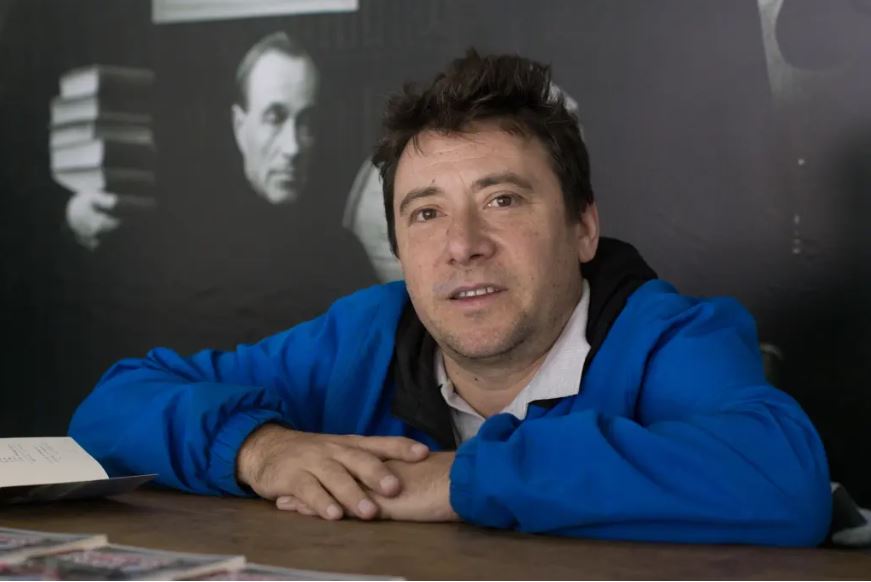
Yes, we are in a paradigm shift, with a five-hundred-year-old world collapsing, and we are only at the beginning- within Gramsci’s “twilight.” Indeed, there are monsters everywhere today. – Romain Migus. D.R.
Mohsen Abdelmoumen: You know Venezuela well, having lived there and continuing to visit regularly. Can you give us an overview of the country’s current situation in the face of threats coming from Trump’s imperial administration?
Romain Migus: When Trump came to power, there was a major unknown, because two different tendencies coexist within his administration regarding Venezuela.
The first is a pragmatic one, representing the MAGA (Make America Great Again) camp. It embodies the aspirations of the U.S. working classes who voted for Donald Trump and hope for an improvement in their quality of life, as well as a complete break with the imperialist policies of previous presidencies. This trend is represented by diplomat Richard Grenell.
When Trump took office on January 10, 2025, the first foreign trip made by a member of his administration was Richard Grenell’s visit to Venezuela to meet President Maduro. This position is marked by strong pragmatism focused on resuming oil exchanges, since the United States – having seen its reserves decrease – now wants to replenish its supply, particularly of extra-heavy crude needed by Texas refineries. For years, Venezuelan extra-heavy crude fed Texas refineries, and some of those refineries are specifically engineered for that type of oil. Despite the United States’ dislike of Maduro, this pragmatic current wants negotiations framed in terms of “oil for migrants.”
The blockade imposed on Venezuela by the United States prevents the country from selling and buying as it wishes. Let me remind you: it is a country under blockade, under economic siege. Companies trading with Venezuela are cut off from the dollar system, which is an utterly barbaric position.
The idea, therefore, was to grant sanctions waivers to certain oil companies so they could trade with Venezuela – Chevron, for example – in exchange for Maduro taking back Venezuelan migrants currently in the United States who wish to return home. This poses no problem for Venezuela, as it is one of the few countries that provides free flights for citizens who were forced to leave, through a program called “Return to the Homeland”, allowing them to come back and rebuild their lives if they so choose.
That is the first position. Among those who support this pragmatic line, we also find journalist Tucker Carlson, who has denounced the absurdities of the war on drugs. This is what is known as the MAGA camp.
On the other hand, there is the “hawks’ camp,” the imperial strategists we have also seen at work in Israel. They are represented by a clique of Latino-Americans headed by Secretary of State Marco Rubio, a Cuban-American; Mauricio Claver-Carone, who oversees the State Department’s Latin America portfolio and is also Cuban-American; and Deputy Secretary of State Christopher Landau, who grew up in Chile when his father was ambassador and later served as ambassador to Mexico. He has a long personal history with Latin America. There are also members of the National Security Council with family or deep personal ties to the region. This small group forms the hawks’ camp – people still living in a Cold War mindset, who never accepted the Cuban Revolution, or even the Soviet Union, and who now want to put an end to Venezuela and the Bolivarian Revolution.
During the first six months of Trump’s term, these two currents remained more or less balanced. But in August 2025, a chain of events sidelined the pragmatists – Grenell and the American people they reflect – and gave satisfaction to the hawks. The sequence unfolded over several months but took a decisive turn last August, when the administration declared drug cartels to be terrorist organizations.
First came the Mexican cartels: Sinaloa, Jalisco Nueva Generación, the Gulf Cartel; then Colombian cartels, the Salvadoran maras, and finally the so-called Venezuelan cartels – mainly the Tren de Aragua, which indeed was a Venezuelan gang but has since been dismantled inside Venezuela. Due to the effectiveness of police repression, especially special police forces, many of its members fled abroad and joined local criminal networks, but the group itself was atomized. There is no central leadership anymore; its members are scattered. Calling it an international cartel is simply inaccurate. Still, it was quite convenient for the U.S. narrative to claim at least one Venezuelan “cartel.”
Then they revived the old story of the “Cartel of the Suns” (Cartel de los Soles). The name refers to the suns displayed on the shoulder insignia of Venezuelan generals: one sun for a brigadier general, two for a division general, three for a general-in-chief, and so on. The allegation is that this cartel is led by the Venezuelan military, with Nicolás Maduro at its head. This has been completely debunked. It is a media fabrication that has existed for years – since 2015. In his book The Myth of the Cartel of the Suns, Spanish journalist Fernando Casado demonstrates that it is a massive fake news story without evidence or basis. The accusation had been forgotten for years and is now being revived.
What is interesting is that neither the UN’s anti-drug agency nor the U.S. NSA mentions the Tren de Aragua – let alone the Cartel of the Suns – as major drug-trafficking organizations or as threats to the United States in any of their previous reports.
When a journalist pointed out exactly this to Marco Rubio, Rubio replied that he did not care what the UN said. Against this backdrop, since August we have seen an escalation: Donald Trump authorized the Pentagon to strike drug cartels or terrorist organizations in foreign countries. It is important to understand that once an organization is labeled “terrorist,” the White House does not need congressional approval to declare war.
Now, if Maduro is declared the leader of the Cartel of the Suns – an allegation they invented – this means Trump is free to wage war on Maduro and the Chavista movement without going through Congress or seeking approval from the American people. Furthermore, since August, the United States has deployed a massive naval presence in the Caribbean, recalling several vessels previously stationed elsewhere. This concentration now represents between 25% and 30% of the U.S. military fleet in the Caribbean.
The first country threatened is, of course, Venezuela. Why Venezuela? Because it has long been a thorn in the side of the American empire and because it symbolizes the multipolar world emerging in the region. But Venezuela is not the only target. Amassing so many ships in the Caribbean clearly has nothing to do with fighting drug trafficking.
Once again, UN and U.S. reports clearly show that 87% of the cocaine entering the United States comes through the Pacific coast – mainly via Ecuador and Colombia – and then moves north through Mexico before crossing the border. Another 10% enters through Colombia’s Atlantic coast. The remaining 3% may try to pass through Venezuela, but the Venezuelan government actively combats this trafficking. Venezuela is a transit country that produces no cocaine. Official reports confirm: 70% of global production is in Colombia, 20% in Peru, and 10% in Bolivia. Venezuela does not produce a single gram. However, due to its geographic position and proximity to Colombia, traffickers try to use Venezuelan territory as a route not only to Europe but especially to Africa – via Caribbean islands – to reach countries like Liberia or Sierra Leone and then, for years, through Sahelian areas where AQIM once operated, or toward the Middle East or Europe, or for stockpiling to raise prices. Venezuela is simply the closest gateway to those regions.
So clearly, drug trafficking is not the real reason for U.S. intervention in Venezuela, even against the Caribbean. If you look at a map of the region, you will see the massive strategic interests: the Panama Canal, through which 5% of global trade passes; control over Venezuelan and Guyanese offshore oil flows; oversight of Brazilian shipments; monitoring Chinese vessels crossing the area; control of Kingston’s major port in Jamaica, one of the world’s largest, and so on.
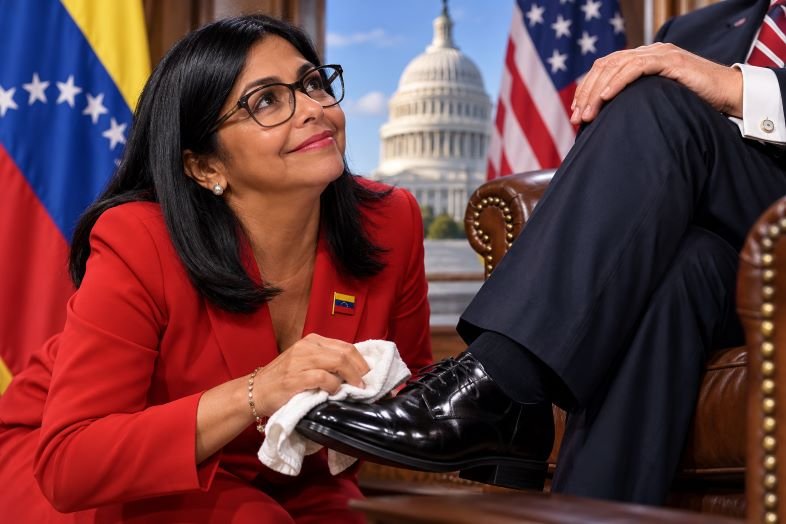
A U.S. officer revealed the truth on Fox News a few days ago, stating that Maduro is not the only target of this Caribbean maneuver. The goal is also to push Russia, China, and Iran out of the Western Hemisphere. So despite the votes and wishes of the American people, we see that the U.S. hawks intend to reassert control over what they have long viewed as their backyard.
In your opinion, why has Trump chosen this moment to threaten Venezuela? What is the ultimate objective behind this U.S. military buildup in the Caribbean?
I would say that, regarding the U.S. deployment, there are actually two objectives. The first was stated by Deputy Secretary of Energy James Danly, who recently said at a conference: “U.S. oil reserves are decreasing because previous administrations sold off too much. Our task now is to rebuild them.” Venezuela holds the largest oil reserves in the world and has diversified its sales; today, its main buyer under the blockade is China. So the first objective is to plunder Venezuela’s oil, with the clear complicity of opposition figures such as María Corina Machado, who has already told Western investors: “We are going to sell everything in this country.” I refer you to Machado’s recent statements, especially at a U.S. corporate conference in Miami one month ago, where she said: “We will privatize oil at every stage – production, refining, transport – but also gold, gas, and all of Venezuela’s resources. Come and take advantage of it; it’s a windfall…” etc.
So, the idea is to strip Venezuela of its oil resources.
And the second objective is broader, as it targets all of Latin America: it is about removing China from the region.
What does this escalation by the Trump administration mean, considering that Venezuela’s president was democratically elected? What do the United States want in Latin America when they attempt to overthrow leftist governments?
To understand this, you have to know a bit about Venezuelan mentality: Nicolás Maduro will never negotiate his departure from power. And why would he? Why didn’t he do it ten years ago? It makes no sense. One must ask the right questions.
If the United States kills Maduro – and this could happen, for example through a targeted drone strike – it should be understood that the most difficult transition the Chavista process ever faced was the post-Chávez transition after Hugo Chávez’s death. Today, there are other leaders – and let me be clear, I do not wish for President Maduro to be assassinated – but if the United States were able to decapitate the Maduro government, there are other potential leaders in Venezuela who have already experienced a difficult succession and who know what position to take to stabilize the country.
This is not a regime like those of Gaddafi, Assad, or Saddam Hussein. It is not dynastic, nor a strongman or purely military regime; it is a political body composed of several currents that have already gone through a transition. The continuity of the Chavista project does not depend on the disappearance of Nicolás Maduro the way Assad’s or Gaddafi’s regimes did.
The United States would like to capture Maduro – well, good luck to them. President Maduro is surrounded, protected, and genuinely loved. This is visible in the enormous crowds where he plays music, laughs with people, dances. Extracting him – as they say – is not going to be easy.
And then there is a military invasion. Once again, an invasion does not equal victory. The U.S. ships carry about fifteen thousand troops – far too few to face an army of 300,000 soldiers, 50,000 police officers, and 5 million militia members. Even if they increased their numbers, Venezuela has trained for asymmetric warfare, hybrid warfare, and guerrilla tactics for twenty years. What would follow is a scenario similar to Afghanistan, with confrontations lasting ten, fifteen, twenty years, because Venezuelans are well organized, know their territory, are armed, and moreover have a high-level strategic agreement with Russia – an agreement Russia shares only with North Korea, China, Iran, and Venezuela. We have seen several Russian ships and planes arrive in Venezuela in recent days, reportedly delivering weapons, including drones, and expertise derived from the war in Ukraine.
So, those who think invading and destroying Venezuela will be easy are mistaken. And who actually wants that today? Who wants the destruction of Venezuela? Who wants rivers of blood – aside from a handful of completely unhinged American hawks?
A large part of Venezuelan migration is due to the blockade imposed by the United States since 2014. This blockade generated enormous emigration in 2015, 2016, 2017, and 2018, and we are talking about five million Venezuelans abroad. These five million people left everything behind somewhat impulsively, since Venezuela is now recovering economically with a growth rate between 5% and 8% and a complete restructuring of its economy. It has broken the vicious circle of oil dependency. And these five million people cannot return because they sold everything before leaving, have no more roots in the country, and because relationships with families back home are filtered through pride. Families still in Venezuela exaggerate their hardships, thinking those abroad will send money, while those abroad often have little access to foreign currency. They face difficult living conditions and, for the first time, experience racism in the countries where they have taken refuge – racism that does not exist in Venezuela. Yet they soothe their conscience by telling themselves they were right to leave.
Venezuelans abroad have developed a shared cognitive framework that no longer resembles the cultural mindset of those who stayed. This is a problem, because it affects five million people; it becomes a social reality whether we like it or not. Many of them have embraced María Corina Machado’s discourse, including her statement that Venezuela must be bombed and everyone killed so that they can “return” to the country. Yet nothing prevents them from returning if they want to – unless they are wanted for crimes, in which case they will be arrested upon arrival, but that concerns only a tiny minority.
So, Venezuelans who emigrated, imagining wonders they never had back home, now blame Nicolás Maduro for their unhappy lives abroad. It is much easier than self-reflection. This is a real problem because the most radical and fascistoid opposition relies heavily on this cognitive terrain of resentment and revenge among Venezuelans abroad. Not all of them, of course, but a large portion. It is tragically ironic, because the bombs threatening Venezuela will not distinguish between Chavistas and non-Chavistas.
To summarize: a military invasion is unlikely. A proxy war like in Libya is also unlikely, because mercenary networks previously attempted such operations and were contained, and especially because Colombia and Brazil – where such mercenaries might be deployed – are currently governed by leaders who do not want war, which is crucial.
Mercenaries could be deployed massively from Guyana or Tobago – that is a possibility. Relying on organized crime is no longer possible, since Venezuela dismantled those networks. However, the United States might try to bomb and concentrate their forces on one end of Venezuela, particularly near the border with Trinidad and Guyana, and attempt to create a Libyan-style Benghazi in eastern Venezuela. They could land ex-deserters, mercenaries – including from Ukraine – and establish a destabilizing beachhead in part of the country. And if that region happens to be oil-rich, all the better for them. This is one possible scenario – indeed the most plausible one. It consists of stealing a piece of Venezuelan territory to establish a center of destabilization.
But that would be on Brazil’s doorstep, and we would see what Brazil is made of. Brazil aspires to be one of the pillars of the BRICS, a leading country of the multipolar world and the Global South. If it allows a war to be imposed on its border without reacting, it would cease to be a country that can claim any leadership role whatsoever. Brazil has a lot at stake in what happens in Venezuela.
We learn that there is a general mobilization of the Venezuelan army and people to resist U.S. imperialist threats. What can you tell us about this?
This is not the first time, and the United States is not catching Venezuela by surprise. For twenty-five years, the U.S. has been trying to overthrow Chavista Venezuela, which means Venezuelans are prepared. Two dates are especially important: May 2004 and January 2006.
The first, in May 2004, saw an incursion of two hundred Colombian paramilitaries who entered the country to assassinate Hugo Chávez and senior officials of the Bolivarian Revolution. That event was the trigger for Chávez to create the Bolivarian Militia: a popular reserve force in which the people share the tasks of national defense.
Then, in 2006, the military doctrine was reformed. Until then, Venezuela’s doctrine was the one taught at the School of the Americas – essentially written by the United States for the entire continent, including Venezuela. Venezuela emancipated itself and created its own military doctrine, establishing that the country would never invade any other nation: it has no offensive army, no imperial army, but a defensive one.
It was clear that Venezuela could never match the power of the United States or any major military power in conventional terms; therefore, it needed to develop asymmetric warfare strategies. And since 2006, Venezuela has trained in asymmetric tactics – guerrilla tactics, one might say.
Today, the Bolivarian Militia has five million members and has developed decentralized command structures, local resistance strategies, and guerrilla armament. In other words, they have been trained for twenty years to defend the territory through asymmetric and hybrid warfare. And indeed, in recent days we have seen the army and the population training to resist a U.S. attack.
Venezuela has suffered several attacks, notably in 2019 during Operation Guaidó, when there were military incursions from Colombia—whether by mercenaries during Operation Gideon in May 2020, or by members of organized crime, who served as the armed wing of the opposition and the United States inside popular neighborhoods. Venezuela neutralized those threats. It defeated the mercenary incursions—though that does not mean such attempts cannot happen again—and the criminal networks were eliminated in the literal sense. Some criminals fled the country; others are six feet under in Venezuela.
This means that for anyone who wants to take up arms in Venezuela today, it is quite difficult. It is undeniable that there have been deserters in the past, but each time they represented less than 1%. Those who wanted to leave the army and take up arms against the legitimate Venezuelan government tried to do so in previous years. But there is an interesting fact: many deserters from the Venezuelan army, especially in 2019 during the Guaidó episode, ended up in migrant camps in the United States, threatened with deportation and treated like dogs, or had to be recruited into mercenary groups or narcotrafficking networks in Colombia because they had no other options.
This sets a very negative example: after being used and forgotten, ending up in degradation or in prison, it naturally leads loyal soldiers to view all of this with disdain.
Today, the Venezuelan people are organized. Everyone knows their role within the national defense structure, and not necessarily on the front lines – there are many tasks. But while the population is prepared to defend the territory, the government – and President Maduro first and foremost – calls for calm and celebration. He encourages people to celebrate Christmas, continue their daily lives, and remain at peace.
So, if you go to Venezuela today, you will see that Venezuelans are very calm, living their everyday routines. One would never think that a country threatened by the U.S. fleet could be so “relaxed.”
We see the United States waging multiple conflicts across the world. Isn’t there a risk of these turning into a global war? With the West led by warmongering fanatics, isn’t the world in danger? Isn’t it time to move toward a multipolar order?
I don’t think so, because the United States no longer has the strength to wage a world war. We are witnessing a complete paradigm shift after five hundred years. We are seeing the entire Western world lose its hegemony, and within the West, the United States – long the hegemonic power of the Western bloc – is now facing serious difficulties. So, as Trump himself said, as did Marco Rubio, the unipolar world as we have known it no longer has any reason to exist. And the United States under Trump is trying to maintain control over those it considers its servants and most loyal vassals – that is, the Western world: Europe, Latin America, and some Asian countries such as Japan, South Korea, Australia, and New Zealand.
In reality, the United States offers them nothing in return. This is genuinely a colonial relationship: the U.S. is the metropolis, and the others are the colonies. The U.S.’s survival now depends entirely on the obedience or subjugation of the states willing to comply.
European states show some discord – Hungary, for instance – but the same is true in Latin America, long considered the “far West.” Latin America is ambivalent in a way that Africa and Asia are not. Its elites see themselves as part of the Western world, as Westerners. But Latin American peoples who seek liberation from oppression and aspire to autonomy and sovereignty are far more attracted to a multipolar world.
Latin America is ambivalent, and we see it today with countries entirely annexed by the United States, such as those in Central America – with the notable exception of Nicaragua and Honduras. Then there are a few South American countries currently resisting – though this changes with elections – such as Brazil, Colombia, and Venezuela. Bolivia, which for twenty years was a center of resistance against the United States, has now switched sides and, though a BRICS member, is moving closer to Washington. Argentina, once a loyal ally of Russia and China, has reversed course under Milei. All of this shows Latin America’s ambivalence – and it will pay a very heavy price for it.
I believe that in the coming years, Africa and – of course – Asia (where this is already the case) will become far more important poles of attraction than Latin American countries, which will pay dearly for their ambivalence toward the U.S. empire.
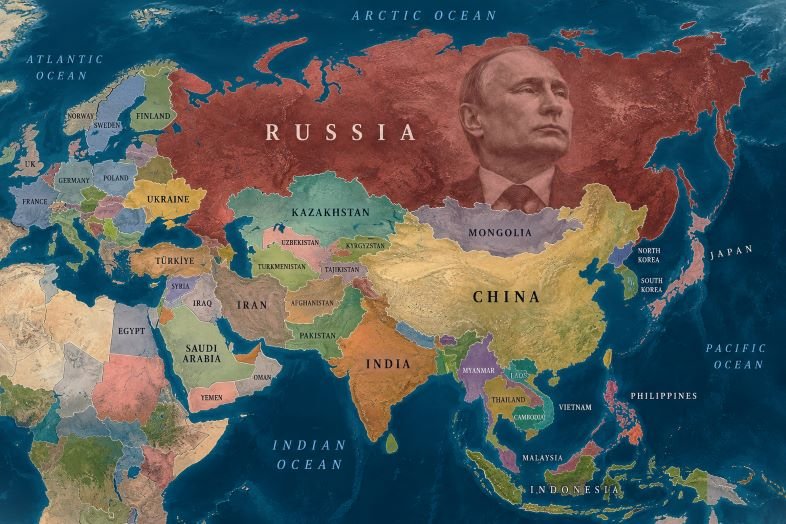
We are at a historical turning point in which five centuries of history are being reshaped. And the pivot of world history in the coming centuries will be Asia – indeed, this is already a reality. One only has to travel to China to see it. This global pivot will revolve around China, but also include major powers like India and Indonesia, as well as middle powers like Vietnam or Iran, the latter being a strategic bridge between Asia and the Middle East. As for the West – starting with Europe – it will be completely downgraded in the coming years.
Will this transition be smooth? Of course not. As the ethologists say: just because a snake has been cut in two doesn’t mean the head won’t still bite, and that the venom is gone. And indeed, the United States continues to bite: it needs to seize territories to ensure its survival.
What will unfold in Venezuela over the coming years concerns the fate of humanity. It is a war that affects everyone, because it will determine how the world of tomorrow is shaped. Will it once again be a world built around conquering, domineering empires? Or a world of free powers that trade and engage in win-win cooperation without submitting to a hegemonic force that controls everything?
With this looming imperialist aggression, are we not witnessing the return of the Monroe Doctrine?
Absolutely. The United States is trying to reassert symbolic and formal control over Latin America – and they say so openly. Symbolically, because it had been a full century since any U.S. Secretary of State had made an official trip to Central America while in office, and now it has happened. A century – just think about that. Marco Rubio traveled to Central America to bring all the region’s vassals back into line: Guatemala, Costa Rica, El Salvador, Panama. Panama was in fact the highlight of the trip. It’s rather amusing, because the president of Panama, Mulino, is a staunch admirer of Trump; he holds a strong anti-migrant, nationalist stance – “Panama First!”, and so on. And Rubio came to tell him: “You’re part of the Belt and Road Initiative, and you must leave it immediately – or we will take control of the canal.”
President Mulino withdrew from the Belt and Road Initiative within the hour. So, we clearly see that it is no longer really a country, but one of those territories ultimately administered by the U.S. State Department, with no sovereignty and no will to defend it. Panama was not always like this – and we remember the great General Omar Torrijos, who regained control of the Panama Canal and was a major nationalist leader in the 1970s and 1980s. And who, incidentally, was killed.
Venezuela, therefore, is a tough bone to chew. Brazil as well. What is happening with Brazil is very interesting, because Trump – astonishingly – imposed 50% tariffs as a result of a judicial ruling against Bolsonaro. These tariffs included a few exceptions, notably oil shipped to the United States and returned to Brazil as gasoline, since the U.S. could not penalize its own refineries. Still, many agricultural products were hit, including Brazilian coffee. And within an hour of these tariffs being implemented, China announced that it would purchase the coffee – with a slight discount. Once again, it would have been the American people who suffered from this policy.
President Lula met with Donald Trump in October, and they reached an agreement to lift these tariffs and adopt mutually acceptable measures.
Thus, Brazil did not let itself be intimidated – nor did Colombia, since President Petro was also threatened. The military threats are not directed only at Venezuela but at all Caribbean countries, as Trump also threatened Colombia. Some countries are outright vassals – U.S. satellites in the region – militarily occupied by Washington, as in the cases of Peru and Ecuador, or where the U.S. holds significant political and military influence, as in Argentina and Chile. Yet all these countries depend economically on China, and the United States offers them no alternative except to cripple their own economies.
I believe that in the coming months, these countries will be pressured by Washington to halt their trade with China. And it will be interesting to see how local business elites – who profit from these exchanges – respond.
So yes, we are witnessing an attempted return of the Monroe Doctrine, wrongly phrased as “America for the Americans,” but which in reality meant “America for the United States” – a colonial doctrine not only for Latin America but for the world. The Monroe Doctrine did not stop at Latin America; the region served as a testing ground before it was later exported to Asia and, after 1945, to the European continent.
Is President Maduro paying the price for his stance in favor of Palestine, among other things?
Yes, of course. Venezuela broke diplomatic relations with Israel in 2006, after the war in Lebanon. Chávez always strongly criticized Israel, and Venezuela has long been a leading defender of the Palestinian people in Gaza and the West Bank. A few days ago, we even saw the Israeli foreign minister claim that Venezuela is a hub for its links with Hamas, Hezbollah, and the Houthis! So – drugs, the Houthis, Hamas, and so on – they no longer know what to invent. And naturally, Israel not only hates the Chavista government but openly favors María Corina Machado, the recent Nobel Peace Prize laureate, who in 2018 signed political agreements with Netanyahu’s Likud party. In 2019 she asked Argentinian president Mauricio Macri and Israeli prime minister Benjamin Netanyahu to “intervene in Venezuela,” and as Nobel Peace Prize laureate she congratulated Netanyahu “for his actions during the war on Gaza.”
So we have a Venezuelan opposition completely subservient to Zionism and utterly opposed to the humanist line of the Bolivarian government.
Gramsci said: “The old world is dying, the new one struggles to be born; now is the time of monsters.” Aren’t Trump, al-Joulani, Macron, Netanyahu, von der Leyen, Zelensky, Milei, etc., the monsters of today?
Yes, we are in a paradigm shift, with a five-hundred-year-old world collapsing, and we are only at the beginning- within Gramsci’s “twilight.” Indeed, there are monsters everywhere today.
But I would go further: What enabled Western domination for several centuries? Its rationalist spirit and its control over science, which made possible its technological advances – first industrial, then military – and in turn its conquests around the globe.
What is interesting is that in today’s Western decline, we now see the reappearance of completely anti-scientific and anti-rationalist tendencies. We won’t retell the entire intellectual history from Descartes to Auguste Comte, but it was scientific rationality that enabled the West’s domination. And today, the West itself is dismantling the very pillar of its historical supremacy. We are witnessing discourses that are profoundly anti-scientific and unfounded – contrary to countries that have recovered what I would call science with conscience, as Rabelais put it: a science that does not become “the ruin of the soul,” a science used for development without turning it into a tool of domination or colonial expansion.
China is the prime example, of course, but India as well. And this is not a religious question: Iran, an Islamic country, is at the forefront of scientific progress in many fields, with women among the leading figures of Iranian science. So, we see how science with conscience has been reappropriated by Global South nations, while the West is shooting itself in the foot – especially in the very domain that once secured its supremacy. It is a sign of the times – and yes, we are in the twilight. Completely.
We also see the return of fanatics: the evangelicals in the United States, the Jewish supremacists in Israel, the medieval lunatics of ISIS in the Middle East. The entire Western bloc is plunging into a long journey through destructive spiritual abysses at the expense of emancipatory science.
Isn’t this West that lectures the entire world on democracy, freedom of expression, and human rights actually ruled by an oligarchy?
Yes – but it no longer works. For years, the West – through its leaders and NGOs – prided itself on preaching democracy, freedom of expression, and human rights to the rest of the world. Except that regarding freedom of expression, when the West bans media such as RT, Sputnik, al-Manar, and turns a blind eye – or even applauds – when one of its members kills three hundred journalists in Gaza with impunity, the entire world sees clearly that it cares nothing for freedom of expression.
When this same West boasts about human rights while closing its eyes to a genocide in Gaza, people across the planet see exactly what is happening – especially the three-quarters of humanity untouched by Western hypocrisy. And even within the West – among everyone except the elites and the naïve – most people no longer believe in this doctrine of human rights, freedom of expression, or democracy. It is mocked in Europe, and all Europeanist elites simply fall in line with former EU Commission president Jean-Claude Juncker, who said that nothing stands above EU treaties and that they cannot be challenged.
We have seen clearly that voting and liberal democracy are myths collapsing before our eyes. In France, for example, we saw the Yellow Vests revolt and the brutal repression that followed. We saw how the will of the French, the Dutch, and the Irish – who rejected the European constitutional treaty in 2005 – was thrown in the trash to force its return through the Lisbon Treaty. People understand all this now, even within the West.
Of course, there are still Euro-believers, slow thinkers, or people who listen to the propaganda channels of these Western regimes. There are still many of them- if we compare reactions to the Ukraine war inside the Western bloc and outside it, we see how effectively propaganda controls minds. But even so, many dams have already broken – and more will break.
A recent French controversy struck me, as someone who has lived in the Global South for twenty years. Some journalists tried to attack a left-wing MP, Danièle Obono Chikirou, because she wrote a report favorable to China, accusing her of denying that China is a dictatorship. But what does it matter if a miserable country like France today calls China a dictatorship? It will change absolutely nothing. Mrs. Chikirou responded very well, but beyond that, what do these people propose? Cutting relations with China? France would never recover!
We must accept that China is a major force of the multipolar world and that the world’s pivot now lies in Asia.
This twilight will last for several decades – I don’t know how long – before each state accepts its new role. In the West, this is far from accepted, even among declining countries of old Europe, the old imperial world, which still believe their pitiful opinions will influence the new winners of the multipolar order. No – those days are over.
The world is reorganizing in a different way. Will it be better? I don’t know – but I think so. That does not mean it will be paradise; we should not place on the shoulders of the multipolar world’s locomotives the responsibilities that Western countries themselves failed to fulfill. But I do believe that a world based on harmonious, win-win relations – free of the uniquely Western idea of domination and colonization as a condition for development – will bring a historic shift in relations between states and between peoples.
We are seeing international law being thrown out the window. Has the world not turned into a jungle ruled by the law of the strongest? How can we escape U.S. hegemony, which has led us to disaster?
We are in the process of leaving U.S. hegemony behind. Whether this will happen with or without war, I cannot say. I hope it happens without war. What is certain is that without war, it will take longer – but we are moving out of it.
For example, in Latin America, China’s growing weight – China is now the main trading partner of most countries on the continent – is already reshaping relationships within the region. Latin American countries had never managed to integrate among themselves because they were constantly parasitized by foreign interests, especially from the United States. China has given them new momentum, particularly in terms of Latin American regional integration, which had never materialized.
Take, for example, the port of Chancay in Peru, inaugurated last year: it is the port around which most exchanges between South America and Asia will now be organized. Previously, to export or import along the entire Pacific coast of Latin America, ships had to go all the way up to the port of Manzanillo in Mexico or Long Beach in the United States – far up in North America. Today, the port of Chancay allows direct trade between South America and Asia – not only China, but also Indonesia, Vietnam, India, South Korea.
There are also long-term infrastructure projects: communication routes, railways, highways crossing Latin America, which have never been built in two hundred years of republican history. The multipolar world is transforming the entire map of the region, and this is precisely what the United States is trying to slow down. U.S. hegemony will persist for some time, but ultimately, I believe their struggle is futile – even if Latin America will be one of the regions where they retain influence the longest.
How can anti-imperialists around the world show effective solidarity with our comrades in Venezuela?
By spreading awareness of Venezuela’s reality and refusing to tolerate the fake news and lies circulated daily about the country; by rejecting propaganda operations meant to sway parties that claim to be anti-imperialist but suddenly stop being anti-imperialist when real anti-imperialists are under threat.
By publicizing the true nature of Venezuela’s participatory democracy, and by explaining Venezuela’s geopolitical importance.
For years, Venezuela has been a pivot of the multipolar project, even if today it has pulled back somewhat to focus on domestic problems caused by the blockade. But it remains a central country in the political construction of a multipolar world. Brazil, for instance, refused Venezuela’s entry into the BRICS – likely because Venezuela would have become one of the political pillars of the organization, and Brazil did not want a competitor or rival in the management of the BRICS. Venezuela has a deeply political vision of the multipolar world – not only an economic one like Brazil or India.
My country, Algeria, has a long history of fraternity with Venezuela, Cuba, etc. Isn’t the anti-imperialist axis facing a new challenge with this U.S. intervention in Venezuela? Isn’t there a need for a global anti-imperialist front?
Yes, absolutely. Algeria indeed has a long tradition of fraternity with Cuba and Venezuela. These countries get along very well.
The anti-imperialist axis must be built, strengthened, and defended. Venezuela has long been a pillar of the anti-imperialist struggle and of the multipolar world.
I remember a conference we organized in Paris some time ago in which I said that the French were only beginning to discover the multipolar world with the war in Ukraine, and that a Global South actually exists. In France, people started talking about the multipolar world and the Global South in 2022 – 2023. But in Latin America, we have been discussing these ideas for more than ten, fifteen years – often longer – and we have been building this world patiently, quietly.
I reminded the audience that we are already at the third Africa–South America summit, the ASA forums, which bring together all the presidents of South America and Africa. The first was held in Nigeria in 2006, the second on Margarita Island in Venezuela in 2009. I remember Muammar Gaddafi’s keynote speech in 2009 where he said: “It is time for us to create the NATO of the South, OTAS, since all communication networks between Africa and South America pass through the North. We need communication networks of the South.” There were also remarkable speeches by Chávez and Lula, the architects of this vision.
Venezuela played a key role not only in building the multipolar world but also in resisting imperial domination and hegemonic ambitions. Venezuela has been part of the anti-imperialist front for a long time – and still is today.
So yes: solidarity and defense of Venezuela. Absolutely.
My country, Algeria, is constantly targeted by attempts at destabilization orchestrated by occult neo-colonial, imperialist, and Zionist circles, aimed at our army and our institutions. How do you explain this continuous Western interference in the internal affairs of other countries?
It is simply the expression of the Western spirit of domination over countries known for resisting this domination and for having sought a third path – whether within the socialist camp at one time, within the Non-Aligned Movement, or today in the defense of the BRICS and the multipolar world. These countries are constantly attacked and constantly destabilized.
But I would say that there is light at the end of the tunnel. In the 1960s and 1970s, resisting Western and U.S. domination was done without real prospects, because countries were freshly decolonized and lacked the economic strength to confront U.S. and Western hegemony. Today, however, they do have that economic strength. And the organization of Global South countries against a wavering Western-American empire gives rise to hope for a better world and a better future – a world based on respect for national sovereignty and a global struggle against imperialism.
Personally, I have observed this change over the past few years, because I run a website called Les 2 Rives, and I can see that social media dynamics have shifted. Five years ago, the countries where I had the most impact were France, Belgium, Switzerland, and Canada—roughly in that order. Today, this is no longer the case. The main countries that now appear in my statistics are France, Haiti, Algeria, and the Congo. And if you look at the data by city, previously I would see Paris, Marseille, Lyon, Toulouse, Lille. Today I see Paris, Port-au-Prince, Algiers…
In other words, the multipolar world listens to the voice of the multipolar world.
Interview conducted by Mohsen Abdelmoumen
Romain Migus is a French writer, journalist, and sociologist known for his expertise on Latin America, particularly Venezuela.