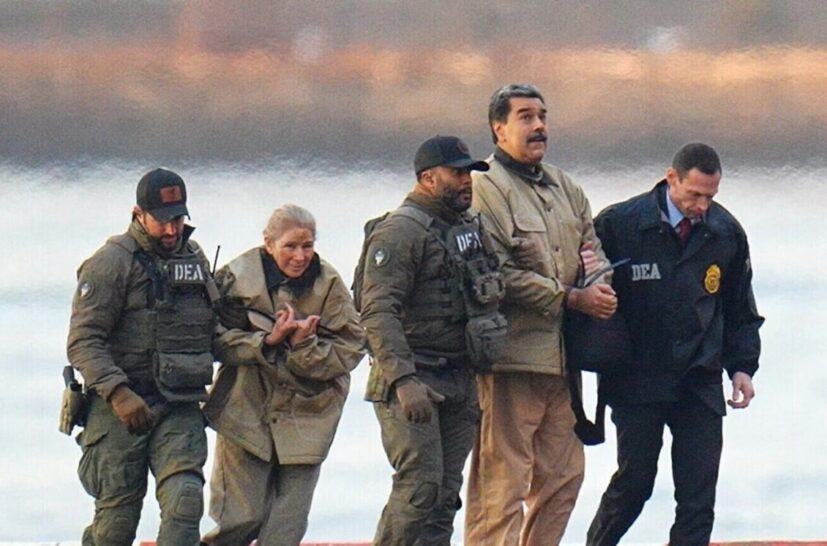
January 4, 2025 – The United States launched a series of airstrikes on Venezuela and captured sitting president Nicolas Maduro. However, is this an American victory over Venezuela, or the starting point of a new quagmire?
On 3 January 2026, the United States launched a series of airstrikes on Venezuela and captured sitting president Nicolás Maduro. Hours later, Donald Trump held a press conference at Mar-a-Lago, with his typical bravado, described the operation as a “spectacular assault”
Regarding this, Professor Wang Xiangsui, a retired Senior Colonel of the People’s Liberation Army, poses a question: Is Maduro’s capture an American victory over Venezuela, or the starting point of a new quagmire? From a tactical perspective, the operation resulted in zero American casualties—a clean success. But strategically, the action was self-contradictory from the outset, representing a major strategic miscalculation.
What was the strategic objective of the Trump administration’s aggression against Venezuela? Judging from his own statements at the press conference, it can be summarized in three layers: First, to capture Maduro and bring him to trial in the United States. Second, Trump vows to ‘run’ Venezuela until a “judicious transition” can happen. Third, to allow American oil companies to enter Venezuela and control the country’s oil resources.
Now, the first objective has indeed been achieved through military means, but in doing so, it has made the second and third objectives immensely more difficult. In this era, long-term political control can hardly be achieved through military violence. Kidnapping a nation’s democratically elected president will only provoke greater resistance and increase the political cost of controlling that country. Invasion and humiliation never bring submission; they only sow seeds of hatred. Venezuela’s resistance has only just begun.
If Trump believes he can rely on a military garrison and a puppet government to suppress Venezuelan resistance, he would do well to recall the U.S. military’s two similar “tactical victories, strategic failures” in the Middle East.
The first example is Afghanistan.
In 2001, U.S. forces invaded Afghanistan, and the military occupation proceeded smoothly. But in August 2021, the world watched images of the chaotic U.S. evacuation from Kabul airport. The Taliban regained power almost immediately after the American withdrawal.
The second is Iraq.
In 2003, U.S. forces invaded Iraq, and Saddam Hussein’s army quickly collapsed. Months later, Saddam himself was captured in a hideout and executed. Militarily, it was a textbook victory. But more than twenty years later, the U.S. has not only failed to establish a stable pro-American regime there but has instead given rise to more extremist, anti-American resistance groups that continuously attack U.S. military bases. Militias like the “Popular Mobilization Forces,” while nominally integrated into the national security apparatus, retain a high degree of autonomy. This “part-military, part-political” identity makes it even harder for the U.S. to divide and rule, further increasing the cost of political control in Iraq.
These two cases reveal a pattern: Military force can topple a government, but military force alone cannot create political legitimacy or legitimacy for a puppet regime. In the action against Venezuela, Trump has committed three even more significant strategic miscalculations.
The First Strategic Miscalculation: Believing that Capturing Maduro Would Destroy Venezuela’s Resistance System
Unlike the governmental structures of Iraq and Afghanistan, which were highly dependent on individuals and lacked modern political party organization, the United Socialist Party of Venezuela (PSUV) is a modern party. It was created in 2007, after Hugo Chávez’s electoral victory, through the merger of multiple left-wing parties including the Movement for the Fifth Republic, the Venezuelan People’s Unity Party, and the Tupamaro movement. It possesses a complete organizational structure, with grassroots units called “The Units of Battle Hugo Chávez” spread across the country. Maduro became the presidential candidate through internal party elections and was elected president through a national vote. Regardless of Western media claims disputing the 2024 election results, within Venezuela, the Maduro government completed full legal procedures and formed a governing coalition with other parties. The PSUV and its coalition, Venezuela’s National Assembly, Supreme Court, Prosecutor General’s Office, and other key state institutions will not automatically collapse just because Maduro himself was captured.
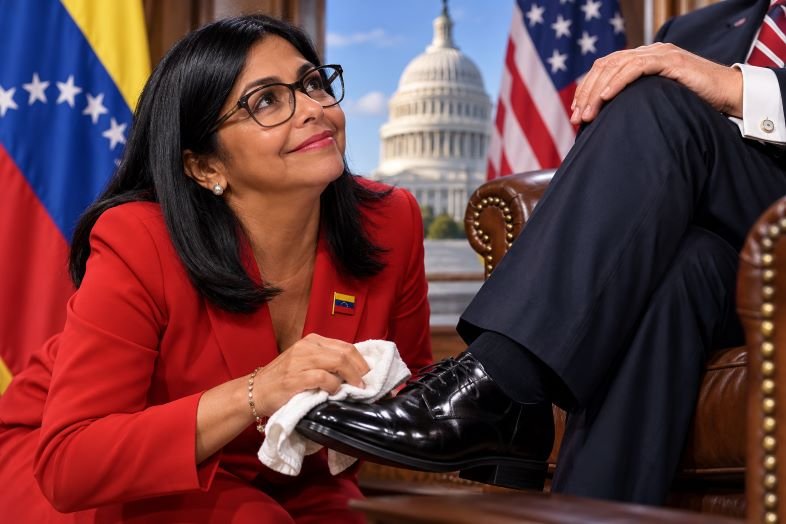
Within hours of Maduro’s capture, Vice President Delcy Rodríguez appeared on national television, clearly stating, “There is only one president in Venezuela, and his name is Nicolas Maduro Moros,” and refused to assume power. This demonstrates the resilience of Venezuela’s modern governmental system.
In short, America can capture Maduro, but it cannot capture a political party, an institutional system, or a governing coalition. This is the essential difference between Venezuela and Iraq or Afghanistan, and it is Trump’s first strategic blind spot.
The Second Strategic Miscalculation: Believing a Decapitation Strike Would Break the Venezuelan People’s Will to Resist
If the first miscalculation was underestimating the resilience of Venezuela’s political system, the second was overestimating the political effect of military deterrence.
The capture of a president by foreign forces is itself a colonial-style humiliation. Even those Venezuelans opposed to Maduro may not accept this so-called “liberation.” No nation willingly accepts foreign troops deciding who its leaders should be.
But Trump’s miscalculation goes further. In the airstrikes, U.S. forces also bombed the tomb of Hugo Chávez located at the “Cuartel de la Montaña” in Caracas.
Chávez was the founder of Venezuela’s “Bolivarian Revolution,” Maduro’s political mentor, and the symbol of the entire Chavista movement. His tomb is the nation’s political sanctuary, a spiritual anchor for his supporters. Destroying it was not attacking a military target, but assaulting a nation’s collective memory and declaring war on the entire Latin American left. Such an act will only push wavering moderates who may have been dissatisfied with Maduro into the anti-American camp, and make potential forces for compromise more resolute.
Meanwhile, Venezuela is not isolated. Brazil, Mexico, Colombia, and other nations issued strong condemnations immediately. Brazilian President Lula stated the attack “crossed an unacceptable line,” reminiscent of Latin America’s “worst moments of intervention.” Colombia has already deployed troops to the border. This means the U.S. will face not only sustained internal resistance within Venezuela but also political pressure from the entire region and the international community.
The Third Strategic Miscalculation: Believing This Would Allow Unobstructed Plunder of Venezuela’s Oil Resources
Venezuela possesses the world’s largest proven oil reserves, accounting for roughly one-fifth of the global total. At his press conference, Trump unabashedly stated that “We’re going to have our very large United States oil companies, the biggest anywhere in the world, go in, spend billions of dollars, fix the badly broken infrastructure, the oil infrastructure and start making money for the country,”
The Trump administration’s lack of disguise about its true intentions could be called “candid.” But the question is: Are American oil companies actually willing to take over? According to a December 18, 2025, report in Politico, the Trump administration asked American oil companies prior to the operation if they were interested in returning to Venezuela. The major companies explicitly refused. The reasons were simple: an unstable security environment, excessive investment risk, and low oil prices. Even if Trump’s military force “opens the door” to Venezuela, corporations are unwilling to jump into this fire pit.
Now, the Trump administration’s actions—capturing a nation’s legitimate president, bombing the tomb of its spiritual leader, and unabashedly revealing its intent to plunder—will undoubtedly further exacerbate the security risks and investment dilemmas for American businesses in Venezuela. The “business opportunity” created by Trump’s military force is precisely the risk American corporations are keen to avoid.
How Will the Trump Administration Conclude This?
Let’s return to the initial question: Is Maduro’s capture the endpoint of victory, or the starting point of a quagmire? While the final outcome awaits history’s verdict, the prevailing trend is likely already clear. When the “world’s policeman” no longer hides its bandit nature, global order inevitably descends into chaos. Muddying the waters might help one fish for temporary gain, but it also ensnares the troublemaker in a sea of uncertainty.
Trump may have won a slick special operations mission, but he is still far from achieving the “management” of Venezuela and control of its oil resources. The road ahead for his administration is long and is destined not to be smooth. Venezuela’s ruling party remains, its state machinery is still functioning, and its military and militias are now on high alert.
Installing a puppet government in a Venezuela seething with public anger and armed with a clear enemy will likely create a new “ulcer” for the United States in Latin America—a wound that bleeds persistently, consumes resources continuously, and is difficult to heal. As Venezuelan Defense Minister Vladimir Padrino López declared, “They attacked us, but they will not defeat us.”
The abduction of Maduro may represent merely a tactical victory for the Trump administration. But it marks only the beginning of broader resistance from Venezuela, Latin America, and the international community.