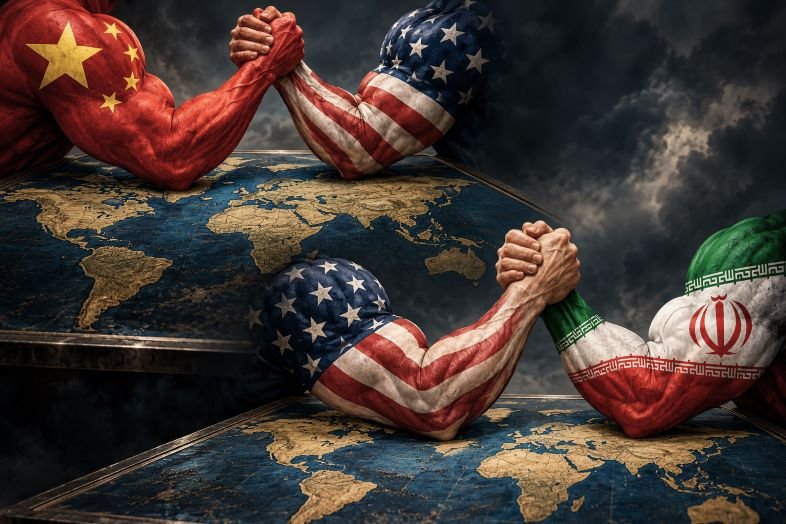
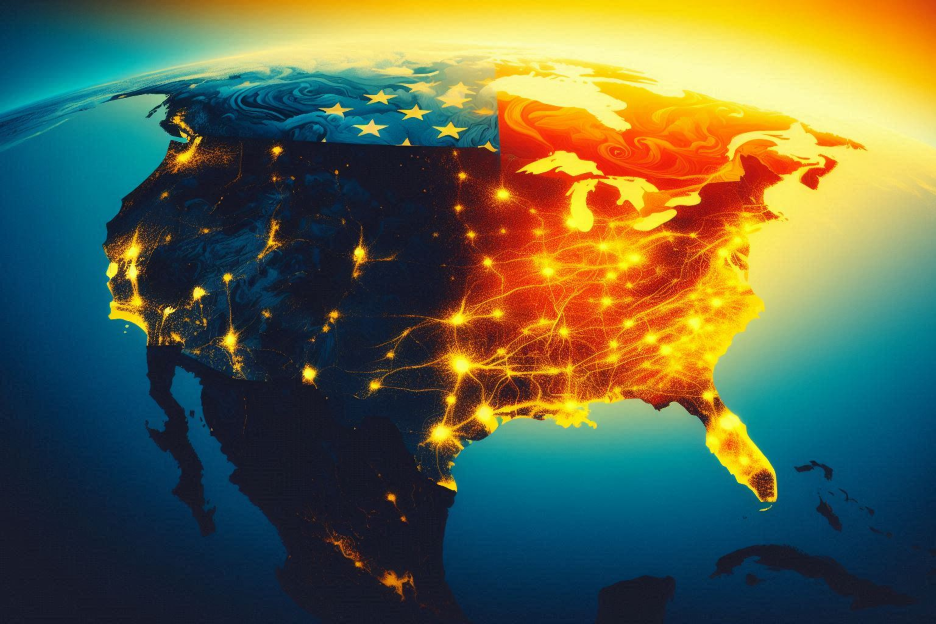
January 5, 2025 – Contrary to the image of an unpredictable and chaotic Trump, the American president’s second term reveals a cold, methodical, and profoundly transactional strategic architecture. Between the encirclement of China, the subordination of Europe, and the consolidation of North Africa, the United States is reshaping the world order not around international law, but around energy, technological, and military power dynamics. We are witnessing the birth of a new age: that of entrenched hegemony.
In the years following the 2024 US presidential election, the world order appears to be unfolding according to new and less visible rules than those of international law: energy, technological, and military power dynamics are taking precedence over coalitions and norms. This article seeks to describe this shift, not as an abstract prophecy, but as a dynamic plausibly embedded in the choices and practices of a power that has demonstrated, since its rise to the top, an ability to reshape the contours of US influence.
This text posits a “Great Geopolitical Shift” between 2025 and 2028, in which American hegemony unfolds according to a logic of locking down and segmenting the international space. The central argument is that the increasing use of material and coercive instruments—control of energy flows, reorganization of value chains, and mastery of maritime access and strategic hubs—could lead to a systematization of power outside the traditional multilateral framework. Within this context, Europe, already grappling with shifting loyalties and dependencies, sees its strategic autonomy redefined; China and Russia evolve under the pressure of a competition that moves from ideologies to the material conditions of power; and North Africa occupies a central, rather than peripheral, position in the regional security and economic system.
The thesis focuses on three main areas: the mechanisms by which Washington seeks to “lock in” flows and resources; the costs and constraints imposed on its partners and adversaries; and the possible room for maneuver for Europe and other key players in the international system. The aim is less to make a definitive prediction than to examine the power dynamics that already appear to have shaped a pivotal period—a period in which international stability is measured less by respect for treaties than by the ability to control the material levers of power.
By elucidating the internal dynamics of this project, the article invites reflection not only on what might happen, but also on what these scenarios imply for the strategic, economic, and moral choices of states and societies. Finally, it is worth recalling that, even if flows and alliances may appear immutable, geopolitical history has always been adept at rewriting the rules: the question is precisely who will have sufficient influence to do so on a 21st-century scale.
I. 2025–2026: The return of “muscular realism”
The year 2025 marks a clear break with the multilateral illusions of the post-Cold War era. Washington no longer acts as the architect of a global order, but as the brutal manager of areas of vital interest.
The decisive intervention in Venezuela in early 2026 sends an unambiguous signal. By ending the Maduro era, the United States secures the world’s largest oil reserves while physically expelling Russian and Chinese influence from the South American continent. This is not just about energy, but about reaffirming the Monroe Doctrine in its 21st-century version: zero tolerance for any rival power in the Western Hemisphere.
This sequence inaugurates what could be called Year One of the strategic fait accompli.
II. The Encirclement of China: From Integration to Asphyxiation
The heart of the Trumpian project is no longer negotiation with Beijing, but its progressive isolation.
In Asia
Tariffs reaching 60%, combined with increased militarization of the Taiwan Strait, are forcing China into a costly defensive posture. The objective is not open warfare, but economic and strategic exhaustion.
In Africa
It is on this continent that the decisive battle for resources is being waged. By targeting Côte d’Ivoire (a logistics and port hub) and South Africa (critical minerals), Washington seeks to bypass the Belt and Road Initiative. Deprived of its essential industrial inputs, the Chinese economy loses its structural advantage. Domination is no longer ideological: it is logistical and mineral.
III. North Africa: the new strategic linchpin
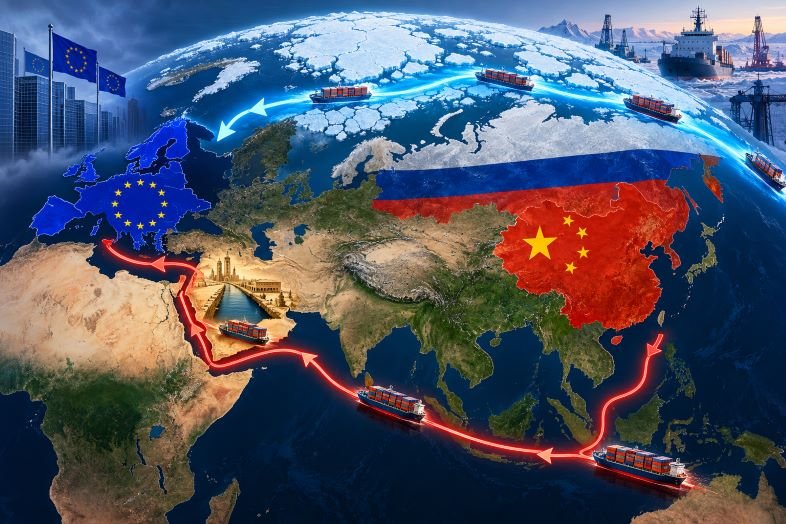
The true innovation of Trump’s second term lies in the centrality given to North Africa. Long considered peripheral, it becomes the center of gravity of the Europe-Africa corridor.
By strengthening its military, naval, and technological presence from Tunisia to Morocco, Washington controls:
- trade flows transiting through Gibraltar,
- Algerian and Libyan energy routes,
- and, by extension, the industrial survival of Europe.
Whoever controls the energy taps of the Maghreb controls the German and Italian economies. This reality transforms the United States into a direct arbiter of European sovereignty.
IV. The methodical subordination of Europe
Far from being an emancipated ally, the European Union appears to be the big loser in this shift.
1. The migration weapon
By influencing security and migration agreements with North African countries, Washington wields formidable leverage. Stabilizing or destabilizing migration flows becomes a diplomatic bargaining chip, forcing Brussels to accept major commercial and strategic concessions.
2. The diversion of value chains
The United States is establishing Special Economic Zones under American control, particularly in Morocco and West Africa.
The result: the Maghreb ceases to be the industrial backyard of Europe to become the outsourced workshop of the American economy, outside European regulatory standards.
V. Russia marginalized, China contained
Syria, Somalia, and the Mediterranean arc are no longer theaters of “perpetual wars,” but outposts of control. Russia is contained far from warm-water ports, and China is prevented from having lasting access to the Mediterranean. A new kind of iron curtain is descending: commercial, digital, energy-related, and geographical.
VI. The doctrine of continuity
The question is no longer whether this project will outlive Trump, but how. In three years, the American administration has:
- The state apparatus has been purged,
- Locked into long-term bilateral treaties,
- Relocated part of its military-industrial complex to key areas.
Trump’s successor, even if from an opposing camp, will inherit an already established hegemony that is difficult to reverse without major systemic costs.
Towards an American hegemony of systemic lock-in
Donald Trump’s second term is neither a historical anomaly nor a populist interlude, but rather the most complete expression of a structural shift in the international system. Behind an apparent brutality of decision-making lies a coherent logic of deliberate, aggressive realism, in which stability no longer rests on international law or multilateral cooperation, but on coercion, dependence, and the control of strategic flows.
What Washington is putting in place between 2025 and 2028 is not the construction of a new normative world order, but the establishment of a hegemonic lock-in system. The United States no longer seeks to lead the world through consensus, but to fragment it into zones of differentiated loyalty, linked to its center by tightly controlled energy, technological, logistical, and security chains. In this configuration, North Africa ceases to be an unstable periphery and becomes a central geopolitical infrastructure, essential both for the encirclement of China, the marginalization of Russia, and the lasting subordination of Europe.
The European Union thus emerges as the major paradox of this reconfiguration. A leading economic power, it proves incapable of converting its capabilities into effective strategic autonomy. Lacking energy sovereignty, militarily dependent, and structurally vulnerable in terms of migration, it finds itself objectively integrated into the American system not as an equal partner, but as a regulated space placed under conditional protection.
China, for its part, is facing a new form of conflict. More than a direct military confrontation, it is experiencing a structural war of attrition aimed at progressively excluding it from the logistical, mining, and digital hubs essential to maintaining its economic power. The Sino-American rivalry is thus shifting from the ideological arena to the control of the material conditions of power.
Ultimately, the era that is dawning is not one of a balanced, multipolar world, but rather one of a hierarchical, rigid, and polarized international system, in which neutrality becomes an increasingly unattainable strategic luxury. Loyalty supplants allegiance, dependence replaces cooperation, and geopolitics reverts to its original nature: the raw management of power relations.
For North Africa, this shift is tragic in nature. It forces a stark choice between accelerated growth under American strategic guidance and the risky pursuit of autonomy that could transform the region into the main arena for confrontation between the great powers of the 21st century. In both cases, the room for maneuver is rapidly shrinking.
The post-2025 world does not mark the end of history, but the end of its illusions. The international liberal order has not been overthrown by its adversaries: it has been methodically abandoned by its principal architect.