January 10, 2026 – JD Vance, propelled to the vice presidency by the $15 million contributed by Peter Thiel, became the face of right-wing tech governance.
Following him, Thiel’s network was integrated into the state apparatus. Under the banner of “patriotic technology,” this new bloc is building a control infrastructure based on cloud computing, AI, finance, drones, satellites, and social media. It’s a faster, more ideologically driven, and fully privatized integrated system: a regime where corporate boards operate as state powers, writing the rules, winning bids, and exporting their business model to humanitarian massacres like the one perpetrated by Israel in Gaza.
The silent political kidnapping of Nicolás Maduro bears the signature of the Palantir corporation. The fate of the president of the Bolivarian Republic of Venezuela was not sealed in the halls of the Pentagon, nor even in Donald Trump ‘s Oval Office . It began to be woven long before, and not by a general with medals on his chest, but by Alex Karp, the CEO of Palantir. A PhD in neo-Marxist social theory who cites Theodor Adorno (a leading figure and representative of the Frankfurt School), he constructed the technological architecture for total surveillance.
Karp understood something that his Silicon Valley contemporaries, preoccupied with selling advertising and “likes,” missed: in a dangerous world, software is the sword and shield of the West. Karp is not a technologist; he earned his doctorate at Goethe University in Frankfurt, under the intellectual tutelage of his mentor Jürgen Habermas, attempting to decipher how language and aggression intertwine in the human psyche.
With these conceptual foundations, I designed the digital panopticon that allowed a Delta Force commando to kidnap a head of state without suffering a single casualty. What enabled them to locate Maduro wasn’t a tip-off from a disloyal colonel, but rather the relational integration of petabytes of data: electricity consumption patterns, thermal signatures, encrypted communications, and subtle logistical movements. All of this was processed by the Maven Smart System and Palantir’s Artificial Intelligence Platform (AIP), ” the most difficult software in the world to crack. “
A technological control infrastructure
In late July 2025, deep within the bureaucratic machinery of the Pentagon, the U.S. military quietly ceded a portion of its sovereignty. A ten-billion-dollar contract with Palantir Technologies, one of the largest in the history of the Department of Defense, was presented as a step toward “efficiency.” This marked the corporation’s entry into the heart of the 21st-century military-industrial complex. A strategic transfer of essential military functions to a private company whose founder, Peter Thiel, has declared that “freedom and democracy are no longer compatible.”
As we digest the images of helicopters from the Special Operations Aviation Regiment (SOAR) flying low over Fort Tiuna and the La Carlota airbase, it’s worth pausing to look beyond the kinetic pyrotechnics. What has happened in Venezuela, dubbed “Operation Absolute Resolution,” is not just an incursion; it is the epistemological triumph of a new way of waging war. It is the moment when algorithms and data devoured the president of Venezuela.
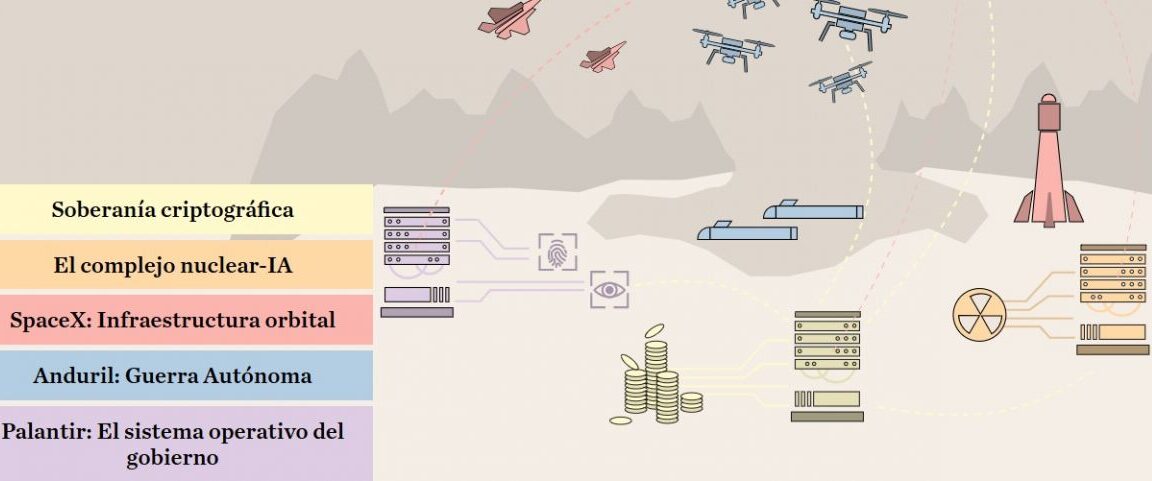
Critical state infrastructures are being privatized in five areas: data, defense, space, energy, and finance, which form the foundation of democratic power. These areas constitute the architecture of privatized sovereignty: a technological regime where power flows through laws, infrastructure, and automated platforms.
Silicon Valley’s tech oligarchy is building this present. The channels are operational. The feedback loops are functioning. The transfers of sovereignty are being completed. Democracy persists as a legacy interface: it is maintained to achieve stability, but at the same time, it is being systematically hollowed out and replaced.
The question now is whether democratic societies can recognize this formation for what it is and build alternatives before the control infrastructure becomes so deeply entrenched that it cannot be deactivated.
The source used to document parts of these reflections is found in The Authoritarian Stack , a project directed by Professor Francesca Bria with xof-research.org that was supported by the Rosa Luxemburg Foundation and funded by the Friedrich-Ebert-Stiftung (FES) Future of Work.
The “authoritarian stack” maps a network of companies, funds, and political actors that transform essential state functions into private platforms. It is based on an open-source dataset of over 250 actors, thousands of verified connections, and $45 billion in documented financial flows. To understand the present, it is helpful to navigate these maps to visualize the links between the new right in Silicon Valley and current power structures.
While Silicon Valley played at being pacifist and rejected military contracts, Karp maintained, “Our software is in the fight,” in a public letter when war broke out in Ukraine. Today, that fight has materialized in the Caribbean. “Operation Southern Spear,” the naval prelude to the capture, was not just a display of brute force; it was a network of sensors feeding an artificial intelligence capable of predicting logistical failures before they occurred, thanks to the ShipOS system.
We are witnessing the end of digital innocence and the beginning of applied cognitive warfare. Karp, the philosopher in the valley, has handed Trump the ultimate tool: the ability to see through the walls of a presidential palace from thousands of miles away. The question hanging in the air is not how they did it, but what it means for the human condition that algorithms and data decide the fate of nations.
The genesis of Palantir, the corporation that at the beginning of 2026 made the roof of Miraflores Palace transparent, arose from the ashes of 9/11. Peter Thiel, the libertarian mastermind behind PayPal, had a revelation about it. The intelligence failure that allowed the attacks wasn’t due to a lack of data, but rather the inability to connect the dots.
The CIA and the FBI had the pieces of the puzzle, but they were isolated in bureaucratic silos. Thiel saw that the technology they had developed at PayPal to hunt financial fraud—a system called IGOR that detected criminal patterns in the chaos of transactions—could be repurposed to hunt terrorists.
Thus Palantir was born, named after JRR Tolkien’s “seeing stones”, those magical orbs that allowed one to see through space and time, although they often corrupted those who looked at them.
The company’s founding mission, known internally as “saving the Shire,” was to provide the West with the analytical superiority necessary for survival. And that superiority manifested itself in the digitized “Chain of Death” that ensnared Maduro.
What differentiates the operation in Caracas from any previous intervention is not firepower, but predictive logistics.
Leaked technical reports on the operation revealed that Palantir’s ShipOS system, described by its creators as a “software Iron Man suit,” managed the complex naval choreography in the Caribbean. It wasn’t just about moving ships; it was about predicting mechanical failures before they occurred and optimizing supply chains in real time, ensuring that when the critical moment arrived, the American war machine would function with Swiss-watch precision.
The Maven Smart System, the platform that fused satellite imagery, radar intercepts, and social media data, not only told US commandos where Maduro was; it told them where he was going to move. It is the triumph of the total rationalization of violence through technology, with a model based on processing enough data to reduce a person’s location to a predictable variable in an algorithmic equation.
The Philosopher of the Valley has demonstrated that, in modern warfare, the algorithmic code of a software and its data are indeed more powerful than the sword, as long as that code directs a Special Operations team with infallible precision.
The ideological alignment with the Trump administration is no coincidence. Peter Thiel, Palantir’s co-founder and Karp’s mentor, was a key figure in Trump’s 2016 transition, wielding such influence that Steve Bannon described his approach as the “Peter Thiel theory of governance”: the idea of deconstructing the administrative state from within. Today, that vision has mutated. Palantir hasn’t deconstructed the state; it has become its operating system.
The capture of Maduro raises crucial questions about sovereignty in the 21st century. The operation was legally based on a narcoterrorism charge built upon terabytes of digital evidence: financial transactions, intercepted communications, and movement patterns, all processed by Palantir’s AI. It is a triumph of digital jurisdiction over territorial jurisdiction.
If algorithmic production can reconstruct your finances and predict your location, physical borders become irrelevant.
It is the ultimate application of “legal warfare” or lawfare, where the judicial sentence is the immediate prelude to the missile.
The impunity with which the United States has operated in a hostile environment, neutralizing Bolivarian defenses, demonstrates a technological gap that conventional brute force cannot close. It’s not about how much military equipment is available, but about the quality of the software and data used to manage the battle.
The West did not conquer the world through the superiority of its ideas, but through its superiority in applying organized violence.