Whose idea was it? No one in particular. It’s an idea that emerged gradually, anticipated by numerous initiatives and formalized after major scandals of habitual corruption in certain spheres of politics, business, churches, the agricultural sector, and the mass media. None of these operate in isolation. Transparency is a contested concept. It can be a pedagogical tool for deconstructing the status quo or a ritual legitimizing the existing order. It all depends on the political framework that frames it. Without a radical reinterpretation that links it to a critique of accumulation, transparency in political financing will remain a mirror in which power sees and recognizes itself, but never questions itself.
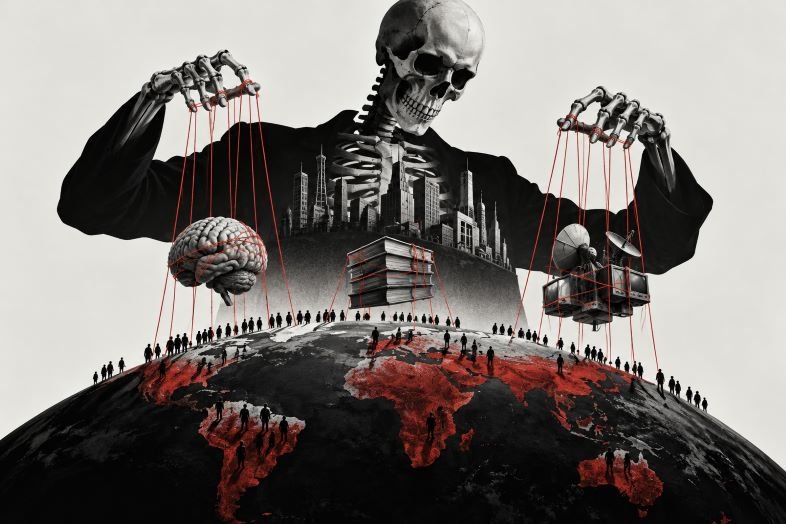
All the money produced, thanks to the working class, is not a neutral substance, but a condensed social sign, a material relationship that, in its circulation, unjustly inscribes the grammar of dominant power on bodies and minds. It is not simply a matter of banknotes, transfers, or accounting balances, but a practical language that says, both explicitly and implicitly, who commands, who obeys, and under what illusions that obedience is disguised. The attempt to “make political financing transparent” thus appears as a historical symptom; the system is forced to partially reveal its inner workings because absolute opacity can no longer be sustained without risking collapse. But this transparency, as formulated by neoliberalism, is not the negation of fetishism, but its refinement, a pedagogy of capital that teaches us to look without seeing, to count without understanding, to accept as natural what is the product of a historically determined social relationship.
From a critical-philosophical perspective, the problem isn’t that money is hidden, but that it governs us. Because transparency, when reduced to publishing figures, names, and amounts, functions as a semiotic operation of “whitewashing,” but it isn’t true transparency. It transforms a relationship of domination into a fact, and the fact into an immoral alibi. We are led to believe that if we know who pays, the act of paying ceases to be corruption and becomes participation. But money under capitalism doesn’t stop buying power simply because it is named; on the contrary, naming it legitimizes its right to do so. Ideology operates here as an economy of the sign; what is visible is not what is true, but what is permitted; what is public is not what is common, but what is administered.
Under capitalism, government control does not guarantee an autonomous space, but rather a superstructure permeated by the logic of accumulation. The bourgeois state, far from being a neutral arbiter, is the organized form of class power, and its seemingly “democratic” rituals function as a stage where the universality of interests that are irreconcilably opposed at the material level are represented. In this context, demanding transparency in political financing without questioning the private ownership of the means of production is equivalent to demanding that the executioner show the axe before beheading. The problem is not the lack of light, but the machinery.
However, the demand for transparency doesn’t arise from nothing, nor is it a mere cynical deception. It is a still ambiguous and incomplete conquest, initiated by social struggles that forced those in power to justify what they are normally incapable of explaining clearly. Every accountability law, every obligation to declare contributions, is the result of historical pressure that fractures the naturalization of dominance. Capital accepts transparency because it trusts in its capacity to reframe and deceive; it distorts criticism and disguises it as “procedure,” turning complaints into forms and indignation into paperwork. Thus, the symbolic struggle is absorbed and returned as a technical norm, neutralized in its subversive potential. That is why, in addition to making financing transparent, it must be politicized.
Here, semiotics becomes indispensable for understanding the mechanism. The money that finances campaigns doesn’t just buy advertising space or legislative support; it buys meaning. It finances narratives, framing, and silences. Neoliberal transparency is limited to the economic signifier and obscures the ideological meaning: who defines the agenda, who sets the terms of the debate, who decides what is thinkable and what is unthinkable. The real power of political financing lies not only in the amount of money, but in its capacity to produce consensus, to shape subjectivities, to colonize the collective imagination. Showing the figure without dismantling the narrative is like showing the price of a commodity without revealing the exploited labor that produced it.
No critique can be content with simply demanding more light within the cave; it must question the cave itself. From an emancipatory perspective, making political financing transparent would only make sense as a tactical moment within a larger strategy: the radical decommodification of political life. As long as politics remains a marketplace of influence, transparency will be merely a polished mirror in which domination gazes at itself with accounting pride. True transparency is not the visibility of money flows, but the intelligibility of the social relations that those flows conceal.
Saying this doesn’t imply dismissing the struggles for accountability, but rather freeing them from their ideological domestication. Every piece of published data can be a weapon if it’s framed within a critical pedagogy that reveals the class structure that produces it. The task isn’t just to show who’s funding it, but to explain why it’s always the same people, why they can do it, why their money is worth more politically than the votes of millions. Emancipatory semiosis consists of re-articulating signs, ensuring that numbers don’t close off meaning, but rather open it up; that transparency doesn’t shut down critique, but rather radicalizes it.
Ultimately, the question is not how to make political financing transparent, but how to abolish the need to finance it with money that, by definition, belongs to the people. True democracy begins where politics ceases to be a purchased privilege and becomes a collective practice sustained by the conscious organization of the people. Until then, all transparency will be partial, monitored, and reversible—a concession by those in power to better perpetuate their rule. The historical challenge is to break this cycle, dismantle the fetishism that turns money into a hijacked fetish, and return to the majority the capacity to decide without market intermediaries. Only then will the light cease to be a reflector of domination and become emancipatory clarity.
(Rebelión)