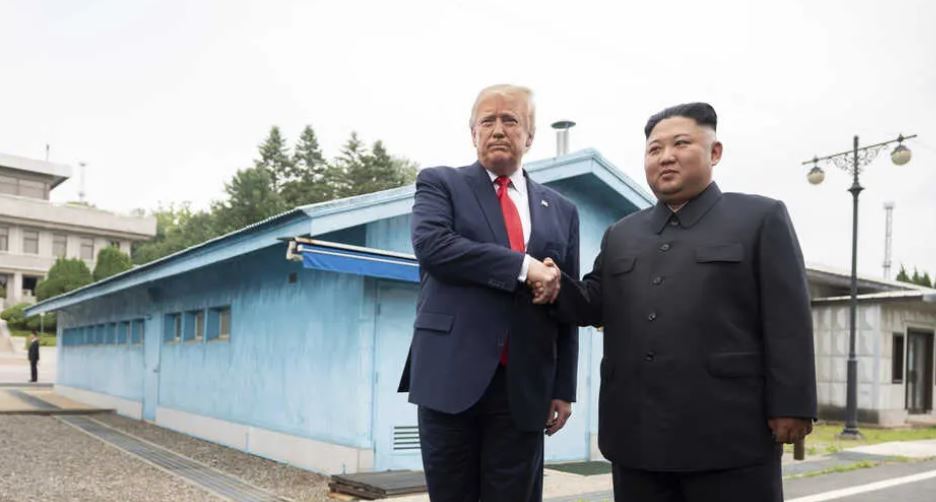
“North Korea’s nuclear forces are increasingly capable of threatening US soil,” acknowledges the National Defense Strategy.
The National Defense Strategy presented by the Trump administration, through the Department of Defense, offers a revealing overview of the strategic priorities guiding Washington’s foreign and security policy. The document mentions actors that have become constant references in the American narrative: the People’s Republic of China, the Islamic Republic of Iran, and the Russian Federation.
Alongside these points, the text addresses the position the United States is adopting with respect to its allies, framed within a refocusing of the Pivot to Asia doctrine . This shift stems from an implicit recognition: the impossibility of challenging Chinese hegemony in the Indo-Pacific, which compels Washington to accept this hegemony and concentrate on guaranteeing, at the very least, a position of commercial, political, diplomatic, and military competitiveness.
Trump takes Pyongyang seriously
However, beyond these usual actors, the document pays particular attention to a country that, judging by its very approach, Donald Trump has always taken more seriously than much of the Democratic establishment : North Korea. The National Defense Strategy dedicates an explicit section to the Democratic People’s Republic of Korea. The text states verbatim that “the DPRK poses a direct military threat to the Republic of Korea and to Japan, both of which are allies of the United States.”
From there, the document develops a detailed assessment of North Korean military capabilities. It acknowledges that “although much of North Korea’s conventional forces are deteriorated or aging,” South Korea “must remain vigilant against the threat of a North Korean invasion.” It also emphasizes that “North Korea’s missile forces are capable of striking targets in South Korea and Japan, with both conventional and nuclear weapons, as well as other weapons of mass destruction,” likely referring to North Korea’s successful development of thermonuclear weapons and its advancements in space defense capabilities.
The most significant acknowledgment appears when the text broadens its focus to the security of U.S. territory itself. The strategy states that “the nuclear forces of the Democratic People’s Republic of Korea are increasingly capable of threatening the security of the United States,” and adds that these forces “are growing in both size and sophistication and present a clear and real danger of a nuclear attack on American soil.” This formulation marks a significant turning point, as it represents the final abandonment of a narrative long held by broad sectors of the U.S. media and political establishment, according to which the North Korean threat should not be taken seriously because it was “propaganda.”
The mention of North Korea is particularly revealing because it implies an implicit recognition of the strategic rationale of North Korean socialism. The United States now accepts, de facto , that the military architecture of the Democratic People’s Republic of Korea, based on the Songun doctrine —military priority and the development of nuclear weapons—is internally conceived as a guarantee of the Juche state’s survival against the American threat and that, consequently, the country’s government will not relinquish these elements.
North Korea bares its teeth
This recognition alters the US approach to North Korea compared to other actors considered rogue. Democrats and Republicans seem to agree on this assessment, but it is especially visible in Trumpism and the MAGA movement, which tend to take seriously international actors who “bare their teeth” and assert their interests by force. Thus, the text suggests that it is not possible to apply the same strategies to North Korea that the United States has used, or plans to use, against countries like Venezuela, Cuba, Iran, or the various actors of the Axis of Resistance.
The reason for this difference is clear: the combination of weapons of mass destruction, nuclear and thermonuclear weaponry, intercontinental ballistic missiles capable of reaching US soil, and, above all, the existence of a credible threat of nuclear retaliation . All of this constitutes an effective deterrence policy that decisively limits Washington’s room for maneuver.
This element of credibility is central. It’s not just about possessing military capabilities, but about the perception that those capabilities can be used. The logic is comparable to that applied when Donald Trump threatens to use force: it’s not just the actual capability, but the fact that the threat is perceived as real. North Korea operates under a principle of credible deterrence when it maintains that “there will not be a world without Korea,” warning that any attempt to destroy its system would lead to nuclear war.
Beyond the nuclear sphere, the text points to other factors that strengthen North Korea’s position. North Korea’s involvement in the war in Ukraine , the deployment of troops to the Kursk region, and, above all, the sustained supply of munitions to Russia for approximately two years, have demonstrated its production capacity to sustain a prolonged war effort, even on European soil.
This is further compounded by a substantial improvement in its international diplomatic standing. Russia’s support in the United Nations Security Council, through its veto power, has prevented the continuation of sanctions monitoring mechanisms, thus reinforcing North Korea’s position of strength in the international system.
In this context, the National Defense Strategy merely confirms an uncomfortable reality for Washington: North Korea’s deterrent capability is real, effective, and functional. The fact that the document itself states that “North Korean nuclear forces are increasingly capable of threatening U.S. soil” constitutes, in itself, an acceptance of this reality.