The year 2026 cannot be read economically in isolation from a structural shift in the way the United States manages competition with China. What is happening is not temporary sanctions or direct military escalation, but rather a complex operational framework that is repricing the elements of power upon which Chinese industrial growth is based, by dismantling the marginal competitor system that gives it a cost advantage, at the heart of which is the discounted oil system.
China’s industrial energy costs are stabilized through oil routes subject to discounts resulting from sanctions and political risks, primarily from Iran and Venezuela. In 2025, supplies from these two routes accounted for approximately 16-17% of China’s total oil imports, and the percentage of sanctioned crude rises to over 22% when a significant portion of Russian crude is included.
This ratio is not just a quantitative figure, but it performs a crucial structural function as a lever for Chinese industrial profit margins, especially in energy-intensive manufacturing sectors.
China relies on oil routes subject to discounts resulting from sanctions and political risks, primarily from Iran and Venezuela, to stabilize its industrial energy costs.
From financial instruments to deterrence
At the beginning of 2026, American pressure moved from the level of financial and logistical tools to the level of hard deterrence.
The tightening of sanctions on Iranian smuggling networks was accompanied by a heavy US military deployment around Iran and the formation of what Donald Trump publicly described as a naval “armada” stretching from the Arabian Gulf to the Arabian Sea.
This deployment is not aimed at waging war with Iran, but rather at maximizing operational uncertainty related to oil smuggling, and raising the cost of each barrel transported outside of the regulatory frameworks.
At the beginning of February 2026, markets saw a temporary rise in Brent prices to the $67-68 range as a result of geopolitical tensions, but medium-term market estimates still predict a lower average for 2026 if negotiation tracks, such as the Oman talks, progress.
This means that the effect of American pressure remains (functional in terms of risks and discounts) rather than being driven by a high global price.
Sanctions
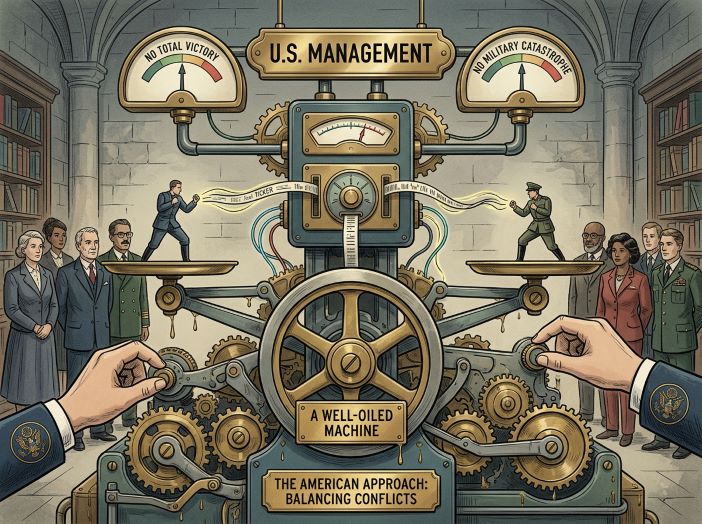
Methodologically, this framework does not operate at the level of cutting quantities but rather through a gradual cost transmission model via maritime deterrence and sanctions, then increased tracking risks, then increased insurance premiums and transit time, then an increase in the marginal cost per barrel, followed by direct pressure on refinery margins, then a cumulative impact on the cost of industrial production, leading to a gradual, non-dramatic slowdown in Chinese industrial growth.
In this sense, the continued flow of Iranian or Venezuelan oil in form does not negate the strategic impact, because the essence of the pressure lies not in the quantity, but in the repricing of risks.
When every low-cost barrel becomes a high-risk barrel, oil loses its function as a long-term pillar of stability for China.
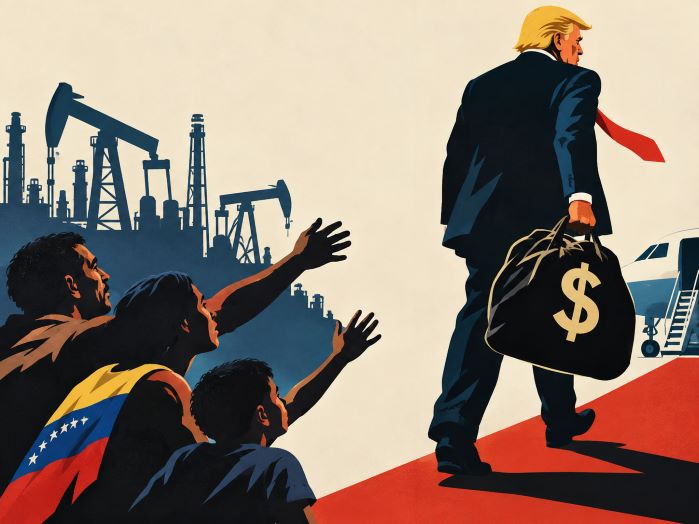
The developments in Venezuela in January 2026—and Washington’s dominance over marketing channels—effectively reduced China’s access to low-cost Venezuelan crude oil, prompting independent Chinese refineries to compensate with discounted Iranian crude in a higher-risk environment, thus increasing pressure on marginal barrels rather than eliminating them.
This impact is most clearly concentrated on independent refineries that rely on discounts to achieve profitability, while large Chinese state-owned companies have a higher absorption capacity through long-term contracts and sovereign support, preventing the impact from being generalized to the entire Chinese economy.
The impact of American pressure remains (functionally at the level of risks and discounts) more than being driven by a high global price.
Intellectual dimension
In this context, the deeper intellectual dimension of the hypothesis becomes apparent. Washington is not confronting China with the logic of direct war, but rather borrowing China’s structural logic and repurposing it against itself. Just as Beijing built its rise through managing time, supply chains, and cost margins, the United States today employs the same approach, but with a different tool:
–Risks accumulate on China instead of production accumulates.
The approach is the same, the tools are different, and the result is not an immediate victory, but rather a slowing down of the accumulation of Chinese power over time.
Chinese analysts believe that this type of pressure is manageable through inventory and supplier diversification, but it raises margin costs and weakens long-term planning certainty, an effect that appears not as a shock but as a gradual erosion of the industrial business environment.
This does not mean that this framework is cost-free for Washington. Maximizing the risks may temporarily raise global prices, create friction with consumer allies, and open the door to asymmetrical Chinese responses or negotiated breakthroughs that may alleviate the pressure without eliminating it. These risks do not invalidate the hypothesis, but rather set a realistic ceiling for it.
Here we can go back in time to ask a question and deconstruct its answer to better understand the context: Is what Trump is doing now similar to America’s blockade of Japan before World War II?
The answer is yes, in terms of structural logic, not in terms of degree. Just as the United States used energy and supply chain restrictions to put pressure on the Japanese industrial economy, it is using the same tool today, but in a less extreme version, because the world is not in a state of hot world war, but rather in a competitive cold war that is managed by time, not bullets. This comparison is invoked as a similarity in the tool, not as a prophecy of escalation or the inevitability of military confrontation.
The gist of the hypothesis is that China is not defeated by being deprived of oil, but rather by the erosion of the marginal discount system that used to grant it discounted oil, so that every barrel of oil that reaches China becomes more expensive, more dangerous, and less suitable for long-term industrial planning.