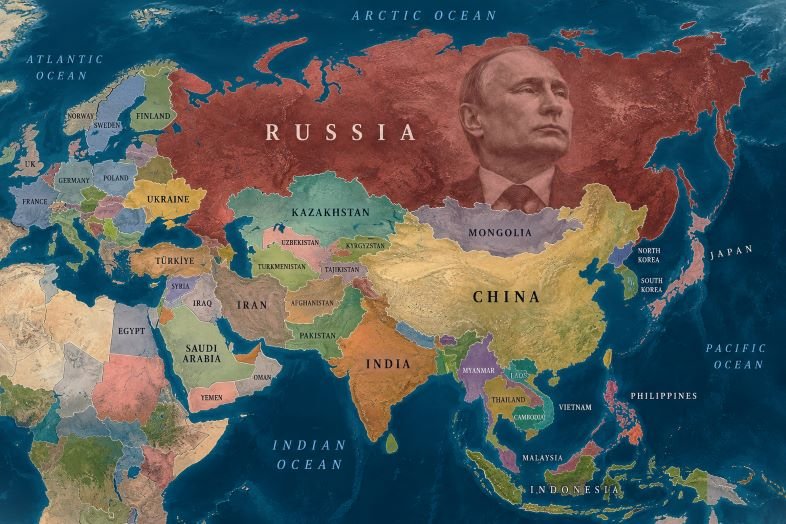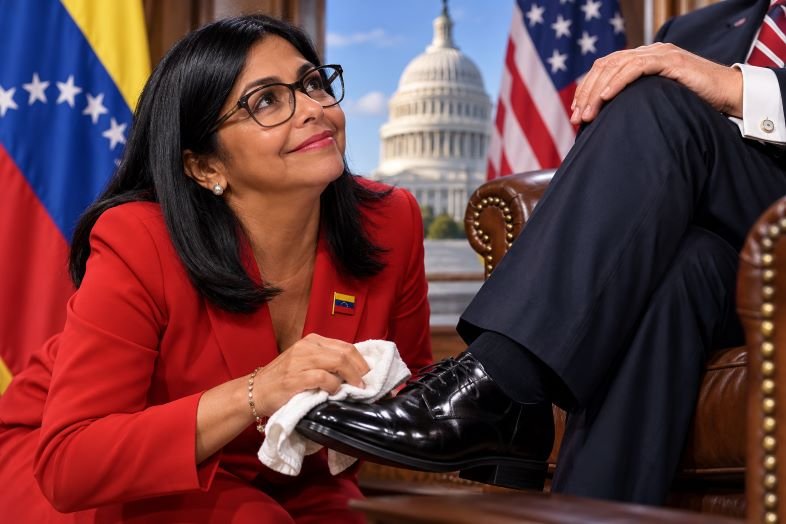
Everything suggests that, whatever new accumulation model emerges in the next decade, the State will be an actor, not only in support, but also in command and direction of the future economic configuration of countries.
What comes after the end of neoliberal hyperglobalism? The statist “double movement” that Polanyi spoke of? An absolute market or an interventionist state? Global exchange of products without any restrictions, or tariffs and centralized economic planning?
With the decline of the “free market” orgy, this debate is resurfacing among politicians and academics. But it’s actually a fallacious question.
With the exception of ideologues who propose a social order based exclusively on market laws, free from the “criminal” intervention of the state (Rothbard), or of a fictitious “post-capitalist” society in which all means of production are state-owned (Trotsky), real history shows that market and state are inherent to modern capitalist society in any of its historical forms. What varies is the way in which they are combined.
In fact, both the state and the market are two distinct ways of unifying societies and are radically intertwined. The market is a way of unifying human labor activities through the abstract labor embodied in things; whereas the state is the abstract unification of the political interdependence of people within a territory.
Markets have existed for thousands of years without the need for capitalism. But they were fragmented and peripheral arenas amidst a sea of peasant and communal economies governed by different production logics. Their current national and global character is the result of a process that has unfolded over the last few centuries, in which the state has played a decisive role. And today, they grow under the protection of states. They are saved from collapse by the “generous” monetary issuance of states (2008, 2020). And they are shielded from the fury of the “dangerous classes” by the same state. Global neoliberalism has been built upon the underlying framework of public resources, coercive action, and the political legitimation of states, giving rise to a particular historical form of capitalist development.
Similarly, the nationalization of any means of production does not eliminate market rules. It introduces regulation into their operation. It prioritizes social needs over profitability in certain sectors of the economy, but it does not establish a new economy distinct from capitalism. Even with the nationalization of all means of production, the calculation of wealth based on abstract labor time, characteristic of market societies, does not disappear. It is only partially subsumed under planning relationships with political and social aims, giving rise to other specific forms of capitalist development.
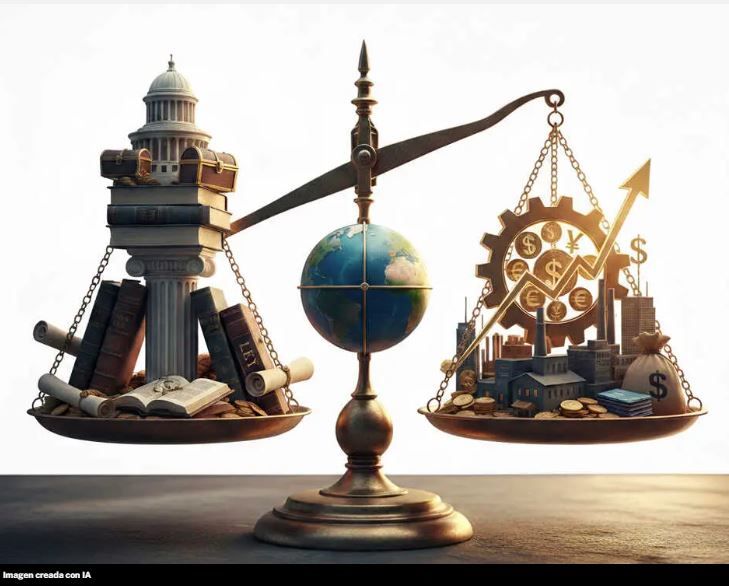
What varies throughout history and the economic cycles of different models of capitalist economic accumulation are the ways in which the market and the State combine and articulate to give rise to a mode of “organic composition” between them; with different results in the internal distribution of wealth as well as in its link with the global economy and other States.
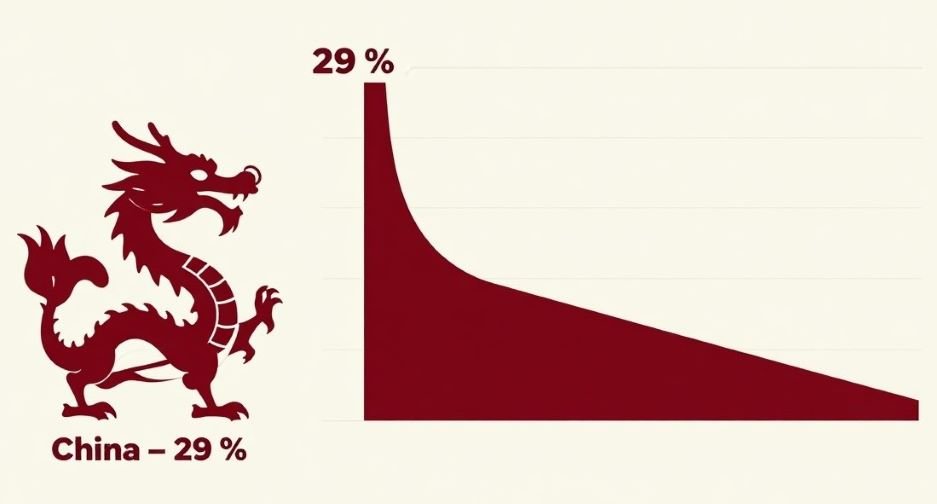
Until recently, the US exhibited the greatest shift towards a market economy, yet still maintained a strong state presence in public spending (35% of GDP). China, on the other hand, has a greater state presence in the economy (between 30-40% of GDP is state-owned), but with complete openness to the global free market. And so, each country combines centralization and liberalization in different ways.
This does not mean that there are no other ways of producing and exchanging wealth that distance themselves from the market and the state, but, for now, they are fragmented, local, and lack the strength to take on national or regional forms. This is the case with traditional urban-rural household economies and specific peasant communities. Or with modern communal forms that flash across the historical firmament like lightning and ephemeral bursts, in the heat of great revolutionary upheavals.
However, there are liminal moments when, regardless of the prevailing organic composition of the state/market relationship, the state assumes an unusual and audacious historical prominence. In fact, following the current global crisis, the future cycle of business accumulation that manages to stabilize in the coming decades depends fundamentally on the initiatives undertaken by the state during these moments of transition/rupture that accompany this liminal period.
The end of the 19th-century liberal cycle (1870-1915) came with the First World War, the contraction of the great European empires, the reorganization of colonial power by imperial states, the retreat to a national war economy (Germany, Russia), the rise of the welfare state (USA), and, finally, a new war between states (Tooze, 2014). The new cycle of Fordist-Taylorist accumulation in the West was established with the Bretton Woods agreements, which created the IMF and the World Bank to finance the reconstruction of national economies under conditions imposed by these organizations, which were predominantly American. These agreements also established the exchangeability of national currencies in relation to the fixed exchange rate of the dollar against gold, leading to the dominance of that national currency in international transactions (B. Steil, 2021).
The end of the Fordist-Taylorist accumulation cycle (1940-1970) was decisively brought about by aggressive US state initiatives. The Bretton Woods international order was dismantled by President Nixon’s government decisions, which ended the convertibility of the dollar into gold. This allowed the US to adjust the money supply through expansionary policies, finance fiscal deficits, and increase public debt without needing to back monetary emissions with gold reserves. Simultaneously, he reshaped global trade in his favor by raising import tariffs, forcing countries to revalue their currencies (Garten 2021).
Under Reagan, the state once again acted as a transformative economic superpower by reducing corporate taxes, deregulating the economy, cutting public spending, reducing workers’ indirect wages, and stifling union membership (W. Niskanen, 1988). From there, free trade policies were promoted globally through the coercive action of major states and their operational arms (IMF, World Bank). In subordinate countries, states dismantled their state-owned property regimes and social rights, creating the conditions for a flood of foreign investment. After the collapse of the USSR, this spread to Eastern Europe and Asia, consolidating the US as the sole global hegemon. The active state during the transition from one accumulation regime to another gave way to a state that merely supports market initiatives.
And today, with the twilight of the neoliberal accumulation regime, the State has once again taken on a leading role.
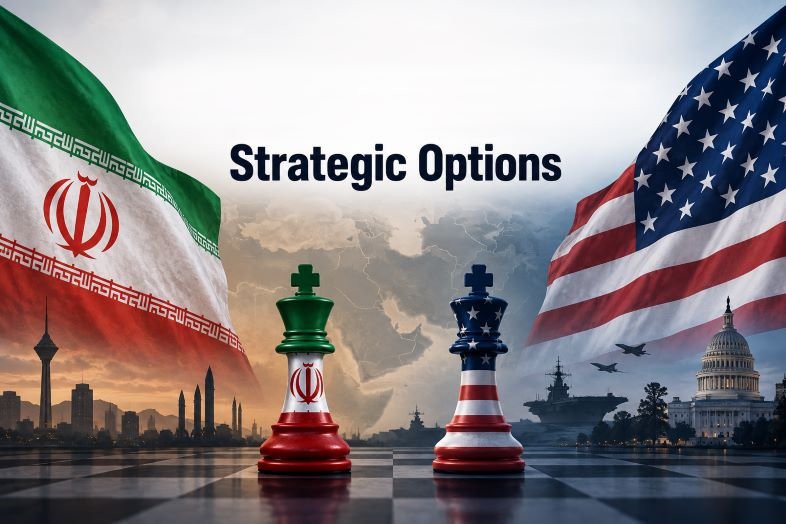
It is states that have prevented the collapse of the financial system and national economies by issuing vast amounts of money, both in 2008-9 and 2020-21. It is states that have unleashed a global tariff war, reconfiguring the flows of world trade to serve “their” economies and corporations. It is states that are rearming and promoting a kind of “military Keynesianism” to try to revive ailing economies (Germany). It is states that are fragmenting value chains and trade alliances (the US with respect to the world). It is states that are unleashing wars (in Ukraine) and radical realignments of global geopolitics (in Venezuela, Iran, Greenland, etc.). It is states that are creating the technical and legal platforms for a colossal deployment of global financial speculation in crypto assets (the GENIUS Act in the US).
For some, this chaos and hyper-statism will arrive with the “end of times.” But in reality, it is a recurring pattern of state behavior in each interregnum between economic cycles, and it marks the death knell of the old order. Even if what will replace it remains undefined.
However, this excessive state intervention is not a monstrous perversion perpetrated by some deranged individual who has seized power. It is the intuition that the old order is no longer useful and that the power of the state must be boldly employed to prop up a new one. Any new one, as long as it is new.
The fact that this is expressed through eccentric figures in government, or through absurd anachronistic rhetoric, should not obscure the fact that this is a manifestation of the disintegration of the old social coalitions that sustained previous governments, and that the new frenetic state activism corresponds to the formation of new social coalitions, new expectations, and awakened collective passions.
For example, Trump came to power with the Republican Party. The economic elites who sponsored him were aligned with Republicans in previous moderate administrations ( Bush Sr. and Jr.) or Democratic administrations (Clinton, Obama); equally convergent. S. Miran, who chairs Trump’s Council of Advisors; S. Bessent, Secretary of the Treasury; S. Miller, advisor on domestic policy; and S. Krishnan, advisor on AI, are all former technocratic executives linked to corporations, hedge funds, and academia. The same was true for those who served under Biden and Obama. The executives of major tech companies themselves, such as P. Thiel (PayPal), A. Karp (Palantir), Musk (SpaceX, Tesla), and the other Silicon Valley magnates, are not emerging elites. Their proximity to power has been continuous for years.
All of them, including Trump, are not a replacement of elites, but rather part of a rotation of influential elites. And, as before, they maintain an adherence to basic principles of governmentality such as devotion to managerial administration, the technocratic legitimization of power, and individual merit.
However, what is different now is the undisguised ambition of state power to make bigger deals; to obtain new business profits; to extend its international ramifications; to materialize its old racist prejudices; to coerce those governments that place obstacles in its path of growth.
It is striking, this what we might call a “perverted Leninism,” with which these elites now come to power. They do not do so to administer it timidly, as some leftists who come to power do. These elites carry the urgency of the crisis within them and know, therefore, that in times of crisis, the power of the State is not for normal management. It must be used to the extreme, with all its monopolized forces, to transform the failing order into a new one that better serves them. And today they can do so without breaking the fundamental quality of every State of presenting itself as belonging to “everyone,” because in times of crisis, a margin of moral tolerance always emerges from society toward the arbitrary actions of the State that seek to resolve the grievances that society suffers.
Trump won the 2024 election based on traditional “white” voters. But he also won the presidency by attracting new “Hispanic,” “Asian,” and “Black” voters (Washington Post, December 2, 2024). And among “white” voters, his support increased significantly among small business owners, the self-employed, declining professionals, and economically disadvantaged communities (N. Smith, November 6, 2024). In other words, he united the aggrieved.
Every general crisis, like the current one, generates a constant reconfiguration of the political loyalties of social classes, as well as the identities around which they aggregate and the common emotions they are willing to embrace.
Trump, and the super-rich elite that surrounds him, has capitalized on the displacement of the working classes and small business owners who have been left behind by a globalism focused solely on markets. He has given refuge to the excluded, the failures, the homeless, the resentful. It is not a movement of the poor, because objectively they are not poor, and if we compare them to workers in other countries, the American lower and middle classes still occupy the top deciles of global wealth. But they are the marginalized from the material excess concentrated by the rich. They are the victims of the paradox of stagnant wealth: they have more than most of the rest of the world, but comparatively they have not improved at all in relation to those who have the most in their country; and who are getting more and more every day.
This is therefore a coalition formed not by the euphoric avalanche of believers in a new world, but by the sorrowful cataclysm of the hopeless. It should come as no surprise that the emotions they embrace are those of resentment, hatred, punishment, and cruelty; all characteristic of what are called “dark passions” (The New York Times, 18/IX/2025).
Similar historical processes are unfolding in other countries around the world. Sometimes the bold left manages to articulate this discontent as a vision of a new world to be conquered. Other times, the extreme right does so, but in the guise of an old world to be restored. And this is especially true when the left disappoints through its passivity.
The question that remains unanswered is how this increased state prominence will affect the new organic composition of the market/state relationship that will emerge after this liminal period. Will the exceptional prominence we are experiencing today give way to a renewed market dominance? To a balance? To an expansion of the state’s economic presence? It is difficult to know for sure.
But, for now, given the nature of events that seem irreversible in the short term, such as the tariff wars that have permanently damaged business confidence and value chains; the new configuration of regionalized geopolitical “spheres of influence”; the widespread push for “industrial policies” in which states are investing enormous amounts of money; and the very resurgence of popular sovereignist sentiment, even in large and medium-sized powers; it is clear that everything points to the fact that, whatever new accumulation model emerges in the next decade, the state will be an actor not only of support, but also of command and direction in the future economic configuration of countries.
Álvaro García Linera is one of the most important intellectual figures in Latin American Marxism. A mathematics student at the National Autonomous University of Mexico (UNAM), he participated in the founding of the Tupac Katari Guerrilla Army (EGTK) and spent several years as a political prisoner in La Paz’s Chonchocoro prison. He was elected Vice President of Bolivia in 2006 and re-elected until the 2019 coup that forced him into exile along with President Evo Morales. Author of more than twenty books, his latest work, “The Concept of the State in Marx: The Commons through Monopolies” (Akal, 2025), explores the theoretical proposals on the state from Marxist and critical thought perspectives, as well as Marx’s position on the matter.