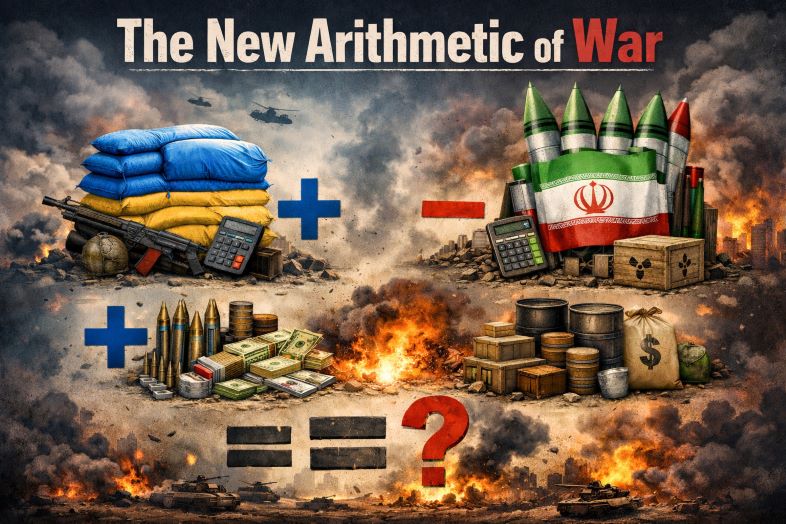
The question that remains unanswered, the one no general or politician wants to address, is how far all those involved are willing to go before accepting that the arithmetic of war has changed forever. And if the answer is too far, then global recession, energy collapse, and nuclear proliferation will cease to be abstract threats and become the stark reality of our time.
There are geopolitical analyses that are read with interest and quickly forgotten. Then there are analyses that should be printed and hung on the walls of the Pentagon, the White House, and every newsroom in the world. The article published by Policy Tensor, a blog specializing in strategy, entitled “Why the US is facing strategic defeat,” belongs to this second category. Not because its conclusions are pleasant—they are not at all—but because its method is relentless: it applies mathematics to warfare and extracts from it an uncomfortable truth that official statements and superficial analyses are determined to conceal.
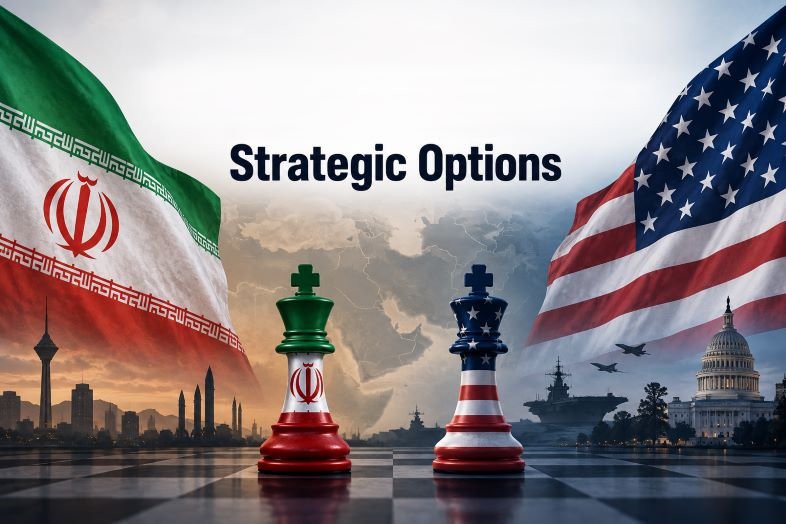
Policy Tensor’s thesis is simple in its formulation and troubling in its consequences. The United States faces a strategic defeat in the Gulf. Not a defeat in the traditional sense of vanquished armies or conquered capitals, but something more subtle and perhaps more profound: the inability to achieve its military objectives before the accumulated costs—economic, political, and global—become unbearable. Or, to put it in the author’s terms: if Iran can sustain its attacks against the oil monarchies, US bases, Israel, and, above all, keep the Strait of Hormuz closed long enough for the United States to offer a ceasefire, then Iran will have won. And the United States, however much its spokespeople talk about “mission accomplished,” will have lost.
To understand why this is the case, we must delve into what the article calls “the mechanics of drone warfare.” And this is where mathematics becomes more eloquent than any political discourse.
Let’s imagine, as the analysis does, that Iran’s warfighting capacity is a reservoir that is simultaneously being filled and emptied. The water going in represents the drones and missiles Iran manufactures. The water going out represents the drones and missiles Iran launches against its targets. The taps filling the reservoir are the factories and production workshops. US bombing attempts to break these taps, to reduce their number. But here comes the first crucial variable: the rate at which Iran can repair the broken taps or rebuild the destroyed factories. The authors of the model call this the “reconstitution rate.” And the ratio between what the United States destroys and what Iran rebuilds determines everything else.
Mathematical analysis, even under conservative assumptions favorable to the United States, shows how difficult it is for the superpower to degrade Iranian capabilities quickly enough. In Washington’s most optimistic scenario—one in which Iran cannot rebuild any facilities and the United States destroys 90 percent of its production capacity every month—Iran could still maintain a high rate of attack for four months. Four months. That’s a long time in modern warfare. It’s enough time for the costs to accumulate irreversibly.
And then there’s the second factor, the one that turns the problem into an operational nightmare. Reports that are beginning to leak out, and which Policy Tensor is collecting and analyzing, indicate that Iran is not only withstanding the bombings, but has managed to strike the US military infrastructure in the region with surprising effectiveness. All the THAAD systems—the most advanced missile defense shields in the world, designed to be virtually invulnerable—have been hit and likely neutralized. The air bases from which the United States launches its attacks have suffered sustained attacks that have severely degraded their sortie capacity, and their radars are no longer providing the necessary eyes. According to the estimates used in the analysis, the sortie rate—that is, the number of missions that can be launched each day—has been reduced by between 35 and 50 percent.
This means the curve isn’t bending downward, as any military commander would prefer, but upward. The deprivation campaign designed to degrade Iranian capabilities has suffered a massive setback precisely when it was most needed. And the emergency response—sending a third aircraft carrier to the region—is itself an admission of weakness: an aircraft carrier can generate dozens of sorties a day, but a land-based airbase can generate hundreds. Naval aviation cannot replace land-based aviation when what is needed is a sustained and intensive bombing capability.
At this point, anyone with even a basic military background will ask the same question: What about the military solution? Where is the plan B, the ground option, the strategy that will break the stalemate?
There is no military solution. That is the uncomfortable but inescapable conclusion. And if there is no military solution, the war becomes a test of endurance, a competition to see who can bear the accumulated costs the longest.
This is where economic analysis becomes just as important as military analysis. Because the costs of this war are not symmetrical. A Shahed-136 drone costs approximately twenty thousand dollars. A Patriot missile, the main U.S. weapon for intercepting it, costs four million. And one isn’t enough; defense protocols usually require launching two or three to guarantee interception. The math is simple: for the price of a single missile, Iran can manufacture two hundred drones. For the price of a full battery, it can overwhelm the defenses of any base for weeks. And while U.S. interceptor inventories dwindle, Iranian drones keep arriving.
But the costs aren’t measured only in missiles. They’re measured in oil tankers unable to cross the Strait of Hormuz, in soaring insurance premiums, in oil prices that begin to climb slowly at first and then in increasingly steep leaps. They’re measured in the global inflation that’s already beginning to emerge, in central banks preparing for further interest rate hikes, in the food crisis that threatens to halve the next harvest due to the rising cost of fertilizers. Ultimately, they’re measured in a global recession that, according to the analysis, would be inevitable if the conflict continues.
And then there’s the factor analysts call “geopolitical,” which is really the mother of all factors: perception. Because when the Gulf countries—those that for decades have financed the U.S. military presence, that have paid out of their own pockets for the construction of bases, that have bought hundreds of billions of dollars worth of American weaponry—see that the United States can’t protect them, they’ll start doing the math. And the math will tell them that perhaps it’s time to diversify alliances, to look for other partners, to negotiate with whoever can offer real security. China is there, with its full checkbooks and its promises of non-interference. Russia too, selling weapons and offering diplomatic cover. The old petrodollar pact—oil for security, dollars for protection—is crumbling before our eyes.
There is a profound irony in all of this, an irony that Iranian strategists probably appreciate. The United States and Israel justified their attacks by claiming they needed to prevent Iran from acquiring nuclear weapons. But the lesson the Iranian leadership is drawing from this war is precisely the opposite: the United States didn’t invade North Korea because North Korea already had the bomb. The United States invaded Iraq because Iraq didn’t. Therefore, if you want to avoid invasion, get nuclear weapons as soon as possible. Most likely, when this war ends—if it ends in any clear way—Iran will accelerate its nuclear program as much as necessary. And then the domino effect will begin: Saudi Arabia will want its own, Turkey too, Egypt probably, and the United Arab Emirates won’t be far behind. Nonproliferation, that dream of the 1970s, will have died for good on the sands of the Gulf.
Meanwhile, Europe watches from afar with its characteristic mixture of impotence and arrogance. European leaders, the same ones who spent the last few years blaming Putin for all their energy woes, now face a scenario that leaves them without a scapegoat. This time they won’t be able to blame the Russian. The energy shock comes from the Gulf, from a US ally, from a conflict they have no control over, but whose consequences they will pay for. Because Europe remains, despite all its efforts to diversify, a gigantic smokestack dependent on energy from abroad. And when the Strait of Hormuz closes, when oil tankers can’t sail, when gas prices skyrocket, European industry grinds to a halt, inflation accelerates, and central banks have no choice but to raise interest rates, further crippling an already struggling economy.
Policy Tensor’s analysis concludes with a warning that should give us all pause: if Russia, and behind it China, decide to rearm and resupply Iran—something that is already evident—this will become a “reverse Ukraine.” A protracted war of attrition in which the United States and its allies will have to sustain a war effort with no end in sight, while its adversaries watch as the superpower slowly bleeds itself dry in a corner of the world it no longer controls.
The conclusion is uncomfortable, but the data supports it. The United States has no military solution to this conflict. It cannot destroy the drone factories quickly enough. It cannot protect its bases from enemy attacks. It cannot indefinitely sustain a war effort whose economic and political costs grow daily. All that remains is diplomacy. Talking with the Omanis, seeking a negotiated solution, accepting that the era in which it could impose its will by force in any corner of the world is over.
The question that remains unanswered, the one no general or politician wants to address, is how far all those involved are willing to go before accepting that the arithmetic of war has changed forever. And if the answer is too far, then global recession, energy collapse, and nuclear proliferation will cease to be abstract threats and become the stark reality of our time.
The petrodollar American dream, the one that began in 1974 with a handshake between Saudis and Americans, is fading into the desert horizon. And what comes next, judging by what we’ve seen, doesn’t promise to be a pleasant awakening.