March 18, 2026 – Recent history—from Iraq to Afghanistan—shows that when the legitimacy of a war fades, constructing new pretexts becomes a structural temptation.
The war with Iran has ceased to be a regime change operation and has become a dangerous crossroads, where military failure and political fracture in Washington are paving the way for increasingly extreme scenarios. In this vacuum, a disturbing narrative is beginning to emerge: the possible creation of a new 9/11 as a catalyst to justify an escalation that could cross the nuclear threshold.
A recent Reuters report, based on US intelligence sources (1), reveals an uncomfortable truth for the White House: despite weeks of intensive bombing by the United States and Israel, the Iranian government is not on the verge of collapse. Far from fracturing, Tehran’s political system maintains internal cohesion, territorial control, and stability in its clerical leadership. This seemingly technical fact acts as the first piece of a larger puzzle: the impossibility of achieving rapid regime change turns the war with Iran into a protracted, uncertain, and potentially far more dangerous conflict.
The initial narrative of a brief and decisive surgical operation crumbles. And when geopolitical plans fail to materialize, history teaches us that powerful nations do not easily retreat: they reconfigure the narrative. It is at this point that Russian analyst Elena Panina (2) introduces a key element: the internal crisis within the US security apparatus itself. The resignation of Joe Kent, a central figure in the counterterrorism structure linked to Donald Trump’s inner circle, is not an isolated event, but a symptom.
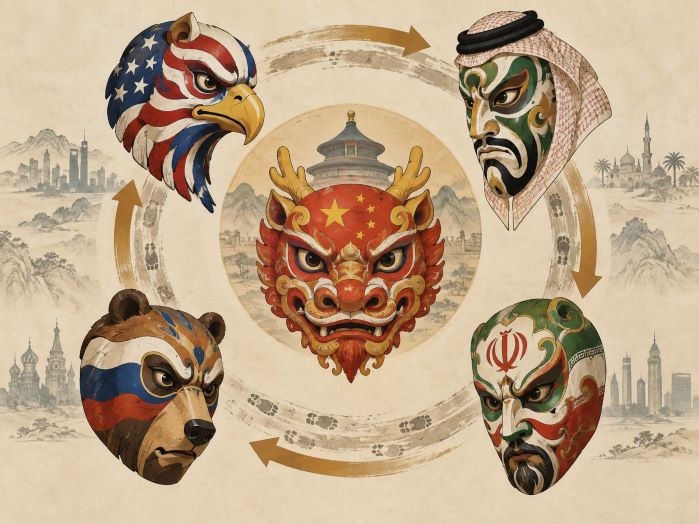
Kent not only implicitly questions the legitimacy of the war, but also points to a deeper fracture: the lack of consensus within the establishment regarding the true objectives of the conflict. If Iran did not represent a direct threat, why initiate a high-risk war? The suggested answer is my own: The pressure from Israel (the Frankenstein) and its lobby, directed by the masterminds of the British and European aristocracy, introduces a structural dimension: the war with Iran would not be solely an American strategic decision, but the result of a convergence of interests among various elites .
This is where the plot thickens. Another text, also by Panina (3), elevates the analysis to more unsettling territory: the possibility of a catalytic event, a turning point capable of reshaping public opinion. Ali Larijani’s statements about a possible “new 9/11 ” should not be read merely as propaganda, but as a warning inscribed in the historical logic of modern warfare. When internal consensus falters, when allies waver, and when the population opposes—as polls in the United States indicate—the temptation to fabricate a casus belli becomes a recurring tactic.
Independent US presidential candidate Diane Sare (4) also articulates this hypothesis explicitly: war with Iran could lead to a false flag attack intended to justify a further escalation, even the use of tactical nuclear weapons. What in the first text was a strategic problem—the resilience of the Iranian state—here becomes an internal political problem for Washington: how to sustain an unpopular war with no visible results.
Thus, faced with the initial military failure, the fissures in the Western power structure, and the need to reconfigure the narrative, an extreme scenario begins to emerge as a possible way out of the crisis. These are not isolated elements, but rather links in a logical sequence that reveals the evolution of a war that never unfolded as planned.
In this context, the war with Iran ceases to be a conventional conflict and becomes a laboratory for systemic crisis. The inability to achieve quick objectives, the erosion of internal consensus, the lack of international support, and the risk of nuclear escalation create a scenario where reality and narrative begin to dangerously intertwine. Recent history—from Iraq to Afghanistan—shows that when the legitimacy of a war fades, constructing new pretexts becomes a structural temptation.
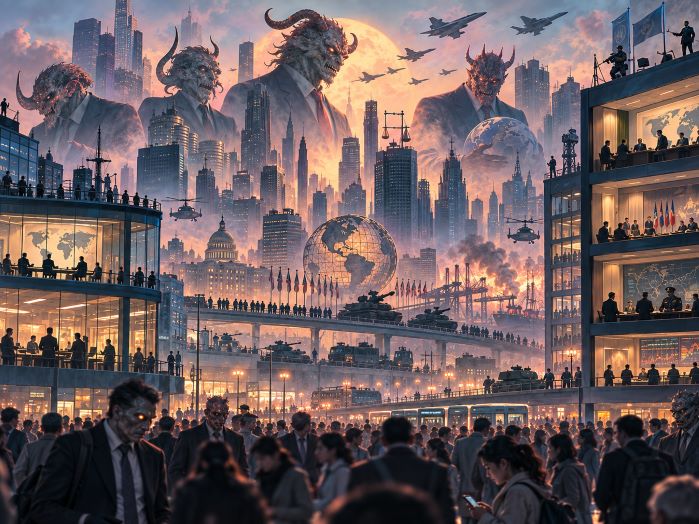
What is truly unsettling is not only the possibility of a manufactured event, but the context in which it could arise: a political system under pressure, divided elites, and an increasingly skeptical public opinion. In this context, a war with Iran becomes more than just a geopolitical confrontation: it is a symptom of an international order in crisis, where decisions no longer respond solely to rational calculations, but to the need to sustain crumbling power structures.
Thus, what began as an offensive aimed at reaffirming hegemony could end up revealing its limitations. And in the process, the line between war and narrative, between reality and political construction, becomes increasingly blurred. The question is no longer just how the war with Iran will end, but what those in power will be willing to do to avoid losing it.
Footnotes
1. Reuters: “US intelligence says Iran government is not at risk of collapse, sources say.” Published on March 11, 2026.
2. Panina, Elena in RUSSTRAT: “Trump’s counterterrorism chief resigned because of the war with Iran”, March 2026.
3. Panina, Elena in RUSSTRAT: “Is the US preparing a new 9/11 to accuse Iran?”, March 2026.
4. Sare, Diane in EIRNS: “Independent Candidates’ Statement: Is the Epstein Class Planning a New 9/11 To Justify Dropping a Nuclear Bomb?”; March 17, 2026.